
Table of Contents
Learn FDD test procedure to measure field density of soil and pavement with step-by-step method, equipment, and practical site tips.
Introduction:
Checking compaction for each layer is very important in road construction. For this, an Engineer uses the FDD test (Field Dry Density Test), which they perform directly on site.
If the soil or pavement layer does not compact properly, it can lead to settlement, cracks, and ultimately failure of the structure. That’s where the FDD Test (Field Density Test) becomes essential.
Aim of the fdd test:
The full form of FDD Test is Field Density Test. Engineers use it to determine the actual density (dry density) of compacted soil or pavement layer in the field.
This test is mainly done by using sand replacement method, in which a small pit is created and its volume and the soil weight removed from it are measured,
In simple words, FDD test tells whether the compaction done at site is correct as per design or not.
To get better knowledge about highway, click on given link below,
what is Superelevation in road: complete guide
camber: what it is? Complete Guide for Beginners
TCS: How to Study Typical Cross Section – Complete Guide
Importance of fdd test:
Proper compaction of each layer is very crucial in road construction. If compaction is poor:
- The road may fail early.
- Settlement and cracks may develop.
- Pavement life is reduced
Therefore, the FDD test ensure that the compaction is within the required standard.
Required equipments:
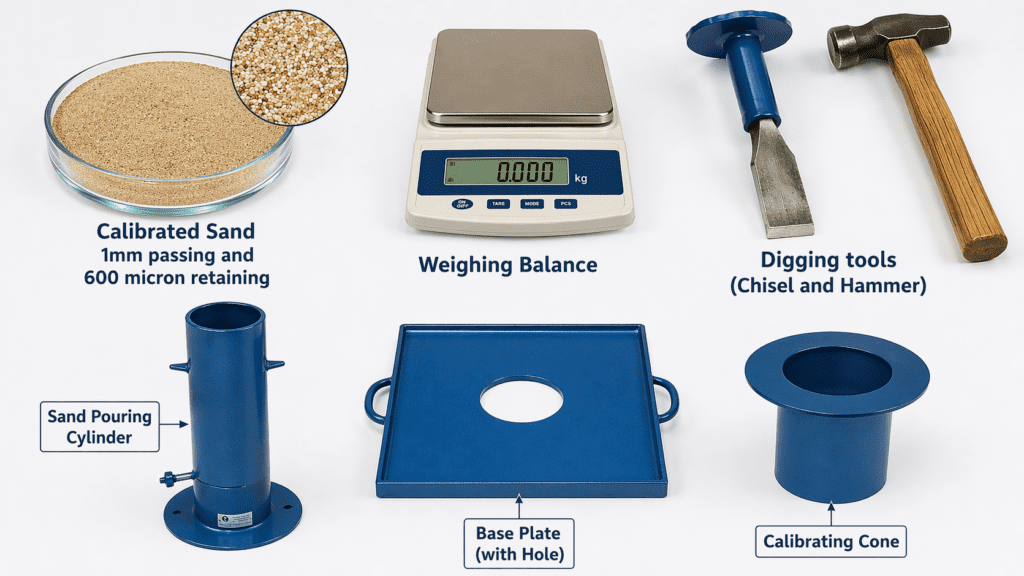
Some basic equipment is required to perform an FDD test:
- Sand Pouring Cylinder.
- Calibrated Sand 1mm passing and 600 micron retaining
- Weighing Balance
- Calibrated Rapid Moisture Meter (RMM) for soil and For granular material use Gas cylinder.
- Digging tools (Chisel and Hammer)
- Metal Tray with central hole
Procedure:
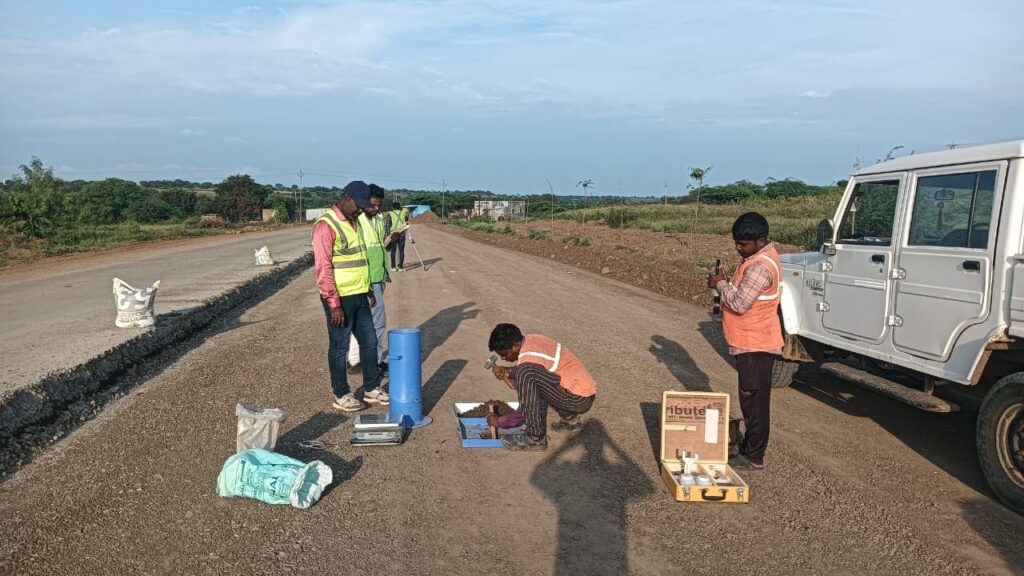
- At first the test location is selected. The surface is cleaned to ensure accurate result.
- A metal tray with hole is placed and the soil is dug through the hole in the middle.
- A small pit is dug through the hole and the resulting soil is carefully collected.
- The diameter and depth of hole may vary (200 mm, 150 mm, 100 mm)
- The extracted soil is weighted to obtain Wet weight.
- Now the sand pouring cylinder is placed on the tray and the is filled with standard sand.
- Calculate the volume of the sand that fills the pit by measuring its weight.
- Calculate the volume of the sand that fills the pit by measuring its weight.
- Take some soil by weight and places it in the RMM.
- Shake the RMM by adding 1 or 2 spoons of calcium carbide.
- Take the Corrected moisture meter reading.
For better Understand follow,
To get better knowledge about Quality control test click on given link below,
how to test slump for Concrete: Practical Site Guide
Types of Cement in Civil Engineering: A Complete Guide
Calculation Process:
Look after the given format:
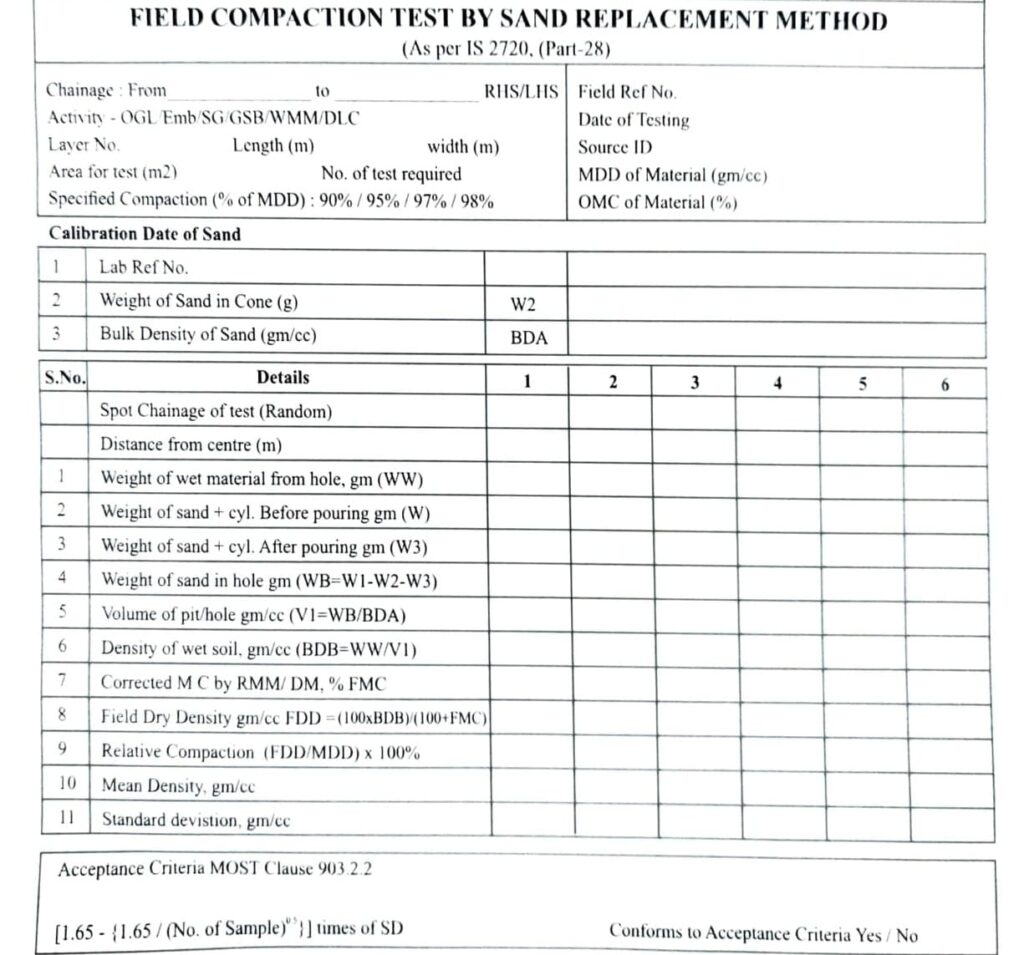
Lets understand how to calculate FDD and Compaction percentage:
Volume of hole = (Weight of sand in hole) / (Bulk density of sand)
Density of wet soil = (Weight of the soil extracted from hole) / (Volume of hole)
Field dry density = (100 X Density of wet soil) / (100 + Corrected moisture meter reading)
Compaction Percentage = (Field dry density / Maximum dry density) X 100
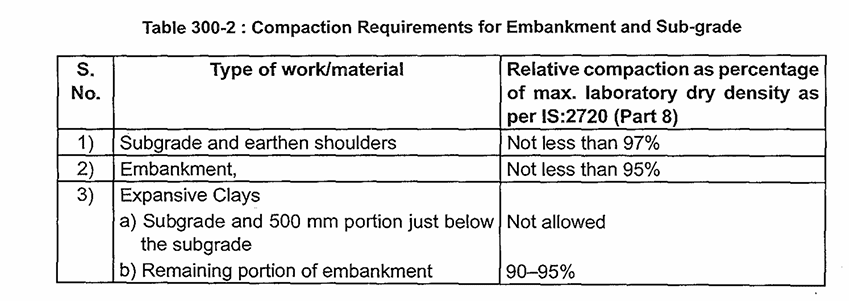
Limits of compaction:
| Layer | Required Compaction | Code Reference |
|---|---|---|
| Subgrade | ≥ 97% of MDD | MORTH Clause 305 |
| Embankment (Below Subgrade) | ≥ 95% of MDD | MORTH Clause 305 |
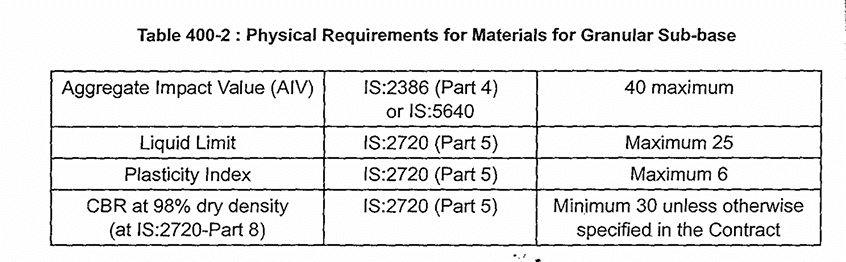
| GSB (Granular Sub Base) | ≥ 98% of MDD | MORTH Clause 401 |
| WMM (Base Course) | ≥ 98% of MDD | MORTH Clause 406 |
| Shoulders (Earthen) | ≥ 97% of MDD | MORTH Clause 305 |
Why is Sand Replacement Method used?
- The sand replacement method is easy to perform in the field and gives accurate results.
- This method uses calibrated sand, whose bulk density is known in advance. When we dig a pit and fill it with sand, we can calculate its volume by weighing the sand.
- This method is especially effective for granular soils and compacted layers.
Common Mistakes on the Site
Engineers or technicians often make some common mistakes when conducting FDD tests, which can lead to inaccurate results.
- The most common mistake is not digging the pit in the proper shape. If the pit is irregular, the volume calculation will be inaccurate.
- Second mistake is taking the wrong moisture reading. If the RMM is not properly calibrated or used properly, the dry density will be inaccurate.
- The third mistake is not properly calibrating the sand. If the bulk density of the sand is not accurate, the entire calculation can be inaccurate.
Relation of FDD Test and Compaction Control
- Compaction control is a crucial part of road construction. If compaction is not correct, the entire pavement structure becomes weak.
- The FDD test tells us whether the compaction has reached the required percentage. For example, 97% compaction is required for subgrade, while GSB and WMM require 98% compaction.
- If the result is less than the required limit, the contractor has to rework that layer to maintain quality.
Practical Site Tips (for Engineers)
When conducting an FDD test on-site, you should keep a few practical considerations in mind.
- Always perform the test at a representative location where you can see that compaction represents actual conditions.
- Before testing in a heavy-traffic area, you should ensure the surface is not disturbed.
- You should be sure to exercise safety when using an RMM, as it uses calcium carbide.
- Keep the sand-pouring cylinder in a vertical position so the sand flows evenly.
Long-Term Impact of Proper Compaction
- If compaction is done correctly and verified with an FDD test, the road’s life is significantly increased.
- Proper compaction reduces settlement, preventing cracks from developing.
- Water infiltration is also reduced, keeping the subgrade strong.
- Maintenance costs are also reduced because the road does not deteriorate as quickly.
Conclusion:
The FDD Test is one of the most important quality control tests used in civil engineering and road construction projects. It helps engineers determine whether the soil or pavement layer has achieved the required level of compaction specified in the design and construction standards. Proper compaction is essential because it directly affects the strength, stability, and long-term performance of any structure. If a layer is not compacted adequately, it may lead to settlement, cracks, rutting, and premature failure of the pavement or embankment.
By performing the FDD Test regularly during construction, engineers can verify the field dry density and compare it with the Maximum Dry Density (MDD) obtained from laboratory tests. This comparison helps in calculating the compaction percentage and ensures that every layer meets the required specifications. As a result, construction quality can be maintained consistently throughout the project.
The sand replacement method used in the FDD Test is simple, reliable, and widely accepted in the construction industry. When conducted correctly with calibrated equipment and accurate moisture content measurements, it provides dependable results for field compaction assessment. However, proper testing procedures, correct pit excavation, and accurate moisture determination are necessary to avoid errors in the final calculations.
In modern road and infrastructure projects, compaction control is a critical aspect of quality assurance. The FDD Test plays a major role in ensuring that subgrade, embankment, GSB, WMM, and other pavement layers achieve the desired density. This ultimately improves the durability, load-bearing capacity, and service life of the structure. Therefore, every civil engineer, site supervisor, and quality control professional should understand the importance of this test and perform it carefully to ensure safe, durable, and high-quality construction.
About the Author
My name is Susanta Kumar Mohapatra. I am a Civil Engineering professional with over 11 years of practical experience in the construction and infrastructure sectors. I hold a B.Tech degree in Civil Engineering and an M.E. degree in Construction Management.
Throughout my professional career, I have worked in various areas such as road construction, highway projects, bridge construction, quality control, material testing, quantity surveying, project planning, billing, and site management. I have a keen interest in conveying practical civil engineering concepts to engineers, students, and construction professionals in a simple and useful manner.
I am the founder of CivilGuruHub.com, where I share technical articles related to civil engineering, laboratory test procedures, construction methodologies, quantity calculation guides, information based on IRC and IS codes, and practical site experiences. My objective is to provide reliable, practical, and field-oriented knowledge to industry professionals and civil engineering students.
I believe that civil engineering should not be limited to theory alone; understanding it through practical site applications is equally essential. With this perspective, I regularly publish educational content that is useful for those working in the construction field.
You can connect with me via CivilGuruHub.com and my YouTube channel, “The Civil Site,” where I regularly share civil engineering tutorials, site execution methods, quality control tests, and practical construction knowledge.
FAQs about FDD test
1. What is the FDD Test?
The FDD (Field Dry Density) Test is a field test used to check the dry density of compacted soil or pavement layers. It determines whether the compaction meets the design requirements.
2. What is the full form of FDD Test?
The full form of FDD is Field Dry Density Test. This test is conducted for quality control in road, highway, embankment, and earthwork projects.
3. Why is the FDD Test conducted?
The primary objective of the FDD Test is to determine the actual dry density of a compacted layer and verify the compaction percentage. This ensures the quality and durability of the road or structure.
4. Which method is most commonly used for the FDD Test?
The Sand Replacement Method is the most widely used method for the FDD Test. In this method, a small pit is excavated, and its volume is determined using calibrated sand.
5. What equipment is required for the FDD Test?
Equipment such as a Sand Pouring Cylinder, Calibrated Sand, Weighing Balance, Rapid Moisture Meter (RMM), Metal Tray, Chisel, and Hammer is required for the FDD Test.
6. How is moisture content determined in the FDD Test?
A Rapid Moisture Meter (RMM) is used to determine moisture content. Calcium carbide is added to the sample to obtain a moisture reading, which is then used in the dry density calculation.
7. What is the required compaction level in road construction?
According to MORTH specifications, the required compaction is a minimum of 97% MDD for the Subgrade, 95% MDD for Embankments, and 98% MDD for GSB/WMM layers.
8. What should be done if the FDD Test fails?
If the compaction level falls below the required limit, the layer is re-compacted and tested again to achieve the required density.
9. What are the most common mistakes made during the FDD Test?
Excavating a pit with an incorrect shape, errors in moisture readings, and failing to properly verify the bulk density of the calibrated sand are among the most common mistakes that can affect the results.
10. What is the relationship between the FDD test and compaction control?
The FDD test is a crucial component of compaction control. It indicates what percentage of the laboratory MDD (Maximum Dry Density) the dry density achieved in the field represents and whether quality standards are being met.

Pingback: potholes: causes, damages and complete methods of repairing
Pingback: how to selct Borrow Area: Complete Guide for Engineers
Pingback: How to prepare the Subgrade bed -civilguruhub.com
Pingback: What is Gantt Chart? 7 Simple Ways to Use It
Pingback: what is Juran’s Trilogy of Quality : Explained Simply
Pingback: Step-by-Step Guide to Murum and GSB Filling PDF 2026