
Table of Contents
Gradient in Civil Engineering with complete details and practical uses in road design. Easy explanation for students and site engineers.
introduction:
Gradient is a very important concept in civil engineering, especially in road design, railway alignment, and drainage systems. In simple terms, gradient means the slope or inclination of a road or surface.
When we work on site, accurate Calculation is crucial for safety, drainage and vehicle movement.
what is it?
It is the upward or downward slope of a surface (such as a road, railway, or slope).
In simple terms: How much height (rise/fall) changes as you move over a certain horizontal distance.
Gradient = Vertical change / Horizontal distance
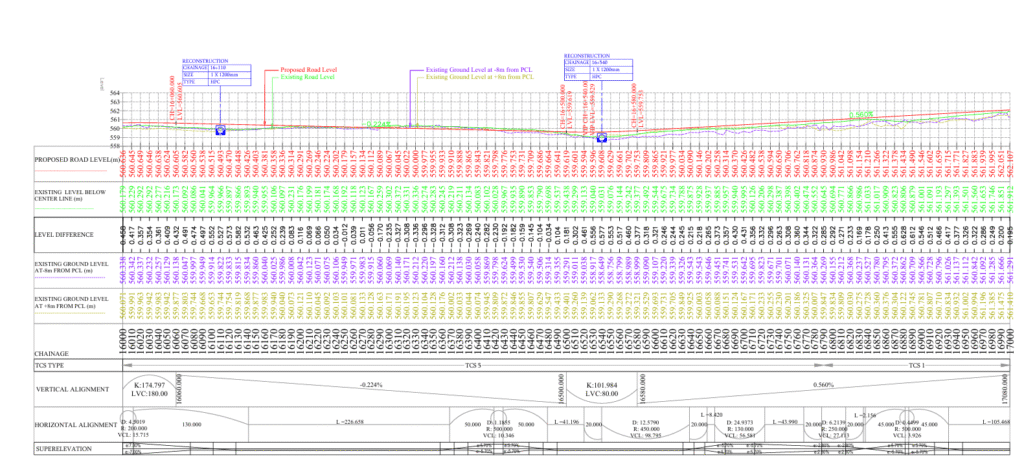
A plan and profile of a highway project attached here to better understand regarding Gradient.
Generally we wrote the gradient in the form of 1 in N
If it is written 1 in 20 then it means 1 meter rise in 20 meter horizontal distance.
Similarly if it is written 1 in 30 then it means 1 meter rise in 30 meter horizontal distance.
how to calculate :
The formula for calculating gradient is given below:
Gradient = (Vertical Rise / Horizontal Distance)
In percentage,
(%) = (Rise / Length) × 100
Types :
There are 4 Main types of gradient in civil engineering. Let’s understand them in a simple and Practical way.
Ruling :
This type of Gradient are most commonly used in civil engineering.
- Comfortable for vehicles.
- Reduce fuel consumption
1 in 30 in Plain area, This is the maximum preferred gradient in Road.
To read TCS (Typical cross section) Properly follow the link given below.
TCS: How to Study Typical Cross Section – Complete Guide
Limiting :
When a Terrain is low or difficult, a ruling gradient is not possible
1 in 20, its just steep but acceptable.
Exceptional :
Exceptional gradient occurs only in special situations allowed for short distances and its very tough to drive.
1 in 15 and tough to drive.
Minimum Gradient :
- Used for drainage.
- To prevent water stagnation
- 1 in 500 or 1 in 1000
- Mostly used in flat areas.
Calculation:
Given data,
Rise = 2m
Length = 40 m
Gradient = 2/40 = 1/20
So Gradient is 1 in 20 and in percentage = (1/20) X 100 = 5%
Lets calculate Gradient from given Plan and Profile,
In given Drawing, lets calculate in each 10 m,
- at location 16+000 = 560.636 m
- 16+010 = 560.645 m
- Gradient = {(506.645 – 560.636) / (16010 – 16000)} X 100 = (0.009/10) X 100= 0.0009 X 100= 0.09%
Similarly you can calculate further.
An excel sheet attached here to better understand, click on given link.
use
- Road Design: For vehicle safety and smooth driving.
- Railway track: For train movement control.
- Drainage system: For water flow.
- Canal construction: For maintaining water.
To get better in Highway, click the given link.
what is Superelevation in road: complete guide
potholes in road: causes, damages and methods of repairing
What is camber : Complete Guide for Beginners
Codes have to follow:
- IRC: SP: 73- 2018
- IRC: SP: 48- 1998
- And IRC: 86- 1983
Importance in road design (Practical View)
- When designing a highway, not only alignment but also the vertical profile is equally important. The gradient determines the vehicle’s effort.
- A steeper gradient will increase engine load and result in higher fuel consumption. A smoother gradient will ensure comfortable driving and reduce accident risk.
- Gradient design in hilly areas is most challenging because the terrain is irregular. Engineers must balance cutting and filling to keep costs under control and maintain safety.
Common Mistakes in Design
- Many times, engineers or contractors make some common mistakes, which later lead to problems.
- The biggest mistake involves ignoring drainage. If a minimum gradient is not provided, water will accumulate and the road will deteriorate quickly.
- Second mistake involves suddenly changing the gradient. This can cause the vehicle to lose control, especially on high-speed roads.
- The third mistake involves not following IRC guidelines. This can make the design unsafe.
The Role of Vertical Curves
- Providing vertical curves is crucial when the gradient changes. This curve smooths out sudden slope changes.
- There are two types of vertical curves: summit curves and valley curves.
- A summit curve is convex in shape and is used at hilltops. A valley curve is concave in shape and is used in depression areas.
- If a vertical curve is not provided, the vehicle may jump or have visibility problems.
Use in Railway and Canal
- Gradient is very important not only in roads but also in railways and canals.
- Railway tracks have a very limited gradient because trains are heavy and difficult to operate on steep slopes.
- In canal design, gradient controls water flow. A steep slope will cause erosion, and a shallow slope will cause water stagnation.
Economic Impact of Wrong Gradient
- If the gradient is not designed correctly, its economic impact is significant.
- Fuel consumption increases, which increases transportation costs.
- The road deteriorates faster, which increases maintenance costs.
- Accidents increase, leading to indirect economic losses.
- Therefore, designing the gradient correctly at an early stage provides long-term savings.
Modern Technology
- Nowadays, software tools handle gradient design instead of manual calculations.
- Software like AutoCAD Civil 3D performs accurate profile design.
- Drones and GIS technology collect terrain data.
- This makes the design more accurate and efficient.
Practical Insight
- In practical terms, the gradient isn’t just a ratio; it serves as the backbone of road performance.
- A good engineer designs gradients based on ground conditions, not just formulas.
- When designing a gradient, three things should always be kept in mind: safety, drainage, and economy.
- If these three are balanced, the road becomes durable and efficient.
Conclusion:
Gradient is one of the most fundamental concepts in civil engineering and plays a crucial role in the design and performance of roads, railways, canals, and drainage systems. Although it may appear to be a simple ratio between vertical rise and horizontal distance, its impact on safety, vehicle operation, construction cost, and long-term maintenance is significant.
In highway engineering, proper slope design ensures smooth vehicle movement, improves driving comfort, and reduces fuel consumption. It also helps in maintaining adequate visibility and minimizes the risk of accidents, particularly in hilly and mountainous terrain. At the same time, providing the correct slope allows effective drainage, preventing water stagnation that can damage pavement layers and reduce the service life of the road.
Engineers must carefully select ruling, limiting, exceptional, and minimum gradients according to terrain conditions and IRC recommendations. Sudden changes in slope should always be avoided, and suitable vertical curves must be provided to ensure a smooth transition between different levels. Failure to follow these principles can lead to operational difficulties, higher maintenance costs, and safety concerns.
Apart from roads, slope design is equally important in railway engineering, where train movement is highly sensitive to steep inclinations, and in canal engineering, where it controls water flow and prevents erosion or stagnation. Modern tools such as AutoCAD Civil 3D, GIS technology, and drone surveys have made profile design more accurate and efficient, helping engineers optimize both safety and economy.
A well-designed Gradient is therefore not just a design parameter but a key factor that influences the overall success of an infrastructure project. By balancing safety, drainage, comfort, and economy, engineers can create durable and efficient transportation networks that serve users effectively for many years.
About the Author
My name is Susanta Kumar Mohapatra. I am a Civil Engineering professional with over 11 years of practical experience in the construction and infrastructure sectors. I hold a B.Tech degree in Civil Engineering and an M.E. degree in Construction Management.
Throughout my professional career, I have worked in various areas such as highway projects, road and bridge construction, quality control, material testing, quantity surveying, project planning, contract management, and site execution. I have a keen interest in conveying practical civil engineering concepts to engineers, students, and construction professionals using simple and accessible language.
I am the founder of CivilGuruHub.com, where I share technical articles, field experiences, laboratory testing procedures, guidelines based on IRC and IS codes, highway engineering concepts, quantity estimation, and practical insights into construction management. My goal is to provide reliable, practical, and field-oriented knowledge to industry professionals and engineering students.
I believe that civil engineering is not limited to theory; practical site experience is what makes an engineer successful. With this mindset, I share my experience and technical knowledge through regular articles and educational content.
You can connect with me via CivilGuruHub.com and my YouTube channel, “The Civil Site,” where I regularly share civil engineering tutorials, highway engineering concepts, laboratory testing methods, and practical site knowledge.
FAQs
1. What is a gradient?
A gradient represents the slope of a road, railway, or surface. It indicates the rate at which the height rises or falls relative to the horizontal distance.
2. How should a “1 in 20” gradient be understood?
A “1 in 20” gradient means there is a rise or fall of 1 meter for every 20 meters of horizontal distance.
3. Why is the gradient important in road design?
The gradient is crucial for vehicle safety, smooth driving, fuel efficiency, and proper drainage. An incorrect gradient can lead to accidents and increased maintenance costs.
4. How is the gradient percentage calculated?
The formula to calculate the gradient percentage is:
Gradient (%) = (Rise ÷ Horizontal Distance) × 100
5. What is a Ruling Gradient?
The Ruling Gradient is the most commonly used gradient, considered comfortable and economical for vehicles. In plain areas, a gradient of 1 in 30 is typically used.
6. What is the purpose of a Minimum Gradient?
A Minimum Gradient is provided for drainage purposes to prevent water from accumulating on the road. In flat areas, a gradient of 1 in 500 or 1 in 1000 is usually provided.
7. What is the difference between Limiting and Exceptional Gradients?
A Limiting Gradient is used when providing the ruling gradient is not feasible. An Exceptional Gradient is provided only under special conditions for short distances and is quite steep.
8. What is a vertical curve, and why is it provided?
A vertical curve is provided to ensure a smooth transition where two different gradients meet. It improves driving comfort and visibility.
9. What role does the gradient play in railways and canals?
In railways, the gradient controls train movement, whereas in canals, it regulates water flow and prevents erosion or water stagnation.
What are the most common mistakes made during gradient design?
The most common mistakes are ignoring drainage, abruptly changing the gradient, and failing to follow IRC guidelines. These factors affect both the performance and safety of the road.

Pingback: How to prepare the Subgrade bed -civilguruhub.com
Pingback: What is a Median in Highway? Full Engineerin Guide