
Table of Contents
introduction
Quality is the most important foundation for the success of any product or service. Today, every company strives to provide its customers with the best possible quality to survive in the market and advance in the competition.
Many experts have developed their own theories for understanding quality management, among which Joseph M. Juran’s “Juran’s Trilogy of Quality” remains the most famous and influential.
In this blog, we will explain Juran’s Trilogy in detail in simple language, so that you can easily apply it in your career, project, or business.
What is Juran’s Trilogy?
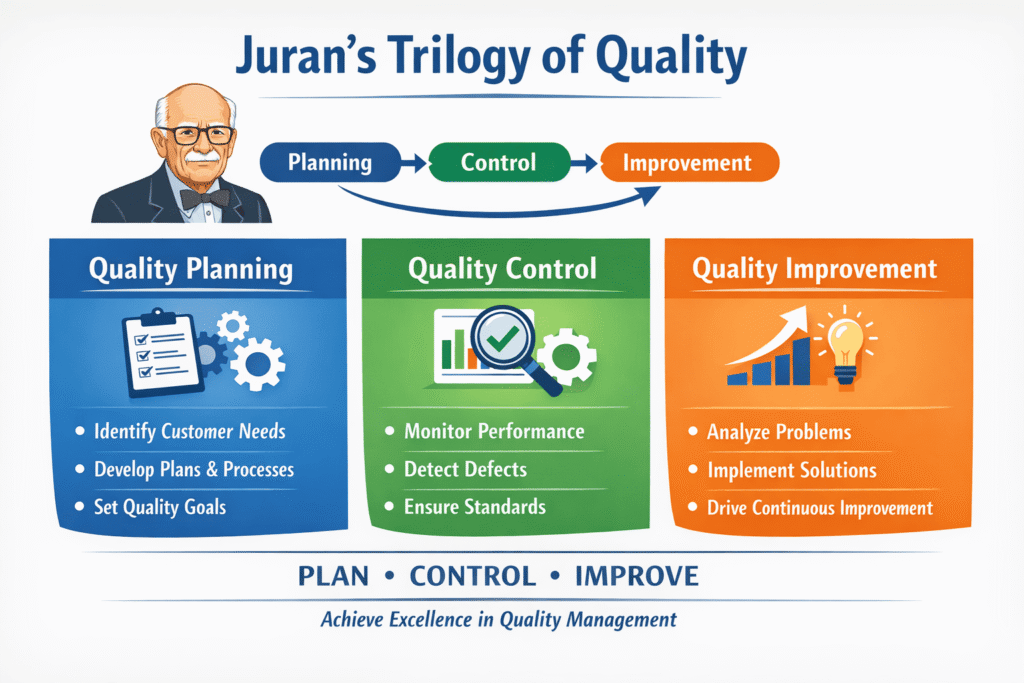
Juran’s Trilogy of Quality presents a model based on three key steps for managing quality:
- Quality Planning
- Quality Control
- And Quality Improvement.
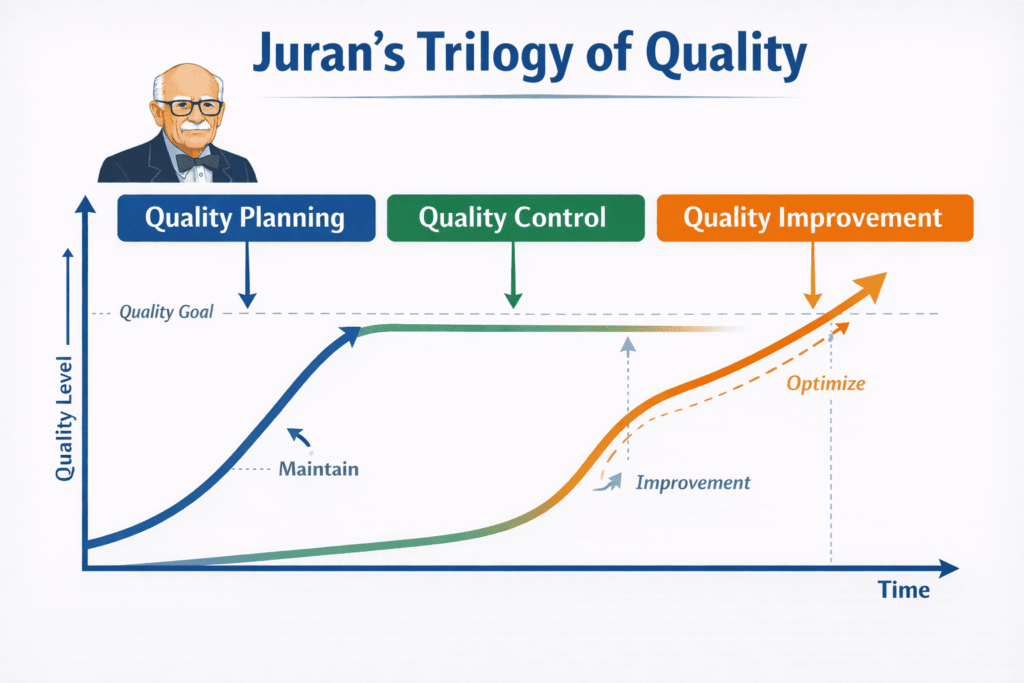
These three together form a robust system for continuously improving quality in any organization.
Juran believed that it is not enough to have a good plan; it is equally important to control and periodically improve it.
Quality Planning
Quality planning is the first and most important part of this trilogy. It determines what the customer needs and how to fulfill them.
- This phase starts with understanding customer needs.
- The goal of every product or service is to meet customer expectations.
- Failure to plan properly at the outset will inevitably lead to problems later.
During quality planning, an organization determines the product to be manufactured, its specifications, and the processes used to produce it. It also ensures that the product meets quality standards.
For example, if you’re building a road, you must first determine its width, thickness, material, and design. If this isn’t planned properly, the road could deteriorate quickly later.
Quality Control
After quality planning, the next step is quality control. This process involves monitoring whether the planned process is being implemented correctly.
- The primary objective of quality control is to ensure that a product or service is manufactured according to established standards.
- Any errors or deficiencies identified are immediately corrected.
- This process involves continuous monitoring. Quality Control collects and analyzes data to determine whether work is progressing on track.
- Suppose you’re making concrete, Quality Control will check whether the mix design is correct, whether the strength is adequate, and whether the work is performed properly.
- If a problem arises, Quality Control immediately corrects it.
Quality Improvement
Quality Improvement is the third and most important step in this trilogy. It examines the potential improvements in the current system.
Juran believed that mere control is not enough; continuous improvement is also essential. Through Quality Improvement, organizations learn from their mistakes and strive to do better in the future.
- In this phase, problems are first identified, their causes analyzed, and then a permanent solution is implemented.
- For example, if a project keeps experiencing the same problem, simply fixing it isn’t enough.
- You need to understand why the problem is occurring and eliminate it at its root.
Significance of Juran’s trilogy
Today, Juran’s Trilogy proves useful in every industry, whether it’s manufacturing, construction, the IT sector, or the service industry.
Its biggest advantage is that it provides a structured approach. This allows for systematic work and minimizes errors.
Additionally, this model makes the organization customer-focused. When you work with customer needs in mind, your chances of success automatically increase.
his model also promotes teamwork. Each individual clearly defines their role, leading to better work performance.
To get Better Knowledge about quality control click on given link.
how to test slump for Concrete
FDD test : complete process and calculation.
Step-by-Step Implementation of Juran’s Trilogy
Implementing Juran’s Trilogy in any organization or project requires a structured approach. First, you need to understand that it’s not just a theory, but a practical system that can be used in everyday work.
Quality planning begins with identifying your target customers. Next, you need to understand their needs.
Often, companies make the mistake of developing products without understanding customer needs, which leads to increased complaints later.
Once the requirements are clear, you need to design processes. Determine how each task will be performed, who will be responsible, and what resources will be needed.
Then comes Quality Control, which monitors these processes.
Finally, Quality Improvement, which analyzes the entire system and improves it. This is a continuous cycle that never ends.
Understand with real-life examples
Suppose you’re working on a road construction project. Juran’s Trilogy can be applied to this situation like this:
- First, in Planning, you’ll determine the soil conditions, traffic load, material selection, and design. This stage is very critical, as it forms the foundation of the entire project.
- Next, in Control, you’ll check the quality of the work on site. For example, whether the compaction is correct, whether the thickness is being maintained, and whether the material is in accordance with standards.
- If you see repeated cracks or failures, you’ll conduct a root cause analysis in the Improvement phase.
- Perhaps there’s a design flaw or poor material quality. Identifying this and implementing a permanent solution is the key to improvement.
To get Better Knowledge about subgrade preparation click on given link.
How to prepare the subgrade bed
Importance of Quality Cost
Juran also placed great emphasis on quality costs. He believed that poor quality has a significant cost, which many people fail to understand.
Quality costs divide into four parts:
- The first is prevention costs, which planners and trainers incur.
- Second is appraisal costs, which inspectors and testers incur.
- Third is internal failure costs, which manufacturers incur in connection with errors that occur during production.
- Fourth is external failure costs, which companies incur due to customer complaints and returns.
With proper planning and control, failure costs can be significantly reduced. This is the main objective of Juran’s Trilogy.
Tools and Techniques That Help
To better implement Juran’s Trilogy, certain tools and techniques help.
- Such as Pareto Analysis, which reveals which problems are having the greatest impact.
- Cause and Effect Diagram (Fishbone Diagram), which helps identify the root cause of a problem.
- Control Charts monitor processes.
By using these tools correctly, you can strengthen your quality management system.
Benefits of Juran’s Trilogy
If you implement this model correctly, you reap several benefits.
- First, your productivity increases because you organize your work.
- Second, you reduce errors, saving both time and costs.
- Third, customer satisfaction increases, which helps your business grow.
- And most importantly, your professional value increases.
conclusion
Quality is a crucial foundation for the success of any organization, project, or business. When quality is managed systematically, the performance of products and services improves, and customer satisfaction increases. To address this, Joseph M. Juran introduced a practical and effective framework known as “Juran’s Trilogy.”
The three main pillars of this model—Quality Planning, Quality Control, and Quality Improvement—combine to form a robust quality management system. Quality Planning involves understanding customer requirements and designing processes to meet them. Quality Control ensures that work is carried out according to predefined standards. Meanwhile, Quality Improvement focuses on continuous enhancement to minimize future errors and failures.
In today’s competitive business environment, merely maintaining quality is insufficient; continuous improvement is essential. Whether in manufacturing, construction, IT, or the service industry, the demand for quality management is rising. Consequently, organizations require a framework that is not only practical but also supports long-term growth.
Juran’s Trilogy is a proven approach that helps organizations become customer-focused, enhance operational efficiency, and reduce quality-related costs. Proper implementation leads to increased productivity, strengthened customer trust, and sustainable business growth.
Ultimately, quality is never achieved by accident; it is attained through proper planning, effective control, and continuous improvement. This very principle guides every professional and organization toward long-term success.
About the Author
My name is Susanta Kumar Mohapatra. I am a civil engineering professional with over 11 years of practical experience in the construction and infrastructure sectors. I hold a B.Tech degree in Civil Engineering and an M.E. degree in Construction Management.
Throughout my career, I have worked in various areas such as road construction, bridge projects, quality control, material testing, quantity surveying, project planning, and site management. I am passionate about sharing practical knowledge related to highway engineering, laboratory testing, and construction management with engineers, students, and construction professionals.
I am the founder of CivilGuruHub.com, where I share technical articles, field experiences, laboratory test procedures, guidelines based on IRC and IS codes, and practical construction knowledge related to civil engineering. My aim is to explain civil engineering concepts in simple language and provide useful, reliable information to industry professionals.
You can connect with me through CivilGuruHub.com and my YouTube channel, “The Civil Site,” where I regularly share civil engineering tutorials and practical site knowledge.
Frequently Asked Questions (FAQs)
1. What is Juran’s Trilogy?
Juran’s Trilogy is a quality management model developed by Joseph M. Juran. It consists of three main components: Quality Planning, Quality Control, and Quality Improvement.
2. What are the three main parts of Juran’s Trilogy?
The three main parts of Juran’s Trilogy are Quality Planning, Quality Control, and Quality Improvement. Together, these three help in maintaining and improving quality.
3. What is the importance of Quality Planning?
Quality Planning involves understanding customer requirements and designing processes to meet them. Effective planning reduces future quality problems.
4. What is the objective of Quality Control?
The primary objective of Quality Control is to ensure that a product or service is being produced in accordance with predefined quality standards.
5. Why is Quality Improvement necessary?
Quality Improvement helps an organization continuously improve. It allows for the identification of the root causes of problems and the implementation of permanent solutions.
6. In which industries is Juran’s Trilogy used?
Juran’s Trilogy is used in almost every sector, including manufacturing, construction, IT, healthcare, education, and service industries.
7. How is Juran’s Trilogy applied in construction projects?
In construction projects, designs and materials are determined during the planning phase, quality checks are conducted during the control phase, and recurring problems are permanently resolved through improvement efforts.
8. What is the ‘Cost of Quality’ according to Juran?
The Cost of Quality includes Prevention Costs, Appraisal Costs, Internal Failure Costs, and External Failure Costs. Proper management of these costs improves both quality and profitability.
9. Which tools are useful for implementing Juran’s Trilogy?
Tools such as Pareto Analysis, the Fishbone Diagram (Cause and Effect Diagram), Control Charts, and Root Cause Analysis help in effectively implementing Juran’s Trilogy.
10. What are the key benefits of Juran’s Trilogy?
This model increases productivity, reduces errors, improves customer satisfaction, lowers costs, and enhances the organization’s overall performance.
11. What is the difference between Juran’s Trilogy and Total Quality Management (TQM)?
Juran’s Trilogy focuses on three specific phases of quality management, whereas TQM is a comprehensive management approach that promotes continuous quality improvement across the entire organization.