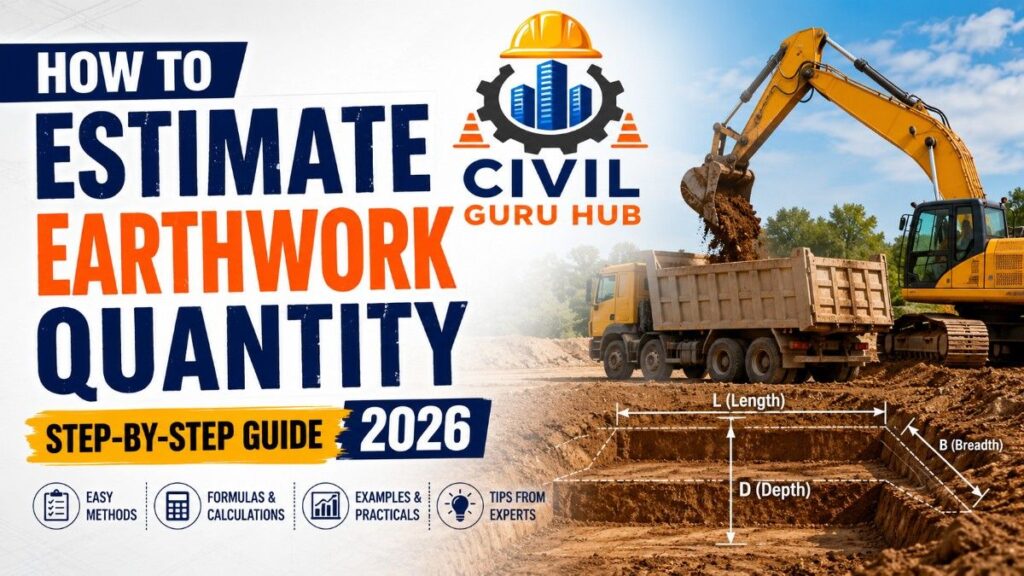
How to estimate Earthwork Quantity: Step-by-Step Guide 2026
How to estimate Earthwork Quantity: Step-by-Step Guide 2026 Read More »
Quantity SurveyQuantity Surveying Guides – Estimation, BOQ, BBS & Construction Billing
Quantity Surveying is a vital component of civil engineering and construction projects; its primary objectives are to accurately calculate construction quantities, control project costs, and maintain proper billing and documentation. In the Quantity Surveying section of CivilGuruHub, we explain key topics—such as quantity estimation, material calculation, BOQ preparation, BBS (Bar Bending Schedule), rate analysis, contractor billing, material reconciliation, and construction cost control—in a practical and easy-to-understand manner. This section focuses not only on theoretical calculations but also on understanding and resolving the practical challenges faced by quantity surveyors, billing engineers, site engineers, and civil engineers at actual construction sites.
Accurate measurement and documentation are crucial in quantity surveying because even a minor error in quantity can significantly impact the total project cost, contractor billing, material consumption, and final payments. Consequently, a professional quantity surveyor must be proficient in reading drawings, verifying the BOQ, recording site measurements, calculating executed quantities, and comparing actual site work against approved drawings and specifications. The guides available on CivilGuruHub are prepared with these practical requirements in mind.
In this category, you can learn about various methods of construction quantity estimation, including calculations for concrete, earthwork, reinforcement, masonry, plaster, excavation, and the different pavement layers in road construction. For highway projects, topics such as chainage-wise measurement, cross-section data, existing ground levels, finished road levels, earthwork calculations, and quantity verification for GSB, WMM, DBM, BC, and drainage works are also essential. Understanding these practical aspects enables site engineers and quantity surveyors to manage actual project measurements more effectively.
The BOQ (Bill of Quantities) is a critical document for quantity management in construction projects. Therefore, the Quantity Surveying section also covers BOQ verification and the relationships between item descriptions, units of measurement, quantity comparisons, drawing verification, variation items, and executed quantities. It is essential to cross-check the Bill of Quantities (BOQ) against approved drawings, technical specifications, and actual site execution, as discrepancies between the drawings and the BOQ can lead to issues with billing, estimation, and project costs.
The Bar Bending Schedule (BBS) is another crucial practical aspect of quantity surveying, particularly in RCC construction projects. Through a BBS, one can calculate the diameter, shape, cutting length, number of bars, total length, and approximate quantity of steel reinforcement. It is vital for civil engineers and quantity surveyors to properly prepare and verify the BBS, as accurate calculation of reinforcement quantities is directly useful for material procurement, steel reconciliation, and contractor billing.
Material reconciliation is also a key component of quantity management in construction projects. Comparing the issued quantities of materials—such as cement, steel, aggregates, sand, bitumen, and others—with actual consumption and balance stock helps control project costs. If material consumption differs significantly from expected quantities, the engineer should investigate potential causes such as wastage, measurement errors, specification changes, excessive consumption, or site-specific issues. Thus, quantity surveying is not limited merely to calculating quantities; it is also linked to material management and project cost control.
Quantity surveyors play a significant role in contractor billing and the preparation of Interim Payment Certificates (IPCs). It is essential to properly verify executed work measurements, approved quantities, quantities from previous and current bills, and cumulative quantities. Billing documents are prepared and cross-checked based on the Site Measurement Book or other approved measurement records. Proper documentation helps minimize future disputes, variation claims, and payment-related issues.
Rate analysis and cost estimation constitute another important part of quantity surveying. The rate for a construction item is not determined solely by the material price; factors such as material, labour, equipment, transportation, wastage, lead, lift, overheads, and specific project conditions can all influence the overall rate. Therefore, understanding rate analysis is beneficial for engineers and quantity surveyors, especially when assessing new, extra, substituted, or variation items.
Digital tools have made modern Quantity Surveying more efficient. Excel spreadsheets, automated formulas, AutoCAD, AutoCAD Civil 3D, digital measurement records, and other engineering software can make quantity calculations and documentation faster and more organized. However, blindly accepting software output is not sound engineering practice. It is equally important to independently verify drawings, survey data, dimensions, units, formulas, and actual site measurements.
In highway quantity surveying, one must properly understand road alignment, typical cross-sections, longitudinal sections, pavement thickness, carriageway width, shoulder width, drainage structures, and chainage-wise measurements. For earthwork quantities, it is crucial to evaluate the difference between existing ground levels and finished formation levels, determine cross-sectional areas, and apply suitable volume calculation methods. Similarly, in pavement construction, one must verify the approved thickness, width, and executed quantities of layers such as GSB, WMM, DBM, and BC.
Quantity surveying is also linked to measurement standards and technical specifications. One may need to refer to applicable IS standards, IRC publications, MoRTH specifications, project specifications, and contract documents for the measurement of various construction activities. For instance, measurement and construction requirements can vary depending on the project type and contract specifications. Therefore, during actual project work, one should always verify the latest applicable standards, approved drawings, specifications, and contract conditions.
CivilGuruHub’s Quantity Surveying section is also useful for students; understanding quantity surveying concepts through practical examples and construction-site scenarios helps bridge the gap between classroom theory and actual field application. Here, students can systematically grasp basic concepts such as quantity estimation, BOQ, BBS, material calculation, construction measurement, highway quantity calculation, and billing.
Knowledge of quantity surveying is also highly valuable for site engineers and working professionals. A practical understanding of quantity management is essential for properly maintaining records of daily site measurements, executed quantities, material consumption, contractor bills, variation statements, reconciliation sheets, and project progress. An organized quantity management system can help improve project cost control, documentation, and financial transparency. The objective of this section is to simplify construction quantity calculations and provide readers with practical engineering knowledge. Here, you can explore technical guides related to estimation, quantity takeoff, BOQ, BBS, material reconciliation, billing, rate analysis, highway quantity surveying, and construction cost management. It is important to verify every calculation against approved drawings, specifications, contract conditions, and applicable standards before using it in an actual project.
Whether you are a civil engineering student, quantity surveyor, billing engineer, site engineer, contractor, or construction professional, CivilGuruHub’s Quantity Surveying section can help you understand the practical aspects of quantity calculation and construction cost management. The goal of this section is to bridge the gap between theoretical knowledge and practical construction work, presenting key quantity surveying concepts in a clear, structured, and useful manner.