
Table of Contents
What Is Camber in Road? Types, Formula, IRC Values & Calculation
The camber is directly affect a road’s safety, drainage, and durability. If Designer do not design it properly, the road can get damaged.
Camber is one of the most important geometric features provided on a road surface. It is the transverse slope given to the pavement surface to drain rainwater from the center of the road towards the edges. Proper camber helps prevent water stagnation, protects pavement layers from moisture damage, improves road safety, and increases the service life of the pavement.
If the camber is too low, rainwater may remain on the road surface and enter the pavement layers. On the other hand, excessive camber can affect vehicle stability and riding comfort. Therefore, the correct camber value should be selected and constructed according to the pavement surface type, rainfall conditions, road geometry, drainage requirements, and applicable design standards.
In this complete guide, you will learn what camber is, why it is provided, different types of camber, the camber formula, practical calculation methods, recommended values for different pavement surfaces, field checking procedures, common construction problems, and the difference between camber and superelevation.
What Is Camber in Road?
Camber is the transverse slope provided on the surface of a road to drain rainwater from the center of the carriageway towards the edges.
On a typical two-way road, the center of the carriageway is generally kept higher than the edges. This creates a sloping surface through which rainwater flows toward the shoulders, side drains, or other drainage facilities.
For example, if a road has a camber of 2%, it means that the road surface changes in level by 2 units vertically for every 100 units of horizontal distance.
In simple terms:
2% Camber = 2 m vertical fall for every 100 m horizontal distance
or
2% Camber = 20 mm fall for every 1 m horizontal distance
The actual direction of slope depends on the road cross-section and design arrangement. On a conventional two-way road, the pavement generally slopes downward from the centerline towards both edges.
Why Is Camber Provided on Roads?
Camber is primarily provided to remove rainwater from the pavement surface. However, its importance extends beyond surface drainage.
To Drain Rainwater Quickly
The main purpose of camber is to prevent rainwater from remaining on the pavement surface.
When rainwater falls on a properly cambered road, it flows toward the edges and is subsequently collected by shoulders, side drains, kerbs, or other drainage facilities.
Without sufficient transverse slope, water may remain on the road surface for a long period, especially during heavy rainfall.
To Protect Pavement Layers
Water is one of the major causes of pavement deterioration.
If water enters through cracks, joints, porous surfaces, or damaged edges, it may reach the base, sub-base, and subgrade layers. Excess moisture can reduce the strength and stability of these layers.
This may result in:
- settlement
- Rutting
- cracking
- Potholes
- Loss of bearing capacity
- Premature pavement failure
Therefore, proper surface drainage is an important part of pavement performance.
To Reduce Waterlogging
A properly constructed camber reduces the possibility of water ponding on the pavement.
Waterlogging can:
- Reduce skid resistance
- Affect vehicle control
- Damage the pavement surface
- Increase maintenance requirements
- Accelerate pavement deterioration
Proper camber helps water move away from the traffic lane as quickly as possible.
To Improve Road Safety
Water accumulation on the pavement can reduce tyre-pavement contact and increase the risk of skidding.
A suitable camber helps remove water from the traffic lane and improves surface drainage.
However, excessive camber can also affect vehicle stability. Therefore, camber should always be designed within the appropriate limits.
To Increase Pavement Service Life
A well-drained pavement generally performs better over time.
When water is effectively removed from the pavement surface, the risk of moisture-related damage is reduced. This can help improve pavement durability and reduce frequent maintenance requirements.
The real significance of Camber:
Camber is not just a slope, but a very important part of road design. If engineers do not provide camber properly, the overall performance of the road can be affected.
When water accumulates on the road, it damages the surface layer and gradually seeps into the lower layers. This weakens the pavement structure and causes cracks to develop. These cracks eventually turn into potholes.
Therefore, engineers consider camber the first and most important part of the drainage system.
Types :
Generally, In highway engineering four types of Camber are used.
Straight Line camber (Plane Camber):
- In this type of camber, the surface of road is formed by Two straight slopes from the center to Edges.
- This type of Camber is simplest and most commonly used in Road design.
- It is suitable for Low and Moderate Rainfall areas.
- Very easy to construct and maintain also.
Straight Line camber (Plane Camber)
Parabolic Camber:
- In this type of Camber, The road surface allows the parabolic curve.
- This type of camber Helps to smooth drainage from center to edge.
- Basically, a parabolic camber provides for High speed Roads.
- For vehicles, these type of camber is more comfortable than straight line camber.
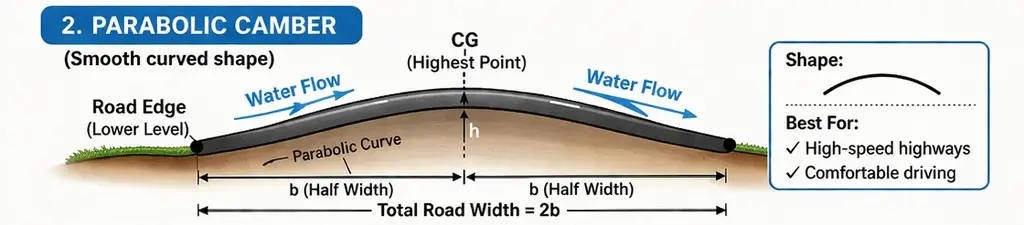
Parabolic Camber
Composite Camber:
- A combination of Straight and Parabolic Camber is known as Composite camber.
- In this type of camber, The parabolic section is near to the center and the Straight section is near to the edge.
- It provides good drainage and driving comfort.
- It is generally used in Modern Road Design.
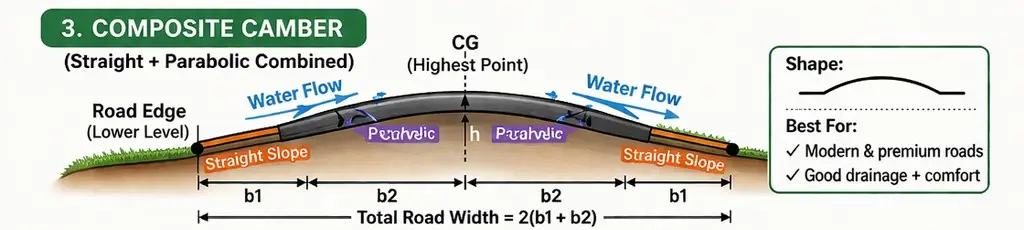
Composite Camber
Barrel Camber:
- In this type of camber, the surface of the road has a rounded or barrel like shape.
- generally this type of camber are not used in Modern road design.
- Mostly found in Old Road design.
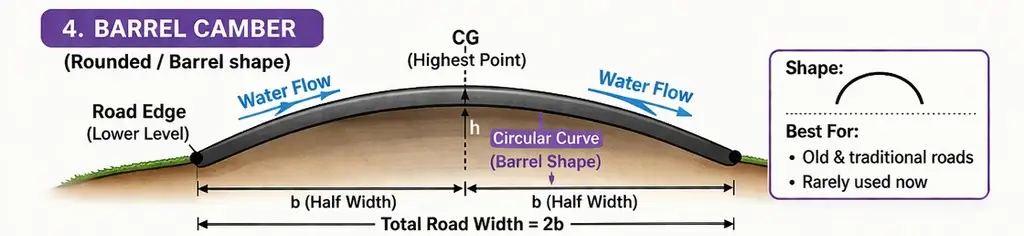
Barrel Camber
Note: At Heavy rainfall area, the camber is high and form smooth or better road the camber must be low
If you want to know all about Highway so, click below
potholes on road:causes, damages and complete methods of repairing
What is Superelevation in road design?
Comparison of Different Types of Camber
| Type of Camber | Cross-Sectional Shape | Main Advantage | Construction |
|---|---|---|---|
| Straight Line Camber | Two straight slopes | Simple and practical | Easy |
| Parabolic Camber | Curved profile | Smooth transition | More complex |
| Composite Camber | Combination of profiles | Balance between drainage and comfort | Moderate |
| Barrel Camber | Rounded profile | Traditional curved profile | Less common today |
IRC codes :
As per IRC codes:
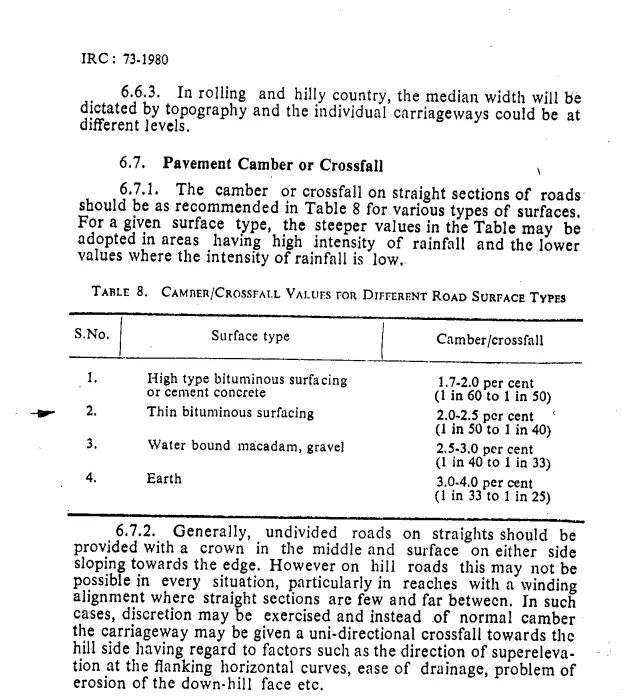
- IRC SP: 73-2018 – Manual for 2 Lane Road
- IRC :73-1980 – Gives standard values of camber for rural roads
- IRC:89 -1983 – Helps in deciding proper camber for drainage
High type bituminous surfacing or Cement Concrete Road → 1.7% to 2%
Thin Bituminous Road → 2% to 2.5%
Water bound Macadam or Gravel Road → 2.5% to 3.0%
Earthen Road → 3% to 4%
camber calculation:
Camber is generally expressed as a ratio:
Camber(%) =(h/b)*100
- h = Height of Crown (Center) above the edge.
- b = Half of the Road width.
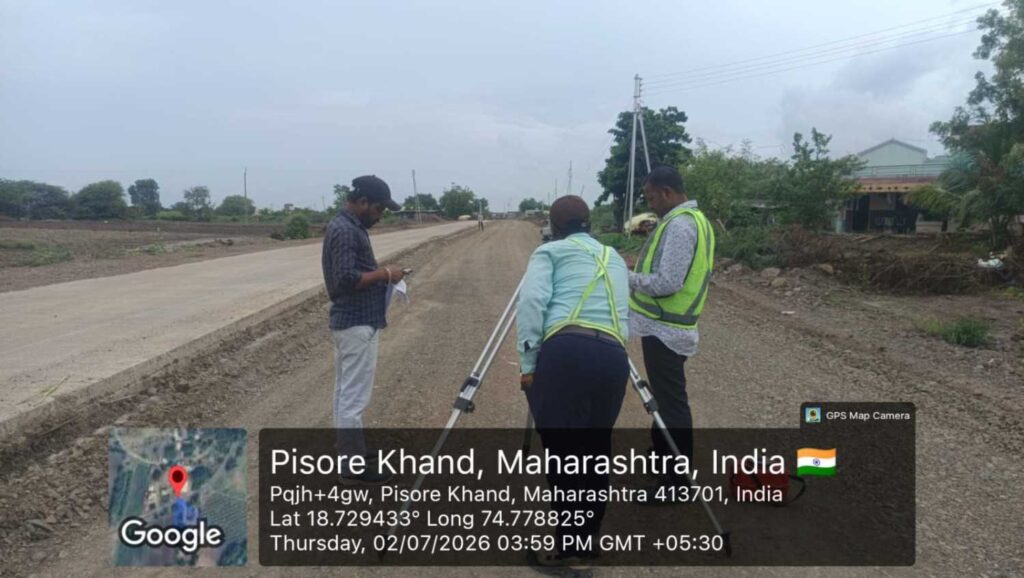
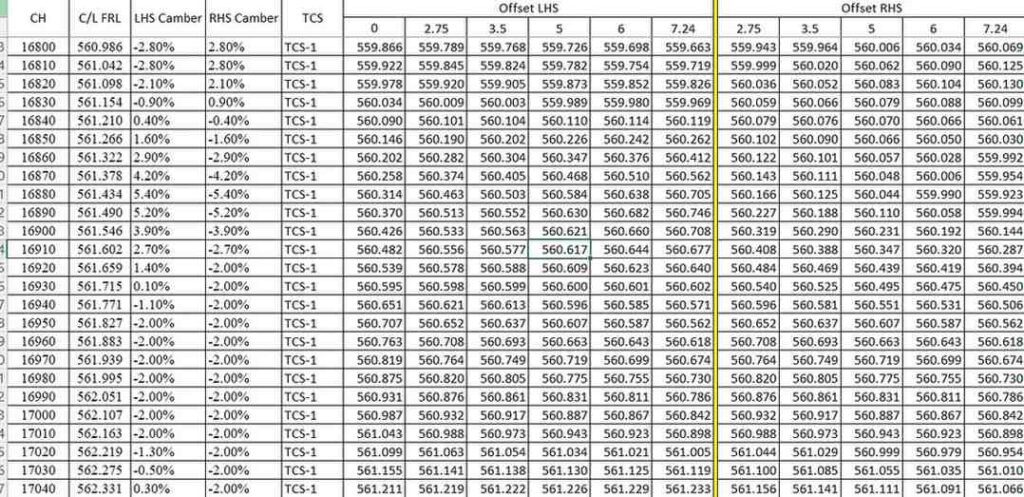
But in field condition, a field engineer having the camber percentage and they have to calculate the Reduce level (RL) at every required interval.
For Example:
At center of the road FRL given as 65.249 and the camber given -2% in both side, so find the FRL value at 0.75m, 2.5 m, 3.5 m, 5m.?
Here,
Given FRL at Center = 65.249 m
Camber (%) = -2%
So FRL at 0.75 m = FRL of Center +(Offset X % of camber)
FRL at 0.75 m = 65.249+( 0.75 X -2%) = 65.234 m
Similarly,
2.5 m = 65.249+(2.5 X -2%) = 65.199 m
3.5 m = 65.249+ (3.5 X -2%) = 65.179 m
5 m = 65.249+(5 X -2%) = 65.149
Relationship Between Camber and Road Drainage
Camber is an important component of surface drainage.
When rainwater falls on the road surface, the transverse slope directs water away from the center of the carriageway towards the edges.
From the pavement edge, water may then be collected and carried away through:
- roadside drains
- Curb and gutter systems
- Shoulder drainage
- Side drains
- Cross-drainage structures
- Natural drainage channels
A pavement may have a proper camber, but if the edge drainage system is blocked or poorly constructed, water may still accumulate.
Therefore, effective drainage depends on both:
Proper pavement camber
Proper functioning of the complete drainage system
Factors Affecting Camber Selection:
The value of camber is not fixed, it depends on many factors.
- The first factor is rainfall intensity. Where there is more rainfall, the camber is kept higher so that the water can drain away quickly.
- Second factor is the type of road surface. On smooth surfaces like cement concrete roads, the camber is kept lower because the water flows away easily.
- The third factor is traffic volume and speed. On high speed roads, the camber should be smooth so that vehicles do not face any discomfort.
- And fourth factor is soil condition. If the subgrade is weak, then drainage becomes even more important.
Effects of Incorrect Camber (Field Problems):
If the camber is not correct, many practical problems arise.
- The most common problem is waterlogging, which makes the road slippery and increases the risk of accidents.
- Second problem is uneven wear and tear. If the camber is uneven, vehicles tend to pull to one side.
- Third problem is shoulder damage. If water is not drained properly, the shoulder area becomes weak.
- Therefore, correct execution of the camber is as important as its design.
Long-Term Performance and Maintenance:
- If the camber is correct, the road’s life automatically increases.
- Maintenance costs are reduced because water damage is minimized.
- Camber can be maintained through regular inspection and timely correction.
- If settlement occurs, camber is restored by re-leveling.
To get calculated Excel sheet click below.
Camber vs. Superelevation
Both camber and superelevation relate to the transverse slope of a road, but they serve different purposes.
| Feature | Camber | Superelevation |
|---|---|---|
| Main Purpose | Rainwater drainage | Counteracting centrifugal force |
| Main Application | Straight road sections | Horizontal curves |
| Surface Arrangement | Slope from the center towards the edges | Tilting the carriageway towards the inside of the curve |
| Main Design Concern | Drainage | Vehicle stability |
| Typical Location | Straight sections | Curved sections |
Simple Difference
The primary purpose of camber is water drainage.
The primary purpose of superelevation is to improve vehicle stability on horizontal curves.
Therefore, the two should not be considered the same.
Watch both Camber and Superelevation detailed video
Camber and Crossfall: What is the Difference?
In engineering practice, the terms “camber” and “crossfall” may sometimes be used in similar contexts, though their technical definitions can vary depending on the specific project and standards.
Generally:
- Camber typically refers to the transverse slope of a road surface, particularly in the context of drainage.
- Crossfall is a broader term describing the transverse inclination of a carriageway or pavement surface.
In modern divided highway sections, crossfall is often unidirectional, whereas traditional two-way roads may feature a drainage slope extending from the centerline towards both sides.
Therefore, one should adhere to the terminology specified in the design drawings and applicable project standards.
Important Construction Quality Control Points
To properly achieve the camber, the following points are important:
- Follow the approved drawings.
- Accurately establish the centerline.
- Verify the required formation levels.
- Check levels layer-by-layer.
- Maintain the approved camber using construction equipment.
- Regularly check edge levels.
- Avoid localized depressions on the surface.
- Verify the final level after compaction.
- Survey the crossfall/camber of the final surface.
- Ensure acceptance based on project specifications.
conclusion
Drainage systems play a crucial role in road engineering, and providing an appropriate transverse slope on the road surface is essential for making this system effective. The durability, safety, and long-term performance of any road depend significantly on how quickly surface water can be drained away. When rainwater does not accumulate on the road, pavement layers remain protected, and moisture-related issues are minimized.
Water accumulation on the road surface can lead to defects such as stripping, rutting, and potholes in bituminous roads, while increasing the likelihood of cracks and surface deterioration in cement concrete roads. For this reason, drainage is always prioritized during road design. A proper slope directs water from the road center toward the shoulders and side drains, thereby extending the pavement structure’s lifespan and reducing maintenance costs.
Camber is a vital design element in highway engineering that contributes to making a road safe, strong, and durable. Its selection should be based on factors such as rainfall intensity, road surface type, traffic conditions, and local site requirements. Alongside design, field execution and regular inspection are equally important, as improper construction or settlement can compromise drainage performance.
In conclusion, an effective drainage system is the foundation of any road’s success. Adhering to all drainage-related standards during design, construction, and maintenance extends the road’s service life, enhances travel safety, and significantly reduces maintenance expenses.
About the Author
My name is Susanta Kumar Mohapatra. I am a civil engineering professional with over 11 years of practical experience in the construction and infrastructure sectors. I hold a B.Tech degree in Civil Engineering and an M.E. degree in Construction Management.
Throughout my career, I have worked in various areas such as road construction, bridge projects, quality control, material testing, quantity surveying, project planning, and site management. I am passionate about sharing practical knowledge related to highway engineering, laboratory testing, and construction management with engineers, students, and construction professionals.
I am the founder of CivilGuruHub.com, where I share technical articles, field experiences, laboratory test procedures, guidelines based on IRC and IS codes, and practical construction knowledge related to civil engineering. My aim is to explain civil engineering concepts in simple language and provide useful, reliable information to industry professionals.
You can connect with me through CivilGuruHub.com and my YouTube channel, “The Civil Site,” where I regularly share civil engineering tutorials and practical site knowledge.
FAQ
1. What is camber?
Camber is the transverse slope of a road, provided from the center towards the edges. Its primary purpose is to quickly drain rainwater and protect the road from damage.
2. Why is camber provided in highway engineering?
Camber prevents water accumulation on the road, improves drainage, extends the pavement’s lifespan, and enhances vehicle safety.
3. What are the different types of camber?
Four main types of camber are used in highway engineering:
Straight Line Camber
Parabolic Camber
Composite Camber
Barrel Camber
4. What are the advantages of parabolic camber?
Parabolic camber provides smooth drainage, offers greater comfort for high-speed vehicles, and improves driving stability.
5. What camber is recommended for bituminous roads according to IRC?
According to IRC, a camber of 1.7% to 2% is generally recommended for high-type bituminous surfacing and cement concrete roads.
6. How is camber calculated?
The basic formula for camber is:
Camber (%) = (h / b) × 100
Where:
h = Height of the crown relative to the edge
b = Half the width of the road
7. What happens if there is no camber on the road?
If a road lacks proper camber, water will accumulate, the pavement will weaken, cracks and potholes will develop, and the road’s service life will be reduced.
8. What is the relationship between camber and drainage?
Camber is a crucial component of the surface drainage system. It prevents waterlogging by directing rainwater from the center of the road to the edges.
9. What factors determine the value of camber?
The value of camber depends on rainfall intensity, road surface type, traffic speed, traffic volume, and subgrade soil conditions.
10. How is camber checked in the field?
Camber is checked in the field using an Auto Level, Total Station, Digital Level, or a straight edge and measuring tape. RL readings are taken and compared against the design camber.

Pingback: potholes in road: causes, dsmages and methods of repairing
Pingback: What is Superelevation in road design? - civilguruhub.com
Pingback: what is Retaining Wall and Its Type: Complete Guide
Pingback: Toe Wall in Civil engineering : A complete guide
Pingback: FDD test: what is it? complete gprocess and calculation.
Pingback: What is Gradient in Civil Engineering- civilguruhub.com
Pingback: TCS: How to Study Typical Cross Section - civilguruhub.com
Pingback: How to prepare the Subgrade bed -civilguruhub.com