
Table of Contents
Introduction
In today’s fast-paced business environment, time management is no longer merely a skill; it has become a survival tool for every project manager. Whether it involves a construction project, an IT initiative, manufacturing operations, or infrastructure development, the pressure of deadlines, client expectations, and budget constraints is ubiquitous. If time is not managed effectively, problems such as project delays, cost overruns, low productivity, and client dissatisfaction can arise.
The primary objective of project management is to successfully complete a project within its defined scope, budget, and timeline. However, under practical field conditions, this is achievable only when the project manager possesses strong time management techniques. A skilled manager does not merely assign tasks; they set priorities, monitor team productivity, and ensure that every activity is executed in accordance with the scheduled timeline.
Time management, in simple terms, means making the best possible use of available time. It encompasses planning, scheduling, delegation, monitoring, and performance tracking. An effective project manager constantly strives to make every minute productive, as project delays directly impact a company’s profitability and reputation.
The 10 proven time management tips listed below are highly beneficial for every project manager. These techniques are grounded in practical field experience and successful project execution methodologies.
1. Clear Project Planning Aur Scheduling (Time Management)
Proper planning serves as the foundation of any successful project. If the planning phase is weak, numerous complications arise during the execution phase. The first and most crucial step in time management is detailed project planning.
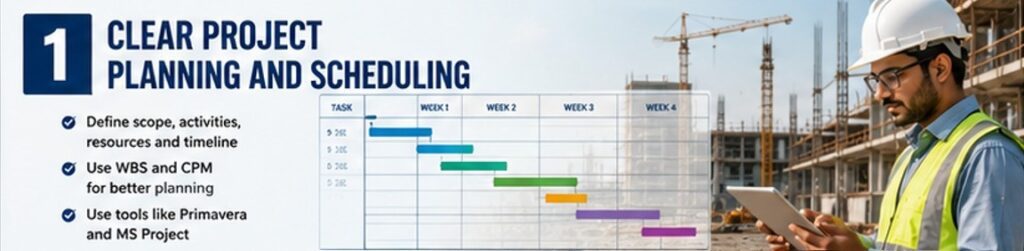
Before a project commences, the Project Manager must define the scope, activities, manpower requirements, machinery requirements, and estimated duration. It is essential to break down every task to create a realistic timeline. This process is also known as the Work Breakdown Structure (WBS).
If the planning lacks clarity, it will lead to confusion at the site, result in idle resources, and cause unnecessary delays. For instance, in a highway construction project, if the project team does not properly define the sequencing of earthwork and drainage activities, the waiting time for machinery will increase.
Modern software tools, such as Primavera and Microsoft Project, greatly assist in project scheduling. With the aid of these tools, the team identifies the Critical Path Method (CPM). Critical activities are those whose delay results in a delay of the entire project. For planning on a smaller scale, Gantt charts are also utilized.
How to Create WBS: 8 Practical Steps Explained
What is Gantt Chart? 7 Simple Ways to Use It
5 Phases of Project Life Cycle (Easy Guide)
Table: Project Planning Components
| Planning Element | Importance |
|---|---|
| Scope Definition | Provide Work clarity provide |
| Activity Sequencing | Maintain Proper workflow |
| Resource Allocation | Reduce Idle time |
| Timeline Preparation | Control Deadline |
| Risk Planning | Avoid Delays |
2. Setting Priorities (Time Management)
Not every task is equally important. For effective time management, a Project Manager must identify high-priority and low-priority tasks. All too often, managers waste so much time on minor issues that critical activities end up getting delayed.
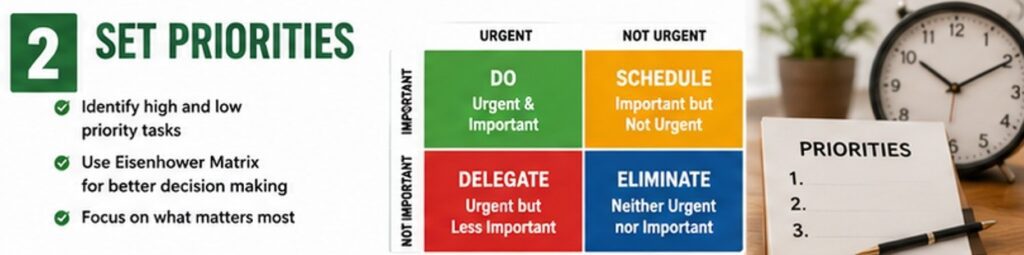
The Eisenhower Matrix is considered the best method for priority management, wherein tasks are divided into four categories:
- Urgent and Important
- Important but Not Urgent
- Urgent but Less Important
- Neither Urgent nor Important
In construction projects, tasks such as concrete pouring, inspection approvals, and material procurement fall into the high-priority category. If these tasks are delayed, the entire project is adversely affected.
A smart Project Manager prepares a daily priority list every morning. This provides the team with clear direction and helps avoid unnecessary confusion. Prioritization boosts productivity and reduces stress levels.
In today’s digital environment, tools like Trello, Asana, and Monday.com are also highly useful for task prioritization. They improve team coordination and make it easy to track pending activities.
Priority Matrix Table
| Task Type | Action |
|---|---|
| Urgent + Important | Immediate action |
| Important + Not Urgent | Schedule properly |
| Urgent + Less Important | Delegate |
| Low Priority | Avoid or postpone |
3. Effective Delegation (Time Management)
A common problem among many Project Managers is the desire to personally control every task. This habit leads to an increased workload and slows down the decision-making process.
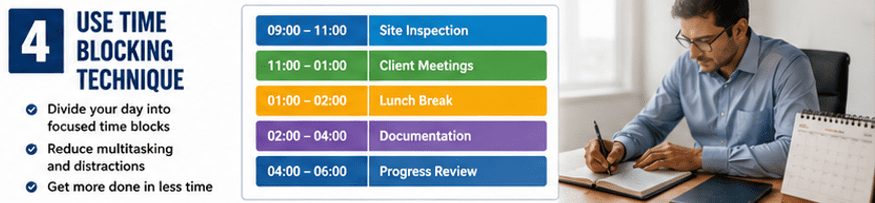
In Time management, Delegation entails transferring responsibility. An efficient manager always identifies the skills of team members and assigns tasks accordingly. This balances the workload and improves overall efficiency.
For instance, a Site Engineer can be entrusted with daily progress monitoring, a Quality Engineer with testing responsibilities, and a Planning Engineer with scheduling responsibilities. This approach enables the Project Manager to focus on strategic decisions.
Effective delegation requires clear communication. When assigning tasks, it is crucial to clearly define deadlines, quality expectations, and reporting structures.
If delegation is implemented properly, it boosts team confidence and accelerates the pace of project execution.
4. Time Blocking Technique (Time Management)
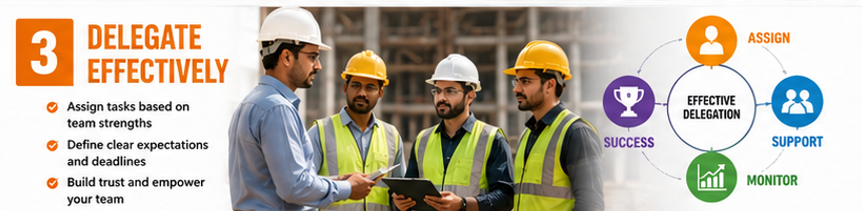
Time Blocking is a modern productivity technique in which a manager divides their entire day into distinct blocks. Each block reserves a specific activity.
For example:
- Morning 9 to 11 = Site inspection
- 11 to 1 = Client meetings
- 2 to 4 = Documentation
- 4 to 6 = Progress review
The biggest advantage of this technique in the process of Time Management is that it reduces multitasking. According to research, excessive multitasking decreases productivity.
Calls, meetings, and emails frequently interrupt Project Managers. Time Blocking helps control distractions and creates a focused work environment.
In construction projects, maintaining separate time blocks—particularly for documentation and site supervision—proves to be highly effective.
5. Daily Progress Monitoring (Time Management)
Monitoring is a critical process Time management. If someone does not monitor progress regularly, minor delays can escalate into major problems in the future. Daily progress reports assist the Project Manager in understanding actual site conditions. It is essential to track the status of every activity.
During the monitoring process, the following points are evaluated:
- Daily work completed
- Pending activities
- Resource utilization
- Delays and issues
- Safety observations
If a delay is detected in any activity, immediate corrective action can be taken. For this reason, daily review meetings are crucial for project success.
In modern projects, drone monitoring, digital reporting, and dashboard systems are also utilized, enabling real-time tracking.
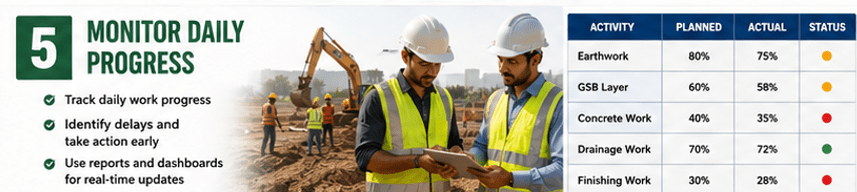
DPR Monitoring Table
| Activity | Planned Progress | Actual Progress |
|---|---|---|
| Earthwork | 80% | 75% |
| GSB Layer | 60% | 58% |
| Concrete Work | 40% | 35% |
6. Making Meetings Productive (Time Management)
Unnecessary meetings are the greatest enemy of time management. All too often, companies hold lengthy meetings that yield minimal output.
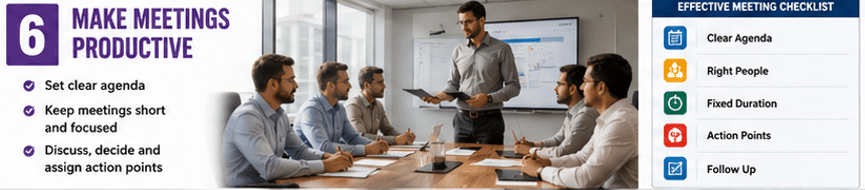
A Project Manager should define a clear agenda for every meeting. Meetings should be conducted only with those members whose involvement is essential.
For an effective meeting:
- Maintain a fixed duration.
- Circulate a clear agenda.
- Note down action points.
- Assign follow-up responsibilities.
Short and focused meetings boost productivity. Daily toolbox talks and progress review meetings should be concise.
7. The Use of Technology and Automation (Time Management)
The role of technology has become extremely important in modern project management. Manual systems carry a higher risk of data loss and delays.
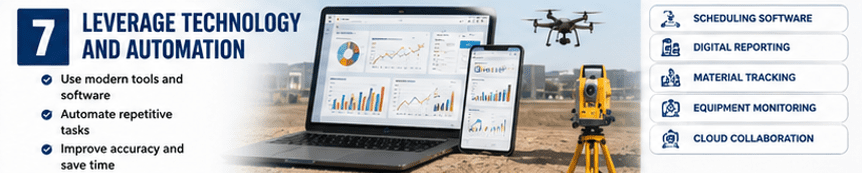
Project managers should utilize scheduling software, digital documentation systems, and cloud-based reporting tools.
Automation simplifies repetitive tasks. Examples include:
- Automatic progress reports
- Digital attendance systems
- Material tracking software
- Equipment monitoring apps
Technology reduces communication gaps and accelerates the pace of decision-making.
Software Comparison Table
| Software | Main Use |
|---|---|
| Primavera | Scheduling |
| MS Project | Planning |
| AutoCAD | Drawing Management |
| Power BI | Data Analysis |
8. Risk Management And Buffer Time (Time Management)
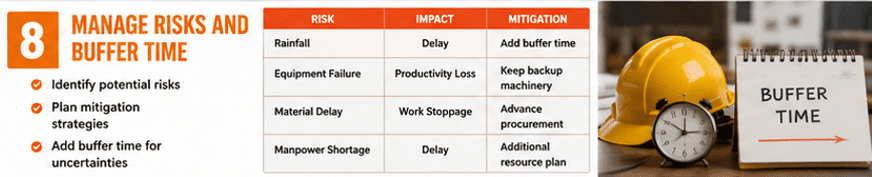
Every project involves unexpected risks. Weather issues, machinery breakdowns, manpower shortages, and material delays are common examples.
An experienced Project Manager always engages in contingency planning. Incorporating buffer time is a smart scheduling strategy.
If the project schedule is designed too tightly, even a minor delay can have a major impact. This is why realistic scheduling is crucial.
Maintaining a risk register—in which potential risks and mitigation measures are recorded—is also a helpful practice.
Risk Management Table
| Risk | Impact | Mitigation |
|---|---|---|
| Rainfall | Delay | Buffer time |
| Equipment Failure | Productivity loss | Backup machinery |
| Material Delay | Work stoppage | Advance procurement |
9. Improve team communication (Time Management)
Poor communication is a major cause of time management to project delays. If instructions are unclear, it leads to increased rework and confusion.
A Project Manager should maintain regular communication with the team. Site meetings and reporting systems must be transparent.
Good communication:
- Reduces errors
- Improves coordination
- Boosts team morale
- Minimizes conflict
Digital communication tools—such as WhatsApp groups, Microsoft Teams, and Zoom meetings—are also highly useful in modern projects.

10. Continuous Improvement And Self-Discipline
Time management is a continuous learning process. Every project offers new lessons that should be applied to future projects.
A Project Manager should improve their daily habits:
- Arriving at the office/site on time
- Engaging in daily planning
- Avoiding distractions
- Evaluating performance
Self-discipline is the foundation of successful leadership. A disciplined manager motivates the entire team.
Regular training and skill development are also essential for continuous improvement.

To Get more Blogs about Project Management click on given links.
What is risk Management: 10 Steps for Successful Projects
What Are 9 Key Differences Between Flexible and Rigid Pavement? complete guide
Conclusion
Time management is the most critical competency for any successful project manager. Hard work alone does not guarantee project success; rather, smart planning and efficient execution truly make a project successful.
In today’s competitive environment, companies prefer project managers who can meet deadlines, utilize resources efficiently, and fulfill client expectations. Consequently, the practical implementation of time management techniques has become absolutely essential.
Proper planning, prioritization, delegation, monitoring, and communication significantly enhance project performance. The use of technology and automation also boosts productivity in modern projects.
A successful project manager understands the value of every minute and inspires their team to be both disciplined and productive. If the 10 proven tips outlined above are followed consistently, project delays will be minimized, cost control will improve, and overall project quality will be enhanced.
About The Author
My name is Susanta Kumar Mohapatra. I am a civil engineering professional with over 11 years of practical experience in the construction and infrastructure sectors. I hold a B.Tech degree in Civil Engineering and an M.E. degree in Construction Management.
Throughout my career, I have worked in various areas such as road construction, bridge projects, quality control, material testing, quantity surveying, project planning, and site management. I am passionate about sharing practical knowledge related to highway engineering, laboratory testing, and construction management with engineers, students, and construction professionals.
I am the founder of CivilGuruHub.com, where I share technical articles, field experiences, laboratory test procedures, guidelines based on IRC and IS codes, and practical construction knowledge related to civil engineering. My aim is to explain civil engineering concepts in simple language and provide useful, reliable information to industry professionals.
You can connect with me through CivilGuruHub.com and my YouTube channel, “The Civil Site,” where I regularly share civil engineering tutorials and practical site knowledge.
FAQ
1. What is Time Management?
Time Management refers to the effective and productive use of available time to ensure that tasks are completed within their deadlines. In Project Management, it is utilized for planning, scheduling, and monitoring purposes.
2. Why is Time Management important for a Project Manager?
A Project Manager has to handle multiple tasks, teams, and deadlines. Effective Time Management reduces project delays, improves productivity, and helps in completing the project within budget.
3. What is the biggest reason for project delays?
Poor planning, improper communication, material delays, and weak monitoring are common reasons for project delays. These issues can be controlled through strong Time Management techniques.
4. What is the best way to improve Time Management?
Daily planning, task prioritization, delegation, and regular progress tracking are the best methods for improving Time Management. The use of modern software tools is also highly beneficial.
5. Does multitasking increase productivity?
No, excessive multitasking actually reduces productivity. Focusing on one important task at a time is more effective and also minimizes errors.
6. Which software tools are useful for Project Time Management?
Software tools such as Primavera, Microsoft Project, Trello, Asana, and Monday.com are widely used for scheduling, task tracking, and resource management.
7. What is the Time Blocking technique?
Time Blocking is a productivity method in which the entire day is divided into distinct time slots. Each slot is reserved for a specific task, thereby minimizing distractions.
8. How does delegation help in Project Management?
Delegation distributes the workload and improves team efficiency. This allows the Project Manager to focus on important strategic decisions, thereby accelerating project execution.