
Table of Contents
Introduction
In the world of highway engineering and road construction, pavement selection constitutes a critical decision. The performance, service life, maintenance costs, and driving comfort of any road depend significantly on whether an engineer utilizes a flexible pavement or a rigid pavement system. In practical field scenarios—whenever an engineer is tasked with designing a road, be it a village road, a state highway, an industrial yard, or a heavy-traffic national highway—the question inevitably arises: which pavement system would be the most suitable?
Many people simplify this distinction by assuming that flexible pavement refers to bitumen-based roads, while rigid pavement refers to cement concrete roads. While this is technically correct, the actual difference extends far beyond just the materials used. The two systems differ fundamentally in their load transfer mechanisms, structural behavior, initial costs, maintenance requirements, riding quality, durability, and construction methodologies.
Currently, both types of pavements extensively utilize across India. Construction crews increasingly construct concrete pavements in various urban areas, whereas bituminous flexible pavements remain the standard choice for highways and long-distance stretches. Consequently, it is imperative for civil engineering students, site engineers, contractors, and even project managers to gain a detailed understanding of the distinctions between flexible and rigid pavements.
In this guide, we will explore nine key differences from the perspective of practical highway engineering. Each point is explained in the context of real-world site conditions and construction logic, ensuring that the concepts presented are not merely useful for academic examinations, but are equally applicable and valuable in the field.
What are flexible and rigid pavement?
| Basis | Flexible Pavement | Rigid Pavement |
|---|---|---|
| Main Material | Bitumen / Asphalt | Cement Concrete |
| Structural Action | Layer by layer load transfer | Slab action |
| Flexibility | More flexible | More stiff |
| Initial Cost | Less | More |
| Maintenance | Required More | Required Less |
| Service Life | Moderate | Long |
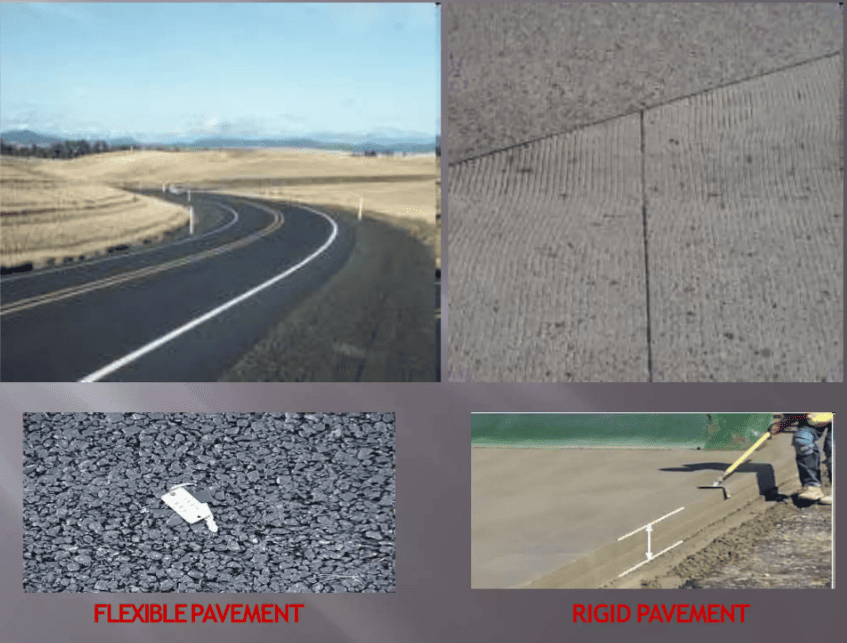
Flexible pavement generally consists of multiple layers—the subgrade, sub-base, base course, and bituminous surface course. In rigid pavement, the concrete slab serves as the primary load-carrying element.
Material Composition and Structure Nature (flexible and rigid pavement)
The primary and most fundamental difference between flexible and rigid pavement lies in their material composition. This distinction determines their entire structural behavior.
The upper layer of a flexible pavement uses bituminous materials. The pavement surface prepares by mixing aggregates with bitumen. Beneath this lie granular sub-base and base layers, which gradually distribute the applied load. This structure is relatively flexible; when a vehicle load applies, the pavement undergoes slight deformation and gradually transmits the stress down to the underlying layers.
In a rigid pavement, the primary load-carrying element is a cement concrete slab. Since concrete possesses a high modulus of elasticity, the slab is quite stiff. Due to this stiffness, a rigid pavement distributes the load over a wider area through what is known as “slab action.”
In a practical field setting, if you observe a freshly constructed bituminous road, you will notice that it exhibits an elastic nature. After repeated loading from heavy traffic, slight deformation may occur. Such behavior is comparatively less pronounced in concrete pavements, as the slab maintains its shape due to its inherent rigidity.
This difference also influences the design philosophy behind each type of pavement. The design of a flexible pavement largely bases on layer thickness and the California Bearing Ratio (CBR). Conversely, the design of a rigid pavement bases on slab thickness, flexural strength, and the modulus of subgrade reaction.
To put it simply, a flexible pavement functions like a layered cushioning system, whereas a rigid pavement distributes the load acting as a strong, rigid slab.

Load Distribution Mechanism (flexible and rigid pavement)
The most critical concept in road design is load transfer. flexible and rigid pavement behave fundamentally differently in this regard.
In flexible pavements, when a wheel load applies to the surface, the stress transfers downward in a conical pattern. The load spreads gradually from the surface layer to the base, and subsequently from the base to the subgrade. Consequently, designers make the upper layers stronger, while the lower layers can be relatively weaker.
If the top layer weakens or suffers excessive loading, the likelihood of deformation increases. For this reason, defects such as rutting, depressions, and fatigue cracking appear commonly in flexible pavements.
The load transfer mechanism in rigid pavements is quite distinct. The inherent rigidity of the concrete slab distributes the load over a wider area. The wheel load spreads directly across a large surface area, significantly reducing the intensity of the stress exerted on the subgrade.
As a result, rigid pavements can perform comparatively better even under weak subgrade conditions—provided, of course, that the slab design is appropriate.
Let’s consider a practical example. If the same heavy truck travels over flexible and rigid pavement, the stress in the flexible pavement will propagate downward gradually, and repeated loading may cause permanent deformation. In a rigid pavement, the slab distributes the load, thereby minimizing deformation.
Thickness Requirement (flexible and rigid pavement)
Pavement thickness in both flexible and rigid pavement design directly impacts both cost and material quantity.
In flexible pavements, the thickness constitutes a combination of multiple layers. The traffic load and the strength of the subgrade determine the total thickness. In cases where the subgrade is weak, the required thickness of the flexible pavement may increase significantly.
For instance, if the subgrade has a low CBR value, the project must increase the thickness of the granular sub-base and base course. Consequently, this leads to an increase in earthwork, aggregate quantity, and compaction effort.
In rigid pavements, the inherent stiffness of the concrete slab allows for a comparatively lower required thickness. Since the concrete slab itself acts as the primary load-carrying member, the structural behavior of the overall pavement section differs.
However, it is crucial to understand that a reduced slab thickness in rigid pavements does not necessarily translate to lower costs. Concrete is an expensive material, and additional components such as reinforcement, joints, and dowel bars may also be required.
Typical Thickness Comparison Between Flexible and Rigid Pavement
| Pavement Type | Typical Total Thickness |
| Flexible Pavement | 450 mm to 900 mm |
| Rigid Pavement | 250 mm to 650 mm |
In field practice, it is frequently observed that flexible pavements prove to be more economical for low-volume rural roads, whereas rigid pavements can offer long-term advantages for heavy-traffic roads.
To get better in Highway follow the below link
How to prepare the subgrade bed:complete process
TCS: How to Study Typical Cross Section – Complete Guide
Initial Construction Cost for flexible and rigid pavement
Initial construction cost plays a pivotal role in project planning in both Flexible and Rigid Pavement projects.
The initial construction cost of flexible pavement is generally lower. Bituminous roads can be constructed relatively quickly and require a lower initial investment. Consequently, the selection of flexible pavement is a common choice for projects facing short-term budgetary constraints.
In India, the majority of rural roads—as well as many roads with moderate traffic volumes—contractors and agencies construct using flexible pavement, as the initial financial burden remains manageable.
Conversely, the initial construction cost of rigid pavement is comparatively higher. The upfront investment is substantial due to the costs associated with cement concrete, formwork, joints, curing, and the requirement for skilled workmanship.
However, basing a decision solely on the initial cost is not a practical approach. In the field of highway engineering, the concept of “life-cycle cost” holds immense significance.
If a road is expected to carry heavy traffic and requires a long design life, the higher initial cost of rigid pavement can be effectively recouped through long-term savings on maintenance.

Initial Cost Comparison Between Flexible and Rigid Pavement
| Cost Factor | Flexible Pavement | Rigid Pavement |
|---|---|---|
| Material Cost | Lower | Higher |
| Construction Speed | Faster | Slower |
| Initial Investment | Lower | Higher |
Therefore, when evaluating costs at the tendering stage, one should consider not only the initial budget but also future maintenance requirements.
Maintenance Requirement for flexible and rigid pavement
The most significant practical drawback of flexible pavement is the frequency of maintenance required.
Bituminous roads gradually deteriorate due to traffic loads, temperature variations, and water infiltration. Surface oxidation, rutting, potholes, and cracking are common issues.
Consequently, flexible pavements require periodic maintenance. Workers may need to carry out operations such as overlaying, patch repair, crack sealing, and resurfacing at regular intervals.
Rigid pavements require comparatively less maintenance. Concrete slabs offer superior long-term durability; provided the design and construction are executed properly, major maintenance is typically not required for many years.
However, if a rigid pavement sustains damage, the repair process becomes relatively more difficult and expensive.
From the perspective of field engineers, the maintenance of flexible pavements is easier because workers can perform patching quickly. In contrast, repairing concrete slabs presents challenges regarding both the time required and traffic management.
This factor is of considerable importance for long-term asset management.
Service Life and Durability (flexible and rigid pavement)
The service life of a road directly affects economic efficiency.
Design life of flexible pavement is generally around 10 to 15 years, although this can be extended through overlays.
The service life of rigid pavement can generally be 20 to 30 years or even longer if drainage and construction quality are good.
Concrete is generally more durable against weathering and heavy repetitive loads.
However, poor joint design or improper curing can quickly damage even rigid pavement.
Service Life Comparison Between Flexible and Rigid Pavement
| Parameter | Flexible Pavement | Rigid Pavement |
|---|---|---|
| Typical Design Life | 10–15 years | 20–30 years |
| Durability | Moderate | High |
For this reason, rigid pavements are considered a long-term strategic investment in high-traffic corridors.
Construction Time and Opening to Traffic (flexible and rigid pavement)
Construction speed plays a crucial role in practical project scheduling.
The construction of flexible pavements is relatively fast. Following layer compaction, the crew can lay the bituminous surface quickly, allowing the road to be opened to traffic sooner.
For this reason, project managers find the use of flexible pavements highly convenient for urgent road widening, urban rehabilitation, and in traffic-sensitive areas.
Rigid pavements require proper curing of the concrete. Generally, the crew needs several days to allow the slab to gain sufficient strength before they can open the road to full traffic.
This implies that the traffic diversion period for rigid pavement projects may be longer.
In urban projects, this factor is often quite decisive.
Riding Comfort and Surface Quality (flexible and rigid pavement)
Driving comfort is also an important parameter for road users.
The surface of flexible pavements is generally smoother. A bituminous surface is preferred for its riding quality.
Vehicles experience comparatively less vibration, especially during high-speed travel.
Rigid pavements feature joints. If the finishing of these joints is not perfect, a slight impact may be felt during vehicle movement.
For this reason, flexible surfaces have remained quite popular for achieving expressway-quality smoothness.
However, modern concrete paving technology has significantly improved the riding quality of rigid pavements as well.
Suitability According to Traffic and Climate (flexible and rigid pavement)
The final selection largely depends on site conditions.
Flexible pavement is practical for roads with moderate traffic, as well as for locations where future widening or frequent utility cuts are anticipated.
Rigid pavement is highly effective for heavy axle loads, industrial traffic, bus corridors, and intersections.
In hot climates, the issue of bitumen softening may arise. Water ingress also adversely affects flexible pavements.
Rigid pavements are subject to temperature stresses; therefore, the proper design of expansion and contraction joints is essential.
Best Application Areas
| Application | Better Choice |
|---|---|
| Village Roads | Flexible Pavement |
| National Highways | Flexible / Rigid (depends on design) |
| Industrial Roads | Rigid Pavement |
| Toll Plazas | Rigid Pavement |
| Urban Internal Roads | Flexible Pavement |
In practical engineering, no single pavement is universally the best. The best pavement is the one selected based on site conditions, traffic loading, soil strength, budget, and maintenance planning.
Summary Table of 9 Key Differences (flexible and rigid pavement)
| Basis | Flexible Pavement | Rigid Pavement |
|---|---|---|
| Material | Bitumen | Cement Concrete |
| Structural Action | Layered system | Slab action |
| Load Distribution | Gradual | Wide area |
| Thickness | Higher | Lower |
| Initial Cost | Lower | Higher |
| Maintenance | More frequent | Less frequent |
| Service Life | Shorter | Longer |
| Construction Time | Faster | Slower |
| Best Use | Medium traffic | Heavy traffic |
| Standard / Code | Title | Relevance to WBS & Project Management |
|---|---|---|
| IS 15883:2009 | Construction Project Management – Guidelines | Project planning, scheduling and control ke liye guidelines provide karta hai. |
| IS 7272 (Part 1):1974 | Guide for Preparation of Project Reports | Project scope aur work packages define karne mein madad karta hai. |
| IS 15883 (Part 2) | Project Monitoring and Control Guidelines | Progress tracking aur performance monitoring ke liye useful hai. |
| PMBOK Guide (PMI) | Project Management Body of Knowledge | WBS preparation aur project scope management ka globally accepted standard hai. |
| ISO 21502:2020 | Project, Programme and Portfolio Management – Guidance | Project structure, deliverables aur work breakdown planning ke liye guidance deta hai. |
Conclusion
Both flexible and rigid pavements serve as essential systems in highway engineering. Each has its own distinct advantages and limitations. If the primary focus of a project emphasizes low initial cost, accelerated construction, and superior riding quality, then a flexible pavement proves to be a highly practical choice.
However, if the road is expected to carry heavy traffic loads, requires a long service life, and the objective seeks to minimize long-term maintenance requirements, then a rigid pavement may emerge as the superior option.
An experienced highway engineer never selects a pavement type based on a single isolated factor. Soil conditions, drainage, axle loads, climatic factors, maintenance budgets, and life-cycle economics—all must be evaluated comprehensively and in conjunction with one another.
In Simple
Flexible pavements offer short-term economic advantages, whereas rigid pavements provide long-term durability.
Making a pavement selection based on this balanced understanding constitutes the true approach to practical highway engineering.
FAQ: Flexible Pavement vs Rigid Pavement
Q.1. What is flexible pavement?
Flexible pavement is a road pavement system in which the upper surface is generally constructed using bitumen or asphalt. In this system, the wheel load is transferred downwards layer by layer. This type of road is somewhat elastic and can undergo slight deformation under traffic loads.
Q.2. What is rigid pavement?
Rigid pavement is constructed using cement concrete. In this system, the concrete slab serves as the primary load-carrying member. It possesses higher rigidity; consequently, the wheel load is distributed over a wider area, resulting in comparatively less deformation.
Q.3. What is the biggest difference between flexible pavement and rigid pavement?
The most significant difference lies in their structural behavior. Flexible pavement transfers the load gradually through its various layers, whereas rigid pavement distributes the load through “slab action.”
Q.4. Which type of pavement is cheaper?
In terms of initial construction costs between Flexible and Rigid pavement, flexible pavement is generally cheaper. However, when considering long-term maintenance costs, rigid pavement can prove to be more economical in many instances.
Q.5. Which type of pavement is more durable?
Between Flexible and Rigid pavement Rigid pavement typically possesses a longer service life than flexible pavement. The design life of flexible pavement is generally 10–15 years, whereas rigid pavement can last for 20–30 years or even longer.
Q.6. Which type of pavement is better suited for heavy-traffic roads?
Between Flexible and Rigid pavement For roads subjected to heavy axle loads and industrial traffic, rigid pavement is generally considered superior due to its higher load-carrying capacity and durability.
Q.7. What are the common types of failures observed in flexible pavement?
Common issues encountered in flexible pavement include rutting, potholes, fatigue cracking, depressions, and surface wear. These failures are typically caused by repetitive traffic loading and poor drainage.