
Table of Contents
Introduction
In the world of project management, if there’s one tool that makes planning simple, structured, and practical, it’s the Work Breakdown Structure (WBS). Whether you’re working on a highway project, building construction, software development, or a smaller assignment, a WBS is equally important everywhere.
The main purpose of a WBS is to divide a large and complex project into smaller, manageable parts. When a project is broken down into smaller tasks, it becomes much easier to plan, monitor, and control.
In this article, we’ll explain step-by-step how to create a WBS, and explain each step in depth with practical examples. This guide will be especially useful for civil engineers, project managers and students.
What is wBS? (Basic Understanding)
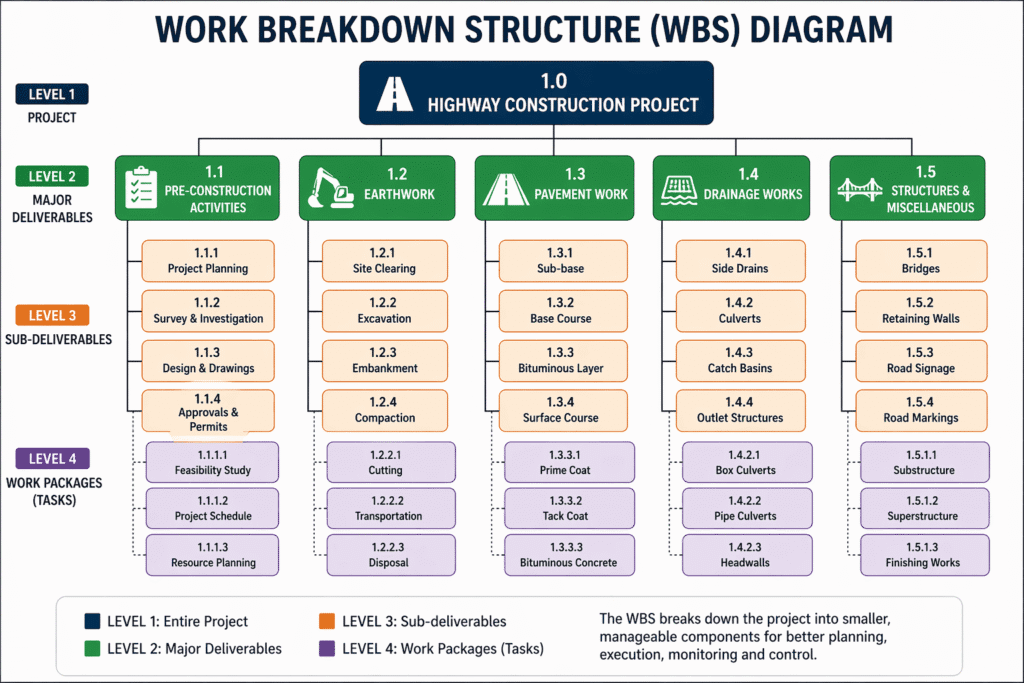
A work breakdown structure is a hierarchical structure that divides a project into phases, deliverables, and tasks. It’s like a tree structure, with the entire project at the top and the work becoming smaller and more detailed as you move down.
For example, if you’re building a highway, it might be broken down as follows:
Highway Project
- Earthwork
- Pavement
- Drainage
- Structures
he earthwork will then be divided into smaller parts such as excavation, embankment, compaction, etc.
Benefits of making WBS
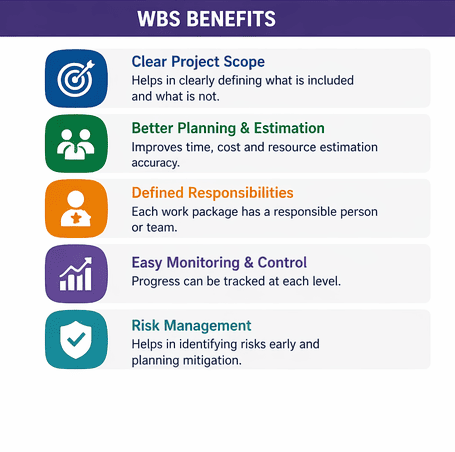
A WBS is not only just a diagram, but also a powerful planning tool that helps to make a project successful. Some of its major benefits are:
- The project scope clearly defines itself
- Each team member clearly understands their responsibilities
- Time and cost estimation accurately reflects the project needs
- Risk management improves
- Monitoring and tracking become easier
How to Create WBS: 8 Practical Steps (Detailed Guide)
Step 1: Clearly Understand the Project Scope
The first and most important step is to understand the scope of the project. If you don’t know what is included and what is not, you can never create an accurate WBS.
When defining the scope, you need to decide:
- What is the project’s objective?
- What will be the final deliverables?
- Which activities will be included?
- Which tasks are outside the scope?
For example, if you’re doing a highway project, the scope might include road construction, drainage systems, culverts, and signage, but nearby commercial development may not be in scope.
If the scope is unclear, the WBS will be incomplete or confusing, which can lead to project delays and cost overruns.
To Get more about Project management details, Click on given link.
What is Gantt Chart? 7 Simple Ways to Use It
5 Phases of Project Life Cycle (Easy Guide)
Step 2: Identify Major Deliverables
Now that you understand the scope of the project, the next step is to identify the major deliverables.
Deliverables are the outcomes that will be achieved after the project is completed. They can be either physical or non-physical.
Major deliverables in a highway project might include:
- Subgrade preparation
- Pavement layers
- Bridges and culverts
- Road markings and signage
This step is important because it will form the foundation of your WBS.
Step 3: Breaking Down the Deliverables into Smaller Components
Now each deliverable must divide into smaller parts. This process is known as decomposition.
For example:
Pavement work can break down into:
- Sub-base
- Base course
- Bituminous layer
And the bituminous layer can further divide into:
- Prime coat
- Tack coat
- Dense Bituminous concrete
- Bituminous concrete
This process continues until you reach manageable tasks.
Step 4: Define Work Packages
A work package represents the smallest unit of a WBS that project managers can easily manage and measure.
A good work package is:
- Clearly defined
- Easily assignable
- Has a time and cost estimate
- Progress trackable
Example:
“Compaction of subgrade from chainage 0 to 1 km” could be a work package.
This step ensures smooth project execution.
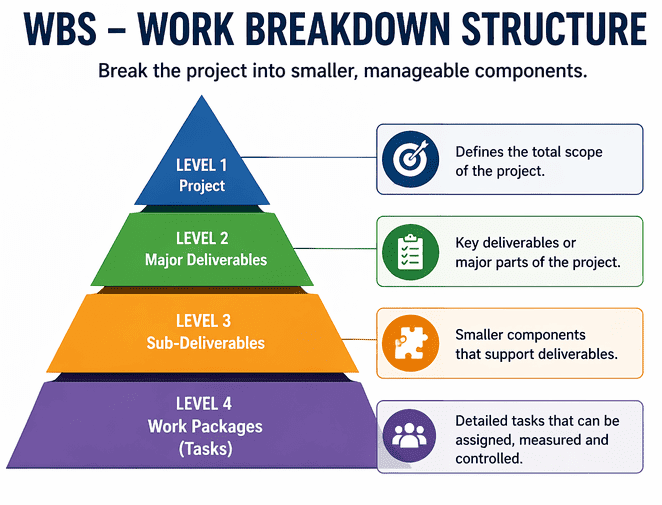
Step 5: Prepare Hierarchical Structure
Now you need to arrange all the elements in a proper structure. This structure can be in a tree diagram or outline format.
The structure will look something like this:
| Level | Description |
| Level 1 | Complete Project |
| Level 2 | Major Deliverables |
| Level 3 | Sub-Deliverables |
| Level 4 | Work Packages |
This hierarchy provides clarity and eliminates any confusion.
Step 6: Assigning the Coding System
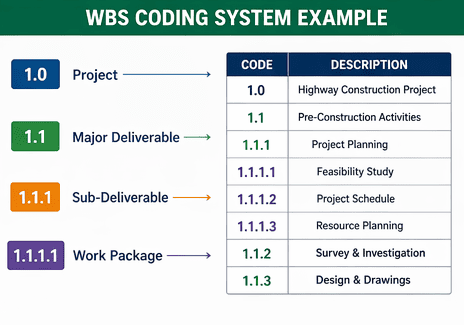
Each WBS element is assigned a unique code called a WBS code.
Example:
- 1.0 Highway Project
- 1.1 Earthwork
- 1.1.1 Excavation
- 1.1.2 Embankment
This coding system is very useful for documentation and tracking.
Step 7: Assign Responsibility
Now each work package needs to be assigned to a specific person or team.
You can also use the Responsibility Assignment Matrix (RAM) in this step.
| Work Package | Responsible Person |
| Excavation | Site Engineer |
| Compaction | Quality Engineer |
| Bituminous Work | Contractor Team |
This makes accountability clear and the project runs smoothly.
Step 8: Review aur Validation Karna
The final step involves reviewing and validating the WBS.
You need to check:
- Are all deliverables included?
- Are any tasks missing?
- Is the structure logical?
- Do all stakeholders agree?
If necessary, make corrections and approve the final WBS.
Example
| WBS Code | Activity | Description |
|---|---|---|
| 1.0 | Highway Project | Complete construction work |
| 1.1 | Earthwork | Soil related work |
| 1.1.1 | Excavation | Cutting of soil |
| 1.1.2 | Embankment | Filling and leveling |
| 1.2 | Pavement | Road layers construction |
| 1.2.1 | Sub-base | First layer |
| 1.2.2 | Base Course | Strength layer |
| 1.2.3 | Bituminous Layer | Final surface |
| 1.3 | Drainage | Water flow system |
| 1.4 | Structures | Bridges and culverts |
Common mistakes that should be avoided
Some common mistakes when creating a WBS affect the project:
- Not properly defining tasks
- Over-detailing or under-detailing
- Including work outside the scope
- Failing to assign responsibility
- Skipping stakeholder review
If you avoid these mistakes, your WBS will be quite effective.
To Get more about Highway details, Click on given link.
How to Study Typical Cross Section – Complete Guide
FDD test: what is it? complete process and calculation.
How to prepare the subgrade bed: complete process
Conclusion
A Work Breakdown Structure (WBS) is not merely a planning tool; it serves as the robust foundation for any project management system. Managing a project directly becomes extremely difficult when it is large in scale and involves numerous activities, teams, and resources. In such scenarios, the WBS functions by breaking the project down into smaller, manageable components. This significantly simplifies project planning, execution, and monitoring.
The primary benefit of a WBS is the clarity it brings to a project. It clearly defines the project scope, identifies every deliverable, and delineates the responsibilities of each team member. Projects often fail not due to a lack of resources, but because of poor planning and ambiguous responsibilities. A WBS addresses this issue by systematically organizing every aspect of the project.
By following the practical steps outlined in this guide to create a Work Breakdown Structure, you effectively develop a detailed roadmap for your project. Each task is clearly defined, every activity becomes measurable, and tracking progress becomes straightforward. This helps the project team understand their objectives and leads to improved productivity.
The importance of a WBS is even more pronounced in civil engineering and construction projects. Projects such as highway construction, bridge building, building construction, and infrastructure development involve a massive scale of work. These projects require multiple stakeholders—contractors, consultants, and suppliers—to work in unison. Failure to prepare a proper WBS at the outset can lead to delays, cost overruns, resource conflicts, and quality-related issues. However, a well-structured WBS significantly mitigates these risks and steers the project in the right direction.
In conclusion, the Work Breakdown Structure serves as the backbone of any successful project. Whether you are a civil engineer, project planner, site engineer, or project manager, creating and effectively implementing a WBS is a highly valuable skill. A properly developed WBS plays a crucial role in completing a project on time, within budget, and to the desired quality.
About the Author
My name is Susanta Kumar Mohapatra. I am a civil engineering professional with over 11 years of practical experience in the construction and infrastructure sectors. I hold a B.Tech degree in Civil Engineering and an M.E. degree in Construction Management.
Throughout my career, I have worked in various areas such as road construction, bridge projects, quality control, material testing, quantity surveying, project planning, and site management. I am passionate about sharing practical knowledge related to highway engineering, laboratory testing, and construction management with engineers, students, and construction professionals.
I am the founder of CivilGuruHub.com, where I share technical articles, field experiences, laboratory test procedures, guidelines based on IRC and IS codes, and practical construction knowledge related to civil engineering. My aim is to explain civil engineering concepts in simple language and provide useful, reliable information to industry professionals.
You can connect with me through CivilGuruHub.com and my YouTube channel, “The Civil Site,” where I regularly share civil engineering tutorials and practical site knowledge.
faq
What is Work Breakdown Structure (WBS)?
Work Breakdown Structure (WBS) is a project management tool that divides a project into small and manageable tasks, making planning and execution easier.
Why is WBS important in project management?
WBS provides a clear project structure, which defines scope, assigns responsibilities, and makes project tracking easy.
How detailed should a WBS be?
It should be detailed enough so that each task can be easily managed and tracked, but unnecessary over-detailing should be avoided.
What is a work package in WBS?
A work package is the smallest unit of work that can be assigned, monitored, and measured.
What is the difference between Work Breakdown Structure and Gantt Chart?
A Work Breakdown Structure divides a project into tasks, while a Gantt chart shows the schedule and timeline of those tasks.

Pingback: What is Time Management? 10 Proven Project Management Tips