
Table of Contents
Introduction
Flexible pavement constitutes a crucial component of highway construction. In India, the majority of roads use flexible pavement technology because its construction is comparatively economical, and its maintenance is relatively simple. Flexible pavement typically consists of multiple layers, including the subgrade, sub-base, base course, and bituminous surface layer. In this type of pavement, the applied load transfers gradually downward; for this reason, its structural behavior is characterized as “flexible.”
Flexible pavement constitutes a crucial component of highway construction. In India, the majority of roads use flexible pavement technology because its construction is comparatively economical, and its maintenance is relatively simple. Flexible pavement typically consists of multiple layers, including the subgrade, sub-base, base course, and bituminous surface layer. In this type of pavement, the applied load transfers gradually downward; for this reason, its structural behavior is characterized as “flexible.”
In the current scenario, flexible pavement failures have become increasingly common due to rising traffic volumes, overloaded vehicles, and inadequate maintenance. Frequently, even newly constructed roads begin to develop cracks within just a few years of completion. The primary causes for this are improper construction practices and drainage-related issues.
In this article, we will examine in detail the 10 major causes of flexible pavement failures and their practical solutions. For each type of failure, the underlying technical reasons, field identification methods, and repair techniques explain comprehensively to provide a practical understanding for civil engineering students, site engineers, highway contractors, and project managers.
What is flexible pavement failure?
Flexible pavement failure describes the inability of the pavement structure to properly perform its designed function. When the road surface cannot efficiently withstand traffic loads and develops cracks, rutting, potholes, settlements, or deformation, we term it pavement failure.
Failure does not occur solely within the surface layer; rather, weaknesses in the subgrade or base layer often lead to its development. We broadly categorize flexible pavement failures into two types:
| Failure Type | Description |
|---|---|
| Structural Failure | Occurs when the pavement loses its load-carrying capacity. |
| Functional Failure | Occurs when riding comfort and surface quality deteriorate. |
We generally consider structural failures severe and may necessitate reconstruction, whereas maintenance can typically rectify functional failures.
1. Fatigue Cracks (Alligator Cracking) in flexible pavement
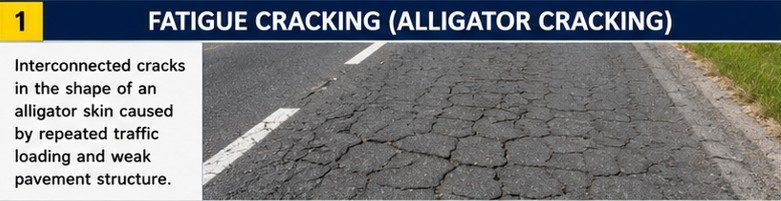
Fatigue cracking is considered the most common and dangerous form of failure in this type of pavements. This type of cracking pattern is also referred to as “alligator cracking” due to its resemblance to the skin of an alligator. These cracks develop in an interconnected polygonal pattern and are typically observed within the wheel path areas.
The primary cause of fatigue cracking is repeated traffic loading. When heavy vehicles continuously apply loads to the pavement surface, tensile stresses develop within the pavement layers. If the pavement thickness is inadequate or the base/subgrade is weak, cracks begin to initiate as a result of this repeated stress. Initially, these cracks appear as hairline fissures, but they gradually evolve into an interconnected network.
Poor drainage is also a major contributor to fatigue cracking. Water infiltration weakens the subgrade and diminishes the structural support provided to the pavement. Consequently, the pavement layers begin to flex, and the rate of cracking accelerates.
Practical Solutions
Proper pavement design is crucial for preventing fatigue cracking. It is essential to provide pavement thickness in accordance with IRC guidelines. The use of a high-quality bituminous mix and adequate compaction are also indispensable.
If cracks are in their initial stages, crack sealing can be performed. However, in cases of severe alligator cracking, the best solution is to remove the affected section and reconstruct it. Improvements in drainage and the control of overloaded vehicles are also vital for long-term prevention.
2. Rutting Failure in flexible pavement
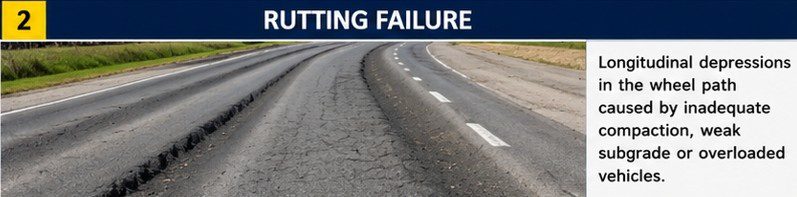
Rutting is a longitudinal depression that develops within the wheel path area of a roadway. This type of failure is generally caused by deformation of the asphalt layer or the underlying subgrade. Rutting renders the road surface uneven and increases the risk of water accumulation during the rainy season.
The primary causes of rutting in Flexible Pavement are inadequate compaction and a weak subgrade. If the bituminous mix is not properly compacted, the aggregate particles begin to shift under the stress of traffic loading. This shifting leads to the development of permanent deformation.
Overloaded trucks also contribute significantly to rutting. The problem of axle overloading is common in India; consequently, even newly constructed roads often develop ruts relatively quickly.
In regions with high temperatures, the use of soft-grade bitumen can also exacerbate rutting, as the asphalt mix tends to soften at elevated temperatures and begins to deform under the pressure of wheel loads.
Practical Solutions
For the prevention of rutting, proper mix design and compaction are the most critical factors. It is essential to adhere to Marshall Stability requirements. The use of dense-graded aggregates and an appropriate grade of bitumen is recommended.
If the rut depth is minor, a surface leveling course can be applied. In cases of severe rutting, milling and resurfacing of the pavement are required. For areas with a weak subgrade, stabilization techniques—such as lime stabilization or cement stabilization—provide effective solutions.
3. Pothole Formation in flexible pavement
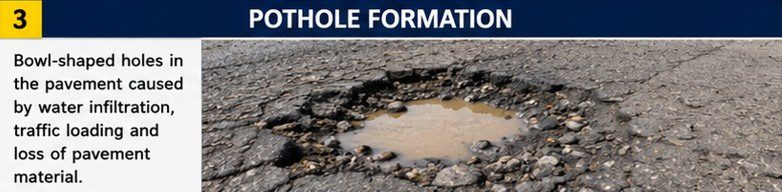
Potholes constitute the most visible and hazardous form of flexible pavement failure. These are bowl-shaped depressions that develop on the pavement surface and directly compromise vehicle safety.
Potholes typically develop as a result of a combination of fatigue cracking and water infiltration. When water penetrates the pavement layers through cracks, it weakens the subgrade. Under the stress of traffic loading, the pavement material begins to disintegrate, eventually resulting in the formation of a pothole.
Poor maintenance also contributes significantly to pothole formation. When crews do not repair minor cracks in a timely manner, water ingress increases, leading to more severe damage.
Practical Solutions
To repair potholes, workers must remove the damaged material, followed by proper patching. After they clean the surface and apply a tack coat, they fill hot-mix asphalt into the cavity and adequately compact it.
For a permanent solution, engineers must make improvements in drainage and preventive maintenance. They can significantly reduce the occurrence of potholes by sealing cracks and conducting periodic inspections.
To know The causes, damages and repairing Method of Potholes Read the article given below link
potholes on road:causes, damages and complete methods of repairing
Here is the difference between Flexible and Rigid Pavement details, Click below Link
What Are 9 Key Differences Between Flexible and Rigid Pavement? complete guide
How to prepare the subgrade bed:complete process
4. Bleeding Failure in flexible pavement
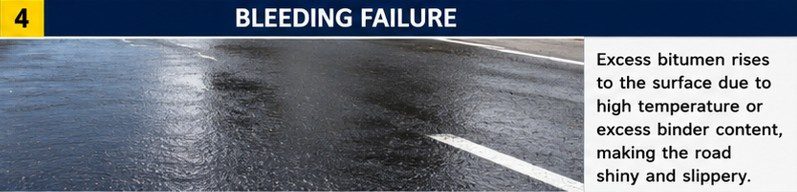
Bleeding is a surface defect characterized by the appearance of excess bitumen on the pavement surface. In this condition, the road surface appears shiny and sticky, particularly during hot weather. The excessive bitumen content primarily causes bleeding.
When the binder in the asphalt mix exceeds the optimum level, high temperatures cause the bitumen to migrate upward. Heavy traffic loading also accelerates this migration of bitumen. Low air voids and improper compaction also contribute to the acceleration of bleeding. This type of failure significantly reduces skid resistance and increases the risk of accidents.
Practical Solutions
To control bleeding, effective methods involve removing the excess bitumen and spreading fine aggregates over the surface. In severe cases, a surface treatment or an overlay may be required. Maintaining a proper mix design and ensuring an optimum binder content are essential for long-term prevention.
Requires IS Code for Bitumen Test IS 1201-1220 (penetration, softening point, ductility, flash point, etc.)
5. Corrugation Failure in flexible pavement
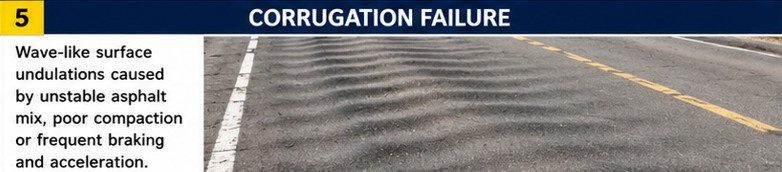
Corrugation refers to wave-like undulations that appear on the pavement surface. It typically develops at intersections, bus stops, and braking zones. The unstable asphalt mix primarily causes this failure.
When the bituminous mix contains an excessive amount of fine aggregates or lacks sufficient stability, traffic loads cause the material to shift, leading to the formation of corrugations. Poor compaction and a weak bond between the pavement layers also contribute to the formation of corrugations.
Practical Solutions
The most effective repair method involves removing the corrugated surface and replacing it with a stable asphalt mix. It is essential to ensure a high-stability mix design and proper compaction.
The modified bitumen in areas subject to heavy traffic loading also helps to improve pavement performance.
6. Edge Cracking in flexible pavement
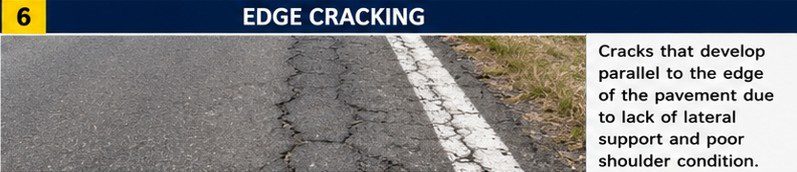
Edge cracks are cracks that develop parallel to the edges of the flexible pavement. They are typically observed along the outer edges of roads.
The primary cause of this is inadequate shoulder support. When the Flexible pavement edge lacks proper lateral support, the edge area begins to crack under the stress of traffic loads.
Poor drainage and vegetation growth also accelerate edge cracking. Water infiltration weakens the support provided to the pavement edge.
Practical Solutions
Shoulder strengthening is the most effective method for preventing edge cracking. The implementation of proper drainage systems and vegetation control are also crucial.
Minor cracks can be sealed, whereas cases of severe damage necessitate the reconstruction of the pavement edge.
7. Slippage Cracking in flexible pavement
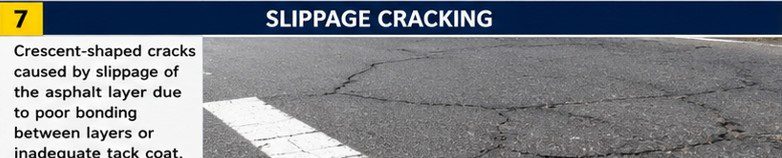
Slippage cracks are crescent-shaped cracks that develop due to the movement of the asphalt surface.
This type of failure occurs when there is a lack of proper bonding between the surface layer and the underlying layer. Under the braking forces exerted by traffic, the top layer begins to slide, resulting in the formation of cracks.
Improper application of the tack coat is the primary cause of this issue.
Practical Solutions
The affected surface should be removed and resurfaced using a proper tack coat. It is crucial to ensure the quality of the layer bonding.
8. Depression Failure in flexible pavement
Depressions are localized low-lying areas where the pavement has settled. During the rainy season, water tends to accumulate in these areas.
Poor compaction and subgrade settlement are the primary causes of this issue. Settlement within utility trenches is also a common reason for the formation of depressions.
Practical Solutions
The depressed area should be excavated and refilled with properly compacted material. Subgrade stabilization and drainage improvements provide long-term solutions.
To Get More details About Highway click on given Link
FDD test: what is it? complete process and calculation.
TCS: How to Study Typical Cross Section – Complete Guide
9. Raveling Failure in flexible pavement
Raveling is a surface defect in flexible pavements characterized by the gradual loosening and dislodging of aggregates from the pavement surface. Initially, this defect manifests as a minor loss of aggregates; however, over time, the surface becomes rough and uneven. In severe cases of raveling, the road surface begins to disintegrate completely, significantly increasing the risk of pothole formation.
Inadequate bitumen bonding primarily causes raveling. When the binder content in the asphalt mix is insufficient, or when the bitumen fails to properly coat the aggregates, traffic action causes the aggregate particles to begin to loosen.
Aging significantly contributes to raveling. Continuous exposure to sunlight, oxidation, and weathering causes the bitumen to become brittle and lose its binding properties. Under these conditions, aggregates begin to separate from the surface.
Poor-quality aggregates and dusty materials also accelerate raveling. If the aggregate surfaces are not clean, proper adhesion cannot be established. Furthermore, inadequate compaction increases air voids within the pavement structure, which facilitates moisture ingress and accelerates the development of raveling.

Practical Solutions
Raveling in its initial stages can be controlled through preventive maintenance. A common method involves applying a “fog seal” treatment, wherein a diluted bitumen emulsion is sprayed onto the surface to restore aggregate bonding. Slurry seals and micro-surfacing are also effective treatments for moderate cases of raveling.
In instances of severe raveling, the damaged surface is milled down, and a new asphalt overlay is applied. During the construction phase, maintaining an optimum bitumen content and achieving proper compaction are crucial for ensuring long-term prevention of raveling.
Utilizing high-quality aggregates and an appropriate binder grade significantly enhances the durability of the pavement. Additionally, conducting regular maintenance inspections helps in identifying raveling at its early stages.
10. Longitudinal and Transverse Cracking in flexible pavement
Longitudinal cracks develop parallel to the direction of traffic, whereas transverse cracks appear in a perpendicular direction.
Temperature variations, shrinkage, and reflective cracking are the primary causes of this phenomenon. Poor joint construction also contributes to increased cracking.

Practical Solutions
Crack sealing and overlays are common repair methods. The use of temperature-resistant bitumen and proper joint construction serve as effective preventive measures.
Important IRC / IS Codes for Flexible Pavement Failures
A few code Links are given below for reference, Its only for study purpose.
| Code | Full Name | Where To Use |
| IRC:37-2018 | Guidelines for the Design of Flexible Pavements | Fatigue cracking, rutting, pavement thickness, structural failure |
| IRC:82-2015 | Code of Practice for Maintenance of Bituminous Road Surfaces | Potholes, bleeding, raveling, crack sealing, preventive maintenance |
| IRC:81-1997 | Guidelines for Strengthening of Flexible Road Pavements Using Benkelman Beam Deflection Technique | Overlay, rehabilitation, strengthening |
| IRC:SP:72-2015 | Guidelines for the Design of Flexible Pavements for Low Volume Rural Roads | Low-volume roads failure explanation |
| IRC:111-2009 | Specifications for Dense Graded Bituminous Mixes and Bituminous Macadam | Rutting, bleeding, corrugation, mix stability |
| MoRTH Specifications (5th Revision) | Road and Bridge Works Specifications | Construction defects, compaction, material quality, tack coat, drainage |
| IS:73-2013 | Paving Bitumen — Specification | Bleeding, temperature cracking, binder selection |
| IS:2386 (Part 1 to 8) | Methods of Test for Aggregates for Concrete | Aggregate quality, raveling, stripping |
| IS:2720 Series | Methods of Test for Soils | Subgrade weakness, settlement, depression, rutting |
| IS:1201-1220 | Methods of Test for Bitumen | penetration, softening point, ductility, flash point, etc. |
Common Pavement Failures and Repair Methods Table
| Pavement Failure | Main Cause | Practical Solution |
|---|---|---|
| Fatigue Cracking | Repeated traffic loading | Reconstruction and overlay |
| Rutting | Weak subgrade | Resurfacing and stabilization |
| Potholes | Water infiltration | Patching and drainage |
| Bleeding | Excess bitumen | Aggregate spreading |
| Corrugation | Unstable mix | Surface replacement |
| Edge Cracking | Weak shoulder | Shoulder strengthening |
| Slippage Cracking | Poor bonding | Tack coat and resurfacing |
| Depression | Settlement | Excavation and recompaction |
| Raveling | Aging binder | Slurry seal |
| Transverse Cracking | Temperature variation | Crack sealing |
Preventive Maintenance Techniques
| Maintenance Activity | Benefit |
|---|---|
| Crack Sealing | Prevents water infiltration |
| Drainage Cleaning | Reduces subgrade weakening |
| Periodic Overlay | Increases pavement lifespan |
| Shoulder Maintenance | Improves edge support |
| Traffic Control | Reduces overloading damage |
Conclusion
Flexible pavement failures constitute a serious challenge in highway engineering. If these failures are not identified and repaired at an early stage, they can escalate into severe structural damage, leading to a substantial increase in maintenance costs. Defects such as fatigue cracking, rutting, potholes, bleeding, and raveling typically develop due to improper drainage, inadequate compaction, poor material quality, and overloaded traffic.
From a practical perspective, pavement performance depends significantly on construction quality and maintenance practices. Proper pavement thickness design, high-quality aggregates, optimum bitumen content, and an effective drainage system can significantly enhance the service life of flexible pavements.
In modern highway projects, adopting a preventive maintenance approach has become imperative. Measures such as crack sealing, periodic inspections, shoulder maintenance, and timely overlays help in controlling pavement failures at their incipient stages.
Civil engineers and contractors should focus not merely on construction but also on the long-term behavior of the pavement. Sustainable road infrastructure is achievable only when design, material selection, construction practices, and maintenance activities are executed scientifically. Understanding flexible pavement failures and implementing practical solutions to address them is of paramount importance for the success of any highway project.
About the Author
My name is Susanta Kumar Mohapatra. I am a civil engineering professional with over 11 years of practical experience in the construction and infrastructure sectors. I hold a B.Tech degree in Civil Engineering and an M.E. degree in Construction Management.
Throughout my career, I have worked in various areas such as road construction, bridge projects, quality control, material testing, quantity surveying, project planning, and site management. I am passionate about sharing practical knowledge related to highway engineering, laboratory testing, and construction management with engineers, students, and construction professionals.
I am the founder of CivilGuruHub.com, where I share technical articles, field experiences, laboratory test procedures, guidelines based on IRC and IS codes, and practical construction knowledge related to civil engineering. My aim is to explain civil engineering concepts in simple language and provide useful, reliable information to industry professionals.
You can connect with me through CivilGuruHub.com and my YouTube channel, “The Civil Site,” where I regularly share civil engineering tutorials and practical site knowledge.
FAQ
1. What constitutes flexible pavement failure?
Flexible pavement failure refers to a condition in which the road surface loses its strength, stability, and riding quality. Defects such as cracks, potholes, rutting, bleeding, and settlement develop, rendering the road unsafe and uncomfortable.
2. What is the most common type of failure in flexible pavements?
Fatigue cracking, also known as alligator cracking, is considered the most common type of failure in flexible pavements. It develops due to repeated traffic loading and a weak pavement structure, creating an interconnected pattern of cracks.
3. What causes pavement rutting?
Rutting is primarily caused by inadequate compaction, a weak subgrade, overloaded vehicles, and a poor asphalt mix design. It results in the development of permanent depressions within the wheel path areas.
4. How do potholes form in roads?
Potholes generally develop through a combination of water infiltration and traffic loading. When water seeps into the pavement layers through cracks, the base layer weakens; subsequently, under the pressure of traffic, the pavement material begins to disintegrate.
5. What is bleeding failure?
Bleeding is a pavement surface defect characterized by the migration of excess bitumen to the road surface. In this condition, the surface becomes shiny and slippery, resulting in a reduction in skid resistance.
6. How can flexible pavement failures be prevented?
Proper pavement design, the use of quality materials, adequate compaction, an effective drainage system, and regular maintenance are the most critical methods for preventing flexible pavement failures.