Table of Contents
Introduction
In today’s world, regardless of the project—whether it is a construction project, an IT project, or a small business initiative—uncertainty is ubiquitous. The process of controlling this very uncertainty is known as Risk Management. Simply put, risk management entails identifying potential problems that may arise during a project in advance, analyzing them, and formulating plans to either avoid them or mitigate their impact.
Many people initiate projects without fully understanding the associated risks, often resulting in delays, cost overruns, or, in some instances, complete project failure. Consequently, a successful project manager always takes risk management seriously. Risk management is not merely a process for solving problems; rather, it is a proactive approach that ensures we remain prepared in advance.
In this blog, we will explore risk management in a straightforward manner and cover, in detail, 10 crucial steps that can contribute to the success of any project.
Step 1: Risk Identification in risk management (Identifying Risks)
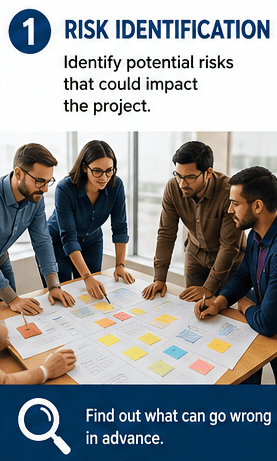
The first and most crucial step in risk management is identifying the risks. If you are unaware of the potential problems that might arise, how can you possibly plan a solution for them? Therefore, it is essential to carefully identify potential risks right from the initial phase of a project.
To identify risks, you must gain a deep understanding of every aspect of your project—including resources, manpower, budget, timeline, and technology, as well as external factors such as weather, market conditions, or government regulations. Each of these elements can represent a potential risk.
Brainstorming proves to be highly beneficial during this process. You should hold meetings with your team members to solicit their input regarding the potential problems they foresee arising in the future. Experienced team members can provide invaluable insights drawn from their past project experiences.
Another important technique involves creating a checklist. You can review records of risks encountered in previous projects and use that information to compile a checklist. This ensures that you do not overlook any common risks.
Risk identification is not a one-time event; it is an ongoing process. New risks may emerge during any phase of the project, so the risk assessment should be continuously updated. By identifying the majority of potential risks at the very outset, you significantly enhance the security and stability of your project.
Step 2: Risk Analysis in risk management (Analyzing Risk)
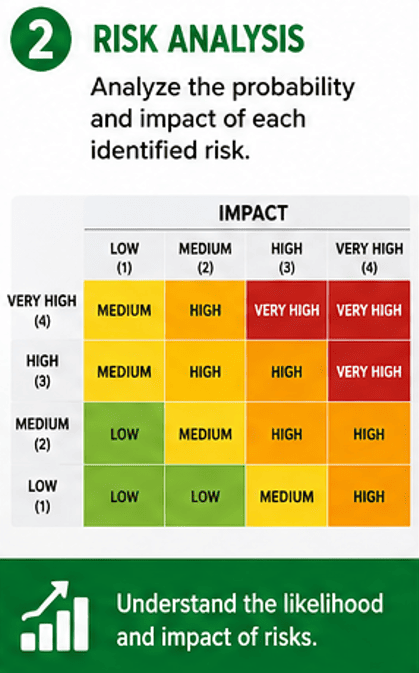
After identifying risks, the next step is to analyze them. Not all risks are created equal; some risks carry a significant impact, while others have only a minor effect. Therefore, it is essential to analyze each risk to understand precisely how dangerous it is.
Risk analysis primarily focuses on two key factors: probability and impact. Probability refers to the likelihood of a risk occurring, while impact refers to the extent of its effect on the project should it materialize.
After identifying risks, the next step is to analyze them. Not all risks are created equal; some risks carry a significant impact, while others have only a minor effect. Therefore, it is essential to analyze each risk to understand precisely how dangerous it is.
Risk analysis primarily focuses on two key factors: probability and impact. Probability refers to the likelihood of a risk occurring, while impact refers to the extent of its effect on the project should it materialize.
Step 3: Risk Prioritization (Risk management)
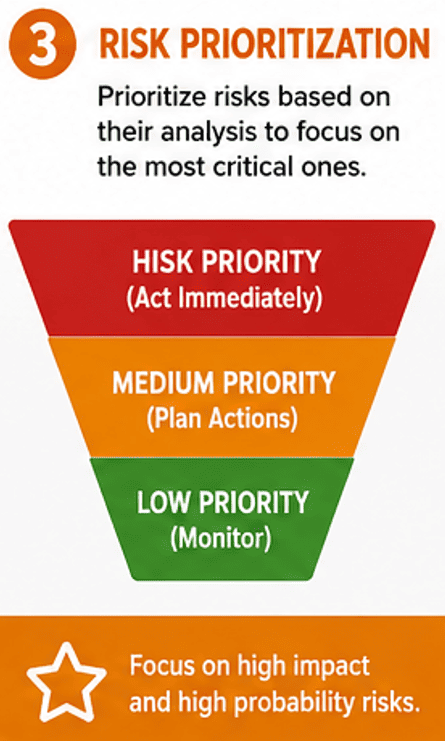
Risk analysis follows the step of prioritization. Here, you decide which risks to address first and which ones to handle later. This step is crucial because it is practically impossible to tackle every risk simultaneously.
When you determine priorities, you must consider both the impact and the probability of each risk. You should address risks characterized by high impact and high probability first. These are precisely the risks that have the potential to cause complete project failure.
The team assigns medium-level risks the next tier of priority, while you simply monitor low-level risks. This approach enables you to utilize your resources efficiently. If you proceed without establishing priorities, your focus will become scattered.
Adopting a structured approach—such as a risk ranking or scoring system—proves highly beneficial. You assign each risk a score and subsequently rank them based on that value. This process significantly simplifies decision-making.
Prioritization provides the team with a clear sense of direction. Everyone knows exactly which risks require immediate action. This clarity streamlines project execution and minimizes unnecessary confusion.
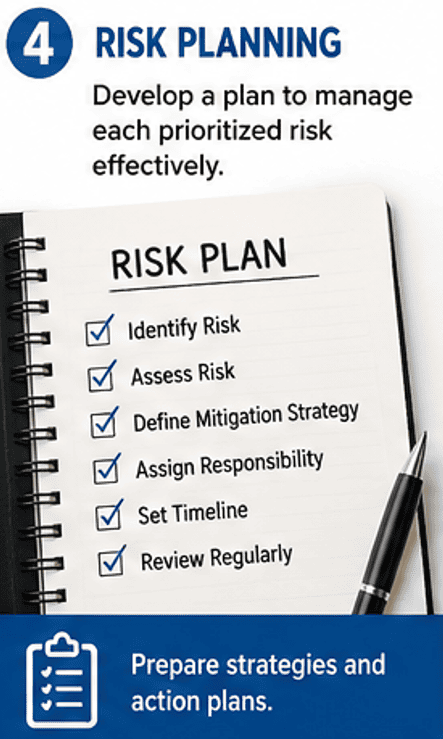
Step 4: Risk Planning in risk management (Planning for Risks)
Now that you have identified, analyzed, and prioritized the risks, the next step is to plan for them. Planning entails determining the specific actions you will take should a risk materialize.
In risk planning, you can formulate various strategies, such as risk avoidance, risk mitigation, risk transfer, and risk acceptance. Each strategy applies according to the specific situation at hand.
Risk avoidance involves completely eliminating a risk—for instance, by avoiding a process that is inherently risky. Risk mitigation, on the other hand, means reducing the impact of a risk; this is the most common approach.
Risk transfer involves shifting the risk to a third party—for example, through insurance or outsourcing. Risk acceptance means acknowledging the risk but keeping a contingency plan ready to address it.
Within the planning phase, developing contingency plans and backup plans is crucial. These plans serve to assist you in navigating unexpected situations. When the planning is robust, the overall confidence level of the project automatically increases.
Step 5: Risk Mitigation in risk management (Reducing Risk)
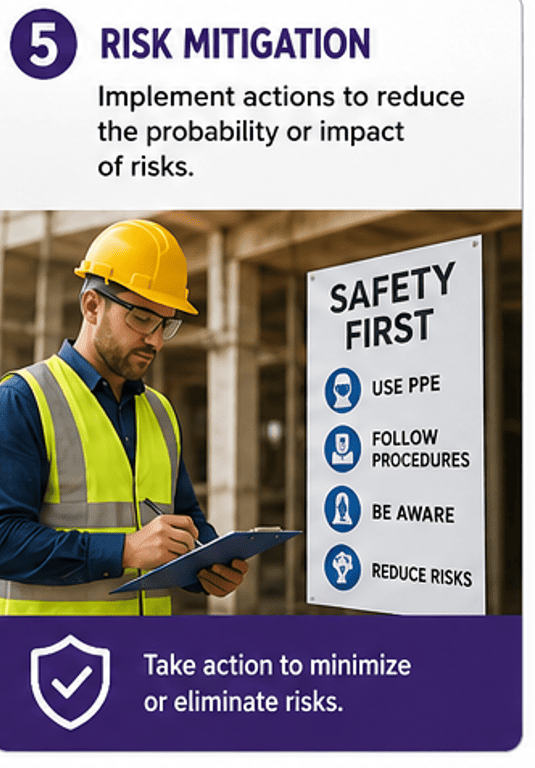
The focus of risk mitigation is to reduce the impact of a risk. Since it is not possible to eliminate every risk, minimizing its effects remains the best option.
To achieve mitigation, you take preventive actions. For instance, if there is a risk of delay, you can add extra buffer time. If there is a risk of quality issues, you can implement strict quality control measures.
Training and proper communication are also crucial components of risk mitigation. When a team is properly trained, mistakes occur less frequently, and the associated risk is automatically reduced.
The use of technology is also beneficial in mitigation efforts. Automation tools and software help minimize errors and enhance efficiency.
Mitigation is a continuous process. You must regularly assess whether your mitigation measures remain effective; if they are not, you need to update them.
To Get mor information regarding Project management click on below link.
5 Phases of Project Life Cycle (Easy Guide)
What is Gantt Chart? 7 Simple Ways to Use It
How to Create WBS: 8 Practical Steps Explained
Step 6: Risk Monitoring (Monitoring Risk)
Risk management does not limit itself solely to planning. Monitoring is a continuous process in which you track the status of existing risks and identify whether any new risks are emerging.
The team utilizes regular meetings and reports for monitoring purposes. During these sessions, the team discusses which risks are currently active and assesses their potential impact.
Key Performance Indicators (KPIs) also help in monitoring. These indicators provide insight into whether or not the project is progressing in the right direction.
If a risk suddenly escalates, you need to take immediate action. Through effective monitoring, you can make timely decisions and prevent a problem from spiraling out of control.
Step 7: Risk Communication in risk management (Team me Communication)
Risk communication is a crucial component of Risk management, yet it frequently gets overlooked. In reality, teams can only manage risks effectively when the right information reaches the right people at the right time. If team members remain unaware of which risks exist, what their potential impact is, or how to address them, then the entire planning process becomes futile.
Effective communication entails more than just sharing information; it also involves ensuring that the information is clear, simple, and easily understood. A project manager must ensure that every stakeholder—whether a client, an engineer, or a site supervisor—fully understands the relevant risks. This ensures that everyone remains mentally prepared and can make quick, sound decisions in the event of an emergency.
Various tools can facilitate communication, such as meetings, progress reports, emails, and dashboards. However, the most critical element is regular communication. Simply identifying a risk once and then forgetting about it will not be effective. Project managers must provide periodic updates, as risks tend to evolve alongside the progress of the project.
Furthermore, transparency is absolutely vital in communication. Teams should never conceal risks, regardless of how serious they may be. When the team understands the truth, they become better equipped to plan effectively. Robust communication enhances teamwork, minimizes confusion, and ensures the smooth execution of the project.
Step 8: Risk Documentation in risk management (Maintaining Records)
Risk documentation entails maintaining a proper record of every identified risk. It is a systematic process in which each identified risk is recorded, described, and assessed in terms of its probability and potential impact; furthermore, the mitigation plan devised to address it is also documented. This process is commonly referred to as a “risk register” for better risk management
The primary benefit of documentation is that it serves as a valuable reference for the future. When you initiate new projects, you can consult past records to easily identify which risks recur and how they were previously managed. This strengthens your planning process and helps prevent the repetition of past mistakes which can help to improve risk management.
Moreover, documentation enhances accountability. When a specific individual takes responsibility for each risk, that individual makes the monitoring and control of that risk significantly easier. Team members gain clarity regarding which specific risks they need to address and what their respective responsibilities entail.
Regularly updating documentation is just as crucial as creating it in the first place. If you merely create a record once and fail to update it subsequently, it becomes outdated and loses its utility. Therefore, you should review and revise documentation during every phase of the project.
Step 9: Contingency Planning in risk management (Backup Plan Banana)
Contingency planning in risk management process is a strategy that businesses employ when a risk actually materializes. In other words, when your primary plan fails or an unexpected situation arises, your backup plan comes into play. It acts as a powerful tool for safeguarding a project against complete failure.
Every project entails certain risks that cannot be entirely avoided. In such instances, you must develop a contingency plan that is absolutely essential. It requires you to pre-determine the specific actions you will take should a particular problem arise—for instance, identifying your alternate supplier in case of a delay in material delivery or determining how you will manage the situation if there is a shortage of manpower.
Contingency planning also incorporates additional budget and time buffers. These buffers help you handle unexpected situations. Without a backup plan, even a minor issue could inflict significant damage upon the project.
Another benefit of this approach is that it boosts team confidence. When team members understand they have a backup plan in place, they remain composed under pressure and are better equipped to make sound decisions. Therefore, you can prove that overlooking contingency planning can be a grave error.
Step 10: Review and Improvement
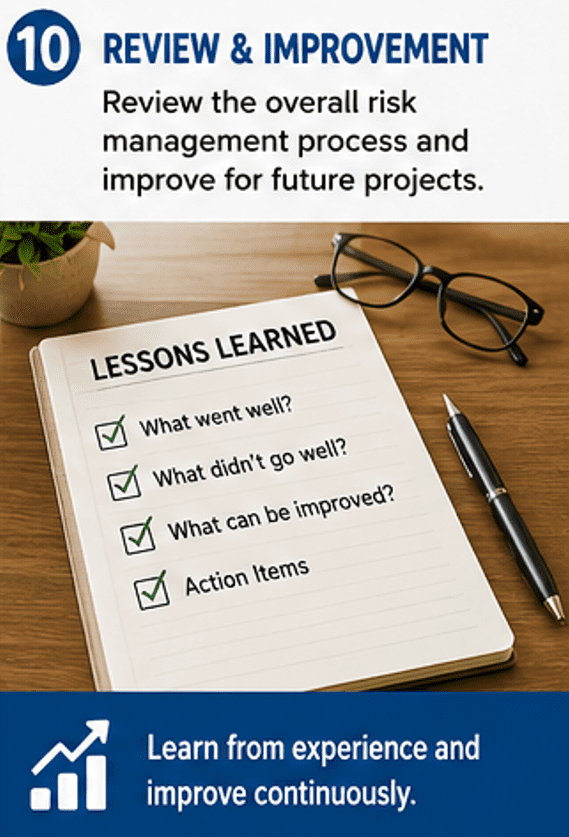
The final step of risk management is review and continuous improvement. This step is crucial because it allows you to assess the effectiveness of your strategies and identify areas for future enhancement.
Upon the completion of a project, you should analyze which risks actually materialized, what their impact was, and how they were handled. This process is also referred to as “lessons learned.” It provides you with real-world experience that proves invaluable for future projects.
During the review phase, you also evaluate which mitigation plans proved successful and which ones failed. If a particular strategy proves ineffective, it is essential to refine it. Conversely, strategies that demonstrate effectiveness can be leveraged in future projects as well.
Continuous improvement implies that you refine your processes with every successive project. It is an ongoing cycle involving learning, implementation, and subsequent review. This approach is indispensable for achieving long-term success.
Conclusion
Risk management serves as the backbone of any project. It is not merely a process, but rather a mindset that keeps you prepared for every situation. When you systematically identify, analyze, and manage risks, your project becomes more controlled and predictable.
In this blog, we have discussed 10 key steps that make risk management effective. Each step holds its own significance, and all are interconnected. By properly following these steps, you can address major project issues proactively.
Most importantly, risk management is a continuous process. It applies not just at the inception of a project, but throughout every single phase. You can ensure the success of your project through regular monitoring, communication, and continuous improvement.
In today’s competitive landscape, only those projects executed with smart planning and effective risk control emerge as successful. Therefore, if you aspire to become a successful project manager, do not overlook risk management. It empowers you with better decision-making capabilities, greater confidence, and long-term success.
About the Author
My name is Susanta Kumar Mohapatra. I am a civil engineering professional with over 11 years of practical experience in the construction and infrastructure sectors. I hold a B.Tech degree in Civil Engineering and an M.E. degree in Construction Management.
Throughout my career, I have worked in various areas such as road construction, bridge projects, quality control, material testing, quantity surveying, project planning, and site management. I am passionate about sharing practical knowledge related to highway engineering, laboratory testing, and construction management with engineers, students, and construction professionals.
I am the founder of CivilGuruHub.com, where I share technical articles, field experiences, laboratory test procedures, guidelines based on IRC and IS codes, and practical construction knowledge related to civil engineering. My aim is to explain civil engineering concepts in simple language and provide useful, reliable information to industry professionals.
You can connect with me through CivilGuruHub.com and my YouTube channel, “The Civil Site,” where I regularly share civil engineering tutorials and practical site knowledge.
FAQS
Q.1. What is Risk Management?
Risk Management is a process in which potential problems that may arise during a project are identified in advance, analyzed, and plans are formulated to mitigate their impact.
Q.2. Why is Risk Management essential in a project?
Risk Management helps protect a project from delays, budget overruns, quality issues, and outright failure. It ensures that the team remains prepared in advance.
Q.3. What is Risk Identification?
Risk Identification involves recognizing—before a project begins—all potential risks that could impact the project’s timeline, cost, resources, or quality.
Q.4. How is Risk Analysis conducted?
Risk Analysis involves assessing the probability and potential impact of each risk to determine its severity and significance.
Q.5. What does Risk Prioritization mean?
Risk Prioritization involves ranking risks based on their severity so that the most critical or dangerous risks can be addressed first.
Q.6. What is Risk Mitigation?
Risk Mitigation is a process involving the implementation of preventive actions to reduce the impact of a risk, rather than attempting to eliminate the risk entirely.
Q.7. What is a Risk Register?
A Risk Register is a document that serves as a record of all identified risks, detailing information such as the risk’s name, potential impact, probability, the person responsible for it, and the mitigation plan.
Q.8. What is a Contingency Plan?
A Contingency Plan is a backup strategy designed to be implemented in the event that the primary plan fails or an unexpected problem arises.
Q.9. Is Risk Management necessary only for large-scale projects?
No, Risk Management is essential for all types of projects—including small projects, business initiatives, IT projects, and construction projects—because every project inherently involves a degree of uncertainty.
Q.10. How does a successful Project Manager control risks?
A successful Project Manager identifies risks, analyzes them, sets priorities, develops mitigation plans, and monitors them regularly throughout the entire project.

FT88no1? Definitely one of the better platforms I’ve tried. Offers a good range of options, and I haven’t had any issues. Big ups! You can visit it here ft88no1
The interface here is very user friendly and the rewards are actually decent. I’m really enjoying my time on idp200m