

Table of Contents
Introduction
In the field of road construction, if any single laboratory test is accorded the utmost importance, it is the CBR (California Bearing Ratio) test. Before designing any flexible pavement, the primary question an engineer faces is whether the soil upon which the road is to be built can safely support the anticipated traffic load. The CBR test provides a scientific answer to this question.
Now a days, assessing the strength of subgrade soil is considered essential in the design of national highways, state highways, district roads, village roads, industrial roads, and even airport pavements. If a road is constructed without testing on soil with low bearing capacity, issues such as cracks, settlement, rutting, and potholes will soon develop in the pavement. Consequently, not only does the initial construction cost rise, but maintenance expenses also increase manifold. The CBR test is performed in the laboratory to prevent such problems.
The standard procedure for conducting the laboratory CBR test is outlined in IS 2720 (Part 16). Published by the Bureau of Indian Standards (BIS), this standard details the complete methodology, covering specimen preparation, soaking periods, surcharge loads, penetration rates, observation recording, and the calculation of the CBR value. The objective of this standard extends beyond merely conducting the test; it aims to maintain a uniform testing system across the country, ensuring that results from different laboratories are comparable.
In civil engineering projects, soil investigation is conducted based on scientific data rather than assumptions, and the CBR test is a crucial component of this investigation. When a geotechnical engineer prepares the laboratory report, the pavement engineer uses it to determine the required thickness of the road crust. A high CBR value allows for a comparatively thinner pavement design, whereas a low CBR value may necessitate measures such as an additional granular sub-base, sub-base improvement, or soil stabilization.
It is also important to understand that the CBR test does not directly measure the soil’s shear strength or bearing capacity. Instead, the test involves pressing a standard plunger into the soil specimen at a controlled speed and recording the load required to achieve specific penetration depths. Subsequently, this load is compared to the reference load of standard crushed stone. The percentage derived from this comparison is known as the California Bearing Ratio, or CBR.
Mathematically, CBR is expressed using the formula given below.
| Parameter | Formula |
| CBR (%) | (Measured Load / Standard Load) × 100 |
Here, the measured load is obtained from the laboratory specimen, whereas the standard load is predefined.
Standard Penetration Load
| Penetration | Standard Load |
| 2.5 mm | 1370 kg (13.24 kN) |
| 5.0 mm | 2055 kg (19.96 kN) |
In practical engineering, the CBR value corresponding to 2.5 mm penetration is generally adopted. However, if the CBR value at 5 mm penetration is significantly higher and there is technical justification, an engineer may consider the 5 mm value. This decision is based on laboratory observations and the recommendations of IS 2720 Part 16.
Now a days, relying solely on the CBR value is not sufficient for road design; factors such as moisture conditions, field compaction, traffic loading, drainage conditions, and climate are also evaluated. Nevertheless, the CBR test remains the most commonly accepted parameter for subgrade evaluation.
Apart from road construction, the CBR test is also used in projects involving railway embankments, industrial yards, warehouse flooring, container terminals, parking areas, and airport pavements. While loading conditions vary across projects, CBR remains a trusted laboratory parameter for evaluating soil strength.
IS Codes related to the CBR Test
It is important to note that IS 2720 Part 16 outlines only the procedure for conducting the test, whereas the recommendations of IRC:37 are generally followed for designing pavement thickness. Therefore, both laboratory engineers and pavement designers should be familiar with these respective standards.
Only put the CBR percentage in a laboratory report is not considered professional practice. The report should also include soil description, moisture content, dry density, compaction method, surcharge weight, soaking period, penetration readings, load readings, a graph, and a final interpretation. A report gains engineering value only when it is comprehensive.
In this article, we will understand the CBR Test in step-by-step detail, in accordance with IS 2720 Part 16. We will explain the purpose of each piece of apparatus, the scientific rationale behind specimen preparation, the procedures for soaked and unsoaked testing, calculation methods, observation tables, graph plotting, result interpretation. Additionally, we will discuss common laboratory errors and their solutions so that students, site engineers, laboratory technicians, and competitive exam aspirants can gain complete practical knowledge from a single article.
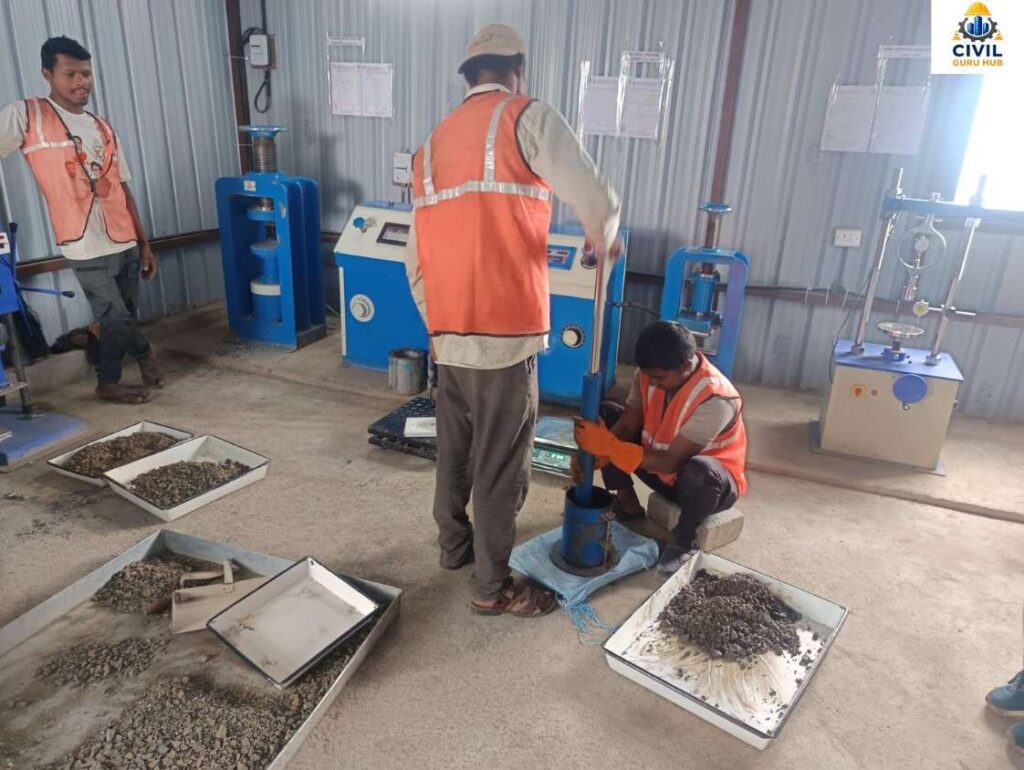
Importance of the CBR Test
Various laboratory tests are performed in road engineering, such as Atterberg Limits, the Proctor Compaction Test, Grain Size Analysis, and the Plate Load Test. However, the CBR (California Bearing Ratio) test is considered the most practical and widely accepted strength test for pavement design.
A key feature of this test is that its results can be directly utilized in designing pavement thickness.
If a soil has a very low CBR value, it implies that the soil cannot efficiently support heavy traffic loads. In such a scenario, the engineer must either improve the soil or increase the pavement thickness.
Conversely, if the soil has a good CBR value, the pavement can be designed to be comparatively thinner, leading to a significant reduction in the project’s total cost.
Let us consider a practical example to understand the importance of the CBR test.
Suppose a highway is to be constructed at two different locations.
At the first location, the soaked CBR value of the soil is 3%.
At the second location, the soaked CBR value is 10%.
Despite the traffic volume being the same at both locations, the pavement thickness will differ. Where the CBR value is 3%, the pavement must be thicker because the soil is weak. Where the CBR value is 10%, a comparatively thinner pavement may suffice.
Thus, the CBR test directly influences both the economy and the durability of the project.
The CBR test is employed in various projects, including government road projects, industrial roads, village roads, airport service roads, and internal campus roads.
In addition to laboratory testing, a field CBR test can also be conducted to determine the in-situ strength of the natural subgrade.
For these reasons, the CBR test is regarded not merely as a laboratory procedure but as a vital decision making tool in pavement engineering.
Overview of IS 2720 Part 16
The Bureau of Indian Standards (BIS) has published a series of standards under the designation IS 2720 for soil testing in India. Each part defines a specific laboratory test for soil.
IS 2720 Part 16 is specifically formulated for the Laboratory Determination of the California Bearing Ratio (CBR Test).
The objective of this standard is to ensure that every laboratory follows a uniform procedure, thereby making test results reliable and comparable.
IS 2720 Part 16 primarily covers the following aspects:
| Subject | Description |
| Test Purpose | Determining the bearing resistance of soil |
| Sample Type | Compacted soil sample |
| Loading Rate | 1.25 mm/minute |
| Standard Penetration | 2.5 mm and 5.0 mm |
| Soaking Duration | 4 days (96 hours) |
| Plunger Diameter | 50 mm |
| Mould Size | Approx. 150 mm diameter |
This standard outlines not only the testing procedure but also details sample preparation, surcharge weight, soaking arrangements, expansion measurement, and the final reporting format.
Failure to accurately follow the IS standard in the laboratory can lead to significant variations in the CBR value. Therefore, strict compliance with the procedure is maintained in NABL-accredited laboratories and government testing facilities.
A professional laboratory report also mentions test conditions, such as:
- Soaked or Unsoaked Test
- Dry Density
- Optimum Moisture Content
- Penetration Load
- CBR Value
- Expansion Percentage
All these parameters are crucial for future pavement design.
Applications of the CBR Test
The use of the CBR test is not limited to highway projects alone; it plays a role in almost every infrastructure development project today.
The CBR test is the most common laboratory test for subgrade evaluation in National Highway, State Highway, and Expressway projects.
Pavement thickness is also determined based on CBR values in rural road development schemes.
Industrial areas experience continuous movement of heavy trucks; therefore, evaluating the strength of the subgrade soil and designing a suitable pavement section is crucial in these locations.
Airport service roads and container yards are also subjected to heavy wheel loads, where the CBR test helps determine the need for soil improvement.
The CBR test is also practically significant for railway approach roads, warehouse access roads, and logistics parks.
It is also performed during pavement rehabilitation projects to assess the strength of the existing subgrade.
Furthermore, numerous design manuals and pavement guidelines utilize the CBR value as an input parameter. In India, the subgrade CBR value plays a vital role in flexible pavement design as per the IRC:37 code.
For these reasons, the CBR test is considered a fundamental topic for civil engineering students; questions related to it appear frequently in both laboratory practical and competitive examinations.
To read more articles on Laboratory Test, check the following guides:
The Ultimate Concrete Nominal mix: 8 Proven Grades with Calculations
How to Conduct GSA Test? Proven IS 2720-4 Procedure
What are Sand Silt Content Test? 7 Easy Steps & Limits
Apparatus Required for the CBR Test
In accordance with IS 2720 Part 16, specific standard apparatus are used in the laboratory. Each piece of equipment has a specific function, and its dimensions adhere to established standards.
| Apparatus | Purpose |
| CBR Loading Machine | Applying penetration load |
| CBR Mould | Preparing the soil sample |
| Spacer Disc | Maintaining the initial sample height |
| Collar | Facilitating compaction during sample preparation |
| Filter Paper | Improving water distribution |
| Perforated Base Plate | Allowing water entry during soaking |
| Surcharge Weights | Simulating pavement load |
| Dial Gauge | Measuring swelling |
| Penetration Plunger | Soil penetration |
| Loading Frame | Controlled loading |
The calibration of each piece of apparatus must be accurate; otherwise, the obtained CBR value may be erroneous.
Machine accuracy is crucial in laboratory testing because both load and penetration directly affect the final result.
Soil Sample Preparation
According to IS 2720 Part 16, sample preparation is the most crucial stage of the CBR test.
If sample preparation is flawed, the final result will also be inaccurate.
First, a representative soil sample is collected. If large particles are present, the soil is processed to meet the required size specifications.
Next, the natural moisture content of the soil is determined.
If the laboratory test is to be conducted at the optimum moisture content, the required amount of water is added to the soil.
After adding water, the sample is thoroughly mixed to ensure uniform moisture distribution.
Following mixing, the soil is sealed and allowed to rest for a period to ensure complete moisture absorption.
This process is vital because uneven moisture distribution hinders proper compaction and can significantly compromise the accuracy of the CBR test.
Importance of Moisture Content and OMC
Every soil has an optimum moisture content (OMC) at which maximum dry density is achieved.
Soil compacted at this moisture content generally develops maximum strength.
Therefore, in laboratory CBR tests, the soil is typically compacted at or near its OMC.
If the moisture content is too low, proper compaction cannot be achieved.
If the moisture content is too high, the dry density decreases.
In either scenario, the CBR value will not accurately reflect actual field conditions.
For this reason, moisture control is considered a critical aspect of laboratory testing.
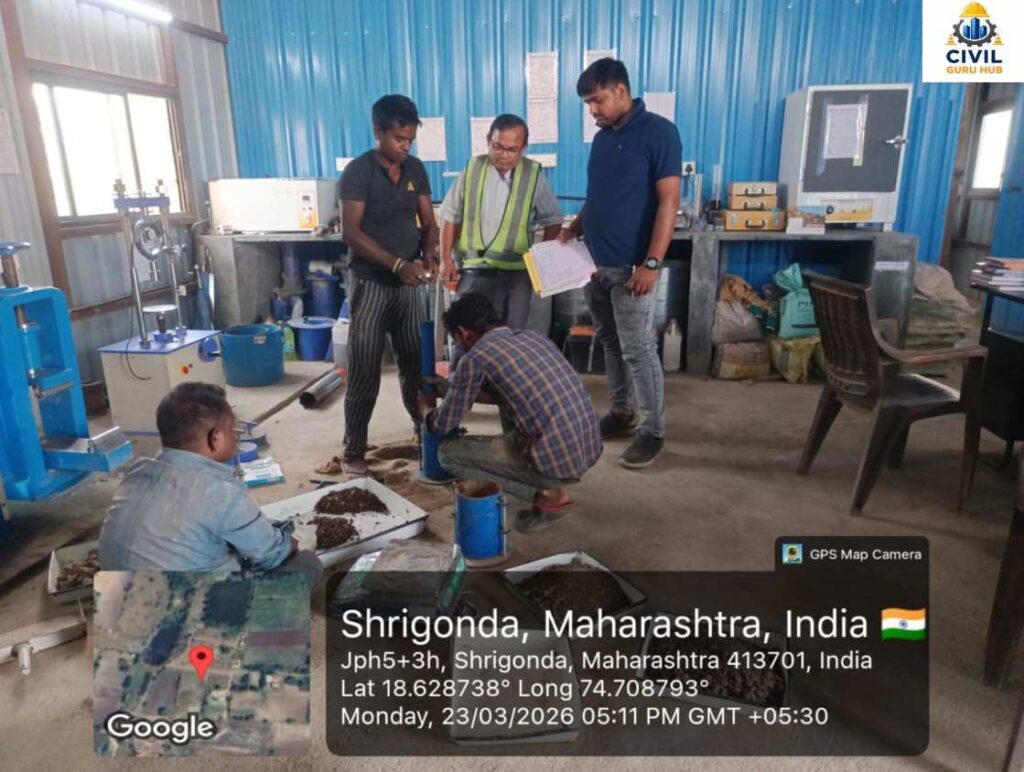
Basic Concept of Soaked and Unsoaked CBR Tests
In actual field conditions, a road does not always remain dry. Factors such as the monsoon, groundwater, and drainage can cause the subgrade to absorb water. For this reason, the CBR test is evaluated under two conditions.
In the Unsoaked CBR test, the sample is used directly for the penetration test after compaction, without being immersed in water. This represents the strength under dry conditions.
In the Soaked CBR test, the compacted sample is immersed in water along with surcharge weights—for approximately four days (96 hours). Swelling is observed during the soaking period, after which the penetration test is performed. This condition represents the rainy season and saturated field conditions.
For highway pavement design, the Soaked CBR value is generally considered more conservative and reliable, as the road must deliver satisfactory performance even under the most unfavorable moisture conditions.
Detailed Laboratory Procedure for the CBR Test (IS 2720 Part 16)
The accuracy of the CBR test in the laboratory depends entirely on strictly following the procedure. If even a single step is not performed according to the standards, the final CBR value will not accurately represent the actual soil strength. For this reason, the BIS has provided clear guidelines for every stage of the process.
After preparing the sample to the required moisture content, a spacer disc and filter paper are placed inside the CBR mould. Subsequently, the collar is attached to the top of the mould to prevent the soil from spilling out during compaction.
The prepared soil is filled into the mould in uniform layers. Each layer is compacted according to the selected compaction energy. For instance, if the test requires 10 blows, then 10 blows are applied to each layer; similarly, 35 blows are applied for medium compaction and 65 blows for heavy compaction.
Once compaction is complete, the collar is removed, and excess soil is trimmed using a straight edge to ensure the top surface of the mould is perfectly level. At this stage, the sample surface must be smooth to ensure proper contact with the surcharge weights and the penetration plunger.
Next, the mould is carefully inverted to remove the spacer disc, and the perforated base plate is attached. Filter paper is placed on both sides to allow water to enter the sample uniformly during the soaking process.
It is crucial to carry out this entire process meticulously, as the subsequent CBR test relies entirely on this prepared sample.
Engineering Significance of the Soaking Procedure
Roads in the field are not used solely during the dry season. In a country like India, subgrade soil absorbs water during the monsoon. An increase in moisture content can reduce the soil’s bearing capacity. The soaked CBR test is performed to simulate these actual field conditions in the laboratory.
After the sample is prepared, surcharge weights are placed on top of the mould. The purpose of these weights is to simulate the self-weight of the pavement layers. Subsequently, the mould is immersed in a water tank.
In accordance with IS 2720 Part 16, the sample is kept submerged in water for approximately 96 hours (4 days). During this period, the soil absorbs water and if it is expansive in nature will swell.
Swelling is monitored using a dial gauge during the soaking process. Each laboratory records the swelling readings on its observation sheet. If excessive swelling occurs, soil stabilization or replacement may be recommended during the pavement design phase.
Once the soaking period concludes, the mould is removed from the water, and excess water is allowed to drain away. The penetration test is performed only after this stage.
The soaked CBR value is generally lower than the unsoaked value because the presence of water reduces friction between the soil particles.
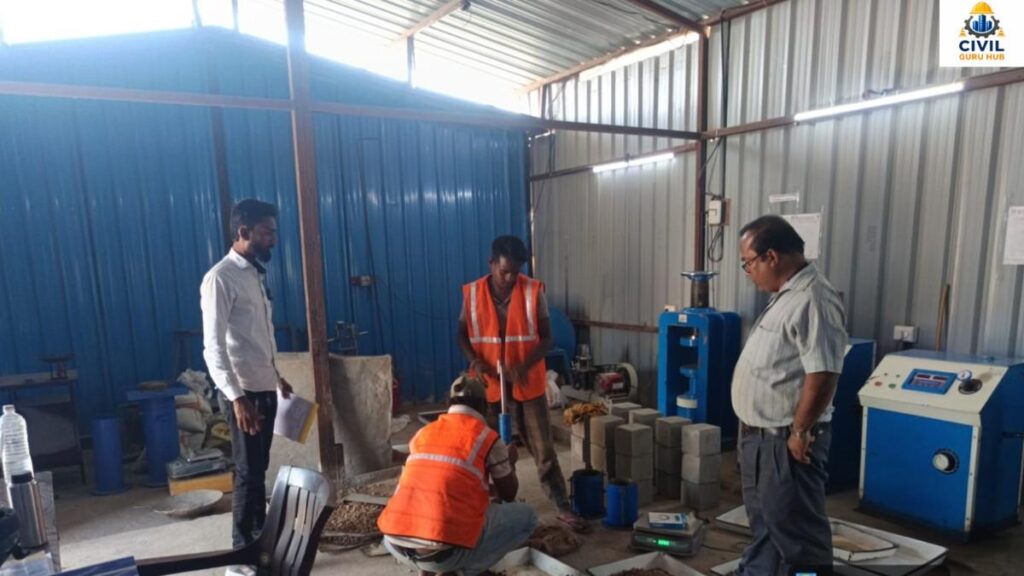
Complete Procedure for the Penetration Test
This is the most critical stage of the CBR test.
The soaked or unsoaked sample is placed centrally beneath the loading machine. Surcharge weights are placed on top of the sample to simulate field loading conditions.
Next, the standard penetration plunger is brought into contact with the soil surface. There should be only initial contact between the plunger and the soil; no additional pressure is applied.
The machine is started, and the plunger is pressed downwards at a constant penetration rate of 1.25 mm per minute.
During penetration, the corresponding load is recorded at each specified penetration depth.
While readings can generally be taken at 0.5 mm intervals, the most important penetration values for calculating the results are:
- 2.5 mm
- 5.0 mm
- 7.5 mm
- 10.0 mm
- 12.5 mm
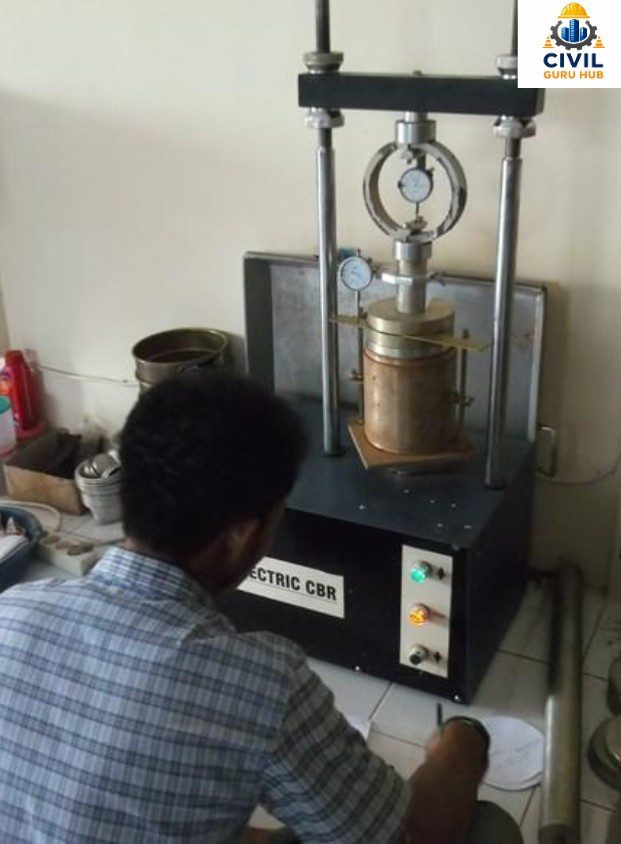
The loading applied by the machine must be smooth and continuous. Fluctuations in the loading speed can lead to inaccurate load values.
An observation sheet is prepared after the entire penetration process is complete.
Typical Observation Table
During the CBR test in the laboratory, observations are generally recorded in the following format:
| Penetration (mm) | Measured Load (kg) |
| 0.5 | 18 |
| 1.0 | 36 |
| 1.5 | 55 |
| 2.0 | 88 |
| 2.5 | 142 |
| 3.0 | 175 |
| 4.0 | 220 |
| 5.0 | 280 |
| 7.5 | 390 |
| 10.0 | 510 |
| 12.5 | 620 |
These values are for illustrative purposes only. Actual readings will vary depending on the soil type and compaction.
Standard Load Values
In IS practice, standard crushed stone loads are used for comparison when calculating the CBR value.
| Penetration | Standard Load |
| 2.5 mm | 1370 kg |
| 5.0 mm | 2055 kg |
CBR Test Calculation
The formula for calculating CBR is very simple.
CBR (%) = (Measured Load / Standard Load) × 100
Let’s look at a practical example.
Assume that in the laboratory:
Load at 2.5 mm penetration = 96 kg
Then,
CBR = (96 ÷ 1370) × 100
CBR = 7.01%
Now, assume the load at 5 mm penetration is:
Measured Load = 170 kg
CBR = (170 ÷ 2055) × 100
CBR = 8.27%
Now, both values are compared.
2.5 mm CBR = 7.01%
5 mm CBR = 8.27%
Normally, the value corresponding to 2.5 mm penetration is adopted for design purposes.
However, if the 5 mm value is consistently higher and the observation curve supports it, then the 5 mm value may be adopted based on engineering judgment.
That is why plotting the load-penetration curve is also important.
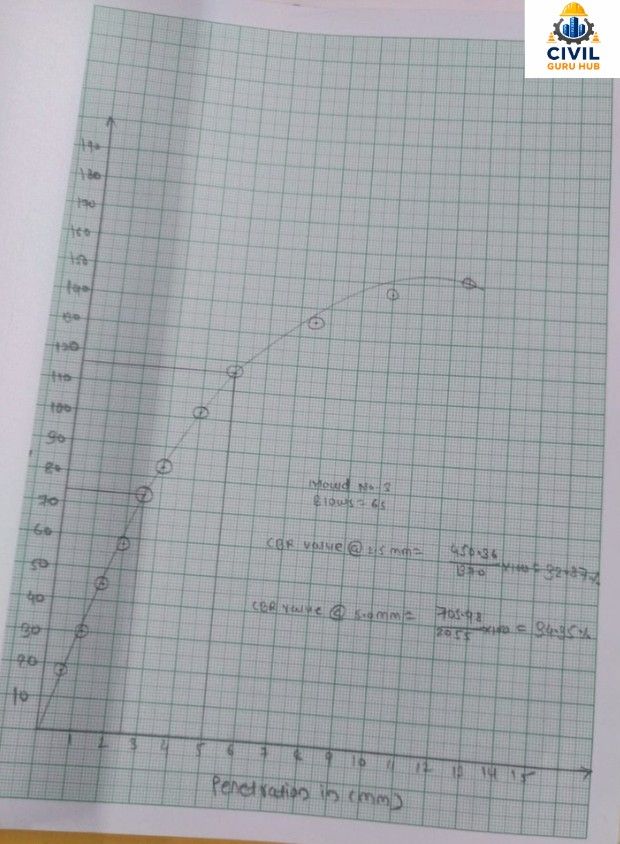
Importance of the Load-Penetration Curve
After every CBR test, a load-versus-penetration graph is prepared in the laboratory.
The horizontal axis of the graph represents penetration.
The vertical axis represents the applied load.
Using this graph, the engineer checks:
- Whether an initial seating correction is required.
- The curve is smooth.
- Whether the readings are abnormal.
- Whether the penetration was performed correctly.
If the initial part of the curve is irregular, a correction can be applied, and calculations are performed based on the corrected origin.
This practice is commonly followed in experienced laboratories.
Factors Affecting CBR Value
The CBR test value varies for different types of soil due to various engineering reasons.
The primary factor is moisture content; excessive moisture in the soil reduces bearing capacity, potentially leading to a lower CBR value.
Compaction energy is another factor. Since soil samples subjected to 10 blows and 65 blows differ in density, their CBR values will also differ.
Particle size distribution plays a significant role as well; well-graded soil generally develops better strength.
Plasticity is also a major factor; soaked CBR values can be significantly reduced in highly plastic clay soils.
Organic matter also negatively affects the CBR value.
For these reasons, representative sampling and proper laboratory practices are essential.
Laboratory Precautions
Certain practical precautions should always be followed when performing the CBR test:
The moisture content must be mixed uniformly.
Compaction should be uniform across every layer.
The machine must be calibrated.
The penetration speed must be maintained exactly at 1.25 mm/minute.
The sample must not be disturbed.
The filter paper should be clean.
Surcharge weights must be properly centered.
The dial gauge reading should start from zero.
Every reading must be noted immediately on the observation sheet.
Ignoring these precautions can compromise both the repeatability and reliability of the CBR test.
Interpretation of CBR Test Results
After the CBR test is completed in the laboratory, the most important step is to correctly interpret the results. Simply looking at the percentage value is not enough; an experienced engineer considers factors such as soil type, moisture conditions, compaction levels, and project requirements alongside the CBR value.
Generally, if the CBR value is very low, it indicates a weak subgrade, meaning that constructing the pavement directly over it would be neither economical nor safe. In such cases, measures like soil stabilization, soil replacement, or increasing the thickness of the granular layer may be required.
If the CBR value falls within a medium range, a standard pavement design can be adopted; conversely, soil with a high CBR value offers superior bearing capacity, allowing for the design of a comparatively thinner pavement section.
It is crucial to remember that CBR test results are evaluated in conjunction with the project’s design life and anticipated traffic loading. Pavement thickness is not determined based on the CBR value alone.
Approximate CBR Value and Soil Strength
The table below serves as a general engineering reference. Actual design should always be carried out in accordance with project specifications and IRC guidelines.
| CBR Value (%) | Soil Strength | General Observation |
| Less than 2 | Very Poor | Soil Improvement Required |
| 2 – 5 | Poor | Thick pavement may be needed |
| 5 – 10 | Fair | Suitable for low to medium traffic |
| 10 – 20 | Good | Suitable for most road projects |
| More than 20 | Excellent | Strong subgrade condition |
These values are intended for preliminary understanding only.
Role of the CBR Test in IRC Standards
IRC:37 is considered the most important guideline for highway pavement design in India. In this guideline, the subgrade strength obtained from the CBR test is used as the primary input when calculating the thickness of flexible pavement.
The process generally unfolds as follows:
First, a representative soil sample is collected.
Next, the CBR test is conducted in the laboratory.
The soaked CBR value obtained is considered the design CBR.
Traffic is estimated in terms of Million Standard Axles (MSA).
Subsequently, the required pavement thickness is determined using IRC design charts or the latest pavement design method.
For this reason, if the CBR test is performed incorrectly, the entire pavement design can become inaccurate.
To read more articles on Laboratory Test, check the following guides:
Relationship Between CBR Test and Pavement Thickness
From an engineering perspective, the CBR test and pavement thickness are directly related.
If the soil is weak, a thicker pavement is required to distribute the wheel load.
However, if the soil is strong, it naturally resists stress better, and a comparatively thinner pavement may suffice.
Due to this principle, pavement thickness generally decreases as the CBR value increases.
Therefore, accuracy in laboratory testing is of great importance.
Common Mistakes in the CBR Test
Certain common mistakes are observed during testing in many laboratories, which affect the final results.
The most common mistake is failing to properly maintain the moisture content. If the sample is not mixed uniformly, the compaction will not be uniform either.
Another error involves the incorrect application of rammer blows; consistency is crucial when applying 10, 35, or 65 blows.
Often, surcharge weights are either not used or incorrect weights are employed.
If the penetration speed deviates from 1.25 mm per minute—being either faster or slower—the observed load can change.
Ignoring machine calibration is also a serious issue.
Shortening the soaking period or disturbing the sample can also lead to inaccurate CBR test results.
Professional laboratories maintain proper records of all these factors.
Conclusion
In road engineering, the CBR test is not merely a laboratory procedure; it serves as the crucial foundation for pavement design. If the subgrade strength is not accurately determined, the long-term performance of the pavement will be unsatisfactory, regardless of the quality of the materials used.
IS 2720 Part 16 provides a standardized procedure that ensures CBR test results obtained across different laboratories remain reliable and comparable. Every stage from sample preparation to compaction, soaking, penetration, calculation, and reporting, holds significant engineering importance.
In road construction projects, engineers must always adhere to practices such as representative sampling, proper moisture control, correct compaction energy, the use of calibrated equipment, and standard testing procedures. Doing so not only yields an accurate CBR value but also results in a pavement design that is both economical and durable.
Whether you are a civil engineering student, site engineer, laboratory technician, or a professional associated with highway projects, a thorough understanding of the CBR test in accordance with IS 2720 Part 16 will strengthen your technical knowledge and assist you in making informed practical decisions in the field.
Click below to get The Excel sheet format for CBR Test
About the Author
My name is Susanta Kumar Mohapatra. I am a civil engineering professional with over 11 years of practical experience in the construction and infrastructure sectors. I hold a B.Tech in Civil Engineering and an M.E. degree in Construction Management. Throughout my professional career, I have worked in key areas such as road construction, bridge projects, quality control, material testing, quantity estimation, project planning, and site management.
My passion for civil engineering inspired me to launch CivilGuruHub.com. The aim of this website is to provide practical and easy-to-understand knowledge to students, site engineers, quantity surveyors, contractors, and civil engineering professionals. Here, I share information related to construction technology, highway engineering, laboratory tests, project management, estimation, tendering, and the latest industry practices.
In addition to the website, I run “The Civil Site” YouTube channel, where I share practical videos, site-related knowledge, and technical explanations regarding civil engineering. My goal is to explain engineering concepts in a simple and practical manner so that every learner can grasp them easily.
I also publish regular quizzes and educational videos on the “Daily IQ Hub” YouTube channel, helping viewers enhance their general knowledge and improve their preparation for competitive exams.
I believe that practical knowledge and continuous learning are the hallmarks of a successful engineer. With this objective in mind, I strive to deliver high-quality, reliable, and industry-focused content through CivilGuruHub and my YouTube channels.
Thank you for your support and trust. I hope CivilGuruHub proves to be a valuable companion in your professional growth and learning journey.
Recommended Equipment for CBR Test
If you are a civil engineering student, laboratory technician, site engineer, or soil testing professional, the CBR test equipment listed below could prove very useful to you. These tools are used for CBR tests, compaction tests, moisture content tests, and other geotechnical laboratory tests. Using high-quality, appropriate equipment enhances the accuracy, efficiency, and reliability of the testing process.
The recommended products listed below have been selected based on their quality, practical usability, and engineering applications. You can choose the equipment that best suits your laboratory requirements, project type, and budget.
| Equipment Category | Recommended Product |
|---|---|
| CBR Testing Equipment | CBR Testing Machine |
| Sample Preparation Tools | CBR Mould with Collar & Base Plate |
| Alternative CBR Mould (IS-spec) | CBR Mould with Perforated Base Plate & Collar |
| Accurate Measurement Devices | Digital Analytical Weighing Balance (Lab use) |
Affiliate Disclaimer
This website may contain ‘affiliate links.’ This means that if you click on a link and purchase a product, we may earn a small commission at no extra cost to you. This commission helps sustain CivilGuruHub and enables us to create free, high-quality resources, guides, and educational content for civil engineers, site builders, quantity surveyors, contractors, and business professionals.
We only recommend products and tools that we believe are useful for professionals in the field. However, you should always conduct your own research before making a purchasing decision.
CivilGuruHub participates in several affiliate programs, including the Amazon Associates Program. This program allows websites to earn advertising fees by advertising and linking to products.
We truly appreciate your support through these affiliate links; it helps us continue sharing civil engineering knowledge. Thank you for supporting Civilguruhub.
Frequently Asked Questions (FAQs)
Q 1. What is the full form of the CBR Test?
Answer: The full form of CBR is California Bearing Ratio. It is a penetration test used to determine the bearing capacity and relative strength of soil.
Q 2. According to which Indian Standard is the CBR Test conducted?
Answer: In the laboratory, the CBR Test is performed in accordance with IS 2720 (Part 16). This standard provides complete guidelines regarding the apparatus, procedure, calculations, and reporting.
Q 3. What is the main purpose of the CBR Test?
Answer: The primary objective of this test is to determine the strength of the subgrade soil so that the required thickness of the flexible pavement can be scientifically designed.
Q 4. What is the difference between Soaked and Unsoaked CBR Tests?
Answer: The unsoaked test represents dry conditions, whereas in the soaked test, the sample is immersed in water for approximately 96 hours (4 days), representing rainy season or saturated field conditions.
Q 5. What penetration speed is maintained during the CBR Test?
Answer: According to IS 2720 Part 16, the penetration speed is maintained at 1.25 mm per minute.
Q 6. What do the 10, 35, and 65 blows signify in the CBR Test?
Answer: They represent compaction energy. Different numbers of blows result in different densities, and the CBR value changes accordingly.
Q 7. How is the CBR value used in pavement design?
Answer: The total thickness of the flexible pavement is determined by using the CBR value in conjunction with the guidelines provided in IRC:37.
Q 8. If the CBR value at 5 mm penetration is higher than that at 2.5 mm, which value is used?
Answer: In general practice, the value at 2.5 mm is adopted. However, if the value at 5 mm is consistently higher and the load-penetration curve supports it, the 5 mm value may be adopted based on engineering judgment.
Q 9. Is the CBR Test conducted only in the laboratory?
Answer: No. The CBR test can be performed both in the laboratory and in the field using specialized equipment; however, the laboratory CBR test is more commonly used for design purposes.
Q 10. Can a road be designed without the CBR test?
Answer: While empirical methods may sometimes be used for small, temporary projects, it is not considered appropriate to create a reliable pavement design for professional highway and pavement projects without the CBR test or an equivalent geotechnical investigation. Therefore, the CBR test is an essential investigation for most projects.