
Table of Contents
Introduction
In the construction industry, successfully completing any project requires not only planning, budgeting, and execution but also a transparent procurement process. The construction tender is a crucial component of this procurement process. Whether the project involves a small residential building, a highway, a bridge, or a large-scale infrastructure development, the construction tender process is utilized across the board.
Many aspiring engineers, contractors, and civil engineering students often wonder what a construction tender is, why it is necessary, and how the tendering process works. In essence, a construction tender is a formal process through which a project owner or client invites contractors to submit bids for a project. This process aims to select the most suitable contractor capable of completing the project in accordance with quality standards and within the stipulated budget.
Today, government projects, public infrastructure initiatives, and private developments alike employ the construction tender system. The tendering process enhances transparency, minimizes the risk of corruption, and ensures competitive project costs.
In this comprehensive guide to construction tenders, we will explore in detail the definition, importance, process, types, documentation, evaluation methods, IRC and CPWD guidelines, practical examples, and common pitfalls associated with tenders.
What is a Construction Tender?
Simply put, a construction tender is an official invitation that solicits quotations or bids from interested contractors for a construction project.
When an organization, government department, or private company needs to have construction work done, they initiate a structured tender process rather than directly appointing a contractor. This process involves providing project details, specifications, drawings, quantity estimates, and contract conditions. Interested contractors study these details and submit their bids.
The primary objective of a construction tender is to provide the best value to the project owner. The lowest price is not the sole basis for selection; factors such as the contractor’s experience, technical capability, manpower availability, machinery resources, and financial strength are also part of the evaluation.
For example, if the National Highway Authority intends to construct a new highway, it will first issue a tender notice containing the project details. Subsequently, interested contractors will submit their technical and financial bids. Following an evaluation, the most suitable contractor will receive the work award.
Thus, the construction tender process offers a systematic and professional approach to project execution.
Why Are Construction Tenders Necessary?
In the construction industry, project values can range from several lakhs to thousands of crores of rupees. Such substantial investments require a fair and transparent selection process. This is why construction tenders are considered the backbone of procurement.
The tender process allows the project owner to compare the capabilities of various contractors available in the market. When multiple contractors submit bids for the same project, competition increases, leading to the optimization of project costs.
Without construction tenders, transparency regarding project costs could diminish, and the likelihood of favoritism or corruption could rise. The tendering process mitigates these risks and enhances accountability.
Another significant benefit is quality assurance. During the tender evaluation, the contractor’s past projects, technical expertise, and resource availability are assessed. This assists the project owner in selecting a high-quality contractor.
The construction tender process is considered essential for large infrastructure projects such as bridges, highways, airports, and metro systems. It ensures the proper utilization of public funds and maintains trust among project stakeholders.
Today, the construction tender process has become even more transparent and efficient through digital procurement systems and e-tendering platforms.

How Does the Construction Tender Process Work?
The construction tender process is completed in several stages. Each stage holds its own significance, and an error at any stage can lead to project delays or financial loss.
1. Tender Planning
Tender planning is the initial and most critical stage of the construction procurement process. During this phase, the project owner or client plans the entire project to prevent any confusion or delays during the execution stage. First, the project’s scope of work is defined, outlining the specific activities the contractor must complete.
Subsequently, architectural and structural drawings, technical specifications, quality standards, material requirements, and applicable codes are prepared. Simultaneously, the estimated project cost, available budget, project duration, and payment terms are determined.
Contractual conditions such as penalty clauses, the defect liability period, insurance requirements, and performance security are also finalized at this stage. Proper planning ensures contractors have a clear understanding of the project, facilitating accurate cost estimation.
Incomplete planning or errors in project documents can lead to an increase in variation orders, claims, and disputes later on; therefore, experienced engineers, consultants, and project managers collaborate to verify every technical and commercial detail.
A robust planning foundation plays a vital role in ensuring the project is completed on schedule, within budget, and to the required quality standards.
2. Tender Notice Publication
Once project planning is complete, the client or project owner publishes an official notice to inform interested contractors about the bidding opportunity. Government organizations typically issue notices via e-procurement portals, departmental websites, and occasionally through newspapers.
Private companies also initiate the procurement process through their official websites, procurement portals, or by sending invitations to selected contractors.
The published notice includes key details such as the project name, work location, estimated cost, completion period, eligibility criteria, document download dates, bid submission deadlines, and the bid opening date. Additionally, information regarding required experience, annual turnover, registration certificates, and the earnest money deposit is specified.
A clear notification enables interested companies to evaluate the project and decide whether to participate. Incomplete or incorrect information in the notice can lead to confusion, requests for clarification, and the need for deadline extensions later on; therefore, all details are carefully verified prior to publication.
A transparent notification process fosters fair competition and provides the client with the opportunity to receive quality proposals from competent contractors.
3. Bid Document Distribution
Following the publication of the notice, interested contractors download or purchase the project documents. These documents provide comprehensive technical and commercial information, enabling contractors to prepare their cost estimates and execution strategies.
The documentation includes detailed drawings, technical specifications, the Bill of Quantities (BOQ), contract conditions, quality standards, the project schedule, material specifications, payment terms, and eligibility requirements.
Contractors study these documents thoroughly to gain a precise understanding of the project scope. Should there be any ambiguity or missing information, a contractor may submit a request for clarification. Accurate documentation assists contractors in formulating realistic pricing and minimizes the likelihood of future disputes.
At this stage, contractors may also conduct site visits to assess actual ground conditions, accessibility, utilities, and potential construction challenges. The primary objective of document distribution is to ensure that all participants receive identical information, thereby maintaining fair and transparent competition.
Well-prepared project documents streamline the procurement process and significantly reduce the risk of unnecessary misunderstandings during the execution phase.
4. Pre-Bid Meeting
The pre-bid meeting is a crucial stage of communication where the client, consultants, and interested contractors come together to discuss technical and commercial aspects of the project. The objective of this meeting is to clarify doubts for all participants and ensure a uniform understanding of project requirements.
Contractors may raise questions regarding drawings, BOQ items, technical specifications, construction methodology, site conditions, quality standards, payment procedures, and contract clauses. The client or consultant provides official clarifications for each query so that all bidders can prepare their proposals based on a shared understanding.
If modifications to specifications or drawings are required, an official corrigendum or addendum is issued. This process significantly reduces the likelihood of future disputes and differences in interpretation. Contractors often discuss observations from site visits as well, enabling the early identification of hidden risks and construction challenges.
Effective pre-bid discussions foster realistic pricing, better planning, and the submission of high-quality proposals. Proper documentation of this stage is also vital, as decisions made during the meeting can serve as a reference during the actual execution of the contract.
5. Bid Submission
Bid submission is a critical stage in the procurement process where contractors submit their technical and financial proposals before the specified deadline. The technical proposal includes the company profile, previous project experience, manpower details, equipment availability, work methodology, quality assurance plan, safety procedures, and the project schedule.
The financial proposal provides the quoted rates—based on the bill of quantities—and the total project cost. Nowadays, most organizations utilize electronic procurement systems that facilitate online submission using digital signatures; however, some projects may still require the submission of physical documents.
Contractors must ensure that all required certificates, declarations, bank guarantees, and supporting documents are properly attached. Proposals may be rejected due to late submission or incomplete documentation. Following submission, the bids are officially opened on the specified date, and a record is maintained.
Accurate documentation and timely submission reflect the contractor’s professionalism. At this stage, the prepared proposal is officially presented to the client and considered for the subsequent evaluation process.
6. Bid Evaluation
During the bid evaluation stage, the client or evaluation committee conducts a detailed technical and financial assessment of all received proposals. Initially, technical documents are verified to confirm eligibility criteria, required experience, financial capability, equipment resources, and manpower qualifications.
The financial proposals of companies that meet the technical requirements are then evaluated. The committee compares quoted prices, BOQ rates, arithmetic accuracy, project schedules, construction methodologies, and overall value for money. For many projects, quality-based selection or a combined technical and financial scoring system is applied. If a proposal contains abnormal pricing or missing information, a request for clarification may be issued.
The evaluation process must be fully documented and transparent to ensure fairness. The objective of this stage is not merely to select the lowest price, but to identify a contractor who is technically competent and financially reliable. Proper assessment helps mitigate future project risks, delays, and quality issues. Careful evaluation lays a strong foundation for successful project execution.
7. Work Award
Once the evaluation is complete, the project is officially awarded to the selected contractor. The client issues a Letter of Acceptance (LOA), Letter of Intent (LOI), or Work Order to the successful bidder, specifying the contract value, project duration, commencement date, and key contractual conditions.
At this stage, the contractor is required to submit performance security, insurance documents, bank guarantees, and other mandatory compliance documents. Before commencing the project, the client and contractor finalize the mobilization plan, resource deployment, site handover, and the initial work schedule.
If the selected contractor fails to meet the stipulated conditions, the client may consider the next eligible bidder in accordance with procurement rules. Following the award, the project officially enters the execution phase, and preparations for construction activities begin.
Proper documentation and timely communication are crucial at this stage, as they formally establish the responsibilities of both parties. A clear award process ensures smooth project implementation and minimizes the likelihood of future contractual disputes.
8. Contract Signing
Contract signing is the final stage of the construction procurement process, where the client and the selected contractor execute a legally binding agreement. This agreement clearly defines the project scope, contract value, payment schedule, completion period, quality standards, technical specifications, variation procedures, dispute resolution mechanisms, insurance requirements, warranty obligations, and termination clauses.
After carefully reviewing the agreement, both parties execute it through their authorized representatives. Once the contract becomes effective, the contractor begins preparations for site mobilization, manpower deployment, equipment arrangement, and material procurement. Simultaneously, the client initiates the site handover, appoints the supervision team, and activates the project monitoring system.
A well-drafted agreement clearly establishes the rights and responsibilities of both parties and provides legal protection during execution. Should any issues or disputes arise during the project, decisions are made in accordance with the clauses of this agreement. Robust contract documentation forms the foundation of successful project management and plays a crucial role in achieving quality, time, and cost objectives.

To read more articles on Project Management, check the following guides:
The Secret to Reduce Construction Costs Without Affecting Quality
What Are the Duties of a Project Manager in Construction? Complete Guide 2026
What Makes Green Roads Sustainable? 10 Secrets
Types
1. Open Tender
It is considered the most transparent and fair procurement process. In this process, any eligible contractor who meets the project’s qualification and technical requirements can submit a bid. Its primary objective is to foster maximum competition, enabling the client to secure a competitive price alongside quality.
Government departments and public sector organizations predominantly use this method because it offers equal opportunities to all contractors. Comprehensive project details—such as the scope of work, technical specifications, estimated cost, eligibility criteria, submission deadline, and contract conditions are published via public notices or online portals. Contractors study these documents to prepare their financial and technical proposals.
The bid opening is also conducted according to a predefined process to ensure transparency. While the high level of competition in this method offers better value to the client, the evaluation process can be time-consuming. This process is widely adopted for large-scale infrastructure, highway, building, and public utility projects, as it reinforces fairness, accountability, and public trust.
2. Limited Tender
Limited Tender is a procurement process in which not all contractors are invited to bid, but only a select few, experienced contractors. This method is used when the project size is small, the completion time is short, or the client already has a list of reliable contractors.
The biggest advantage of this process is that bid evaluation is completed quickly and there are no unnecessary delays in project execution. Because there are only a limited number of participants, the client has an easier time comparing proposals.
Contractors invited in this process are selected based on their technical capability, financial strength, and previous project experience. This also makes quality maintenance relatively easy. However, due to less competition, price optimization is sometimes not as effective as in open competition.
This approach is widely used in private organizations and medium-scale projects. When speed, reliability, and experienced contractors are required, this method is considered a practical and efficient option.
3. Selective Tender
In a selective tender, the client first conducts a detailed pre-qualification process of contractors and only invites those contractors who satisfy predefined standards to submit bids. During pre-qualification, the company’s financial stability, technical expertise, manpower, machinery, safety record, quality management system, and previous project performance are assessed.
The purpose of this process is to ensure that only competent and capable contractors compete for the project. This automatically eliminates low-quality or inexperienced contractors, providing the client with better execution quality. This method is most commonly used for complex infrastructure, industrial plants, bridges, and specialized engineering projects.
The evaluation process is also relatively simple because all participants are pre-qualified. This process reduces the risk of project failure and makes contract management more effective. Although the initial pre-qualification process is time and resource consuming, it is considered a very reliable and professional procurement approach for long-term project success.
4. Negotiated Tender
A negotiated tender is a procurement method where the client directly discusses the project’s terms and conditions with a specific contractor. This process does not involve open competition; instead, an agreement is reached through mutual negotiation regarding cost, quality, timelines, payment terms, and technical requirements.
This approach is particularly useful when the project is highly specialized, requires confidentiality, or involves an existing successful working relationship between the client and the contractor. It is also employed for emergency situations, extension works, maintenance contracts, and unique engineering projects.
The primary advantage of this method is that decision-making and project commencement can occur very rapidly. Additionally, the client and contractor can develop flexible solutions tailored to the project’s practical requirements. However, the absence of competition means there is no benefit of price comparison.
Therefore, maintaining transparency, proper documentation, and fair pricing during the negotiation process is crucial. With proper planning, this method can deliver both quality and speed.
5. Single Tender
In a Single Tender, the entire project is offered directly to a single contractor, and no bids are invited from other contractors. This method is typically used for emergency works, disaster management, defense projects, proprietary technology, or highly specialized construction activities.
This approach is adopted when a project needs to start immediately and any delay could result in financial loss or compromise public safety. In this process, the client relies on the contractor’s technical capability, previous experience, and available resources. Since there is no competition, project mobilization occurs very quickly, and administrative formalities are minimized.
However, transparency and price competitiveness may be comparatively lower with this method. Consequently, its use requires strong justification and a proper approval process. Both government and private sectors employ this method only under special circumstances. This procurement approach proves highly beneficial when speed, expertise, and uninterrupted execution are of paramount importance.
6. E-Tender
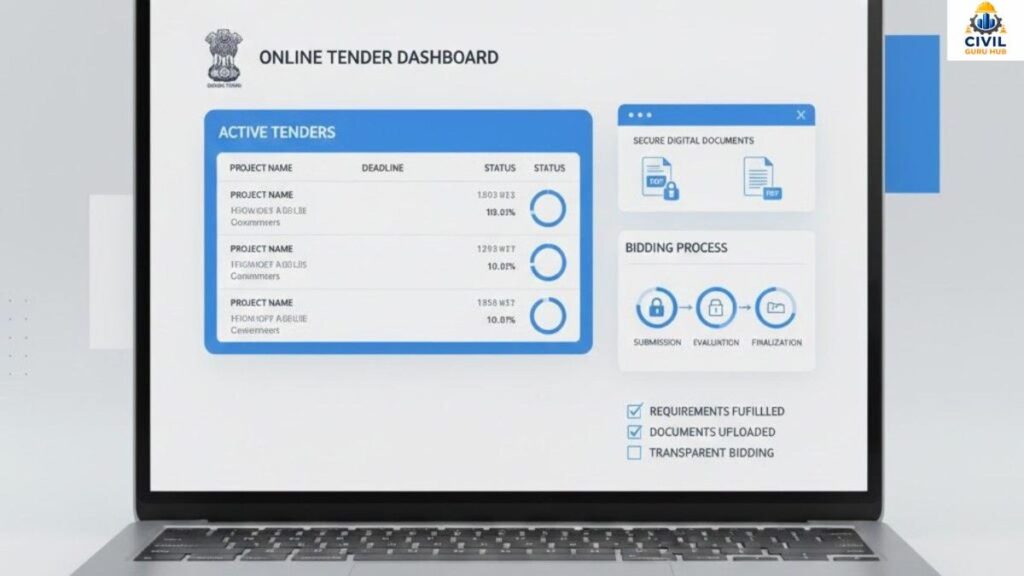
E-Tender is a digital procurement system in which the entire bidding process is conducted via an online platform. Nowadays, most government departments and many private organizations utilize this process because it significantly enhances transparency, efficiency, and accountability.
In this system, project notices, eligibility criteria, technical specifications, bid submissions, document uploads, and bid openings are all handled through a digital portal. Contractors can register and submit their proposals from any location using the internet. This reduces paperwork and manual errors while maintaining a digital record of the entire process.
Online submission fosters fairness and minimizes human intervention. The evaluation process becomes more systematic, and the speed of awarding projects increases. Features such as cybersecurity, digital signatures, and encrypted document submission ensure data security. In the modern construction industry, this system is rapidly being adopted as an efficient, cost-effective, and transparent procurement solution.
E-Tender

Important Documents
Several documents play an important role in the construction tender process.
| Construction Tender Document | Purpose in the Tender Process |
|---|---|
| Notice Inviting Tender (NIT) | Official document inviting eligible contractors to submit bids for the project. |
| Bill of Quantities (BOQ) | Provides item-wise quantities, units, and estimated work for accurate cost estimation. |
| Technical Specifications | Defines the required quality standards, materials, workmanship, and construction methods. |
| Project Drawings | Includes architectural, structural, and engineering drawings for proper project execution. |
| General Conditions of Contract (GCC) | Outlines the standard contractual terms, responsibilities, payment conditions, and legal obligations. |
| Special Conditions of Contract (SCC) | Specifies project-specific requirements, special clauses, and additional contract conditions. |
| Bid Submission Forms | Standardized forms that contractors must complete and submit with their technical and financial proposals. |
| Contract Agreement Format | Final legal agreement signed between the client and the selected contractor before project execution. |
It is very important for the contractor to carefully understand these documents as they form the basis of future contracts.
Important Codes and Guidelines
| Construction Code / Standard | Purpose & Application in Construction Projects |
|---|---|
| CPWD Works Manual | Standard guidelines for government construction works, tendering procedures, contract management, and project execution. |
| General Financial Rules (GFR) | Defines procurement procedures, public purchasing policies, financial management, and government contract regulations. |
| CVC Guidelines | Ensures transparency, integrity, vigilance, and corruption-free procurement in public construction projects. |
| IRC Specifications | Provides design, construction, quality control, and maintenance standards for highways, roads, and bridges. |
| MoRTH Specifications | Technical specifications for road construction, highway engineering, pavement works, bridges, and infrastructure projects. |
| IS 1200 Series | Standard method of measurement for civil engineering works, quantity estimation, and billing purposes. |
| IS 456: Plain and Reinforced Concrete Code | Covers design, construction, quality control, durability, and workmanship requirements for reinforced concrete structures. |
| IS 800: General Construction in Steel | Design and construction code for structural steel buildings, industrial structures, and steel framework. |
The Importance of the Bill of Quantities (BOQ)
In construction tenders, the BOQ (Bill of Quantities) is considered one of the most important documents. It is a detailed statement listing all the work items involved in a project along with their estimated quantities.
For instance, if a tender is issued for a highway project, the BOQ will specify quantities for activities such as earthwork excavation, embankment filling, GSB (Granular Sub-Base), WMM (Wet Mix Macadam), bituminous layers, drainage works, and structures. Contractors quote their rates based on these quantities.
A proper analysis of the BOQ is key to the success of any construction tender. Experienced contractors conduct a detailed rate analysis for each item. This analysis accounts for material costs, labor costs, equipment costs, overhead expenses, and profit margins.
Many new contractors make a common mistake: they prepare their bids based solely on the total project value without conducting an item-wise analysis. Consequently, they often face financial losses during project execution.
Studying the BOQ also helps the contractor understand the actual scope of the project. If the quantity of a particular item appears unusual, the contractor can seek clarification during the pre-bid meeting.
Therefore, the analysis of the BOQ should be given the utmost importance in every construction tender.
What is a Technical Bid?
In the construction tendering process, bids are typically submitted in two parts: the Technical Bid and the Financial Bid.
The purpose of the Technical Bid is to evaluate the contractor’s capabilities. At this stage, the contractor’s experience, workforce strength, machinery resources, financial stability, and past performance are assessed.
For a highway project tender, the contractor is required to provide details of previously completed projects. If the estimated project value is ₹100 crore, the client generally prefers contractors who have successfully completed projects of a similar scale in the past.
Technical Bids often include the following documents:
| Required Tender Document | Purpose in the Tender Process |
|---|---|
| Company Registration Certificate | Verifies the legal existence and registration of the company. |
| GST Registration Certificate | Confirms tax compliance and GST registration status. |
| PAN Card | Establishes the company’s financial and tax identity. |
| Work Experience Certificates | Demonstrates previous project experience and technical capability. |
| Equipment and Machinery Details | Shows the availability of construction equipment and resources required for project execution. |
| Audited Financial Statements | Evaluates the company’s financial stability, net worth, and ability to complete the project. |
Financial Bids are opened only after the Technical Bid evaluation is complete and the contractors are deemed qualified. This process helps the project owner select high-quality contractors.
Ignoring the Technical Bid requirements can be a major mistake for a contractor in a construction tender. Often, despite being the lowest bidder, a contractor may fail to win the project due to a lack of technical qualification.
How is the Financial Bid Evaluated?
The financial bid is opened after the technical qualification stage. At this stage, the rates quoted by the contractor and the total project cost are analyzed.
Many people believe that the contractor quoting the lowest rate always wins the construction tender. In reality, this is not always the case. Many projects utilize the Quality and Cost Based Selection (QCBS) method, where both technical and financial scores are taken into account.
When preparing a financial bid, the contractor must consider market rates, fluctuations in material prices, labor costs, and project risks. Quoting rates that are too low can lead to losses during execution, whereas quoting rates that are too high renders the bid uncompetitive.
Financial evaluation involves analyzing both item rates and the total contract value. Many organizations also investigate abnormally low bids to mitigate potential future project risks.
A successful construction tender is one where the contractor quotes rates that are both competitive and practical.
What is an Earnest Money Deposit (EMD)?
EMD, or Earnest Money Deposit, is a crucial part of the tendering process. It is a security amount that a contractor must deposit when submitting a bid.
The primary objective of the EMD is to deter frivolous or non-serious bidders. By depositing the EMD, the contractor demonstrates their commitment to the project.
In construction tenders, the EMD value is determined based on the project cost; in many government tenders, it is set as a specific percentage of the estimated project cost.
The EMD may be forfeited if the contractor withdraws their bid or refuses to sign the contract after it has been awarded. Consequently, the EMD is considered an effective tool for maintaining tender discipline.
The successful contractor is required to submit Performance Security after the contract is awarded, whereas the EMD is refunded to the unsuccessful bidders.
Performance Security and Performance Guarantee
When a contractor is awarded a project through a construction tender, they are required to deposit Performance Security.
The purpose of Performance Security is to provide financial protection to the project owner. If the contractor fails to adhere to the contract conditions or leaves the project incomplete, the client can utilize the security amount to recover losses.
Performance Security holds great significance in infrastructure projects, as the project value can run into crores of rupees.
Typically, Performance Security is collected as a percentage of the contract value. It can be submitted in the form of a Bank Guarantee or a Fixed Deposit.
In a robust construction tender system, Performance Security is a crucial component of risk management.
Role of the Tender Evaluation Committee
The Tender Evaluation Committee is a team constituted by the project owner to conduct an impartial assessment of all bids.
The committee’s objective is not merely to select the lowest bidder but to choose the most suitable contractor; therefore, a detailed analysis of both the Technical Bid and the Financial Bid is carried out.
During the evaluation of construction tenders, the committee also considers the contractor’s previous projects, equipment capabilities, manpower availability, and financial performance.
This committee plays a crucial role in maintaining transparency and fairness in the procurement process.
What is the E-Tendering Process?
With the advancement of digital technology, significant changes have occurred in the construction tendering process. Previously, tender documents were submitted manually, but today, most government and private organizations utilize the e-tendering system. E-tendering is an online procurement process where the majority of tasks—ranging from the publication of the tender notice to bid submission and evaluation—are conducted on a digital platform.
The greatest benefit of digitizing construction tenders is transparency. When the entire process takes place online, human interference is minimized, and the likelihood of favoritism is significantly reduced. Additionally, contractors can download tender documents and submit their bids online from any location.
In the e-tendering process, contractors require a Digital Signature Certificate (DSC). Contractors use the DSC to authenticate electronic documents. After registering on the tender portal, a contractor can view project details, download tender documents, and upload bids online.
Nowadays, most construction tenders for road and highway projects are processed through e-procurement portals. Organizations such as NHAI, CPWD, Railways, and State PWD departments are also utilizing digital tendering systems.
| E-Tender Process Stage | Description of the E-Tendering Process |
|---|---|
| Contractor Registration | Register on the official e-tender portal and complete the verification process before participating in bids. |
| Tender Document Download | Download the tender documents, technical specifications, BOQ, drawings, and eligibility criteria from the portal. |
| Technical & Financial Bid Preparation | Prepare all required technical documents, financial quotations, and supporting certificates as per tender requirements. |
| Online Bid Submission | Upload the technical and financial bids securely through the e-tender portal before the submission deadline. |
| Electronic Bid Opening | Authorized officials electronically open the submitted bids on the scheduled date and time. |
| Technical & Financial Evaluation | Evaluate bidder eligibility, technical qualifications, compliance, and financial quotations to identify the most suitable contractor. |
| Contract Award & Work Order | Award the contract to the successful bidder and issue the Letter of Acceptance (LOA) or official work order for project execution. |
E-tendering has made the construction tendering process more efficient, transparent, and time-saving.
What is a Letter of Acceptance (LOA)?
When a contractor’s bid is successful, the project owner issues a Letter of Acceptance (LOA) to them. An LOA is an official document informing the contractor that their bid has been accepted.
The LOA is considered a crucial milestone in the construction tender process. Once the LOA is issued, the process of contract execution between the contractor and the client begins.
The LOA specifies details such as the project value, contract duration, scope of work, and key terms and conditions related to contract execution. Upon receiving the LOA, the contractor is required to submit their acceptance within a specified timeframe.
Many contractors view the LOA merely as a formal letter, but in reality, it holds significant legal importance. Following the issuance of the LOA, the contractor is considered officially committed to the project.
Therefore, the LOA stage in a construction tender must be handled with great care.
Work Order and Contract Agreement
The step following the Letter of Award (LOA) involves the Work Order and the Contract Agreement. A Work Order is an official authorization that permits the contractor to commence project execution.
The Contract Agreement is a legally binding document that defines the rights and responsibilities of both the client and the contractor. This agreement outlines the project scope, payment terms, dispute resolution mechanism, completion period, and quality requirements.
The Contract Agreement plays a crucial role in the construction tender process, as most future disputes are resolved based on this document.
A standard construction contract typically includes the following clauses:
| Tender Contract Clause | Purpose and Explanation |
|---|---|
| Scope of Work (SOW) | Clearly defines the project work, technical specifications, deliverables, and contractor responsibilities. |
| Payment Terms | Specifies the payment schedule, billing milestones, retention amount, and payment conditions. |
| Project Completion Period | Defines the total contract duration, project start date, and required completion deadline. |
| Defect Liability Period (DLP) | Specifies the period during which the contractor must repair defects at no additional cost after project completion. |
| Liquidated Damages (LD) | Defines the predetermined financial penalty imposed for delays in project completion beyond the agreed schedule. |
| Force Majeure Clause | Covers unforeseen events such as natural disasters, war, pandemics, or government actions that may affect contract performance. |
| Arbitration Clause | Establishes the legal procedure for resolving disputes between the client and contractor without going to court. |
Before signing the Contract Agreement, the contractor should carefully understand every clause.
What are Liquidated Damages (LD)?
Liquidated Damages (LD) is a common clause in construction tender contracts. Its purpose is to compensate the client for losses incurred due to project delays.
If a contractor fails to complete the project within the stipulated completion period and the delay is attributable to them, the client may impose LD.
Delays in infrastructure projects—such as highways, bridges, and flyovers—can lead to public inconvenience and financial losses. For this reason, the LD clause is given significant importance in construction tender agreements.
LD is typically calculated as a predetermined percentage of the contract value. Every contract also defines a maximum limit for LD.
Contractors should engage in realistic planning when preparing their bids to avoid facing penalties for delays in the future.
Risk Factors in Construction Tenders
Every construction tender carries certain risks. It is essential for both the contractor and the client to understand and manage these risks.
The most common risk is the escalation of material prices. Sudden increases in the rates of cement, steel, bitumen, and diesel can impact the contractor’s profitability.
Another risk relates to weather conditions. Excessive rainfall, floods, or natural disasters can affect the project’s progress.
Labor shortage is also a significant risk. Often, the availability of manpower is affected because the project site is located in a remote area.
Design changes and variations in scope can also impact project costs and timelines. Therefore, risk assessment and mitigation planning are crucial during the construction tender process.
Major Risks in Construction Tenders
| Construction Risk Factor | Impact on Construction Project | Possible Solution |
|---|---|---|
| Material Price Increase | Increases overall project cost and affects the construction budget. | Lock material rates early, sign long-term supplier contracts, and maintain a contingency budget. |
| Labour Shortage | Reduces productivity and delays project completion. | Hire skilled workers in advance, improve workforce planning, and provide proper training. |
| Weather Conditions | Causes work stoppages, schedule delays, and lower site efficiency. | Monitor weather forecasts, adjust construction schedules, and protect work areas. |
| Design Changes | Leads to additional costs, rework, and project delays. | Finalize designs before construction and implement a strict change management process. |
| Equipment Breakdown | Interrupts construction activities and decreases productivity. | Perform regular preventive maintenance and keep backup equipment available. |
| Cash Flow Issues | Slows project execution and affects material procurement and labour payments. | Maintain proper financial planning, monitor cash flow, and ensure timely client payments. |
Effective risk management is the hallmark of successful construction tender execution.
A Practical Example of a Highway Project Tender
Suppose the estimated cost of a state highway widening project is ₹150 crore. The project owner publishes a tender notice and invites interested contractors to submit their bids.
The tender documents include drawings, specifications, the Bill of Quantities (BOQ), and contract conditions. Interested contractors visit the project site and prepare a detailed cost estimate.
Following the submission of technical bids, an evaluation committee verifies the contractors’ experience and qualifications. Only the financial bids of qualified contractors are opened.
After the financial evaluation, the Letter of Award (LOA) is issued to the lowest responsive bidder. The contractor submits the performance security, and the contract agreement is signed.
Subsequently, the site is handed over, and project execution begins.
This practical example illustrates how a construction tender operates in a real-world project.
Best Practices for Winning Construction Tenders
Tendering is not merely a game of quoting the lowest rate; a successful contractor always focuses on strategic planning and detailed analysis.
Tender documents should be read line-by-line, and any ambiguities should be clarified during the pre-bid meeting.
Rate analysis must be realistic. Quoting extremely low rates solely to win the project can lead to future losses.
Effectively presenting past project experience and technical capabilities is also crucial; strong documentation enhances a contractor’s credibility.
The secret to success in construction tenders lies in accurate estimation, proper planning, and risk assessment.
Common Mistakes in Construction Tenders
Contractors often make certain common mistakes during the construction tender process that can lead to the rejection of their bids.
The most common error is failing to read the tender documents thoroughly. Contractors frequently quote rates without fully understanding the specifications, which can subsequently result in disputes and financial losses.
Another significant mistake is overlooking the analysis of the Bill of Quantities (BOQ). Competitive bidding is not feasible without an accurate analysis of quantities and rates.
Failing to properly assess financial capability and resource planning is also a major issue. Many contractors submit low bids but incur losses during project execution.
Therefore, conducting detailed planning and risk assessment is essential before submitting a construction tender.
Essential Tools Every Contractor and Site Engineer Should Have
Having the right tools and equipment is essential for understanding construction tenders and improving project execution. The products listed below can greatly assist you with tender planning, site management, and quantity verification.
| Construction Tool | Primary Use | Best For |
|---|---|---|
| Auto Level Machine | Accurate level checking, elevation measurement, and land surveying | Site Engineers |
| Measuring Wheel | Road distance measurement, site layout, and alignment work | Quantity Surveyors |
| Scientific Calculator | Quantity estimation, structural calculations, and cost estimation | Civil Engineers |
| Laptop | Project planning, BOQ preparation, AutoCAD drawings, documentation, and project management | Civil Engineers & Project Managers |
| Safety Helmet & Reflective Jacket | Personal protective equipment (PPE) for construction site safety and compliance | Engineers & Construction Workers |
Affiliate Disclaimer
This website may contain ‘affiliate links.’ This means that if you click on a link and purchase a product, we may earn a small commission at no extra cost to you. This commission helps sustain CivilGuruHub and enables us to create free, high-quality resources, guides, and educational content for civil engineers, site builders, quantity surveyors, contractors, and business professionals.
We only recommend products and tools that we believe are useful for professionals in the field. However, you should always conduct your own research before making a purchasing decision.
CivilGuruHub participates in several affiliate programs, including the Amazon Associates Program. This program allows websites to earn advertising fees by advertising and linking to products.
We truly appreciate your support through these affiliate links; it helps us continue sharing civil engineering knowledge. Thank you for supporting Civilguruhub.
Conclusion
In the construction industry, the construction tender is a process that lays a solid foundation for the successful execution of any project. Whether the project involves a small residential building, a commercial complex, or a large-scale highway, bridge, or infrastructure development, the tendering system plays a vital role. The tender process enables the project owner to select the most suitable contractor, while offering contractors the opportunity to participate in fair and transparent competition.
Throughout this guide, we have explored what a construction tender is, why it is necessary, how the tender process functions, and the roles played by key components such as tender documents, BOQ, Technical Bids, Financial Bids, EMD, Performance Security, and Contract Agreements. We also examined how e-tendering has made the procurement process more transparent, faster, and more efficient.
For a successful construction tender, merely quoting the lowest rate is insufficient. A contractor must thoroughly understand project specifications, drawings, site conditions, resource requirements, and risk factors. Accurate cost estimation, realistic pricing, and proper planning are the keys to long-term success. Similarly, project owners should select contractors based on technical capabilities and quality standards.
In today’s competitive construction market, knowledge of tendering has become an essential professional skill for civil engineers, site engineers, quantity surveyors, project managers, and contractors alike. A professional who understands the construction tender process well can not only manage projects more successfully but also unlock new career opportunities. Therefore, a sound understanding and practical application of tendering are crucial for sustainable growth and project success within the construction industry.
About the Author
My name is Susanta Kumar Mohapatra. I am a civil engineering professional with over 11 years of practical experience in the construction and infrastructure sectors. I hold a B.Tech in Civil Engineering and an M.E. degree in Construction Management. Throughout my professional career, I have worked in key areas such as road construction, bridge projects, quality control, material testing, quantity estimation, project planning, and site management.
My passion for civil engineering inspired me to launch CivilGuruHub.com. The aim of this website is to provide practical and easy-to-understand knowledge to students, site engineers, quantity surveyors, contractors, and civil engineering professionals. Here, I share information related to construction technology, highway engineering, laboratory tests, project management, estimation, tendering, and the latest industry practices.
In addition to the website, I run “The Civil Site” YouTube channel, where I share practical videos, site-related knowledge, and technical explanations regarding civil engineering. My goal is to explain engineering concepts in a simple and practical manner so that every learner can grasp them easily.
I also publish regular quizzes and educational videos on the “Daily IQ Hub” YouTube channel, helping viewers enhance their general knowledge and improve their preparation for competitive exams.
I believe that practical knowledge and continuous learning are the hallmarks of a successful engineer. With this objective in mind, I strive to deliver high-quality, reliable, and industry-focused content through CivilGuruHub and my YouTube channels.
Thank you for your support and trust. I hope CivilGuruHub proves to be a valuable companion in your professional growth and learning journey.
Frequently Asked Questions (FAQs)
Q1. What is a Construction Tender?
u003cbru003eAnswer: A construction tender is an official process in which the project owner invites bids or quotations from contractors to select the most suitable contractor for the project.
Q2. Why is a Construction Tender important?
u003cbru003eAnswer: A construction tender ensures transparency, fair competition, and cost control. Through this process, the project owner can select a quality contractor and ensure the proper utilization of public funds.
Q3. What are the main types of Construction Tenders?
u003cbru003eAnswer: The main types of construction tenders include Open Tender, Limited Tender, Selective Tender, Negotiated Tender, Single Tender, and E-Tender. Each type is used according to the specific requirements of the project.
Q4. What is the difference between a Technical Bid and a Financial Bid?
u003cbru003eAnswer: A Technical Bid evaluates the contractor’s qualifications, experience, and resources, whereas a Financial Bid assesses the rates quoted and the total cost of the project.
Q5. What is BOQ in a Construction Tender?
u003cbru003eAnswer: BOQ (Bill of Quantities) is a detailed document listing all the work items of the project and their estimated quantities. Contractors quote their rates based on this document.
Q6. What is Earnest Money Deposit (EMD)?
u003cbru003eAnswer: EMD is a security amount that a contractor must deposit when submitting a bid. Its purpose is to encourage serious bidders and discourage non-serious bids.
Q7. What is E-Tendering?
u003cbru003eAnswer: E-Tendering is an online tendering system where tender publication, document downloading, bid submission, and evaluation are conducted via a digital platform.
Q8. How is the winner of a Construction Tender selected?
u003cbru003eAnswer: The tender winner is selected based on technical qualifications, the financial proposal, past experience, and project requirements. It is not always mandatory to select the lowest bidder for every project.
Q9. What happens after a contractor wins a Construction Tender?
u003cbru003eAnswer: After winning the tender, the contractor is issued a Letter of Acceptance (LOA) and must submit Performance Security; project execution begins once the contract agreement is signed.
Q10. What are the common mistakes contractors make during the tendering process?
u003cbru003eAnswer: Failing to read tender documents carefully, making errors in BOQ analysis, quoting unrealistic rates, ignoring risk assessment, and submitting incomplete documents can lead to tender rejection or project losses.