
Table of Contents
Introduction
Concrete is considered the most widely used construction material in the world. It forms the primary basis for the structural strength of buildings, roads, culverts, drains, pavements, and foundations. The quality of concrete depends on the correct proportions of its constituents: cement, sand, aggregate, and water. This specific ratio is known as the “mix proportion.” When this proportion follows a pre-determined standard ratio, it is referred to as “Nominal Mix.”
Nominal Mix is primarily used in small- to medium-scale construction projects that do not require extensive laboratory testing. In India, Nominal Mix has been widely used for residential and low-rise buildings for many years. Even today, it is commonly employed in village construction, compound walls, pathways, PCC (Plain Cement Concrete) work, and small RCC (Reinforced Cement Concrete) members.
The major advantage of Nominal Mix is that it does not require complex calculations or laboratory-based mix design. A site engineer or supervisor can prepare the concrete simply by following the standard ratio. However, material quality and proper batching remain crucial for maintaining quality control.
In this article, we will examine Nominal Mix concrete grades ranging from M5 to M35 in detail. We will explain the ratio, practical applications, calculation methods, quantity analysis, and construction procedures for each grade step-by-step. Additionally, relevant IS Codes and technical tables will be provided to ensure this article serves as a comprehensive reference guide for engineers, diploma students, site supervisors, and contractors.
What is Nominal Mix?
Nominal mix refers to a predetermined concrete proportion in which cement, fine aggregate, and coarse aggregate are mixed in a fixed ratio. This process does not require laboratory trial mixes; instead, standard ratios are used based on the desired concrete strength.
For example, if the ratio for M20 grade concrete is 1:1.5:3, it means the concrete is prepared by mixing 1 part cement, 1.5 parts sand, and 3 parts aggregate.
The objective of a nominal mix is to provide concrete that is easily workable on-site and possesses acceptable strength. While quality control in this process is less rigorous compared to ‘Design Mix,’ it is considered practical and cost-effective for smaller projects.
The grade of concrete indicates its characteristic compressive strength at 28 days. For instance, M20 signifies a strength of 20 MPa, M25 signifies 25 MPa, and other grades are defined similarly.
Important IS Codes for Nominal Mix
| IS Code | Description |
|---|---|
| IS 456:2000 | Plain aur Reinforced Concrete Code |
| IS 10262 | Concrete Mix Proportioning Guidelines |
| IS 383 | Fine and Coarse Aggregate Specification |
| IS 1199 | Concrete Sampling aur Testing |
| IS 516 | Compressive Strength Test |
| IS 9103 | Concrete Admixtures Specification |
According to IS 456:2000, Nominal Mix can be used for concrete grades up to M20. Design Mix is considered more appropriate for higher grades; however, standard nominal proportions can be understood for educational and estimation purposes.
Concrete Grade and Nominal Mix Ratio Table
| Grade | Nominal Mix Ratio |
|---|---|
| M5 | 1:5:10 |
| M7.5 | 1:4:8 |
| M10 | 1:3:6 |
| M15 | 1:2:4 |
| M20 | 1:1.5:3 |
| M25 | 1:1:2 |
| M30 | 1:0.75:1.5 |
| M35 | 1:0.5:1 |

Basic Procedure of Concrete Calculation
For every Nominal Mix calculation we will consider 1 cubic meter wet concrete as the basis.
Dry Volume Factor = 1.54
Cement Density = 1440 kg/m³
1 Cement Bag = 50 kg
Formula:
Dry Volume = Wet Volume × 1.54
If ratio = a:b:c
Total Parts = a+b+c
Cement Quantity = (a/Total Parts) × Dry Volume
Sand Quantity = (b/Total Parts) × Dry Volume
Aggregate Quantity = (c/Total Parts) × Dry Volume
M5 Grade Nominal Mix Calculation (1:5:10)
M5 is one of the concrete grades with the lowest strength. It is used for non-structural works such as leveling courses, bedding concrete, and temporary structures.
Total Parts
1 + 5 + 10 = 16
Dry Volume
1 × 1.54 = 1.54 m³
Cement Quantity
= (1/16) × 1.54
= 0.096 m³
Weight
= 0.096 × 1440
= 138 kg
Cement Bags
= 138/50
= 2.76 Bags
Sand Quantity
= (5/16) × 1.54
= 0.481 m³
Aggregate Quantity
= (10/16) × 1.54
= 0.962 m³
Water Requirement
Approximately 70 to 80 liters
This nominal mix is considered suitable for foundation bedding and sub-base works.
M7.5 Grade Nominal Mix Calculation (1:4:8)
M7.5 grade concrete is widely used for PCC (Plain Cement Concrete) works. It is utilized for flooring bases and minor foundations.
Total Parts
1 + 4 + 8 = 13
Dry Volume
1.54 m³
Cement
= (1/13) × 1.54
= 0.118 m³
Weight
= 0.118 x 1440
= 170 kg
Bags
=170/50
= 3.4 Bags
Sand
= (4/13) x 1.54
= 0.474 m³
Aggregate
= (8/13) x 1.54
= 0.948 m³
Water
85 liters
This nominal mix yields concrete that is both economical and workable.
To Get More articles regarding Quality control Click on Given Link
How to Conduct GSA Test? Proven IS 2720-4 Procedure
What are Sand Silt Content Test? 7 Easy Steps & Limits
how to perform Proctor Test: 10 Easy Steps (Complete Guide)
M10 Grade Nominal Mix Calculation (1:3:6)
M10 grade concrete PCC is used in road base, drain work and leveling courses.
Total Parts
1+3+6
= 10
cement
= (1/10) × 1.54
= 0.154 m³
weight
= 0.154 x 1440
= 222 kg
Bags
= 222/50
= 4.44 Bags
sand
= (3/10) x 1.54
= 0.462 m³
Aggregate
=(6/10) x 1.54
= 0.924 m³
water
110 liters
The M10 Nominal Mix has a good balance of strength and economy.

M15 Grade Nominal Mix Calculation (1:2:4)
M15 grade concrete has been quite popular for older RCC works and PCC foundations.
Total Parts
1 + 2 + 4
= 7
Cement
= (1/7) × 1.54
= 0.22 m³
Weight
= 0.22 x 1440
= 317 kg
Bags
= 6.34 bags
Sand
= (2/7) x 1.54
= 0.44 m³
Aggregate
= (4/7) x 1.54
= 0.88 m³
Water
160 liters
The M15 mix falls under the medium-strength concrete category and has been used in various applications within residential construction.
M20 Grade Nominal Mix Calculation (1:1.5:3)
M20 is one of the most widely used grades for RCC construction in India.
Total Parts
1 + 1.5 + 3
= 5.5
Cement
= (1/5.5) × 1.54
= 0.28 m³
Weight
= 0.28 x 1440
= 403 kg
Bags
= 8.06 Bags
Sand
= (1.5/5.5) x 1.54
= 0.42 m³
Aggregate
= (3/5.5) x 1.54
= 0.84 m³
Water
190 liters
M20 mix is considered the minimum RCC grade for beams, slabs, columns, and footings.
M25 Grade Nominal Mix Calculation (1:1:2)
M25 grade is used in high-strength residential and commercial construction.
Total Parts
1+1+2
= 4
cement
= (1/4) × 1.54
= 0.385 m³
weight
Bags
= 0.385 x 1440
= 554 kg
Bags
= 554/50
=11.08 Bags
sand
= (1/4) x 1.54
=0.385 m³
Aggregate
= (2/4) x 1.54
=0.77 m³
water
230 liters
M25 Mix produces more dense and durable concrete.
M30 Grade Nominal Mix Calculation (1:0.75:1.5)
M30 grade concrete is used in bridges, multistorey buildings and heavy structures.
Total Parts
1+0.75+1.5
=3.25
cement
= (1/3.25) x 1.54
=0.474 m³
weight
= 0.474 x 1440
=682 kg
Bags
=13.64 Bags
sand
= (0.75/3.25) x 1.54
= 0.355 m³
Aggregate
= (1.5/3.25) x 1.54
=0.71 m³
water
250 liters
This Mix provides concrete with high strength and low permeability.
To Get More articles regarding Quantity Survey Click on Given Link
BBS in Construction:A full guide for Calculation, Formula & Examples
How to Calculate Camber Tolerance in Road Construction Step by Step
How to Create a Flawless Highway Quantity Survey Checklist? 19 Expert-Level Tips
M35 Grade Nominal Mix Calculation (1:0.5:1)
M35 grade concrete is commonly used in high-rise and infrastructure projects.
Total Parts
1 + 0.5 + 1
= 2.5
Cement
= (1/2.5) x 1.54
= 0.616 m³
Weight
= 0.616 x 1440
= 887 kg
Bags
= 887/50
= 17.74 bags
Sand
= (0.5/2.5) x 1.54
= 0.308 m³
Aggregate
= (1/2.5) x 1.54
= 0.616 m³
Water
270 liters
For actual projects, a ‘Design Mix’ is generally recommended for M35 grade concrete; however, this calculation is useful for understanding the concept of a ‘Nominal Mix’.
Quantity Summary Table for All Nominal Mix Grades
| Grade | Ratio | Cement Bags | Sand (m³) | Aggregate (m³) |
|---|---|---|---|---|
| M5 | 1:5:10 | 2.76 | 0.481 | 0.962 |
| M7.5 | 1:4:8 | 3.40 | 0.474 | 0.948 |
| M10 | 1:3:6 | 4.44 | 0.462 | 0.924 |
| M15 | 1:2:4 | 6.34 | 0.44 | 0.88 |
| M20 | 1:1.5:3 | 8.06 | 0.42 | 0.84 |
| M25 | 1:1:2 | 11.08 | 0.385 | 0.77 |
| M30 | 1:0.75:1.5 | 13.64 | 0.355 | 0.71 |
| M35 | 1:0.5:1 | 17.74 | 0.308 | 0.616 |
Step-by-Step Procedure for Preparing Concrete Mix
Preparing concrete correctly is essential to achieve the desired strength, durability, and long service life of any structure. Whether it is a residential building, pavement, footing, column, slab, or small construction project, following a systematic procedure helps ensure consistent quality and performance. Every stage, from selecting materials to curing, plays a significant role in determining the final characteristics of the concrete.
The first step is to determine the required grade and calculate the quantity of materials needed. Based on the specified mix proportion, the crew measures cement, fine aggregate (sand), coarse aggregate, and water carefully. Accurate measurement is extremely important because even small variations can affect workability and compressive strength. For better accuracy and uniformity, we prefer weigh batching. However, for small-scale construction works where advanced equipment may not be available, we can also adopt volume batching with proper supervision.
After batching, the next stage is mixing. The objective of mixing is to ensure that all ingredients are distributed uniformly throughout the concrete mass. In machine mixing, workers generally introduce coarse aggregate and sand into the mixer first. Then, they add cement, and all materials are dry mixed for a short duration to achieve a uniform color and consistency. Once the dry ingredients blend properly, the crew adds water gradually according to the specified water-cement ratio. Maintaining the correct water content is one of the most important aspects of concrete production because excessive water reduces strength, while insufficient water makes placement and compaction difficult.
The workers should then transport the prepared concrete to the placement location as quickly as possible. During transportation, they must take care to prevent segregation, which occurs when coarse aggregate separates from the mortar. They should also avoid excessive delays because they can reduce workability and affect the quality of the finished structure. The team should ensure the material reaches the formwork in a fresh and workable condition.
Placement is the next critical stage. The crew should deposit concrete as close as possible to its final position to avoid unnecessary handling. They generally place it in layers of suitable thickness to ensure proper compaction. They should take care to avoid dropping the material from excessive heights, as this may lead to segregation. Proper supervision during placement helps maintain uniformity and structural integrity.
Once they place it, the crew carries out compaction to remove entrapped air voids. Mechanical vibrators, particularly needle vibrators, commonly assist them for this purpose. Effective compaction increases density, improves bond strength, and enhances durability. Inadequate compaction can create honeycombing and weak zones within the structure, reducing overall performance.
After compaction, the workers perform finishing operations. They level, smoothen, and shape the surface according to project requirements. Proper finishing not only improves appearance but also enhances usability and durability.
The final and most important stage is curing. After the concrete has gained its initial set, sufficient moisture must be maintained to support the hydration process. Continuous curing for at least seven days is generally recommended, while fourteen days or more provides better results. Adequate curing significantly improves strength development, reduces shrinkage cracks, and increases long-term durability.
By carefully following these steps, high-quality Nominal Mix concrete can be produced efficiently for various construction applications. Proper material selection, accurate batching, controlled mixing, effective compaction, and adequate curing collectively ensure that the Nominal Mix concrete achieves the desired performance and service life.

Advantages of Concrete with Standard Proportions
One of the biggest advantages of this method is its simplicity and ease of use. Unlike design-based concrete, it does not require extensive laboratory testing, trial mixes, or detailed calculations before construction begins. The proportions of cement, sand, and coarse aggregate are predetermined, making the process straightforward and convenient for site engineers, contractors, and workers. Because the mix proportions are already established, construction activities can start quickly without waiting for laboratory reports or technical approvals.
Another significant benefit is cost-effectiveness. Since there is no need for specialized testing and mix design procedures, the overall project cost can be reduced, especially in small and medium-sized construction works. This makes it an economical choice for residential buildings, compound walls, pathways, small foundations, flooring works, and other non-critical structures. Contractors often prefer this approach for projects where speed and simplicity are more important than achieving highly optimized strength.
Material estimation is also much easier. Engineers and quantity surveyors can calculate the required quantities of cement, sand, and aggregate using standard proportions, which simplifies procurement and inventory management. Accurate estimation helps reduce wastage and allows better control over construction expenses. Additionally, site supervisors can easily monitor material consumption and compare it with planned quantities.
The method is particularly useful in locations where laboratory facilities are unavailable or difficult to access. In rural areas and small construction sites, obtaining professional mix design services may not always be practical. In such situations, standard proportions provide a reliable solution that can be implemented with minimal technical resources.
Training and supervision requirements are also lower. Workers can quickly understand the mixing procedure because the proportions remain fixed. This reduces the chances of confusion during batching and mixing operations. As a result, project execution becomes smoother and more efficient.
Furthermore, the method allows faster construction progress because less time is spent on planning and testing activities. When proper materials are used and construction practices are followed correctly, satisfactory strength and durability can be achieved for many common applications. These advantages make it a popular choice for routine construction works where simplicity, affordability, and ease of execution are the primary considerations.
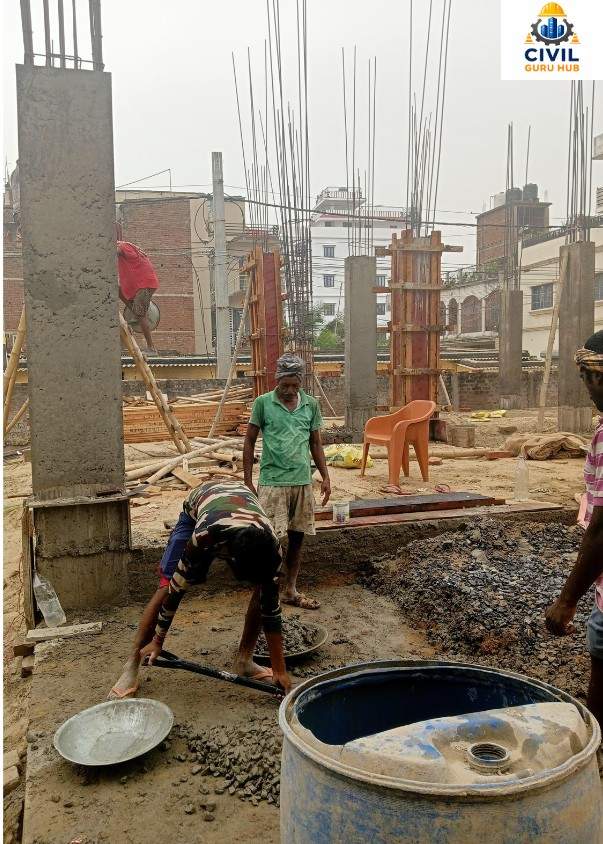
Limitations of Concrete with Standard Proportions
Despite its many advantages, this method also has several limitations that must be understood before selecting it for a project. The most significant drawback is that the proportions are fixed and do not account for variations in material properties. Cement quality, aggregate grading, sand characteristics, and water quality can differ from one location to another. Since these factors are not scientifically evaluated before determining the mix, the actual strength achieved in the field may vary considerably.
Another limitation is the lack of optimization. Design-based concrete is developed through laboratory testing to achieve specific strength and durability requirements with the most economical use of materials. In contrast, standard proportions may contain either insufficient or excessive cement depending on the quality of available materials. Excess cement can increase construction costs, while inadequate cement content may reduce strength and durability.
This method is generally unsuitable for high-rise buildings, long-span structures, bridges, dams, industrial facilities, and other critical infrastructure projects. Such structures require precise control over compressive strength, workability, durability, and long-term performance. Design-based concrete provides greater reliability because it is developed through engineering analysis and testing procedures. For this reason, most modern large-scale projects rely on engineered concrete mixtures rather than fixed proportions.
Durability can also become a concern in aggressive environmental conditions. Structures exposed to marine environments, chemical attacks, severe weather, or heavy loading require carefully designed concrete with controlled permeability and enhanced resistance properties. Fixed proportion mixes may not consistently provide these characteristics.
Workability variations present another challenge. Since material properties are not thoroughly evaluated, the concrete may become either too stiff or excessively workable. This can affect placement, compaction, and finishing operations. Poor workability may lead to honeycombing, segregation, or inadequate compaction, ultimately reducing structural performance.
Quality control is also more difficult because strength cannot be predicted with the same level of confidence as a laboratory-designed mix. As construction standards continue to evolve and performance requirements become more demanding, reliance on scientifically designed concrete has increased. Therefore, while standard proportion concrete remains useful for many small projects, it has limitations that restrict its application in complex and high-performance construction works.
Recommended Tools for Accurate Nominal Mix Concrete Calculation
If you handle tasks such as nominal mix concrete calculation, batching, quantity estimation, and quality control at a construction site, certain practical tools can make your work more accurate and efficient. The products listed below can be useful for civil engineers, contractors, and site supervisors.
| Product Name | Purpose | Useful For |
|---|---|---|
| Digital Weighing Scale | Accurate batching of cement, sand, and aggregates | Site Engineers, Contractors |
| Measuring Tape (30 m) | Measuring layouts, distances, and dimensions | Civil Engineers, Supervisors |
| Concrete Slump Cone Test Kit | Checking the workability of fresh concrete | Quality Control Engineers |
| Scientific Calculator | Concrete mix and quantity calculations | Engineering Students, Civil Engineers |
Note: In any nominal mix concrete work, the use of accurate measurement and quality testing tools can enhance the quality, strength, and durability of the concrete. Suitable tools should be selected based on site conditions and project requirements.
Conclusion
Concrete prepared using predetermined proportions has played an important role in the development of the construction industry for many decades. It provides a practical and economical solution for a wide range of building activities, particularly where simplicity and ease of implementation are important. Engineers and contractors can select a suitable option for specific construction applications as various grades are available to meet different strength requirements.
Contractors commonly use lower grades in plain cement concrete works such as leveling courses, pathways, flooring bases, and other non-structural elements. These applications generally do not require high compressive strength, making fixed proportion concrete a practical choice. Builders frequently use medium-strength grades in reinforced concrete components such as slabs, beams, columns, footings, and staircases in small and medium-sized buildings. Higher grades provide increased strength, and designers can use them where greater load-carrying capacity is required, although modern engineering practice often recommends design-based concrete for such applications.
The performance of any concrete depends not only on the selected grade but also on construction practices. Achieving satisfactory results requires high-quality materials, accurate batching, proper mixing, a controlled water-cement ratio, effective compaction, and adequate curing. Even the best proportioning system cannot compensate for poor workmanship or inadequate quality control. Therefore, the construction team must pay attention to every stage of construction.
Understanding this concept is highly important for civil engineers, site supervisors, quantity surveyors, contractors, and construction professionals. Knowledge of standard concrete proportions helps professionals in quantity estimation, material planning, budgeting, cost control, and site management. It also enables them to make informed decisions regarding the suitability of different grades for various applications.
Although modern construction increasingly favors laboratory-designed concrete for major projects, fixed proportion concrete continues to be widely used because of its convenience and practicality. A clear understanding of its advantages, limitations, and applications helps construction professionals select the most appropriate solution for each project. When used correctly and supported by proper construction practices, it can provide reliable performance, satisfactory strength, and long-term durability for many types of structures.
About The Author
I am Susanta Kumar Mohapatra, a Civil Engineering professional with over 11 years of practical and technical experience in the construction industry. I hold a B.Tech degree in Civil Engineering and an M.E. degree in Construction Management. Throughout my professional career, I have worked in key areas such as building construction, quantity estimation, project planning, quality control, concrete technology, structural execution, and site management.
My objective is to convey technical Civil Engineering concepts in simple, practical language to students, site engineers, diploma holders, contractors, and construction professionals. With this aim, I launched civilguruhu.com, where I share detailed articles, practical guides, information on IS Codes, quantity calculations, and topics related to construction management.
Additionally, I run a YouTube channel named “The Civil Site,” where I publish educational videos covering Civil Engineering, Construction Technology, Estimation, Quantity Surveying, Concrete Mix Design, Site Execution, and career guidance. I always strive to present information in an accessible and useful manner by bridging theoretical knowledge with real-world construction practices.
My passion for Civil Engineering and Construction Management drives me to continuously learn, teach, and share my experiences with industry professionals. If you are looking for practical and reliable information on any Civil Engineering topic, you can benefit from my articles and educational content.
Affiliate Disclaimer
This article may contain affiliate links. If you purchase a product or service through these links, we may receive a small commission at no additional cost to you. This commission helps support website maintenance, content research, and the continuous updating of educational resources.
We recommend only those products and tools that are useful and relevant to Civil Engineering, Construction Management, and Site Execution. The purpose of recommending any product is to provide readers with better information and useful options. However, it is essential to independently verify the specifications, features, pricing, and suitability of any product or service before purchasing it.
The primary objective of CivilGuruHu.com and The Civil Site is to provide quality educational content. Affiliate partnerships do not influence our editorial content; all our reviews, recommendations, and technical information are prepared impartially and with the reader’s best interests in mind.
Thank you for your support. Every purchase you make contributes to strengthening our educational mission.
Frequently Asked Questions (FAQs) About Nominal Mix Concrete
1. What is Nominal Mix Concrete?
Nominal Mix Concrete involves a predefined concrete proportion where cement, sand, and aggregates are mixed in a standard ratio. It does not require laboratory trial mixes and is used in small- to medium-scale construction projects.
2. What is the difference between Nominal Mix and Design Mix?
Nominal Mix is based on predetermined ratios, whereas Design Mix is prepared based on laboratory testing and material properties. Design Mix offers greater accuracy regarding strength and durability.
3. What is the ratio for M20 grade Nominal Mix?
The standard ratio for M20 grade Nominal Mix is 1:1.5:3. This means 1 part cement, 1.5 parts sand, and 3 parts coarse aggregate.
4. Why is a Dry Volume Factor of 1.54 used for Nominal Mix?
The volume of concrete decreases after mixing, and there are also voids (empty spaces) between the materials. Taking these factors into account, a Dry Volume Factor of 1.54 is used for quantity calculations.
5. What is the ratio for M15 grade concrete?
The ratio for M15 grade Nominal Mix is 1:2:4. This grade is used for PCC works and certain RCC applications.
6. Can Nominal Mix be used for M25 grade and higher?
For practical construction projects, Design Mix is recommended for M25 grade and above. However, Nominal Mix proportions can be studied for educational and estimation purposes.
7. What should the Water-Cement Ratio be for Nominal Mix concrete?
The Water-Cement Ratio depends on project requirements and workability. It is generally maintained between 0.40 and 0.60 to ensure that strength and durability are not compromised.
8. What are the main advantages of Nominal Mix Concrete?
The biggest advantage of Nominal Mix is its simplicity. Calculations are easy, on-site implementation is quick, and it is considered an economical option for small projects.
9. How can the quality of Nominal Mix concrete be improved?
The quality and strength of Nominal Mix concrete can be enhanced by using high-quality cement and aggregates, ensuring accurate batching, controlling water quantity, achieving proper compaction, and curing for a minimum of 7 to 14 days.
10. What is the minimum concrete grade recommended for RCC construction?
According to IS 456:2000, the minimum recommended concrete grade for RCC construction is M20. This grade is widely used in structural members such as beams, slabs, columns, and footings.