
Table of Contents
Introduction
In the fields of geotechnical engineering and soil mechanics, the Grain Size Analysis (GSA) test is considered a crucial laboratory test. The success of any construction project depends largely on the quality of the soil upon which the structure is to be built. Whether it involves road construction, building foundations, bridge approach embankments, or railway formations, understanding the soil’s particle size distribution is essential.
The GSA test is conducted for this very purpose. Through this test, engineers can determine the proportions of gravel, sand, silt, and clay particles present in the soil. The particle size distribution of soil directly influences properties such as compaction, permeability, shear strength, settlement, and bearing capacity.
The Indian Standard IS 2720 (Part 4) outlines the standard procedure for soil grain size analysis. This standard describes both sieve analysis and hydrometer analysis methods.
Nowadays, the GSA test has become a mandatory quality control activity for highway projects, airport pavements, retaining structures, and embankment construction. If the soil gradation is improper, issues such as settlement, rutting, cracking, and drainage problems may arise in the future.
In this article, we will examine the complete GSA test procedure including apparatus, calculations, observation tables, and result interpretation in detail, in accordance with IS 2720 (Part 4).
What is the GSA Test?
GSA stands for Grain Size Analysis.
It is a laboratory test aimed at determining the percentage of different particle sizes within the soil. Through this test, soil particles are classified according to their size.
The results of the GSA test provide engineers with information regarding:
- Whether the soil is well-graded or poorly-graded.
- The percentage of sand in the soil.
- The percentage of gravel in the soil.
- The content of fine particles.
- The soil’s drainage characteristics.
- Its compaction behavior.
According to IS 2720 Part 4, Grain Size Analysis can be performed using two methods:
- Sieve Analysis
- Hydrometer Analysis
Sieve analysis is used for coarse-grained soils, while hydrometer analysis is used for fine-grained soils.
Importance of the GSA Test
The GSA (Grain Size Analysis) test holds great importance in the construction industry.
When a soil sample is collected from a project site, Grain Size Analysis is the first step taken to assess its suitability.
Excessive clay content in the soil can lead to drainage issues, while an excess of gravel can make achieving proper compaction difficult.
GSA test results are utilized in the following applications:
Highway Engineering: The GSA test is crucial for the design of road embankments and subgrades.
Foundation Design: It assists in estimating the bearing capacity of the foundation.
Earth Dam Construction: It is used in the selection of filter materials and embankment materials.
Retaining Wall Design: It helps evaluate the suitability of backfill material.
Airport Pavement: The GSA test is conducted to evaluate runway subgrades.
Therefore, GSA test results are included in every geotechnical investigation report.
What is IS 2720 Part 4?
IS 2720 Part 4 is a standard published by the Bureau of Indian Standards (BIS) that defines the standard methodology for the grain size analysis of soil.
The primary objective of this standard is to determine the size distribution of soil particles.
IS 2720 Part 4 covers the following topics:
| Particular | Description |
|---|---|
| Standard | IS 2720 Part 4 |
| Test Name | Grain Size Analysis |
| Purpose | Particle Size Distribution |
| Method | Sieve Analysis & Hydrometer Analysis |
| Applicable Soil | Coarse and Fine Grained Soil |
| Governing Authority | BIS |
This standard ensures that every laboratory follows the same procedure and that the results remain reliable.
Apparatus Required for GSA Test
Certain standard apparatus are required to conduct Grain Size Analysis in accordance with IS 2720 Part 4.
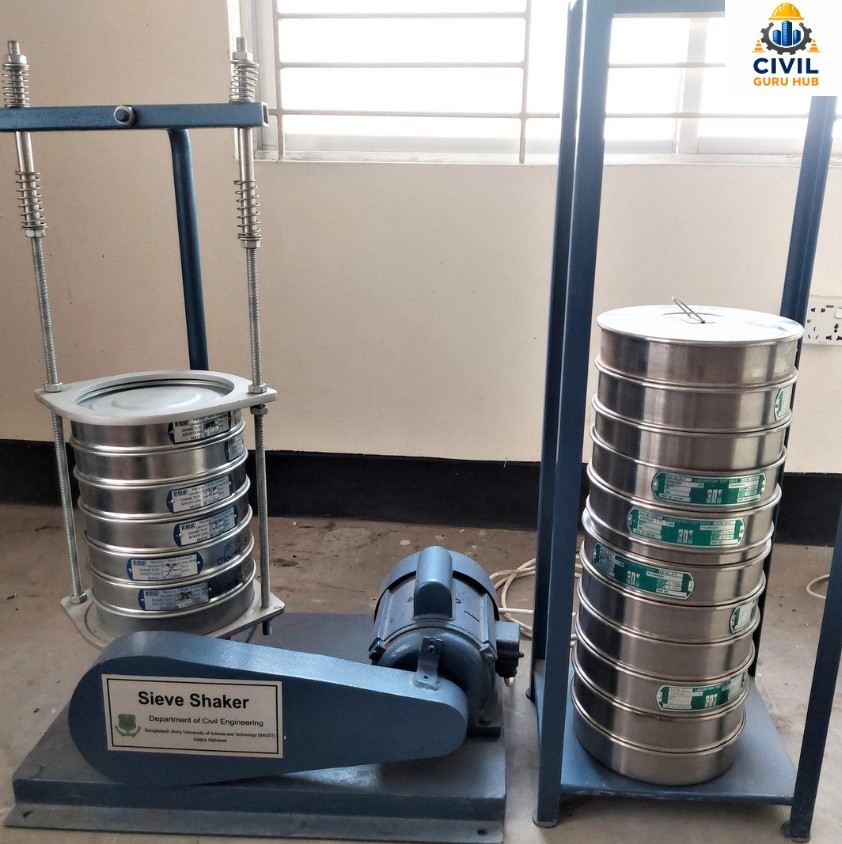
Sieve Set
Various IS sieves are used:
IS Sieve Size
80 mm
40 mm
20 mm
10 mm
4.75 mm
2 mm
600 micron
425 micron
300 micron
150 micron
75 micron
Weighing Balance
An accurate digital balance is required.
Sieve Shaker
Provides uniform shaking.
Oven
Used for drying the sample.
Brushes
For cleaning the sieves.
Tray
For sample collection.
Hydrometer
For fine-grained soil analysis.
All this apparatus must be calibrated and clean.
Sample Preparation for GSA Test
The accuracy of the GSA test depends significantly on sample preparation.
First, a representative soil sample is collected.
Detailed sample preparation procedure:
Step 1: Sample Collection
A representative sample is collected from the site.
The sample must be free from contamination.
Step 2: Drying
The sample is dried in an oven at a temperature of approximately 105°C to 110°C.
The purpose of drying is to remove moisture.
Step 3: Breaking of Lumps
Soil lumps are broken gently.
Care must be taken not to crush the particles.
Step 4: Sample Weighing
The required quantity is weighed.
| Maximum Particle Size | Sample Weight |
|---|---|
| 4.75 mm | 500 g |
| 10 mm | 1000 g |
| 20 mm | 2000 g |
| 40 mm | 5000 g |
Proper sample preparation is crucial for an accurate GSA test.
GSA Test Procedure (IS 2720 Part 4)
Now, let us understand the detailed laboratory procedure for the GSA test.
Step 1: Taking the Dry Soil Sample
First, an oven-dried soil sample is taken.
The total weight of the sample is recorded.
Example:
Total Sample Weight = 1000 g
This value will be used in the calculations.
Step 2: Sieve Arrangement
The IS sieves are arranged in descending order.
The largest sieve is placed at the top, and the smallest sieve is placed at the bottom.
Arrangement:
40 mm → 20 mm → 10 mm → 4.75 mm → 2 mm → 600 micron → 425 micron → 300 micron → 150 micron → 75 micron
A pan is placed at the bottom.
Step 3: Sample Placement
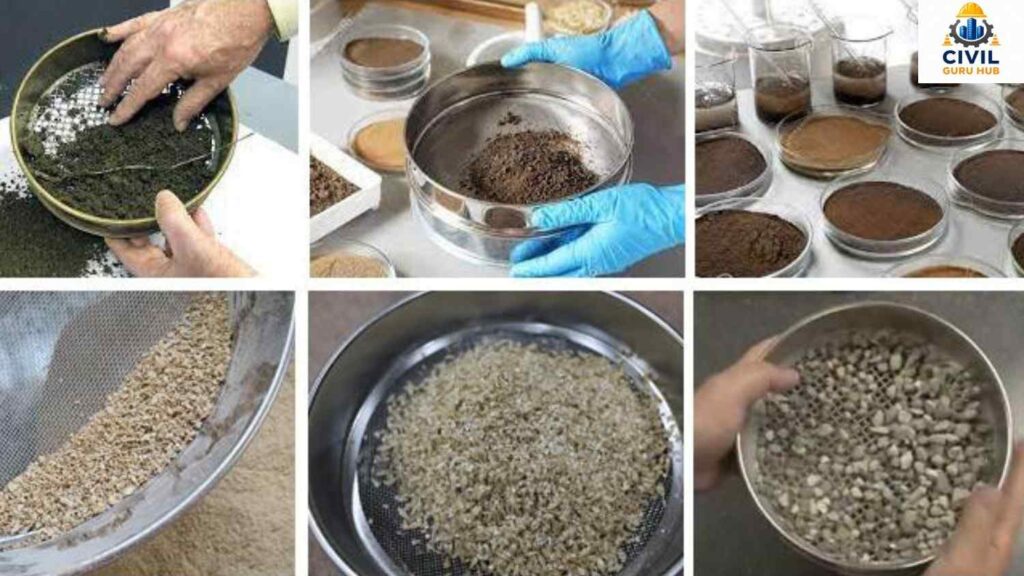
The sample is carefully placed on the top sieve.
Ensure that the sample does not spill.
Step 4: Mechanical Shaking
The sieve set is shaken in a sieve shaker for approximately 10 to 15 minutes.
Shaking causes the particles to separate according to their size.
Step 5: Collection of Retained Material
The material retained on each sieve is collected and weighed.
The weight retained on each sieve is noted in the observation table.
Step 6: Recording Observations
An accurate record of the weight retained on each sieve is maintained.
GSA calculations are performed based on this data.
Observation Table for GSA Test
| Sieve Size | Weight Retained (g) |
|---|---|
| 4.75 mm | 50 |
| 2 mm | 150 |
| 600 micron | 250 |
| 425 micron | 200 |
| 300 micron | 150 |
| 150 micron | 100 |
| 75 micron | 70 |
| Pan | 30 |
Total = 1000 g
To get more Articles regarding Quality control, Click on given link.
What are Sand Silt Content Test? 7 Easy Steps & Limits
What Are Deming’s 14 Principles of Quality Management? A complete Guide
What Are Atterberg Limits in Soil Testing? Easy Procedure in 9 Simple Steps
How is the GSA Calculation Performed?
After completing the GSA test, the most important step is converting the observations into calculations. Many students and site engineers make mistakes at this stage. Sieve analysis is not limited merely to separating soil into particles of different sizes; it is also essential to analyze that data to understand the soil’s grading and engineering properties.
In accordance with IS 2720 Part 4, after recording the weight of the material retained on each sieve, the cumulative retained percentage and the percentage passing are calculated.
Let us assume the total dry sample weight is 1000 grams.
Observation table:
| Sieve Size | Weight Retained (g) |
|---|---|
| 4.75 mm | 50 |
| 2 mm | 150 |
| 600 Micron | 250 |
| 425 Micron | 200 |
| 300 Micron | 150 |
| 150 Micron | 100 |
| 75 Micron | 70 |
| Pan | 30 |
Now, let us calculate the percentage retained.
Formula:
Percentage Retained = (Weight Retained ÷ Total Sample Weight) × 100
Example:
Percentage Retained on 4.75 mm Sieve
= (50 ÷ 1000) × 100
= 5%
Calculations are performed in the same manner for all sieves.
Next, the cumulative retained percentage is determined.
Example:
4.75 mm = 5%
2 mm = 5 + 15 = 20%
600 Micron = 20 + 25 = 45%
425 Micron = 45 + 20 = 65%
300 Micron = 65 + 15 = 80%
150 Micron = 80 + 10 = 90%
75 Micron = 90 + 7 = 97%
Percentage Passing Formula:
Percentage Passing = 100 – Cumulative Retained Percentage
Following this calculation, the particle size distribution curve is plotted. This very curve is considered the final output of the GSA test.
Detailed Calculation Table for GSA Test
| Sieve Size | Weight Retained (g) | % Retained | Cumulative % Retained | % Passing |
|---|---|---|---|---|
| 4.75 mm | 50 | 5 | 5 | 95 |
| 2 mm | 150 | 15 | 20 | 80 |
| 600 Micron | 250 | 25 | 45 | 55 |
| 425 Micron | 200 | 20 | 65 | 35 |
| 300 Micron | 150 | 15 | 80 | 20 |
| 150 Micron | 100 | 10 | 90 | 10 |
| 75 Micron | 70 | 7 | 97 | 3 |
| Pan | 30 | 3 | 100 | 0 |
This table is the most important part of the test report.
How to Create a Grain Size Distribution Curve?
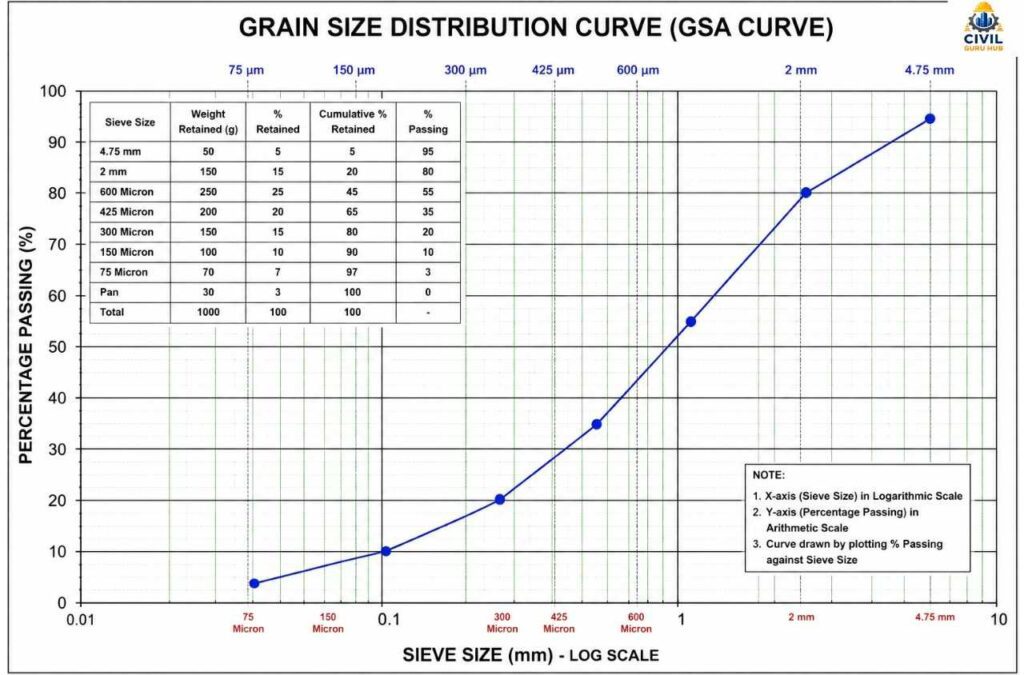
The primary objective of the GSA (Grain Size Analysis) test is to prepare a Grain Size Distribution Curve.
This curve is also frequently referred to as the Particle Size Distribution Curve.
On graph paper:
The sieve size is plotted on the horizontal axis (X-axis) using a logarithmic scale.
The percentage passing is plotted on the vertical axis (Y-axis).
A point corresponding to the percentage passing is marked for each sieve size.
Subsequently, all these points are connected to form a smooth curve.
The smoother and more continuous the curve, the better the grading is considered to be.
The GSA curve allows engineers to immediately determine whether the soil is:
- Well-graded
- Uniformly graded
- Gap-graded
- Poorly graded
The GSA curve plays a crucial role in highway embankment and pavement projects.
Even today, the GSA curve is considered a mandatory requirement in geotechnical investigation reports.
What are D10, D30, and D60?
D10, D30, and D60 are very important parameters in the GSA (Grain Size Analysis) test.
These values are derived from the Grain Size Distribution Curve.
D10
The particle size at which 10% of the material is finer is called D10.
It is also known as the Effective Size.
D30
The particle size at which 30% of the material is finer is called D30.
D60
The particle size at which 60% of the material is finer is called D60.
Suppose the following values are obtained from the GSA curve:
D10 = 0.15 mm
D30 = 0.35 mm
D60 = 0.75 mm
Now, these values will be used to calculate Cu and Cc.
Coefficient of Uniformity (Cu)
The Coefficient of Uniformity is used to evaluate soil grading in the GSA test.
Formula:
Example:
Cu = 0.75 ÷ 0.15
Cu = 5
The Coefficient of Uniformity indicates the variation in soil particle sizes.
A high Cu value indicates a wide range of particle sizes in the soil.
Such soil generally provides better compaction and strength.
Coefficient of Curvature (Cc)
In the GSA test, the Coefficient of Curvature indicates the continuity of soil gradation.
Formula:
Example:
Cc = (0.35)² ÷ (0.15 × 0.75)
Cc = 1.09
This value indicates whether the soil grading is smooth or not.
For well-graded soil, the Cc value should generally be between 1 and 3.
Identifying Well-Graded and Poorly Graded Soil
The most important outcome of the GSA (Grain Size Analysis) test is soil classification.
Well-Graded Soil
Well-graded soil contains particles of various sizes in appropriate proportions.
Characteristics:
- Good compaction
- High strength
- Minimal settlement
- Better drainage
- Suitable for highway projects
Poorly Graded Soil
Poorly graded soil consists predominantly of particles of only a few sizes.
Characteristics:
- Weak compaction
- Lower stability
- Uneven settlement
- Impact on construction quality
That is why highway engineers always carefully analyze the GSA test report.
Practical Applications of the GSA Test
The GSA Test, conducted in accordance with IS 2720 Part 4, is not merely a laboratory requirement but also a crucial component of field decision-making.
In road construction, the GSA Test is used to assess the suitability of subgrade and embankment materials.
For bridge approach filling, the GSA Test evaluates settlement and drainage characteristics.
In retaining wall backfill, the GSA Test ensures that water pressure does not build up.
In airport runway construction, the GSA Test helps improve pavement performance.
For railway embankments, the GSA Test ensures long-term stability.
Consequently, the GSA Test is considered one of the most frequently performed tests in any geotechnical laboratory.
To get more Articles regarding Quality control, Click on given link.
how to perform Proctor Test: 10 Easy Steps (Complete Guide)
how to perform Proctor Test: 10 Easy Steps (Complete Guide)
7 Major Types of Soil: A Complete Guide step-by-step
What is Hydrometer Analysis?
In a Grain Size Analysis (GSA) test, when soil particles are extremely fine smaller than the opening of a 75-micron sieve, sieve analysis alone does not yield accurate results. In such cases, Hydrometer Analysis is required. According to IS 2720 Part 4, the hydrometer method is used to determine the particle size distribution of fine-grained soils, such as silt and clay.
The principle of Hydrometer Analysis is based on Stokes’ Law. When soil particles are suspended in water, larger particles settle quickly, while smaller particles settle slowly. The particle size distribution is determined by measuring this settling behavior.
Hydrometer Analysis plays a crucial role in GSA testing because clay and silt particles are too small to be separated using standard sieve analysis.
Data obtained from Hydrometer Analysis is highly useful for understanding the engineering properties of fine-grained soils, such as plasticity, compressibility, permeability, and settlement behavior.
For projects involving road embankments, earth dams, canal linings, and foundations, the results of Hydrometer Analysis provide design engineers with vital information regarding soil behavior.
Apparatus Required for Hydrometer Analysis
In accordance with IS 2720 Part 4, specific standard apparatus are required for Hydrometer Analysis.
| Apparatus | Purpose |
|---|---|
| Hydrometer | Density Measurement |
| Measuring Cylinder | Suspension Preparation |
| Thermometer | Temperature Recording |
| Stop Watch | Time Measurement |
| Mechanical Stirrer | Soil Dispersion |
| Distilled Water | Sample Preparation |
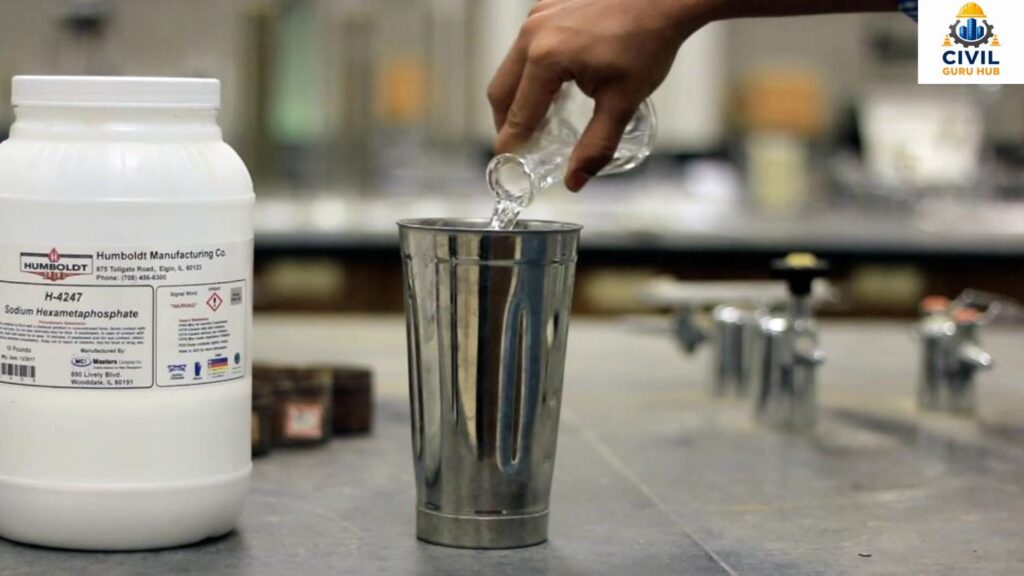
| Dispersing Agent | Particle Separation |
The accuracy of the apparatus is crucial in Hydrometer Analysis, as even a minor error can affect the final GSA test results.
Hydrometer Analysis Procedure
First, the soil sample is passed through a 75-micron sieve. Only the material that passes through the sieve is used for the hydrometer analysis.
Next, the soil is mixed with a dispersing agent. The objective of this process is to separate the soil particles to prevent flocculation.
The prepared suspension is transferred to a measuring cylinder, and distilled water is added to bring the mixture up to the required volume.
After thoroughly shaking the cylinder, a stopwatch is started.
Hydrometer readings are recorded at various time intervals.
Typically, readings are taken at:
- 0.5 minutes
- 1 minute
- 2 minutes
- 4 minutes
- 8 minutes
- 15 minutes
- 30 minutes
- 60 minutes
- 120 minutes
- 240 minutes
- 1440 minutes
The particle size distribution is determined based on these readings.
This constitutes the core procedure of the hydrometer analysis, which completes the fine fraction analysis of the GSA test.
Common Mistakes in the GSA Test
Many laboratories and students make certain common mistakes while conducting the GSA test, which can lead to inaccurate results.
The first mistake is failing to obtain a representative sample.
If the soil sample does not represent the entire site, the GSA test result may be incorrect.
A second common mistake is not drying the sample properly.
The presence of moisture can affect the retained weight.
The third mistake is neglecting to clean the sieves.
Often, particles from a previous sample remain trapped in the sieve, which can affect the new test.
The fourth mistake is breaking up lumps using excessive force.
According to IS 2720 Part 4, the particles should not be crushed.
The fifth mistake is incorrect weighing.
The digital balance must be properly calibrated.
The sixth mistake is making errors in the cumulative percentage calculation.
A calculation error can result in an incorrect grading curve.
Professional laboratories follow strict quality control procedures to avoid these mistakes.
Important Precautions for the GSA Test
It is essential to follow certain precautions when conducting Grain Size Analysis in accordance with IS 2720 Part 4.
Sample contamination must be avoided.
Oven drying should be performed within the recommended temperature range.
Sieves must be clean and free from damage.
Excessive vibration should be avoided while shaking the sample.
Material retained on each sieve must be collected carefully.
Weight measurements must be accurate.
Temperature variation should be kept to a minimum during Hydrometer Analysis.
Data should be recorded immediately in the observation table to minimize human error.
Adhering to these precautions ensures that the GSA test results are reliable and repeatable.
Recommended Equipment for Grain Size Analysis (GSA) Test
Performing the Grain Size Analysis (GSA) test accurately requires certain essential laboratory equipment. The tools and instruments listed below are commonly used in geotechnical and highway engineering laboratories. If you wish to set up your own laboratory or purchase this equipment for educational purposes, you may consider the recommended products listed below.
| Product Name | Purpose |
|---|---|
| ASTM Standard Sieve Set | Used for separating soil particles of different sizes during the Grain Size Analysis (GSA) Test. |
| Mechanical Sieve Shaker | Ensures accurate and efficient sieving of soil samples. |
| Electronic Weighing Balance | Used for precise measurement of sample weights. |
| Drying Oven | Used to dry soil samples before conducting the test. |
| Sample Trays and Brushes | Used for sample handling and cleaning of sieves after testing. |
Conclusion
The GSA Test (Grain Size Analysis Test) is a fundamental yet crucial laboratory test in soil investigation. Conducted in accordance with IS 2720 Part 4, the GSA Test accurately determines the particle size distribution of soil and provides engineers with vital information regarding soil grading, drainage characteristics, compaction behavior, and engineering suitability.
The GSA Test is utilized in virtually all civil engineering projects, including road and bridge construction, retaining walls, embankments, airport pavements, and foundation engineering. Through this test, soil can be classified into categories such as well-graded, poorly graded, or gap-graded.
Accurate sample preparation, proper sieve analysis, correct calculations, and adherence to IS 2720 Part 4 guidelines are essential for obtaining reliable results. When conducted using the correct procedure, the GSA Test contributes significantly to enhancing the safety, durability, and long-term performance of a project.
Therefore, every civil engineer, laboratory technician, and quality control engineer should possess a thorough understanding of the GSA Test procedure, calculations, and result interpretation. This test is considered the foundation of geotechnical investigation and plays a pivotal role in the success of any construction project.
About The Author
My name is Susanta Kumar Mohapatra. I am a civil engineering professional with over 11 years of practical experience in the construction and infrastructure sectors. I hold a B.Tech degree in Civil Engineering and an M.E. degree in Construction Management.
Throughout my career, I have worked in various areas such as road construction, bridge projects, quality control, material testing, quantity surveying, project planning, and site management. I am passionate about sharing practical knowledge related to highway engineering, laboratory testing, and construction management with engineers, students, and construction professionals.
I am the founder of CivilGuruHub.com, where I share technical articles, field experiences, laboratory test procedures, guidelines based on IRC and IS codes, and practical construction knowledge related to civil engineering. My aim is to explain civil engineering concepts in simple language and provide useful, reliable information to industry professionals.
You can connect with me through CivilGuruHub.com and my YouTube channel, “The Civil Site,” where I regularly share civil engineering tutorials and practical site knowledge.
Affiliate Disclaimer
Some product recommendations and links provided on Civil Guru Hub may be affiliate links. This means that if you purchase a product suggested by us through these links, we may receive a small commission at no extra cost to you. This does not affect the price you pay for the product.
Our objective is solely to provide information about useful, high-quality products related to civil engineering, highway engineering, geotechnical engineering, and other technical fields. We do not recommend any product or brand merely to earn a commission. Our priority is always to provide accurate, reliable, and useful information to our readers and the engineering community.
It is your responsibility to independently verify the specifications, reviews, and suitability of any product before purchasing it. Civil Guru Hub will not be directly liable for the quality, availability, or performance of any product.
Thank you for your trust and support. Your support encourages us to continue providing useful, high-quality engineering content.
FAQ – GSA Test (Grain Size Analysis Test)
1. What is the GSA Test?
The GSA (Grain Size Analysis) Test is a geotechnical laboratory test used to determine the particle size distribution of soil. This test reveals the proportions of gravel, sand, silt, and clay particles present in the soil.
2. What is the objective of the GSA Test?
The primary objective of the GSA Test is to understand the soil’s grading and particle size distribution. It allows for the assessment of the soil’s compaction characteristics, drainage capacity, and engineering suitability.
3. According to which Indian Standard is the GSA Test conducted?
The GSA Test is conducted in accordance with IS 2720 Part 4. This standard provides the complete procedure and calculation methods for the grain size analysis of soil.
4. Which methods are used in the GSA Test?
According to IS 2720 Part 4, two methods are used in the GSA Test:
Sieve Analysis
Hydrometer Analysis
Sieve analysis is used for coarse-grained soil, while hydrometer analysis is used for fine-grained soil.
5. What is the smallest standard sieve used in the GSA Test?
In the GSA Test, the 75-micron IS Sieve is generally the smallest sieve used. Hydrometer analysis is performed for particles smaller than this size.
6. Why is the GSA Test important in highway construction?
In highway construction, the GSA Test is conducted to evaluate the quality of subgrade, embankment, and granular layers. It enables engineers to select suitable materials and helps improve pavement performance.
7. What are D10, D30, and D60?
D10, D30, and D60 are particle sizes derived from the Grain Size Distribution Curve.
D10 = Effective Size
D30 = Intermediate Size
D60 = Representative Coarse Size
These values are used to calculate Cu and Cc.
8. What does the Coefficient of Uniformity (Cu) indicate?
The Coefficient of Uniformity (Cu) represents the variation in soil particle sizes. A higher Cu value indicates a wide range of particle sizes, suggesting that the soil is likely well-graded.
9. What is the difference between well-graded and poorly-graded soil?
Well-graded soil contains a good distribution of various particle sizes, resulting in better compaction and stability. Poorly-graded soil consists of a limited range of particle sizes, and its engineering properties are comparatively inferior.
10. In which projects is the GSA test used?
The GSA test is used in almost all civil engineering projects, such as road construction, bridge projects, retaining walls, earth dams, railway embankments, airport pavements, and building foundations. It is considered a crucial test in soil investigation.