
Table of Contents
A complete guide to Deming’s 14 Principles of Quality Management covering quality improvement, continuous learning, leadership, and modern engineering practices.
Introduction
In today’s rapidly evolving industrial and infrastructure landscape, merely manufacturing products or constructing structures is not sufficient; maintaining their long-term reliability and performance is equally critical. For this very reason, quality management has become an essential component of every industry.
Whether in civil engineering, highway construction, manufacturing, or the software sector, effective quality management is universally regarded as the bedrock of project success.
The world-renowned management expert W. Edwards Deming steered modern quality management in an entirely new direction. He articulated that simply eliminating defects through final inspections is inadequate.
True quality management is achieved only when an organization embraces continuous improvement across all levels—including planning, production, employee training, and leadership. Deming’s “14 Points” are grounded in this philosophy and continue to be followed by the world’s leading companies to this day.
Deming believed that a robust quality management system fosters long-term growth, customer trust, and operational efficiency within an organization. His principles emphasize waste reduction, teamwork, productivity enhancement, and customer satisfaction. Consequently, global organizations such as Toyota, Siemens, Tata, and L&T have successfully implemented Deming’s philosophy.
The role of quality management is equally critical in civil engineering projects. By adopting proper quality management practices in areas such as road construction, bridge works, concrete batching, pavement design, and safety operations, one can significantly reduce defects, delays, and maintenance costs.
In the construction industry, poor quality management can lead to the emergence of serious issues, including cracks, structural settlement, leakage, and outright structural failures.
Deming’s 14 Points provide organizations with a systematic framework that fosters a culture of continuous improvement. Effective quality management is not confined merely to the completion of a project; rather, it also enhances long-term durability and bolsters customer confidence.
It is for these reasons that quality management is regarded as the backbone of success in modern industries and the civil engineering sector.

Deming’s 14 Principles of Quality Management
1. Create Constancy of Purpose Toward Improvement in quality management
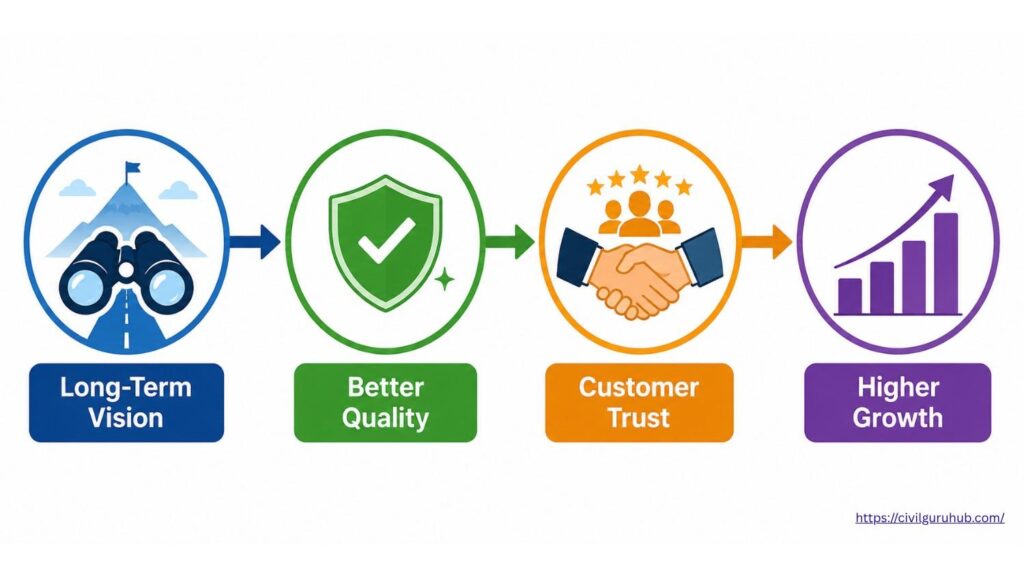
Deming’s first principle, “Constancy of Purpose,” is considered a cornerstone of Quality Management. The primary objective of this principle is to guide an organization to work towards long-term improvement and sustainable growth, rather than focusing solely on short-term profits or temporary targets. Today, many companies make decisions based solely on immediate financial gains, which negatively impacts their future performance and longevity. However, a truly successful organization is one that plans with future challenges in mind and prioritizes continuous improvement.
In the civil engineering sector, the importance of this principle is even more pronounced, as infrastructure projects are directly linked to public safety and a long service life. If, in a road, bridge, culvert, or building project, a contractor focuses exclusively on cost-cutting while disregarding quality standards, the initial construction costs may indeed be lower; however, future maintenance and repair costs could escalate significantly. For this very reason, modern Quality Management systems place special emphasis on long-term durability and performance.
For instance, in highway construction projects, the role of the drainage system is critical. If a contractor fails to provide adequate side drains, cross-drainage structures, or subgrade protection—perhaps to save on the initial budget—water infiltration will begin during the rainy season. Gradually, the pavement begins to weaken, leading to the development of issues such as cracks, potholes, rutting, and settlement. In such a scenario, the governing authority is compelled to repeatedly expend funds on repairs and rehabilitation. Consequently, IRC guidelines assign mandatory importance to drainage design and pavement protection to ensure the long-term longevity of the pavement.
Deming’s principle encourages organizations to adopt a future-oriented mindset. When a company operates with a long-term vision, its employees are also motivated to focus on continuous improvement and innovation. This approach fosters greater customer trust and strengthens the organization’s reputation. The true purpose of effective Quality Management is not merely to avoid defects, but to achieve sustainable performance.
Example Table
| Wrong Approach | Correct Approach |
|---|---|
| Cheap material use | Standard material use |
| Short-term savings | Long-term durability |
| Frequent repairs | Sustainable construction |
| Ignoring drainage system | Proper drainage planning |
| Temporary performance focus | Continuous improvement focus |
2. Adopt the New Philosophy in Quality Management
In the construction industry, success is not defined solely by the speedy completion of a project. In today’s modern infrastructure projects, the most critical element is Quality Management. According to Deming, organizations must transform their traditional management mindset, as the conventional approach historically focused exclusively on production quantity, deadlines, and short-term targets. Consequently, this approach often leads to compromised quality in numerous projects.
Previously, the primary objective for many construction companies was simply to complete a project on schedule, even if the workmanship was merely average. However, in today’s competitive landscape, clients expect structures that are durable, safe, and defect-free. For this reason, the modern philosophy of Quality Management places the highest priority on teamwork, process improvement, and customer satisfaction.
It is frequently observed at construction sites that engineers and supervisors focus solely on meeting their daily targets. If concrete is not properly vibrated, shuttering alignment is inaccurate, or compaction is inadequate, serious defects may emerge in the future. Issues such as honeycombing, surface cracks, structural settlement, and leakage are predominantly caused by poor quality control practices. Rectifying these defects incurs both additional costs and delays.
Deming’s philosophy asserts that quality should not be the sole responsibility of the QA/QC department. Every worker, site engineer, supervisor, and project manager must take personal responsibility for their work. True improvement becomes possible only when the entire organization adopts a “quality-first” mindset. A robust Quality Management culture enhances project performance over the long term and significantly reduces the need for rework.
This approach also yields a profound impact at the practical level. For instance, at a concrete batching plant, if slump tests are performed regularly and the water-cement ratio is strictly controlled, the concrete strength will remain consistent. Similarly, soil compaction tests and concrete cube testing must not be overlooked. Through proper testing and monitoring, potential defects can be identified and rectified at their nascent stages. This proactive approach constitutes a vital component of a modern Quality Management system.
Today, major infrastructure companies are leveraging digital inspection systems, comprehensive quality checklists, and Standard Operating Procedures (SOPs) to elevate the quality of workmanship. This not only enhances transparency but also ensures that accountability is rigorously maintained. The ultimate objective of the modern Quality Management philosophy is not merely the detection of defects, but more importantly their prevention.
Relevant IS Codes for Quality Control
| Work Activity | Relevant IS/IRC Code |
|---|---|
| Concrete Quality Control | IS 456:2000 |
| Soil Compaction Testing | IS 2720 |
| Highway Construction Quality | IRC SP 11 |
| Concrete Mix Design | IS 10262 |
| Cube Strength Testing | IS 516 |
3. Stop Depending on Inspection in Quality Management
A fundamental principle of Quality Management is that long-term quality cannot be achieved by relying solely on inspection. The primary function of inspection is to identify defective work; however, its objective is not to prevent defects. For this reason, modern Quality Management systems place greater emphasis on a prevention-based approach.
In construction projects, it frequently happens that defects are discovered only during the final inspection. By that stage, the major portion of the project work has already been completed, and rectifying these issues entails additional time, labor, and cost. Effective Quality Management focuses on maintaining process control right from the inception of the project, thereby ensuring that errors are avoided during the initial stages themselves.
Road construction serves as a practical illustration of this principle. If factors such as aggregate gradation, asphalt temperature, compaction, and moisture content are continuously monitored, pavement defects can be significantly reduced. Conversely, if a contractor relies exclusively on the final inspection, issues such as cracks, rutting, and uneven surfaces tend to surface at a later stage. This leads to an escalation in both repair costs and maintenance expenditures. Consequently, modern Quality Management advocates for preventive monitoring and continuous improvement.
Flow Diagram
Process Control
↓
Defect Prevention
↓
Better Quality
Final Inspection Only
↓
Defect Detection
↓
Higher Rework Cost
Graph can be made:
X-axis = Time
Y-axis = Defects
Line 1 = Inspection-based approach
Line 2 = Prevention-based approach
In Prevention approach, defects gradually reduce.
4. End the Practice of Awarding Business on Price Tag Alone
In the construction industry, awarding a contract solely to the lowest bidder is not always the right decision. Quite often, due to the reliance on the “L1 system” (lowest bidder approach), the actual quality of a project ends up being compromised. When a contractor secures a tender at an extremely low rate, they face pressure to compromise on material quality in order to preserve their profit margins. For this very reason, prioritizing robust Quality Management has become essential in modern infrastructure projects.
In today’s context, effective Quality Management entails more than just conducting inspections; it also involves ensuring the use of durable materials, skilled workmanship, and adherence to standard construction practices. If substandard cement, low-grade aggregates, or undersized reinforcement are utilized, the structural integrity of the building gradually begins to deteriorate. This leads to increased maintenance costs and can even jeopardize public safety. Consequently, experienced engineers consistently emphasize that a strong Quality Management system serves as the bedrock of long-term durability.
| Lowest Price Contractor | Quality-Oriented Contractor |
|---|---|
| Cheap materials | Standard materials |
| Poor workmanship | Skilled workmanship |
| Frequent failures | Long service life |
Its direct impact can be clearly observed in civil engineering projects. In flexible pavement construction, if a contractor fails to maintain the pavement thickness in accordance with IRC 37 guidelines, rutting and cracking begin to develop very rapidly. While a low-cost approach may appear economical initially, it results in significantly higher expenses for future repairs and rehabilitation. For this very reason, proper Quality Management and performance-based contractor selection are increasingly being regarded as the optimal approach for sustainable infrastructure development in the future.
5. Improve Constantly and Forever
According to the Deming philosophy, continuous improvement serves as the foundation of any successful project. In the construction industry, new challenges and learning opportunities arise daily; therefore, it is essential to regularly monitor and refine processes. Effective Quality Management is achievable only when site engineers, supervisors, and the management team analyze daily performance, learn from mistakes, and adopt superior methodologies.
In modern construction projects, continuous improvement has a direct impact on project quality, safety, and productivity. When a company utilizes advanced technology and up-to-date methods, its overall Quality Management system is significantly strengthened. For instance, superior surveying instruments enhance accuracy; advanced batching plants ensure concrete quality remains consistent; and drone monitoring makes site inspections faster and more reliable. Similarly, modern testing equipment aids in identifying defects at their nascent stages.
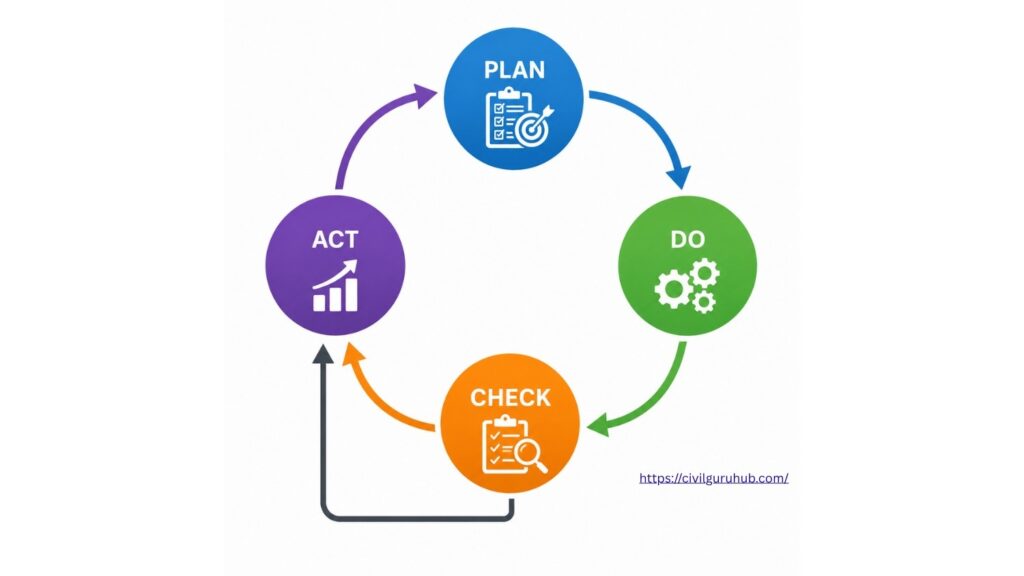
Deming’s PDCA Cycle—Plan → Do → Check → Act—is another vital tool for driving continuous improvement. Through this cycle, organizations evaluate performance at every stage and implement improvements for the future. Robust Quality Management practices not only enhance project durability but also effectively reduce the need for rework and minimize cost overruns. For these reasons, continuous improvement is regarded as the backbone of modern Quality Management.
To get more Idea about Quality control, click on given links. below.
what is Juran’s Trilogy of Quality : Explained Simply
7 Major Types of Soil: A Complete Guide step-by-step
what is Fly Ash:A complete guide step-by-step.
6.Importance of Worker Training in Quality Management
In the construction industry, it is not merely materials and machinery that are important; skilled manpower also directly impacts project quality. If workers and site engineers are not provided with proper training, the Quality Management system cannot be implemented effectively. Even today, at many construction sites, the labor force lacks proper knowledge regarding concrete vibration, compaction standards, curing processes, and material handling. Consequently, defects such as honeycombing, segregation, surface cracks, and poor compaction are observed in the structure.
The primary objective of effective Quality Management is to ensure that every construction activity is executed in accordance with standard specifications. When workers receive regular practical training, their workmanship improves, and site errors are significantly reduced. Similarly, imparting knowledge of updated construction techniques and testing procedures to engineers is also a crucial component of Quality Management.
Proper training proves highly beneficial in road construction projects as well. For instance, providing training to hot mix plant operators regarding asphalt temperature control and mixing timings enhances both pavement durability and the overall lifespan of the road. Regular workshops and on-site demonstrations further strengthen the Quality Management system.
| Training Type | Benefit |
|---|---|
| Safety Training | Accident reduction |
| Quality Training | Better workmanship |
| Equipment Training | Higher efficiency |
Real Life Example of Quality Management Through Training
In the construction projects undertaken by the Delhi Metro Rail Corporation, workers and engineers were provided with regular practical training. Special sessions were conducted focusing on concrete pouring, rebar fixing, vibration techniques, and curing methods. Thanks to this robust Quality Management approach, structural defects in the projects were observed very rarely, and construction quality was maintained in accordance with international standards.
Similarly, in several highway projects executed by the National Highways Authority of India, hot mix plant operators received training in asphalt temperature control and compaction procedures. Following this training, a noticeable improvement was observed in pavement density and road durability. This example clearly demonstrates that proper worker training plays a crucial role in ensuring the success of any Quality Management system.
7. Institute Leadership
In the construction industry, technical knowledge alone is not sufficient; strong leadership is equally important. There is a significant difference between a supervisor and a leader. A supervisor primarily ensures that instructions are followed, whereas a true leader motivates their team, builds their confidence, and manages the project smoothly. For this very reason, in modern construction projects, leadership is considered a vital component of Quality Management.
In large-scale construction projects, multiple activities—such as concreting, reinforcement work, surveying, material handling, and safety inspections—occur simultaneously. If leadership is weak, coordination issues arise, leading to project delays. Strong leadership fosters better communication, and workers perform their duties with a greater sense of responsibility. This directly enhances Quality Management and reduces the likelihood of rework.
A good leader does not merely focus on achieving targets; they also take the time to understand and address the workers’ concerns. They ensure safety, uphold quality standards, and encourage teamwork. When workers feel motivated, productivity increases automatically. Effective leadership strengthens the Quality Management process and mitigates the risk of project defects.
In today’s competitive construction sector, strong leadership grounded in Quality Management alongside technical skills is absolutely essential for the successful execution of projects.
| Situation | Result |
|---|---|
| Poor Leadership | Delay, confusion, defects |
| Effective Leadership | Better coordination, high quality work |
Real Life Example
Consider a highway bridge construction project where concreting work was being carried out continuously. During the initial phase of the project, the site supervisor merely issued instructions to the workers; however, there was a lack of proper coordination and motivation. Consequently, recurring issues such as labor confusion, material delays, and defects in concrete finishing became frequent occurrences. Rework increased, and the project schedule began to fall behind. In this scenario, Quality Management was not being implemented effectively.
Subsequently, the company appointed an experienced project leader who initiated daily team meetings, resolved issues faced by the workers, and placed a strong focus on both safety and quality standards. The leader improved communication channels among the engineers, supervisors, and labor teams. Following these measures, the quality of the concrete improved, material wastage decreased, and the pace of work accelerated. This example demonstrates that effective leadership directly enhances Quality Management and boosts project productivity.
8. Drive Out Fear in Quality Management
Effective Quality Management in the construction industry is possible only when employees can openly share their concerns without fear. In many organizations, workers or site engineers conceal actual issues due to management pressure, a blame culture, or job insecurity. While a project may appear to run smoothly in the short term, these very hidden defects can lead to serious structural failures in the long run.
For instance, if compaction is inadequate in a road project—and the site engineer fails to report the issue despite being aware of it—it can lead to pavement settlement, cracking, and significantly increased maintenance costs in the future. Therefore, the primary objective of a robust Quality Management system is not merely to conduct inspections, but also to cultivate a work culture founded on trust.
In a healthy communication environment, workers confidently and immediately report unsafe practices, material defects, or execution errors. This enhances project quality and minimizes the need for rework. Effective Quality Management consistently fosters teamwork, transparency, and a problem-solving approach, rather than a culture of blame.
Fear-Free Environment → Better Communication → Early Problem Detection
9. Break Down Barriers Between Departments
In the construction industry, successful project delivery does not depend solely on machinery, manpower, or budget. True success is achieved when every department works in proper coordination with one another. Often in projects, the design team, procurement team, QA/QC team, and site execution team operate in isolation. This creates a communication gap that directly impacts project performance. For this very reason, the role of Quality Management has become critically important in modern construction projects.
When information is not shared smoothly between departments, outdated drawings may be utilized, incorrect materials may be ordered, and unnecessary rework on-site increases. These issues not only lead to project delays but also drive up project costs. Effective Quality Management ensures that every team operates based on up-to-date information and in alignment with common project goals.
In today’s infrastructure projects, integrated teamwork is essential. Regular coordination meetings, shared reports, and digital collaboration tools enhance transparency among departments. Robust Quality Management practices reduce communication barriers, thereby improving both productivity and construction quality. When all teams function as a cohesive unit, project execution becomes faster, safer, and more efficient. This coordination-based approach is considered a major pillar of modern Quality Management.
| Department Issue | Project Impact | Quality Management Solution |
|---|---|---|
| Poor communication | Rework and delays | Regular coordination meetings |
| Wrong drawings | Construction errors | Centralized document control |
| Material delay | Work stoppage | Better procurement planning |
| Lack of teamwork | Reduced productivity | Integrated project collaboration |
Design Team ↔ Site Team ↔ QA/QC ↔ Procurement
To get more knowledge about Quality control, click on given links. below.
how to perform Proctor Test: 10 Easy Steps (Complete Guide)
FDD test: what is it? complete process and calculation.
10. Eliminate Slogans and Unrealistic Targets in Quality Management
In the construction industry, merely displaying motivational slogans does not result in actual improvement. Slogans such as “Do Better Work,” “Zero Defects,” or “Finish Fast” may sound appealing, but they yield no practical benefit if workers are not provided with proper training, modern equipment, and clear work procedures. The primary objective of effective Quality Management is not merely to meet targets, but to ensure long-term, durable, and safe construction.
At many construction sites, management sets unrealistic deadlines and ambitious daily targets. Consequently, workers operate under immense pressure, leading to the neglect of critical quality checks. Effective Quality Management is achievable only when planning is realistic and the workforce receives adequate support.
For instance, in a highway paving project, if an excessively high daily paving target is imposed, the contractor may rush through compaction testing, temperature monitoring, and surface finishing. This compromises the road’s durability and can lead to an increase in cracks, rutting, and maintenance issues in the future. A robust Quality Management system always prioritizes a balance between productivity and quality control.
Therefore, instead of relying on slogans, companies should focus their attention on training, supervision, inspection, and continuous improvement. This approach serves to strengthen sustainable Quality Management practices.
Real Life Example of Poor Quality Management
This issue has been observed in numerous road construction projects across India, where contractors were assigned excessively high daily targets to expedite project completion. In one specific highway resurfacing project, there was immense pressure to complete the work before the onset of the monsoon season. Due to this pressure, the hot mix asphalt was not maintained within the proper temperature range, and the compaction process was also rushed. Surface testing and density checks were likewise conducted at a limited scope.
Consequently, cracks and potholes began to develop on the road surface within just a few months. Infiltration of rainwater weakened the pavement layers, leading to a significant increase in maintenance costs. Subsequent investigations revealed that unrealistic targets and lax quality management practices were the primary contributing factors.
Had a proper Quality Management system been adhered to—including the establishment of a realistic work schedule and the allocation of sufficient inspection time for site engineers—these defects could have been avoided. This example clearly demonstrates that speed is not the sole priority in construction projects; effective Quality Management focuses on delivering infrastructure that is durable, safe, and long-lasting.
11. Eliminate Numerical Quotas in Quality Management
In the construction industry, focusing solely on numerical targets often negatively impacts the actual quality of a project. When workers and supervisors are evaluated solely on the basis of daily output or production figures, their primary focus shifts toward completing the work as quickly as possible. In such a scenario, the quality of workmanship, safety standards, and long-term durability may be compromised. For this very reason, modern Quality Management systems assign limited importance to numerical quotas and place a greater emphasis on overall performance quality.
For instance, if a labor team is assigned a target of simply laying “100 blocks per day,” they may make errors in alignment, curing, finishing, or material handling in an effort to maintain that pace. While the project may appear to be progressing rapidly at the outset, this can lead to an increase in cracks, leaks, and maintenance issues in the future. The objective of effective Quality Management is not merely to achieve quantitative targets, but rather to ensure sustainable and defect-free work.
In contemporary construction projects, companies are increasingly adopting quality-based evaluation systems that accord equal importance to safety, innovation, teamwork, and workmanship. This approach not only boosts employee motivation but also significantly reduces the costs associated with rework. Robust Quality Management practices enhance both long-term client satisfaction and project reliability. Consequently, successful organizations prioritize maintaining a balance between quantity and quality. Ultimately, effective Quality Management serves to improve both a project’s reputation and its profitability.
| Performance Factor | Percentage |
|---|---|
| Quality | 40% |
| Safety | 30% |
| Productivity | 20% |
| Innovation | 10% |
12. Remove Barriers to Pride of Workmanship in Quality Management
In the construction industry, the success of any project depends not solely on drawings and machinery, but also on the workmanship and dedication of the workers. Therefore, a fundamental principle of Quality Management asserts that employees should take pride in their work. When workers are provided with a conducive environment, safe working conditions, and high-quality tools, their confidence naturally improves.
If defective materials are utilized at the site, machinery is not properly maintained, or unrealistic deadlines are imposed, even skilled workers are unable to deliver quality output. In such a scenario, instances of errors, rework, and material wastage begin to escalate. The objective of effective Quality Management is not merely to conduct inspections, but also to provide support to workers, thereby enabling them to deliver their best performance.
In civil engineering projects, the contribution of masons, bar benders, welders, and machine operators is of paramount importance. Their skills directly influence the durability and finishing of the project. When a company provides appropriate equipment, training, and a respectful work culture, the standard of workmanship improves significantly. Robust Quality Management practices also serve to boost worker motivation and enhance the overall quality of the project. For this very reason, modern construction companies regard employee satisfaction as an integral component of Quality Management.
Real Life Example
In a highway project, contractors initially utilized low-quality bricks and outdated machinery, which led to cracks and uneven finishing in the wall construction. The workers were also working under pressure due to an unrealistic deadline, resulting in an increase in rework.
Subsequently, the management implemented Quality Management—providing high-quality materials, introducing modern equipment, and establishing a realistic timeline. As a result, the workers performed with greater confidence, and the final structure turned out to be smooth, durable, and defect-free.
13. Institute Education and Self-Improvement
In today’s modern construction industry, the role of “Institutional Education and Self-Improvement” has become paramount. Technology is evolving at a rapid pace; therefore, continuous learning is essential for engineers and site professionals. In particular, understanding and applying new tools and digital techniques has become mandatory for strengthening Quality Management. Today, systems such as BIM technology, drone surveys, GPS machine control, and AI-based monitoring are making construction processes smarter. These tools not only save time but also enhance accuracy—factors that directly bolster Quality Management.
If an engineer stays consistently updated, they can identify and rectify site-related issues proactively, thereby minimizing rework and keeping costs under control. In this process, Quality Management acts as a backbone, ensuring that the entire project adheres to established standards and remains safe. Through modern education and self-improvement, engineers also enhance their decision-making and planning capabilities—attributes crucial for long-term success. Consequently, every professional should embrace continuous learning to ensure that Quality Management is upheld and that projects are completed to the highest standards.
14. Put Everybody to Work for Transformation
Quality improvement is not solely the responsibility of top management; rather, it is a shared responsibility of the entire organization. Real transformation is not possible unless individuals at every level are actively involved. Effective Quality Management is achieved only when management is committed to a clear vision and actively supports continuous improvement. Engineers play a critical role, as they are responsible for designing and monitoring processes. Workers are equally important, as the actual execution lies in their hands; therefore, providing them with proper training is essential. Suppliers must also be integrated into the system to ensure the consistent quality of raw materials.
For sustainable improvement, Quality Management must evolve from being merely a policy into a deeply ingrained culture. When every employee understands and accepts their responsibilities, defects decrease and productivity rises. Effective coordination and communication also serve to strengthen this process. Ultimately, an organization achieves success only when every stakeholder is fully aligned.
| Level | Responsibility | Impact on Quality |
|---|---|---|
| Management | Strategy & commitment | High |
| Engineers | Process control | High |
| Workers | Execution | Critical |
| Suppliers | Material quality | Medium to High |
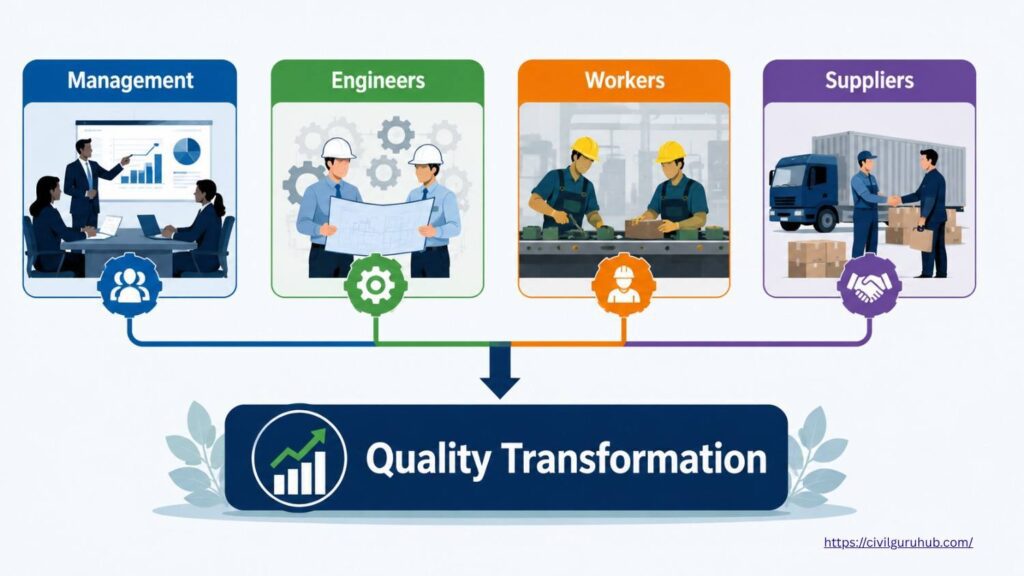
Quality transformation process flow
Real-Life Example of Deming Principles
- The Japanese automobile industry achieved world-class quality by adopting the principles of Dr. W. Edwards Deming. The core focus of these principles lies in continuous improvement, defect prevention, and process control. The most powerful example of this is the Toyota Production System, where production is controlled not merely as a matter of output, but through the lens of Quality Management.
- Toyota adopted “Kaizen”—meaning continuous improvement—within its system, allowing every process to progressively improve, step by step. This approach enabled the prevention of defects right at the production stage, thereby significantly reducing the need for rework and minimizing wastage. For this very reason, Toyota’s Quality Management system has become a global benchmark.
- Today, this same concept is being applied within the civil engineering sector as well. Robust Quality Management systems are implemented in large-scale infrastructure projects—such as highways, metro rail networks, and bridges—to ensure that materials, design, and construction adhere to established standards at every stage. This approach serves to minimize project delays and failures.
- The most significant benefit of Deming’s principles is that they facilitate a shift from an inspection-based system to a preventive one. Consequently, modern construction companies are adopting rigorous Quality Management practices in their projects to ensure long-term durability and safety.
Advantages of Deming’s Principles
| Advantage | Impact |
|---|---|
| Better quality | Customer satisfaction |
| Reduced defects | Lower repair cost |
| Employee involvement | Higher productivity |
| Continuous improvement | Long-term growth |
Challenges in Implementation
- Implementing Deming’s principles in real-life projects is not an easy task, especially when an organization adheres to a traditional working style. While the focus of these principles lies on long-term improvement, numerous practical challenges must be confronted during the initial stages.
- The primary challenge is resistance to change, wherein both employees and management exhibit hesitation in accepting the new system. Another major issue is inadequate training; if workers do not receive proper knowledge, the Quality Management system cannot be implemented effectively. Similarly, a lack of leadership serves as a significant obstacle, as sustaining Deming’s principles becomes difficult without strong leadership guidance.
- Additional challenges—such as budgetary constraints and time pressures—further complicate project execution. Organizations often prioritize short-term deliverables, a practice that can lead to compromises in Quality Management.
- Nevertheless, despite all these challenges, the long-term impact of Deming’s principles is profoundly powerful. Once a robust Quality Management system is established, productivity increases, defects decrease, and overall project efficiency improves—factors that ensure sustainable growth for any organization.
Conclusion
Deming’s 14 Principles of Quality Management are not merely industrial theory; rather, they constitute a practical management philosophy capable of transforming any organization. The primary objective of these principles is long-term improvement, customer satisfaction, and defect prevention.
In the fields of civil engineering and the construction industry, the significance of these principles is even greater, as infrastructure projects are directly linked to public safety and national development. If Deming’s principles are applied effectively in highway construction, bridge works, concrete structures, and project management, the quality, durability, and efficiency of projects can improve dramatically.
In today’s modern engineering landscape, neither low cost nor rapid completion is the sole priority. Sustainable quality, safety, and reliability are equally important. For this very reason, Deming’s philosophy provides a powerful foundation for future infrastructure development.
Frequently Asked Questions (FAQs) on Quality Management
1. What is Quality Management in construction projects?
Quality Management in construction projects is a systematic approach to ensure that all activities, materials, and processes meet defined standards and specifications. It focuses on preventing defects, improving durability, and delivering safe infrastructure rather than just inspecting finished work.
2. Why is Quality Management important in civil engineering?
Quality Management is important in civil engineering because it ensures the long-term strength, safety, and performance of structures like roads, bridges, and buildings. It reduces maintenance costs, prevents failures, and improves overall project reliability.
3. How does Quality Management improve project efficiency?
Quality Management improves project efficiency by reducing rework, minimizing errors, and ensuring proper planning and execution. When processes are controlled from the beginning, time, cost, and material wastage are significantly reduced.
4. What is the role of workers in Quality Management?
In Quality Management, workers play a crucial role as they directly execute construction activities. Their skills, training, and awareness determine the actual quality of work, making proper training and supervision essential for success.
5. How does Deming’s philosophy relate to Quality Management?
Deming’s philosophy of Quality Management emphasizes continuous improvement, leadership, teamwork, and defect prevention. His 14 principles help organizations shift from inspection-based systems to prevention-based quality control systems.
6. What are the main challenges in implementing Quality Management?
The main challenges in Quality Management include resistance to change, lack of training, weak leadership, budget limitations, and time pressure. Despite these challenges, long-term benefits make it highly valuable for any organization.