
Table of Contents
introduction:
Fly ash has become a very important material in the construction industry today. This by-product from thermal power plants is not just waste but a valuable construction material that improves the durability, strength, and sustainability of concrete.
In this blog, we will study in detail the types, classes, properties, uses of fly ash, and its various standards such as IS, IRC, MORTH, and ASTM.
What is fly ash?
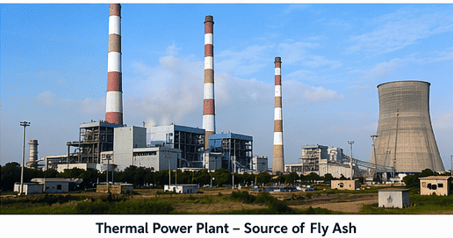
Fly ash is a fine powder that thermal power plants produce after coal combustion.
When operators burn pulverized coal at high temperatures, non-combustible particles rise with the flue gases and collectors gather them through electrostatic precipitators – this is called fly ash.
Its particle size is finer than cement and its color can range from gray to dark gray.
Types of Fly Ash (Classification)
Fly Ash mainly classifies on the basis of:
On the basis of chemical composition
- Class F Fly Ash
- Class C Fly Ash
On the basis of Collection Process
- Dry Fly Ash
- Bottom ash
- Pond Ash
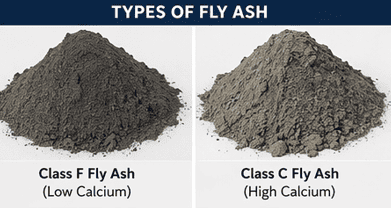
What are Class F and Class C fly ash?
Class F Fly Ash
Class F Fly Ash is a low-calcium ash produced from bituminous coal.
It has a high silica, alumina, and iron oxide content, and a calcium oxide (CaO) content generally less than 10%.
Properties
Class F Fly Ash is a pozzolanic material, meaning it does not exhibit inherently cementing properties. It requires calcium hydroxide (lime) for hydration.
Usage
Class F Fly Ash is most commonly used in structural concrete and durability-based applications. It is sulfate-resistant and performs best in aggressive environments.
Where does it use?
- Mass concrete structures such as dams
- Marine structures
- Pavements and highways
- RCC structures where durability is important
Class C Fly Ash
Class C Fly Ash is a high-calcium ash produced from sub-bituminous or lignite coal.
It has a calcium oxide (CaO) content of 15% or more.
Properties
Class C Fly Ash possesses pozzolanic and self-cementing properties. This means it can react like cement upon contact with water.
Usage
Contractors use Class C Fly Ash for fast construction and early strength development.
Where is it used?
- Road base and subbase
- Soil stabilization
- Precast concrete
- Low-strength concrete works
To get knowledge about Types of Cement used in construction, click on given link.
Types of Cement in Civil Engineering
| Parameter | Class F | Class C |
| Calcium Content | Low (<10%) | High (>15%) |
| Cementing Nature | Non self-cementing | Self-cementing |
| Heat of Hydration | Low | Moderate to High |
| Sulphate Resistance | High | Moderate |
| Durability | Excellent | Moderate |
| Setting Time | Slow | Faster |
Class F vs Class C (Difference)
The difference between Class F and Class C is their calcium content and behavior. Class F provides more durable and long-term strength, while Class C is better for early strength and fast setting.
Class F requires external lime for hydration, while Class C is self-cementing.
Physical Properties
The properties of fly ash depend on its source and combustion process.
- Fineness : The particle size of fly ash is finer than cement. Its fineness improves the workability of concrete.
- Shape : The particles are spherical, which creates a ball bearing effect and makes the mix workable.
- Color : Varies from light gray to dark gray.
- Specific Gravity : Generally ranges from 2.1 to 2.6.
Chemical Properties
Fly ash is mainly composed of silica (SiO₂), alumina (Al₂O₃), iron oxide (Fe₂O₃) and calcium oxide (CaO).
Class F has more silica and alumina, while Class C has a higher calcium content.
Engineering Properties of Fly Ash
Fly ash significantly improves the performance of concrete:
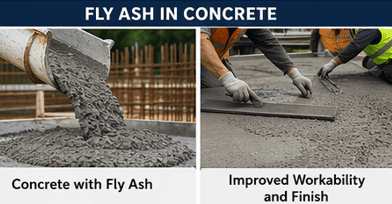
- Spherical particles provide lubrication, which improves concrete workability.
- The reduction of heat of hydration reduces cracking in mass concrete.
- The reduction of permeability increases durability.
- The increase in long-term strength contributes to enhanced performance.
Uses of Fly Ash (Application in Construction)
Fly ash has a wide range of uses.
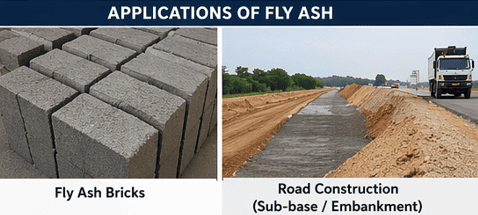
- Companies use it as a cement replacement in concrete. This reduces costs and improves durability.
- In road construction, engineers use fly ash for embankment and subgrade.
- For soil stabilization, Engineers use fly ash to strengthen weak soil.
- Manufacturers also use fly ash in the manufacture of bricks and blocks, which are eco-friendly.
Fly Ash in Concrete
- It is generally used as a cement replacement at 15% to 35%.
- In high-volume fly ash concrete (HVFA), it can exceed 50%.
- Class F is best for durability, while Class C is useful for early strength.
Advantages
- The biggest advantage is that it is an eco-friendly material. Fly ash converts industrial waste into a useful product.
- It increases the durability of concrete and reduces permeability.
- Reduces shrinkage and cracking.
- Cost-effective because the cement requirement is reduced.
Disadvantages of Fly Ash
- Fly ash’s initial strength develops slowly, especially in Class F.
- Sources may vary in quality.
- Cold weather increases setting time.
Relevant standards of fly ash (IS, IRC, MoRTH, ASTM)
IS Standards (Indian Standards)
Some important IS codes for regulating the use of fly ash in India are:
- IS 3812 (Part 1): 2013 – Fly Ash for use in concrete, This standard defines the physical and chemical requirements of fly ash.
- IS 3812 (Part 2): 2013 – Fly Ash for use as admixture in mortar and concrete.
IRC Guidelines
The use of fly ash in road construction is guided under IRC: SP-58.
It provides guidelines for fly ash embankment, subgrade and pavement design.
MoRTH Specifications
MoRTH (Ministry of Road Transport and Highways) promotes the use of Fly Ash.
MORTH Section 305 – Embankment construction with Fly Ash
In this, specifications of compaction, moisture control and layer thickness of Fly Ash are provided.
ASTM Standards
Internationally, ASTM standards for fly ash are followed:
- ASTM C618 – Standard Specification for Coal Fly Ash, This defines Class F and Class C classifications.
- ASTM C311 – Testing methods for fly ash
Fly Ash Testing (Important Lab Tests)
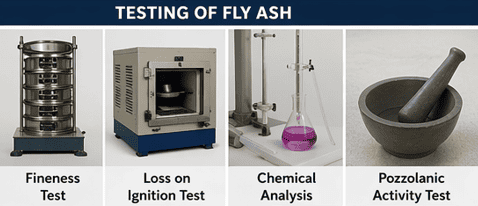
It is important to check the quality of fly ash before using it.
- Particle size should check using a fineness test (Blaine air permeability method).
- Unburnt carbon content is measured using a Loss on ignition (LOI) test.
- Silica, alumina, and calcium content are checked using a chemical analysis.
- Reactivity is measured using a pozzolanic activity test.
Environmental Impact
The use of fly ash benefits the environment.
- It reduces landfill waste.
- It reduces CO₂ emissions because it reduces cement production.
- It conserves natural resources.
Conclusion
In contemporary times, It has emerged as a vital material in the civil engineering and construction industries. Once considered merely a waste product of thermal power plants, it is now a key component of sustainable construction. Its use not only enhances the quality and durability of concrete but also reduces cement consumption, making construction projects more economical and environmentally friendly.
Both Class F and Class C possess distinct characteristics and applications. Class F is valued for its durability, sulphate resistance, and long-term performance, whereas Class C is a superior choice for early strength development and fast-track construction projects. Selecting the appropriate type of fly ash based on specific project requirements is crucial.
It is being successfully utilized in various sectors, including road construction, embankments, soil stabilization, concrete production, and the manufacturing of fly ash bricks. Its spherical particles improve concrete workability, reduce permeability, and extend the service life of structures. Consequently, the use in modern infrastructure projects is steadily increasing.
Quality control and testing in accordance with IS, IRC, MoRTH, and ASTM standards are equally important to ensure the safety and performance of the construction. Overall, It is a sustainable, cost-effective, and high-performance construction material destined to play a pivotal role in future green construction technologies. Every civil engineer should possess a thorough understanding of the properties, uses, and standards associated with fly ash to enable the construction of durable and eco-friendly structures.
About the Author
My name is Susanta Kumar Mohapatra. I am a civil engineering professional with over 11 years of practical experience in the construction and infrastructure sectors. I hold a B.Tech degree in Civil Engineering and an M.E. degree in Construction Management.
Throughout my career, I have worked in various areas such as road construction, bridge projects, quality control, material testing, quantity surveying, project planning, and site management. I am passionate about sharing practical knowledge related to highway engineering, laboratory testing, and construction management with engineers, students, and construction professionals.
I am the founder of CivilGuruHub.com, where I share technical articles, field experiences, laboratory test procedures, guidelines based on IRC and IS codes, and practical construction knowledge related to civil engineering. My aim is to explain civil engineering concepts in simple language and provide useful, reliable information to industry professionals.
You can connect with me through CivilGuruHub.com and my YouTube channel, “The Civil Site,” where I regularly share civil engineering tutorials and practical site knowledge.
Frequently Asked Questions (FAQs)
1. What is Fly Ash?
Fly Ash is a fine powder produced after burning coal in thermal power plants. It is used in concrete, road construction, embankments, and brick manufacturing.
2. What is the difference between Class F and Class C Fly Ash?
Class F Fly Ash has low calcium content and is pozzolanic in nature, whereas Class C Fly Ash has high calcium content and possesses self-cementing properties.
3. Why is Fly Ash used in concrete?
Fly Ash improves the workability, durability, and long-term strength of concrete. It also reduces the heat of hydration and lowers the risk of cracking.
4. What percentage of Fly Ash is used in concrete?
Generally, 15% to 35% Fly Ash is used in concrete as a replacement for cement. In High Volume Fly Ash Concrete, this percentage can exceed 50%.
5. What are the benefits of Fly Ash?
Fly Ash enhances concrete durability, reduces permeability, lowers cement consumption, cuts costs, and supports environmentally friendly construction.
6. What are the disadvantages of Fly Ash?
Fly Ash results in slower early-stage strength development; its quality can vary depending on the source, and the setting time may increase in cold weather.
7. How is Fly Ash used in road construction?
In road construction, Fly Ash is used for embankments, subgrades, soil stabilization, and pavement layers. It reduces construction costs and improves performance.
8. Which standards apply to Fly Ash in India?
The primary standards for Fly Ash in India are IS 3812 (Part 1 & Part 2), IRC SP-58, and MoRTH Section 305. ASTM C618 and ASTM C311 standards are followed at the international level.
9. How is the quality of fly ash tested?
Tests such as fineness, loss on ignition (LOI), chemical analysis, and pozzolanic activity are conducted to assess the quality of fly ash.
10. Is fly ash beneficial for the environment?
Yes, fly ash converts industrial waste into useful material, reduces landfill waste, decreases the demand for cement production, and helps lower CO₂ emissions.
11. What is the primary use of fly ash?
Fly ash is primarily used in concrete production, road embankment construction, soil stabilization, and the manufacturing of fly ash bricks. It improves both the quality and sustainability of construction.