
Last Updated: June 2026
Table of Contents
Introduction
In the civil engineering industry, a Project Manager’s role extends far beyond merely approving drawings or attending office meetings. In real-world construction projects, a Project Manager plays a pivotal role at every stage from initial planning right through to final execution. Whether highway construction, bridge projects, building works, or large scale infrastructure development is involved, effective project management significantly determines the ultimate success of a project.
In today’s competitive construction sector, companies look beyond mere academic qualifications; they emphasize practical knowledge and management skills equally. A successful Project Manager must simultaneously handle a multitude of responsibilities, including project scheduling, resource allocation, cost control, communication, quality assurance, and safety management. Daily challenges inevitably arise on-site, and the ability to manage these situations efficiently shows the true strength of an experienced Project Manager.
Construction projects typically demand completion within strict timelines and fixed budgets. If planning is weak, communication gaps exist, or resource management is inadequate, delays and cost overruns commonly occur. Consequently, the modern civil engineering industry strongly focuses on integrating practical management skills with technical expertise.
In this detailed guide, we will explore the topic “What Skills Does a Civil Engineering Project Manager Need? 12 Essential Skills” in depth, utilizing practical site examples, industry best practices, management concepts, and real-world construction scenarios. Furthermore, you will discover which tools, software, and field equipment assist a Project Manager in their daily tasks and learn through professional recommendations—how to utilize them most effectively.
1. Leadership Skill – A Project Manager’s Most Powerful Quality
The success of any construction project does not depend solely on drawings, machinery, or manpower; rather, it also hinges on the capability of the Project Manager leading the project. Daily challenges inevitably arise at the site, and effectively handling such situations is an integral part of strong leadership.
A skilled Project Manager is not merely someone who issues instructions. Their role is to align the entire team toward a common goal. In construction projects, various personnel including site engineers, QA/QC engineers, billing engineers, surveyors, safety officers, and contractors handle distinct responsibilities. Synchronizing all these departments to maintain a smooth workflow constitutes the most critical responsibility of leadership.
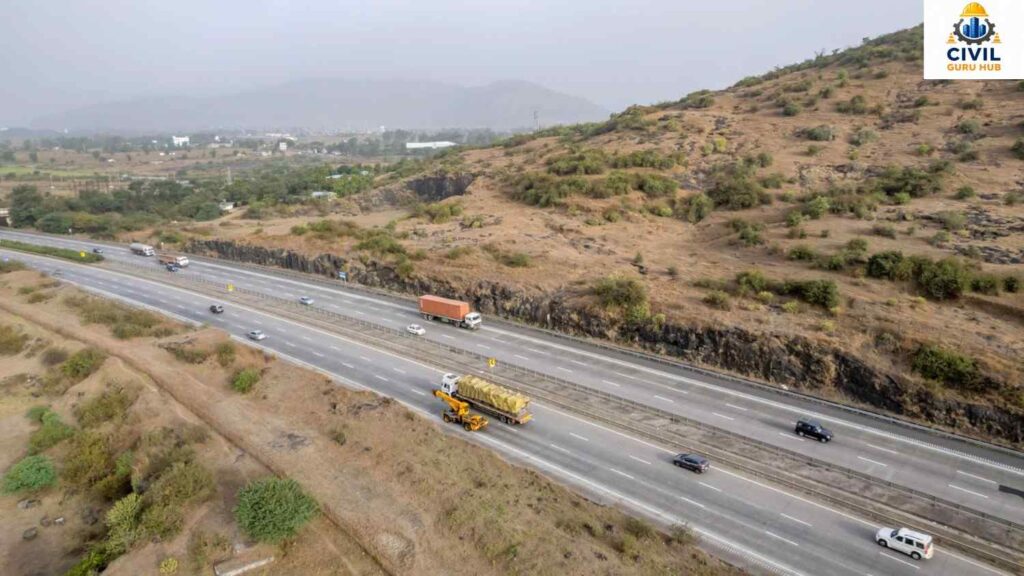
In practical site conditions, leadership becomes even more vital. For instance, if heavy rainfall delays earthwork on a highway project, the Project Manager must immediately formulate an alternative plan. Through smart planning—such as initiating drainage work, culvert construction, or retaining wall activities in parallel, project progress can be effectively maintained.
Managing daily labor, allocating resources, and maintaining productivity at construction sites also constitute a major component of leadership. When conflicts arise or emergency situations develop, swift decision-making saves the project from incurring major losses.
Leadership skills generally encompass the following key capabilities:
- Decision-making ability
- Team motivation
- Conflict resolution
- Emergency handling
- Productivity management
An experienced Project Manager understands that successful project execution cannot be achieved through technical knowledge alone. It is strong leadership, effective communication, and timely decisions that significantly mitigate project delays and quality issues. For this very reason, leadership is regarded as the most powerful attribute of every successful Project Manager
2. Communication Skills – The Backbone of Every Successful Project Manager
Communication is considered the backbone of the construction industry; for this very reason, possessing strong communication skills is absolutely essential for every successful Project Manager. In any construction project, multiple teams work in tandem—including engineers, contractors, laborers, consultants, and clients. If communication lacks clarity, even minor errors can escalate into significant financial losses.
An efficient Project Manager must maintain proper communication at every level. Understanding client expectations, coordinating with contractors, issuing instructions to labor teams, and conducting meetings with consultants are all integral parts of their daily responsibilities. Consequently, communication skills are counted among a Project Manager’s most valuable attributes.
To cite a practical example: imagine that M25 grade concrete was specified for use at a site, but the batching plant mistakenly supplied a lower grade instead. If the Project Manager fails to share this information in a timely manner—and does not immediately alert the concerned teams—there is a significant risk that the entire concrete slab may have to be rejected. In such situations, rapid and accurate communication serves to safeguard the project against major financial losses.
In construction projects, communication primarily takes two forms:
- Verbal Communication
- Written Communication
Verbal communication is crucial for meetings, toolbox talks, and issuing on-site instructions, whereas written communication is indispensable for documentation and securing approvals. A professional Project Manager ensures project transparency by diligently maintaining daily reports, approval records, and general documentation.
Important Documents Managed by Project Manager
| Document Type | Purpose |
|---|---|
| DPR | Daily work progress tracking |
| RFI | Clarification request |
| MOM | Meeting records |
| Inspection Request | QA/QC approval |
| Work Permit | Safety authorization |
Daily Progress Reports (DPRs), approvals for Bar Bending Schedules, RFI submissions, and site instructions predominantly fall under the purview of written communication. For this very reason, industry standards and project specifications regard comprehensive documentation and effective communication as critical factors for project success. Ultimately, it can be said that a skilled Project Manager does not merely manage the work itself; rather, through the power of effective communication, they ensure the smooth and seamless execution of the entire project.
To get More knowledge about Project Management, Click the links given below and read articles.
What Makes Green Roads Sustainable? 10 Secrets
What Are the 15 Most Important Project Management Skills for Civil Engineers in 2026?
What is Time Management? 10 Proven Project Management Tips
3. Planning and Scheduling Skills
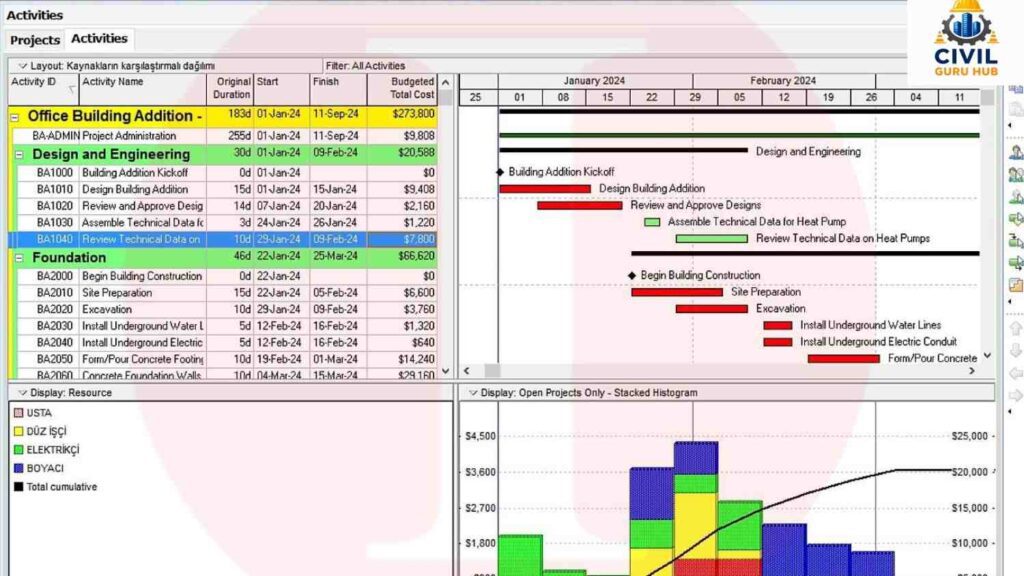
The hallmark of a successful Project Manager is their planning capability. In the construction industry, planning is regarded as the roadmap for a project; without proper planning, resources can be wasted, delays may occur, and project costs can escalate. Consequently, a skilled Project Manager always prioritizes detailed planning and scheduling before a project even commences.
The primary objective of planning is to ensure that every project activity is executed in the proper sequence. This process involves considering multiple factors, such as material availability, manpower requirements, machinery utilization, and budget management. If planning is weak, unnecessary delays and resource conflicts can easily arise at the project site.
The planning process generally encompasses the following key activities:
- Material planning
- Labor planning
- Equipment scheduling
- Financial planning
- Activity sequencing
In highway construction projects, planning and scheduling become even more critical, as multiple activities often proceed in parallel. An experienced Project Manager must ensure that all activities are executed with proper coordination.
Typical highway project activities include:
- Earthwork
- GSB (Granular Sub-Base) laying
- WMM (Wet Mix Macadam) construction
- Prime coat application
- DBM (Dense Bituminous Macadam) layer construction
- BC (Bituminous Concrete) layer laying
If a Project Manager fails to maintain proper scheduling and coordination, machinery may sit idle, labor productivity may decline, and the overall project cost could increase significantly. For this reason, efficient planning directly impacts both project profitability and timely completion.
Common Planning Software Used by Project Manager
| Software | Purpose |
|---|---|
| Primavera P6 | Project scheduling |
| MS Project | Activity planning |
| AutoCAD | Drawing coordination |
| Excel | Quantity tracking |
Relevant IRC Standards
| IRC Code | Purpose |
|---|---|
| IRC 37 | Flexible pavement design |
| IRC 58 | Rigid pavement |
| IRC SP 84 | Highway project specifications |
An efficient Project Manager does not merely manage activities; they also successfully deliver the project by effectively balancing resources, time, and cost.
4. Time Management Skills
In the construction industry, a phrase is very common—”Time is Money.” And in terms of ground reality, this phrase proves to be absolutely true. The success of any construction project depends not solely on quality and cost, but equally on time management. For this very reason, possessing strong time management skills is crucial for a Project Manager.
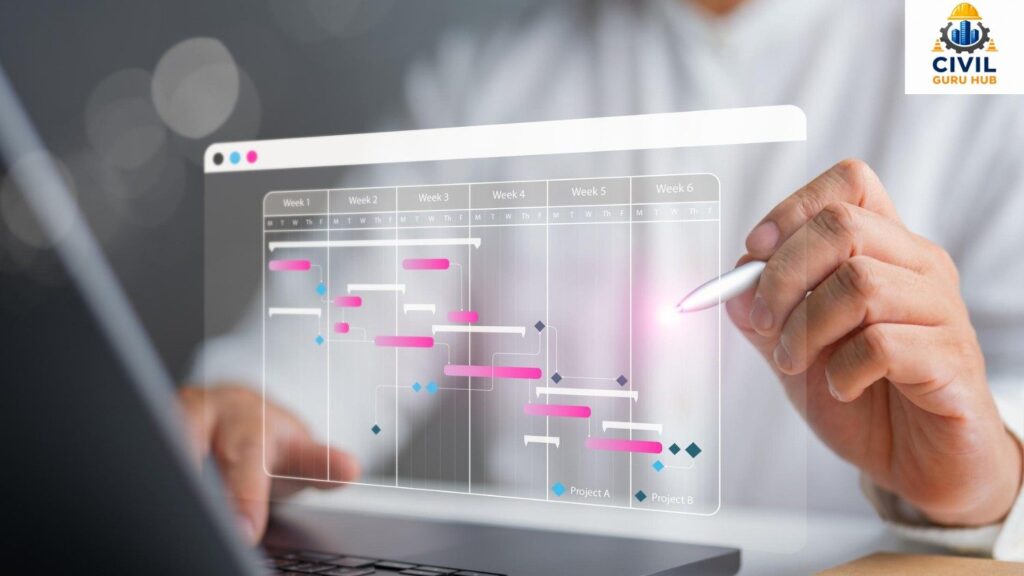
A Project Manager must continuously monitor the timeline of every single activity within the project. Whether it involves foundation work, concreting, girder launching, or finishing activities—maintaining the schedule for every stage is essential. If a major activity is delayed, it can have a ripple effect on the entire project timeline.
For example, if the launching of a bridge girder is delayed by 10 days, multiple subsequent activities may automatically be postponed. In such a situation, an experienced Project Manager immediately takes corrective actions and formulates a plan to bring the delay under control.
To manage time effectively, a Project Manager must understand several key concepts:
- Understanding Critical Path Analysis
- Performing Resource Balancing
- Applying Delay Mitigation Techniques
- Monitoring Daily Targets
- Maintaining Work Progress Tracking
Site conditions also directly impact project timelines. Some common reasons for delays are listed below:
| Delay Reason | Impact |
|---|---|
| Rainfall | Earthwork stop |
| Material shortage | Work delay |
| Labour issue | Productivity reduce |
| Equipment breakdown | Project slowdown |
Given the practical conditions in the field, a smart Project Manager always incorporates buffer planning and contingency management. Unexpected situations can arise at any moment; therefore, having alternative plans ready is extremely important for ensuring project completion.
Simply, effective time management is the key to completing a project within its scheduled timeline.
5. Technical Knowledge Skill
The success of any construction project does not depend solely on planning or manpower management; it is equally important for a competent Project Manager to possess practical technical knowledge. If technical understanding is weak, errors in site execution, rework, delays, and quality issues may arise. For this reason, technical knowledge is considered a core skill for a successful Project Manager.
During daily site activities, a Project Manager is required to interpret drawings, decipher specifications, and verify field execution. If the manager possesses a proper understanding of technical aspects, they can effectively monitor contractor activities and uphold quality standards.
In highway projects, technical understanding becomes even more critical because multiple activities are executed simultaneously. A highway Project Manager must possess comprehensive knowledge ranging from pavement construction to geometric control.
Generally, the following technical concepts are required in highway construction projects:
- Pavement layers and their functions
- Camber calculations and drainage requirements
- Superelevation design and application
- Horizontal and vertical curve setting
- Soil compaction requirements and field testing
- Concrete mix design principles
Important IS Codes for Project Managers
| IS Code | Purpose |
|---|---|
| IS 456 | RCC Design |
| IS 10262 | Concrete Mix Design |
| IS 800 | Steel Structures |
| IS 1200 | Measurement Methods |
Important IRC Codes
| IRC Code | Purpose |
|---|---|
| IRC 6 | Bridge Loads |
| IRC 37 | Flexible Pavement Design |
| IRC 112 | Concrete Bridges |
The greatest advantage of technical knowledge is that it enables a Project Manager to minimize quality disputes on-site, avoid execution errors, and facilitate faster decision-making. Ultimately, a strong technical understanding ensures superior project quality and smoother execution.
6. Budget Management Skill
In the construction industry, budget management is a critical skill for every successful Project Manager. To complete any project on time and within budget, a Project Manager must continuously monitor project expenses. If cost control is inadequate, even a technically successful project can result in financial losses.
An efficient Project Manager does not focus solely on site execution; they also devote equal attention to budget tracking, resource utilization, and the reduction of unnecessary expenses. Budget management encompasses activities such as BOQ monitoring, material wastage control, labor productivity analysis, and equipment fuel consumption tracking.
For example, if concrete wastage on a project consistently stands at 8% while the allowable limit is only 3%, the Project Manager must immediately conduct a root cause analysis. The reasons for such wastage could range from poor handling or improper batching to issues with site management. In such situations, making prompt decisions is the responsibility of the Project Manager.
Through regular cost monitoring, a Project Manager can avoid future cost overruns and maintain project profitability.
Budget Tracking Table
| Item | Estimated Cost | Actual Cost |
|---|---|---|
| Cement | ₹5,00,000 | ₹5,40,000 |
| Steel | ₹8,00,000 | ₹7,90,000 |
| Labour | ₹3,00,000 | ₹3,20,000 |
To get More knowledge about Highway, Click the links given below and read articles.
What Makes Green Roads Sustainable? 10 Secrets
How to Calculate Camber Tolerance in Road Construction Step by Step
To get More knowledge about Highway, Click the links given below and see the video.
What is superelevation in road design? Complete Explanation
Potholes- Causes, Formation, Repair Methods, IRC Standards & Road Maintenance .
7. Risk Management Skills
In the construction industry, every project inherently involves a certain degree of uncertainty and risk. For this reason, risk management is a skill that every successful Project Manager must possess. Whether the project is a small-scale undertaking or a large-scale infrastructure project, identifying potential risks and planning for them in advance is crucial for project success.
An experienced Project Manager does not merely wait for problems to arise; instead, they proactively identify potential risks and formulate solutions for them beforehand. If risks are not managed in a timely manner, they can lead to project delays, cost overruns, safety hazards, and quality issues.
Common Construction Risks
| Risk Type | Example |
|---|---|
| Safety Risk | Labour accident |
| Financial Risk | Material price increase |
| Technical Risk | Design error |
| Environmental Risk | Heavy rainfall |
In construction projects, factors such as weather fluctuations, labor shortages, equipment breakdowns, and material cost volatility can also pose significant risks. A skilled Project Manager develops contingency plans to mitigate the impact of unexpected situations.
The primary objective of risk management is to minimize project losses and ensure the smooth execution of the project. Consequently, developing risk management skills is considered to be of paramount importance for an efficient Project Manager.
8. Safety Management Skill
In the construction industry, safety is not merely a requirement; it serves as the very foundation of every successful project. Minimizing accidents and providing a safe working environment for laborers at any construction site constitutes a primary responsibility of a Project Manager. If site safety is not managed properly, it can lead to project delays, financial losses, and even serious incidents.
A skilled Project Manager constantly monitors site activities to ensure that workers are adhering to safety procedures. Practices such as daily toolbox talks, safety inspections, the proper use of Personal Protective Equipment (PPE), and hazard identification play a crucial role in enhancing site safety. Furthermore, a Project Manager must also prioritize emergency planning and risk assessment to ensure that unexpected situations can be handled swiftly and effectively.
In construction projects, activities such as excavation, working at heights, and operating heavy machinery fall into the high-risk category. Consequently, an experienced Project Manager strictly enforces safety standards and motivates the team to embrace a safety-first culture. Ultimately, a Project Manager is deemed truly responsible when they accord equal importance to the safety of the workers as they do to the success of the project itself.
Important Safety Standards
| Standard | Purpose |
|---|---|
| IS 3696 | Safety during construction |
| IS 3764 | Excavation safety |

9. Problem Solving Skill
Construction projects rarely go exactly according to plan. Every day on site brings new challenges, unexpected delays, technical issues, and situations that require immediate action. This is where problem solving becomes one of the most important qualities of a Project Manager.
A skilled Project Manager constantly faces situations where quick thinking and practical decision-making are necessary. Sometimes machinery suddenly stops working during critical activities. In other cases, drawing conflicts create confusion between teams, or material shortages affect project progress. Without strong problem-solving ability, these issues can quickly turn into costly delays.
A good Project Manager does not simply react to problems; they analyze the situation, identify the root cause, evaluate possible solutions, and implement the most effective option. This ability helps maintain project schedules, control costs, and improve coordination among teams.
Problem solving also requires communication and leadership. A successful Project Manager listens to engineers, supervisors, contractors, and workers before making decisions. This collaborative approach often produces faster and more practical solutions.
In modern construction, technical knowledge alone is not enough. The ability of a Project Manager to solve problems efficiently often determines whether a project moves forward smoothly or struggles with continuous delays.
| Common Problem | Impact on Project | Problem Solving Approach |
|---|---|---|
| Machinery Breakdown | Work Delay | Arrange backup equipment and repair quickly |
| Drawing Conflict | Construction Errors | Review drawings and coordinate teams |
| Labour Shortage | Reduced Productivity | Reallocate workforce and adjust schedule |
| Material Delay | Activity Stoppage | Find alternative supply options |
| Weather Issues | Project Delay | Modify work sequence and planning |
10. Negotiation Skills
In construction projects, negotiation skill is an ability that empowers every successful Project Manager. Engaging in discussions with contractors, suppliers, and clients on a daily basis constitutes a vital part of a Project Manager’s routine. If a Project Manager possesses effective negotiation skills, the project’s cost, quality, and timeline can be managed with greater control.
A skilled Project Manager does not merely focus on lowering rates; rather, they strive to create a “win-win” situation in which both parties remain satisfied. Through effective negotiation during the material procurement phase, material costs can be reduced, thereby keeping the overall project budget under control.
Delays are a common challenge in construction projects. This is where a Project Manager’s negotiation ability plays a crucial role, as proper communication and timely discussions can help avoid disputes and unnecessary delays.
Claims and conflicts are also an inherent part of the construction industry; however, an experienced Project Manager can minimize such claims through clear discussions and practical solutions. Ultimately, strong negotiation skills directly enhance project profitability, stakeholder satisfaction, and overall project success.
| Negotiation Benefit | Impact on Project |
|---|---|
| Reduced Material Cost | Better budget control |
| Fewer Delays | Improved project schedule |
| Lower Claims | Reduced disputes and conflicts |
| Better Relationships | Improved stakeholder coordination |
| Higher Profitability | Increased project success |
11. Software Management Skills
In today’s construction industry, technical knowledge alone is not sufficient; a successful Project Manager must also possess a strong understanding of modern software tools. The use of digital tools helps make a project faster, more organized, and error-free. Consequently, software management has emerged as a crucial competency for every Project Manager.
A professional Project Manager handles tasks such as planning, drawing reviews, progress tracking, billing, and reporting on a daily basis. When one possesses strong software proficiency, decision-making improves, and project execution proceeds more smoothly.
Software knowledge is also highly beneficial for enhancing coordination between the project site and the office. Nowadays, companies tend to prefer candidates who, in addition to technical expertise, can efficiently utilize software tools. Therefore, a skilled Project Manager should continuously strive to learn new digital tools.
Listed below are some commonly used software applications and their respective uses:
| Software | Use |
|---|---|
| AutoCAD | Drawings and drafting work |
| STAAD Pro | Structural analysis and design |
| Primavera | Project planning and scheduling |
| MS Excel | Billing, calculations, and reporting |
Strong software skills significantly help a project manager manage projects efficiently and improve productivity.
12. Quality Control Skill
Quality control serves as the backbone of any construction project; consequently, quality management skills are considered crucial for a successful Project Manager. Alongside planning, execution, and monitoring, it is the Project Manager’s responsibility to ensure that every project activity is completed in strict accordance with the required standards and specifications.
In the construction industry, compromising on quality can directly lead to increased costs, rework, delays, and client dissatisfaction. For this reason, experienced Project Managers consistently prioritize on-site quality checks, testing procedures, and documentation. Quality control entails more than just conducting tests; identifying potential problems and taking preventive measures to avoid them in the future is equally important.
Common Quality Tests Used in Construction
| Test | Purpose |
|---|---|
| Slump Test | Measures concrete workability |
| Cube Test | Determines concrete compressive strength |
| Core Cutter Test | Measures soil field density |
Regular testing and proper inspection ensure that construction materials meet the required performance standards.
An efficient Project Manager maintains quality records, implements corrective actions, and fosters quality awareness among the project team. From a long-term perspective, robust quality practices enhance a company’s reputation, build client trust, and facilitate the securing of future projects. Thus, quality control is regarded as a core responsibility for every professional Project Manager.
The Future of Project Managers in Construction Projects
In today’s times, India’s infrastructure sector is growing at a rapid pace. New expressways, metro corridors, bridges, industrial projects, and smart city developments can be seen springing up everywhere. To successfully complete all these projects, the demand for skilled Project Managers is continuously on the rise. Consequently, Project Management has emerged as a robust career option within the construction industry.
The role of a Project Manager extends far beyond merely supervising the site; it also entails handling critical responsibilities such as planning, resource management, budgeting, scheduling, and team coordination. In large-scale construction projects, an experienced Project Manager plays a pivotal role in maintaining the project’s pace, quality, and cost control.
Both government organizations and the private sector are offering experienced Project Management professionals attractive salary packages and ample opportunities for career growth. Given the ongoing expansion of infrastructure, the likelihood of the demand for this role increasing even further in the future remains very strong.
If a civil engineer complements their technical knowledge with enhanced leadership skills, communication abilities, planning expertise, and management capabilities, becoming a successful Project Manager can prove to be a highly promising career choice for the future.
Conclusion
In the civil engineering industry, the success of any project does not depend solely on drawings, calculations, and technical knowledge. A successful Project Manager is one who can effectively balance planning, leadership, communication, and execution. Daily challenges inevitably arise at the site, and making the right decisions in such situations is the hallmark of an experienced Project Manager.
In today’s competitive construction industry, a Project Manager should not rely solely on traditional methods. It is equally important to continuously update one’s knowledge regarding modern software tools, practical site management techniques, quality control practices, IS codes, and IRC standards. It is the combination of technology and field experience that fosters long-term success.
Whether the project involves highways, bridge construction, building works, or large-scale infrastructure, a skilled Project Manager plays a pivotal role in controlling project costs, timelines, and quality across the board. For this very reason, the demand for Project Managers in the construction sector is continuously on the rise.
Furthermore, if you strategically incorporate construction tools, safety equipment, engineering books, and site accessories into your blog content, your opportunities for affiliate marketing and earning potential can also improve significantly.
Essential Tools and Products Every Civil Engineering Project Manager Should Consider
A professional Project Manager requires not only technical knowledge but also the right tools and equipment. The products listed below can prove highly useful for enhancing the efficiency of planning, site inspections, quality control, and project monitoring. If you are a civil engineering student, a site engineer, or a Project Manager, these tools can significantly boost your daily productivity.
| Product Category | Recommended Use |
|---|---|
| Safety Helmet | Site safety inspections |
| Reflective Safety Jacket | Highway and construction site visits |
| Safety Shoes | Daily site work protection |
| Auto Level | Level checking and surveying work |
| Measuring Tape | Site measurements and verification |
| Total Station Tripod Accessories | Surveying and alignment work |
| Scientific Calculator | Quantity and engineering calculations |
| Construction Diary | Daily progress recording |
| Project Planning Notebook | Scheduling and task tracking |
| Laptop | Comfortable office work setup |
| Wireless Mouse | Primavera and AutoCAD work |
| External Hard Drive | Drawing and project data backup |
| Engineering Handbook | Technical reference on site |
| IRC Code Books | Highway engineering standards |
| IS Code Reference Books | Construction quality compliance |
| Tablet for Site Reporting | Digital inspections and DPR preparation |
| Walkie Talkie Set | Large project communication |
| Laser Distance Meter | Fast and accurate measurements |
| Power Bank | Long site visits and field work |
| Smart Watch | Task reminders and productivity tracking |
Disclaimer
The information provided in this article is presented for educational and informational purposes only. The standards, IS Codes, IRC Guidelines, tools, and management practices utilized in civil engineering projects may vary depending on the project’s location, client requirements, and the latest revisions. Before undertaking work on any construction project, it is essential to verify the relevant, up-to-date IS Codes, IRC publications, contract documents, and project specifications.
The products and tools mentioned in this article have been suggested with the practical needs of civil engineering professionals in mind. Some of the links provided may be affiliate links; if you make a purchase through these links, we may earn a small commission at no additional cost to you. This helps support our educational content.
Civil Guru Hub shall not be held liable for any direct or indirect damages resulting from the use of any product, service, or construction method. Readers are strongly advised to consult with qualified professionals and refer to the latest official standards before making any engineering decisions.
About Author
Susanta Kumar is a passionate Civil Engineering content creator and the founder of ‘Civil Guru Hub’. His objective is to provide practical, easy-to-understand, and industry-relevant knowledge to civil engineering students, site engineers, and construction professionals. He has published numerous educational articles and videos covering topics such as highway engineering, building construction, surveying, project management, quantity estimation, IS Codes, and IRC standards.
His forte lies in explaining practical civil engineering concepts in simple language, thereby enabling both students and working professionals to acquire real-world construction knowledge. Through ‘The Civil Site’, he regularly shares valuable information regarding the latest engineering practices, construction techniques, and career guidance.
If you wish to learn more about civil engineering, construction technology, project management, or infrastructure development, we invite you to visit ‘The Civil Site’ regularly and stay connected with our educational content.
Website: https://civilguruhub.com/
YouTube Channel: The Civil Site
Specialization: Civil Engineering, Highway Engineering, Construction Management, Surveying, IS Codes & IRC Standards, Quantity Estimation, and Project Management.
FAQs – Civil Engineering Project Manager Skills
1. What does a Civil Engineering Project Manager do?
A Civil Engineering Project Manager plans, manages and executes construction projects. It handles budgeting, scheduling, quality control, safety management, labor coordination and client communication so that the project is completed on time and within budget.
2. Which skills are most important for a Project Manager in civil engineering?
Leadership, communication, planning, technical knowledge, budgeting, safety management and problem-solving skills are most important for a successful Project Manager. Software knowledge is also very necessary in modern projects.
3. Which software should a civil engineering Project Manager learn?
A Project Manager should learn software like Primavera P6, MS Project, AutoCAD, STAAD Pro and MS Excel. These software help in planning, scheduling, billing and project monitoring.
4. Which IS and IRC codes are useful for Project Managers?
Some important standards for Civil Engineering Project Manager are:
IS 456 – RCC Design
IS 10262 – Concrete Mix Design
IRC 37 – Flexible Pavement Design
IRC 112 – Concrete Bridge Design
These codes improve project quality and technical execution.
5. Can a site engineer become a Project Manager?
Yes, a site engineer can become a successful Project Manager by developing experience and management skills. Career growth is accelerated by gradually improving leadership, planning, communication and technical expertise.

Pingback: Contractor Project Manager: Roles, Skills, and Strategies – Optio Station: Best Project Management App for Prioritization