

Last Update: July 2026
Table of Contents
Introduction: What is Concrete Mix Design and Why Is It So Important?
Concrete is the most widely used construction material in the construction industry. Whether it is a building foundation, a bridge, a highway pavement, or an industrial structure, concrete is used everywhere. However, simply mixing cement, sand, and aggregates does not result in high-quality concrete. To obtain concrete that is durable, economical, and possesses the required strength, the proportions of the ingredients must be determined scientifically. This process is known as Concrete Mix Design.
The primary objective of Concrete Mix Design is to produce concrete that achieves the specified compressive strength, maintains workability, meets durability requirements, and minimizes unnecessary cement consumption. If Concrete Mix Design is not carried out correctly, it can directly impact the structure’s strength, service life, and performance.
In India, the standard most commonly followed for Concrete Mix Design is IS 10262:2019. This standard provides a detailed methodology for proportioning concrete ingredients. Additionally, the durability requirements outlined in IS 456:2000 are also taken into consideration.
IS 10262:2019 is more advanced than the previous version. It offers more practical guidance regarding supplementary cementitious materials, aggregate grading, the selection of the water-cement ratio, and trial mix adjustments. For this reason, professional engineers, quality engineers, and laboratory technicians currently rely on this standard for Concrete Mix Design.
If you are a site engineer, quality control engineer, laboratory technician, or a civil engineering student, understanding Concrete Mix Design is crucial. This knowledge will help you make better decisions in the field and improve the quality of your projects.
Important Codes to be Followed in Concrete Mix Design
Before designing concrete mix, it is very important to understand the standards which are used in the calculation process.
| Code | Description |
|---|---|
| IS 10262:2019 | Concrete Mix Proportioning Guidelines |
| IS 456:2000 | Plain and Reinforced Concrete Code |
| IS 383:2016 | Coarse and Fine Aggregate Specification |
| IS 2386 Series | Aggregate Testing Methods |
| IS 516 | Concrete Strength Testing |
| IS 1199 | Workability Testing |
| IS 9103 | Chemical Admixture Specification |
All these codes together make the Concrete Mix Design process technically correct and reliable.
Step 1: Collecting Design Stipulations and Target Requirements
According to IS 10262:2019, the first and most crucial step in any concrete mix design is collecting the design inputs. If the input data is incorrect, the entire concrete mix design could be flawed.
Design stipulations involve understanding the project requirements. At this stage, decisions are made regarding the concrete grade, exposure conditions, workability requirements, and aggregate characteristics.
Let us assume we need to design M30 grade concrete.
Design Inputs:
| Parameter | Value |
|---|---|
| Grade of Concrete | M30 |
| Exposure Condition | Moderate |
| Cement Type | OPC 53 Grade |
| Maximum Aggregate Size | 20 mm |
| Workability | 100 mm Slump |
| Degree of Supervision | Good |
| Pumping Requirement | No |
| Admixture | Not Used |
All these inputs play a significant role in concrete mix design. For instance, if the exposure condition is ‘Severe,’ restrictions are imposed on the water-cement ratio. Similarly, an increase in slump requirements can lead to a higher water demand.
Durability requirements must also be considered in accordance with IS 456.
| Exposure Condition | Maximum W/C Ratio | Minimum Cement Content |
|---|---|---|
| Mild | 0.55 | 300 kg/m³ |
| Moderate | 0.50 | 300 kg/m³ |
| Severe | 0.45 | 320 kg/m³ |
| Very Severe | 0.45 | 340 kg/m³ |
| Extreme | 0.40 | 360 kg/m³ |
These values are vital during concrete mix design because durability requirements can sometimes be even more critical than strength requirements.
Therefore, the success of any concrete mix design relies on the accurate collection of design data.
Step 2: Calculation of Target Mean Strength
In concrete mix design, achieving merely the characteristic strength is not sufficient. Variations in strength can occur during actual production. For this reason, IS 10262:2019 mandates the calculation of target mean strength.
Formula for Target Mean Strength:
Where:
fck = Characteristic Strength
s = Standard Deviation
For M30 grade:
fck = 30 MPa
Standard deviation as per IS standards for good quality control:
s = 5 MPa
Calculation:
Target Mean Strength = 30 + (1.65 × 5)
Target Mean Strength = 38.25 MPa
| Parameter | Value |
|---|---|
| Characteristic Strength | 30 MPa |
| Standard Deviation | 5 MPa |
| Target Mean Strength | 38.25 MPa |
This value represents the actual strength target for the concrete mix design.
Many novice engineers mistakenly assume that M30 simply means 30 MPa and base the mix design on that figure. However, according to IS 10262:2019, concrete mix design is developed based on target mean strength to ensure that the minimum characteristic strength of 30 MPa is maintained even after accounting for production variations.
Consequently, the calculation of target mean strength is considered the most critical engineering step in concrete mix design.
Step 3: Selection of Water-Cement Ratio
After calculating the target mean strength, the next step is to select the water-cement ratio.
In concrete mix design, the water-cement ratio is directly related to both the strength and durability of the concrete.
General principle:
- A lower water-cement ratio results in higher strength.
- A higher water-cement ratio results in lower strength.
IS 10262:2019 allows engineers to select the water-cement ratio based on laboratory experience and previous data.
For M30 grade, typically:
Selected Water-Cement Ratio = 0.45
Now, let us check the durability requirement.
For Moderate Exposure:
Maximum W/C Ratio = 0.50
Selected W/C Ratio = 0.45
Condition satisfied.
| Parameter | Value |
|---|---|
| Selected W/C Ratio | 0.45 |
| Permissible W/C Ratio | 0.45 |
| Status | OK |
Selecting the water-cement ratio is one of the most important decisions in concrete mix design because both the cement content and water content are determined based on it.
If the water-cement ratio is kept unnecessarily low, cement consumption will rise, increasing the project cost. If it is too high, both strength and durability may be compromised.
That is why experienced engineers select the water-cement ratio very carefully during concrete mix design.
To read more articles on Laboratory Test, check the following guides:
IS 2720 Part 16 CBR Test: Everything You Need to Know in 2026
The Ultimate Concrete Nominal mix: 8 Proven Grades with Calculations
How to Conduct GSA Test? Proven IS 2720-4 Procedure
Step 4: Determination of Water Content
Selecting the water content is crucial in concrete mix design. Water directly controls the workability of the concrete. If the water content is low, the concrete becomes stiff, making compaction difficult. If the water content is excessive, both strength and durability are compromised.
IS 10262:2019 provides reference tables that engineers use to select the initial water content.
Recommended water content for 20 mm nominal maximum aggregate size and a slump of 25–50 mm:
| Aggregate Size | Water Content |
|---|---|
| 10 mm | 208 kg |
| 20 mm | 186 kg |
| 40 mm | 165 kg |
In our example, the required slump is 100 mm.
According to IS 10262, adjustments to water content are made based on changes in slump.
An increase of approximately 6% can be considered when moving from a slump of 25–50 mm to 100 mm.
Calculation:
Initial Water Content = 186 kg/m³
Increase = 186 × 6%
Increase = 11.16 kg
Adjusted Water Content:
186 + 11.16 = 197.16 kg
Adopted Water Content:
197 kg/m³
| Description | Value |
|---|---|
| Initial Water Content | 186 kg |
| Slump Adjustment | 11 kg |
| Final Water Content | 197 kg |
The selection of water content in concrete mix design may also vary depending on project conditions. Water demand can be higher for pumped concrete, congested reinforcement, and situations requiring high workability.
However, engineers must remember that increasing water content can reduce strength. Therefore, using superplasticizers is often more beneficial in practical projects.
For this reason, determining water content is considered a balancing act in concrete mix design, where both workability and strength must be managed simultaneously.
Step 5: Calculation of Cement Content
Now that both the Water Content and the Water-Cement Ratio are available, the Cement Content can be determined.
A fundamental relationship is used to calculate the Cement Content in concrete mix design.
Formula:
Cement Content = Water Content ÷ Water-Cement Ratio
In our example:
Water Content = 197 kg
Water-Cement Ratio = 0.45
Calculation:
Cement Content = 197 ÷ 0.45
Cement Content = 437.78 kg/m³
Adopted Cement Content:
438 kg/m³
| Parameter | Value |
|---|---|
| Water Content | 197 kg |
| Water-Cement Ratio | 0.45 |
| Cement Content | 438 kg |
According to IS 456:2000, the minimum cement content for ‘Moderate Exposure’ is:
300 kg/m³
Calculated Cement Content:
438 kg/m³
Condition satisfied.
| Requirement | Value |
|---|---|
| Minimum Cement Content | 300 kg |
| Actual Cement Content | 438 kg |
| Status | OK |
In concrete mix design, cement content directly influences the project cost. Cement is the most expensive constituent; therefore, the addition of unnecessary cement should be avoided.
It is often observed in the field that contractors increase the quantity of cement citing a ‘safety factor.’ This raises costs and can also increase the risk of shrinkage cracking.
IS 10262:2019 provides a scientific concrete mix design methodology to avoid this issue.
Step 6: Aggregate Proportion Selection
Aggregates occupy approximately 70% to 80% of the volume in a concrete mix. Therefore, the selection of aggregate proportions significantly influences concrete performance.
IS 10262:2019 provides a reference table for selecting the volume of coarse aggregate.
For 20 mm aggregate and Zone II sand:
| Fine Aggregate Zone | Volume of Coarse Aggregate |
|---|---|
| Zone I | 0.60 |
| Zone II | 0.62 |
| Zone III | 0.64 |
| Zone IV | 0.66 |
In our example:
Fine Aggregate = Zone II
Coarse Aggregate Fraction = 0.62
Fine Aggregate Fraction:
1 − 0.62 = 0.38
| Material | Fraction |
|---|---|
| Coarse Aggregate | 0.62 |
| Fine Aggregate | 0.38 |
Aggregate grading is crucial in concrete mix design. Proper grading minimizes voids and reduces the requirement for cement paste.
Aggregates with poor grading can make the concrete harsh and reduce workability.
For this reason, conducting a sieve analysis of the aggregates is essential before designing the concrete mix.

Step 7: Collecting Specific Gravity Data
To apply the Absolute Volume Method, the specific gravity of the materials is required.
Laboratory test results:
| Material | Material |
|---|---|
| Cement | 3.15 |
| Fine Aggregate | 2.65 |
| Coarse Aggregate | 2.70 |
| Water | 1.00 |
Using the specific gravity of the actual project materials is the best practice for concrete mix design.
If laboratory results are not available, the values recommended by IS standards can be used; however, actual test values are always more accurate for the final design.
Specific gravity is used to calculate the volume of concrete constituents, and aggregate quantities are determined based on this.
Step 8: Calculation of Aggregate Quantity using the Absolute Volume Method
The Absolute Volume Method is used to determine the aggregate quantity in accordance with IS 10262:2019.
First, the volume of cement is calculated.
Cement Volume: 438 ÷ (3.15 × 1000) = 0.139 m³
Water Volume: 197 ÷ 1000 = 0.197 m³
Air Content (for 20 mm aggregate) = 2% = 0.02 m³
Total Occupied Volume:
0.139 + 0.197 + 0.02 = 0.356 m³
Aggregate Volume: 1 − 0.356 = 0.644 m³
This volume will now be divided into Fine Aggregate and Coarse Aggregate.
Step 9: Calculation of Fine Aggregate Quantity
Fine Aggregate Fraction: 0.38
Fine Aggregate Volume: 0.644 × 0.38 = 0.245 m³
Fine Aggregate Weight: 0.245 × 2.65 × 1000 = 649.25 kg
Adopted Value: 649 kg/m³
| Description | Value |
|---|---|
| Fine Aggregate Volume | 0.245 m³ |
| Specific Gravity | 2.65 |
| Fine Aggregate Weight | 649 kg |
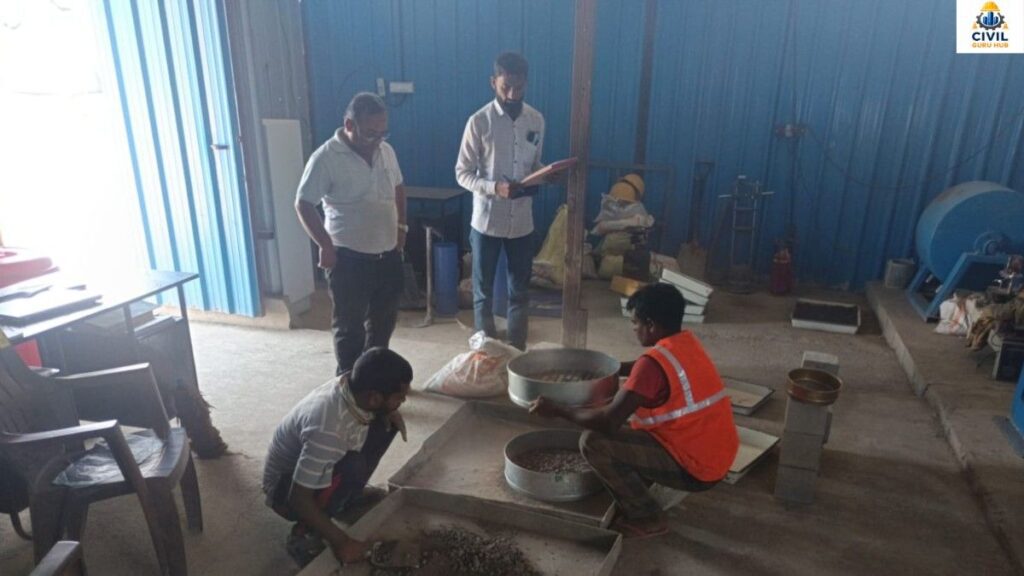
In concrete mix design, the quantity of sand directly influences workability. Excess sand can increase shrinkage, whereas insufficient sand can make the mix harsh.
Therefore, it is crucial to follow the aggregate proportions recommended by IS 10262.
Step 10: Coarse Aggregate Quantity Calculation
Coarse Aggregate Fraction: 0.62
Coarse Aggregate Volume: 0.644 × 0.62 = 0.399 m³
Coarse Aggregate Weight: 0.399 × 2.70 × 1000 = 1077.3 kg
Adopted Value: 1077 kg/m³
| Description | Value |
|---|---|
| Coarse Aggregate Volume | 0.399 m³ |
| Specific Gravity | 2.70 |
| Coarse Aggregate Weight | 1077 kg |
Coarse aggregate forms the concrete skeleton and supports compressive strength. Good quality and angular aggregate generally provide better bond and higher strength.
Optimizing coarse aggregate quantity in concrete mix design is important for both strength and economy.
Final Calculated Concrete Mix Design (Before Trial Mix)
| Material | Quantity (kg/m³) |
|---|---|
| Cement | 438 |
| Water | 197 |
| Fine Aggregate | 649 |
| Coarse Aggregate | 1077 |
| Water-Cement Ratio | 0.45 |
Thus, we have calculated the complete material quantities in accordance with IS 10262:2019.
However, the concrete mix design is not yet fully complete. According to IS 10262:2019, it is also mandatory to prepare trial mixes in the laboratory and verify the actual compressive strength.
To read more articles on Laboratory Test, check the following guides:
What are Sand Silt Content Test? 7 Easy Steps & Limits
What Are Deming’s 14 Principles of Quality Management? A complete Guide
how to perform Proctor Test: 10 Easy Steps (Complete Guide)
Step 11: Trial Mix Preparation
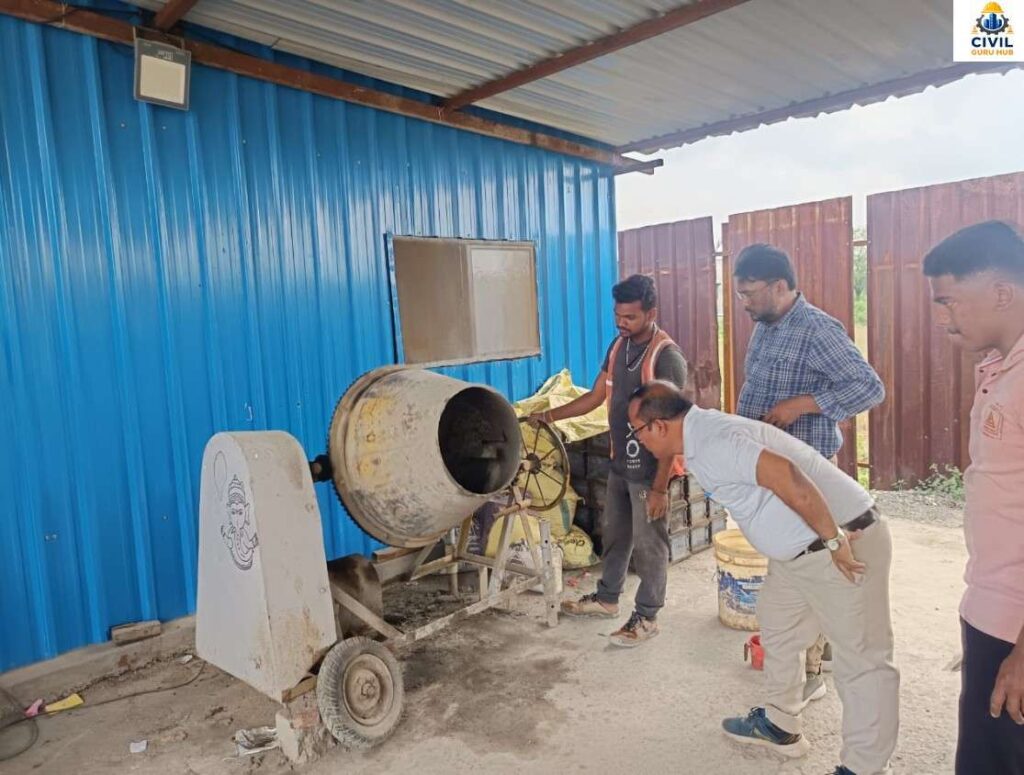
After calculating the concrete mix design, the next step is to prepare a trial mix in the laboratory. The purpose of the trial mix is to verify whether the calculated proportions yield the required strength and workability.
In the laboratory, the dry materials are first mixed thoroughly. The cement, sand, and coarse aggregate should be mixed until a uniform color is achieved. Subsequently, the calculated quantity of water is added.
During the mixing process, the engineer should observe the consistency and cohesiveness of the concrete. If the concrete appears excessively stiff or excessively wet, a record of this should be maintained.
IS 10262:2019 recommends preparing more than one trial mix. For example:
| Trial Mix | W/C Ratio |
|---|---|
| Trial 1 | 0.43 |
| Trial 2 | 0.44 |
| Trial 3 | 0.45 |
This approach makes it easier to identify the optimum concrete mix design.
In practical projects, experienced quality engineers always prepare at least three trial mixes. This ensures the best balance between strength and workability.
The objective of concrete mix design is not merely to achieve maximum strength; producing economical, workable, and durable concrete is equally important.
Step 12: Slump Test and Workability Verification
The workability is checked immediately after the trial mix is prepared.
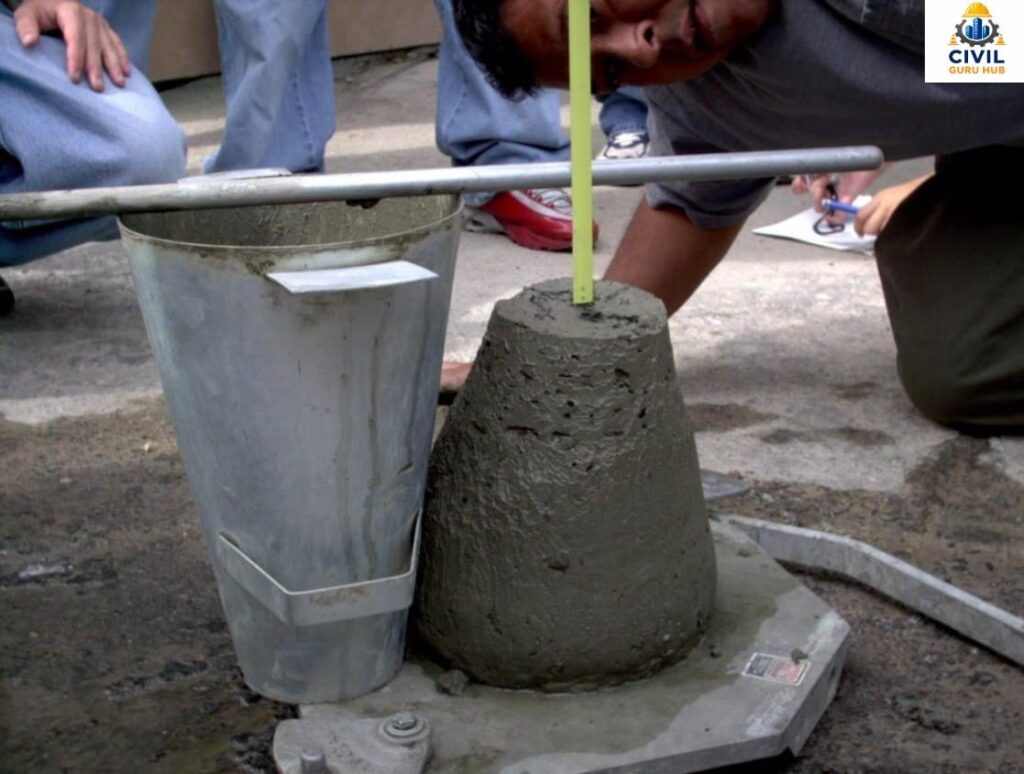
The slump test is the most common method used to verify workability.
A slump cone is used in accordance with IS 1199 standards.
Target slump for our design example: 100 mm
If the actual slump falls between 95 mm and 105 mm, the concrete mix design meets the workability requirement.
If the slump is too low, adding water directly is considered poor practice. Doing so alters the water-cement ratio and affects the concrete’s strength.
In professional quality control, it is considered more appropriate to use admixtures to adjust the slump.
A key principle of concrete mix design is that strength and durability must not be compromised while improving workability.
For this reason, the slump test is mandatory for every trial mix.
To get More Idea about Slump test Click on given link
how to test slump for Concrete: Practical Site Guide
See the video for better Understanding
Step 13: Cube Casting Procedure
Compressive strength testing is the most important part of validating a concrete mix design.
Concrete cubes are cast using the trial mix.
In India, cubes of the following size are generally used: 150 mm × 150 mm × 150 mm
The cube mould is first cleaned and oiled.
The concrete is filled into the mould in three layers.
Each layer is compacted using a standard tamping rod.
Vibration may also be applied if a vibration table is available.
After casting, the specimen is kept in a laboratory environment for 24 hours.
After 24 hours, the cube is removed from the mould and transferred to a curing tank.
The curing temperature should be maintained at approximately: 27 ± 2°C
The reliability of the concrete mix design depends directly on the quality of curing. Due to poor curing, even a good mix may exhibit low strength.
Therefore, proper control of laboratory curing conditions is essential.

Step 14: Compressive Strength Test
The compressive strength test is conducted in accordance with IS 516.
Cube testing is generally performed at:
- 7 days
- 28 days
Target Mean Strength for our M30 Concrete Mix Design: 38.25 MPa
Assume the trial test results are as follows:
| Cube No. | 28-Day Strength (MPa) |
|---|---|
| Cube 1 | 39.1 |
| Cube 2 | 40.3 |
| Cube 3 | 38.9 |
Average Strength: (39.1 + 40.3 + 38.9) ÷ 3 = 39.43 MPa
Comparison:
| Parameter | Value |
|---|---|
| Required Target Mean Strength | 38.25 MPa |
| Achieved Strength | 39.43 MPa |
| Result | Pass |
This indicates that the Concrete Mix Design is achieving the required strength.
If the strength had fallen below the target, it might have been necessary to reduce the water-cement ratio or revise the cement content.
In this manner, the final Concrete Mix Design is approved through laboratory testing.

Common Mistakes Made by Engineers in Concrete Mix Design
In field projects, the failure of a concrete mix design is often due to execution errors rather than calculation errors.
The most common mistakes include:
- Manually adding water at the site
- Ignoring moisture correction
- Failing to check aggregate grading
- Inadequate curing
- Improper cement storage
- Starting direct production without a trial mix
- Ignoring cube testing
The objective of IS 10262:2019 is precisely to minimize these mistakes.
Recommended Civil Engineering Tools for Accurate Concrete Mix Design
If you wish to perform concrete mix design accurately—whether in a laboratory or at a construction site—the tools listed below can make your work more precise, efficient, and professional. Most of these tools are essential for site engineers, quality engineers, and civil engineering students alike.
| Product | Use |
|---|---|
| Digital Weighing Scale | For accurately weighing cement, sand, and aggregates |
| Slump Cone Test Set | For checking concrete workability (Slump Test) |
| Concrete Cube Mould (150×150×150 mm) | For casting cubes for Compressive Strength Tests |
| Moisture Meter | For measuring the moisture content of aggregates |
| Digital Vernier Caliper | For aggregate sizing and laboratory measurements |
| Scientific Calculator | For mix design calculations and solving engineering formulas |
Affiliate Disclaimer
Disclosure: Some product links in this article may be affiliate links. If you purchase a product through these links, we may receive a small commission at no extra cost to you. This helps us maintain our website and create free, high-quality educational content related to civil engineering.
We recommend only those tools and products that are genuinely useful for engineers and students in areas such as concrete mix design, laboratory testing, and construction site work. Before purchasing any product, please be sure to check its features, specifications, and customer reviews. Our recommendations are based entirely on our research and practical experience.
Conclusion
According to IS 10262:2019, concrete mix design is a scientific and systematic process aimed at achieving the required strength, durability, and workability. In this process, steps such as gathering design stipulations, calculating Target Mean Strength, selecting the Water-Cement ratio, determining water content, calculating cement content, proportioning aggregates, applying the Absolute Volume Method, conducting trial mix testing, and verifying strength are all equally important.
In our example, the final approved concrete mix design for the M30 grade was obtained as follows:
| Material | Quantity (kg/m³) |
|---|---|
| Cement | 438 |
| Water | 198 |
| Fine Aggregate | 649 |
| Coarse Aggregate | 1077 |
| Water Cement Ratio | 0.45 |
Final Mix Ratio: 1 : 1.48 : 2.46
If moisture correction, proper batching, compaction, and curing are carried out in accordance with site conditions, this concrete mix design can easily achieve the required M30 strength and ensure long-term durability for the structure.
About the Author
My name is Susanta Kumar Mohapatra. I am a Civil Engineering professional with over 11 years of practical experience in the construction and infrastructure sectors. I hold a B.Tech degree in Civil Engineering and an M.E. degree in Construction Management. Throughout my professional career, I have worked in key areas such as road construction, bridge projects, quality control, material testing, concrete mix design, highway engineering, quantity estimation, project planning, site execution, and construction management.
I launched CivilGuruHub.com with the aim of sharing my passion for Civil Engineering and my practical knowledge with a wider audience. The primary objective of this website is to provide practical, industry-oriented information in simple language to Civil Engineering students, site engineers, quality engineers, quantity surveyors, contractors, and construction professionals. Here, I publish detailed, original, and research-based articles on topics such as construction technology, concrete technology, highway engineering, structural engineering, material testing, IS codes, IRC codes, quantity surveying, estimation and costing, project management, tendering, and Civil Engineering calculators.
Alongside the website, I also run a YouTube channel named “The Civil Site,” where I explain practical site experiences, laboratory tests, construction techniques, engineering calculations, software tutorials, and technical concepts through easy-to-understand videos. My goal is to ensure that every student and engineer understands not just the theory, but also its practical application.
Additionally, I share educational content related to general knowledge, quizzes, and competitive exam preparation through my YouTube channel, “Daily IQ Hub.” The aim of this channel is to enhance viewers’ knowledge and strengthen their exam preparation.
I believe that a successful engineer is one who is always ready to learn and continuously updates their practical knowledge. With this mindset, I always strive to provide high-quality, reliable, practical, and industry-standard content through CivilGuruHub.com and my YouTube channels, enabling every reader and viewer to excel in their careers.
Thank you sincerely for your trust and support. I am confident that CivilGuruHub.com and my educational platforms will prove to be reliable companions in your learning journey and professional growth. If you wish to take your knowledge in the field of Civil Engineering to the next level, please continue to follow our articles and videos regularly. We will keep bringing you fresh, practical, and industry-focused content.
FAQs – Concrete Mix Design as per IS 10262:2019
Q 1. What is Concrete Mix Design?
Answer: Concrete Mix Design is a scientific process in which the quantities of cement, water, fine aggregate, and coarse aggregate are determined in such a way that the concrete achieves the required strength, workability, and durability. In India, the IS 10262:2019 standard is followed for this purpose.
Q 2. What is the main objective of IS 10262:2019?
Answer: The objective of IS 10262:2019 is to formulate a concrete mix design that is economical while also providing the required compressive strength, durability, and workability. This standard also emphasizes trial mixes and laboratory verification.
Q 3. What is the difference between Concrete Mix Design and Nominal Mix?
Answer: In a Nominal Mix, the ratio of cement, sand, and aggregate is fixed beforehand (e.g., 1:1.5:3), whereas Concrete Mix Design is formulated based on laboratory tests and calculations. Mix Design is more accurate, economical, and suitable for producing high-strength concrete.
Q 4. How is Target Mean Strength calculated?
Answer: The formula for Target Mean Strength is:
Target Mean Strength = Characteristic Strength + (1.65 × Standard Deviation)
This calculation accounts for strength variations during production to ensure that the required characteristic strength is consistently achieved.
Q 5. Why is the Water-Cement Ratio so important in Concrete Mix Design?
Answer: The Water-Cement Ratio directly affects the strength and durability of concrete. A lower Water-Cement Ratio increases strength, whereas a higher ratio can reduce both the strength and the service life of the concrete.
Q 6. Why is it necessary to prepare a trial mix?
Answer: A trial mix is used to verify whether the calculated concrete mix design yields the required slump and compressive strength. If the results are not satisfactory, the mix proportions are revised.
Q 7. When is moisture correction performed in Concrete Mix Design?
Answer: When moisture is present in sand or coarse aggregate, a moisture correction is performed before batching. This ensures the actual water-cement ratio is maintained and the quality of the concrete is not compromised.
Q 8. What should be the water-cement ratio for M30 concrete mix design?
Answer: IS 10262:2019 does not prescribe a fixed water-cement ratio; it depends on laboratory data and durability requirements. However, in practical projects, a water-cement ratio of approximately 0.40 to 0.45 is commonly used for M30 grade concrete.
Q 9. Which IS codes are used in concrete mix design?
Answer: The most important standards are:
IS 10262:2019 – Concrete Mix Proportioning
IS 456:2000 – Plain and Reinforced Concrete
IS 383:2016 – Aggregates Specification
IS 2386 – Aggregate Testing
IS 516 – Compressive Strength Test
IS 1199 – Workability Test
Q 10. Can concrete mix design be done without a laboratory?
Answer: The preliminary calculation phase can be carried out without a laboratory; however, according to IS 10262:2019, laboratory trial mixes, slump tests, and 28-day compressive strength tests are essential to approve the final concrete mix design. Without these tests, a mix design cannot be considered final or reliable.