
Table of Contents
Introduction
In highway engineering, a “median” is a very important component that physically separates traffic from two different directions on the road.
Proper design and maintenance of medians on high-speed corridors, expressways, and national highways has become a key factor in road safety.
Mediators are not just dividers; they support many engineering aspects, such as safety, drainage, lighting, and future widening.
In this article, we will understand the concept, types, design standards, IRC codes, construction practices, and real-life examples of medians in detail.
What is Highway Median?
A median is the central portion of a highway that separates traffic from opposite directions. This strip can be paved, unpaved, depressed, or raised.
In simple terms: Median = separation zone in the middle of the road.
The main purpose of a median:
- Separating opposite traffic
- Preventing head-on collisions
- Maintaining traffic discipline
Importance of Median
Medians are crucial on highways, especially on high-speed roads.
For Safety:
Medians significantly reduce head-on collisions. Roads without medians are more likely to have fatal accidents.
For Traffic Flow:
Medians maintain smooth traffic movement and reduce overtaking conflicts.
Glare Reduction:
Medians help reduce glare from opposite vehicle headlights during night driving.
Future Expansion:
Wide medians provide space for future widening.
Types
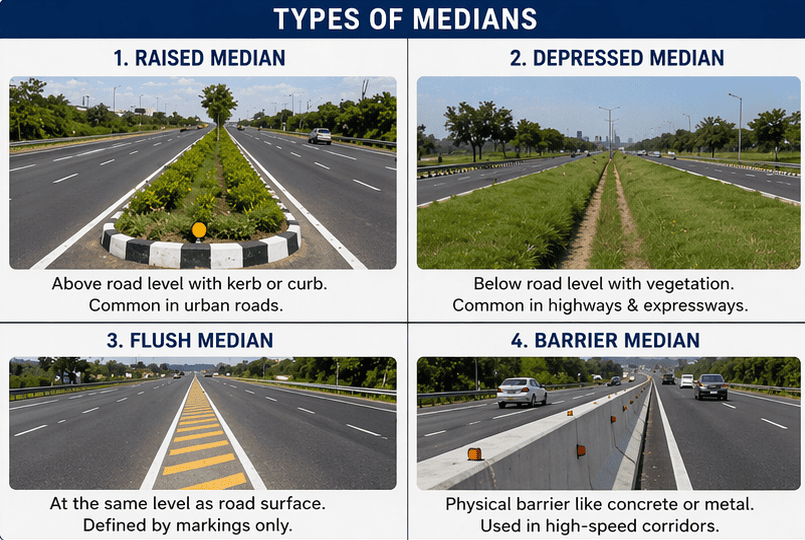
Highway medians divide into several types based on design and function:
Raised
This median raises above ground level, usually made of a concrete Kerb or stone Kerb.
- It is common on urban roads.
- It helps in pedestrian control.
- It is suitable for landscaping.
Depressed
This median is below road level and is planted with vegetation or grass.
- Used on highways and expressways
- Effective in glare reduction
- Useful for drainage
Flush
It is at the level of the road surface and is defined only by markings.
- Used on low-traffic roads
- Cost-effective
- Safety comparatively low
Barrier
It consists of a physical barrier, such as:
- Concrete barrier (New Jersey type)
- Metal crash barrier
- Used on high-speed corridors
- Provides maximum safety
Design Considerations
Several engineering factors must be considered when designing a median.
- Engineers analyze traffic volume and speed. High-speed roads require a wider, barrier-type median.
- Available land width also influences design. In urban areas, designers use narrow raised medians due to space constraints.
- Safety is the most important factor. The median should prevent vehicle crossover and reduce accident severity.
- Engineers must design a proper drainage system to prevent water accumulation.
Safety Benefits
The biggest advantage of is safety improvement.
It prevents head-on collisions, which are the most fatal accidents. Additionally, the median acts as a glare screen, preventing the headlights of opposite traffic from disturbing the driver.
Barrier medians significantly reduce fatal accidents, especially on expressways.
Construction Process
Median construction is a systematic process.
Site clearing and earthwork are performed first. This is followed by subgrade preparation.
In the case of a raised median, PCC (Plain Cement Concrete) or kerb construction is performed. This is followed by finishing, painting, and the installation of reflective markers.
Depressed medians require proper slope and grass turfing.
To get details about How to prepare Subgrade Bed, click on given link.
How to prepare the subgrade bed
To read more about highway , click on given link.
What is Gradient: in Civil Engineering?
How to Study Typical Cross Section
Median Design Standards (as per IRC Codes)
The main guidelines for design in India are provided by the Indian Roads Congress (IRC).
Important IRC Codes:
- IRC: 86-1983 – Geometric Design Standards for Urban Roads
- IRC: 73-1980 – Rural Highways Design
- IRC: SP:84 – Four Lane Highways Manual
- IRC: SP:87 – Six Lane Highways Manual
Width
- Minimum: 1.2 m (Urban roads)
- Preferred: 3 m to 5 m
- Expressways: 10 m or more
Height (Raised ):
- The height of a raised median generally ranges from 150 mm to 300 mm, although in some cases it can go up to 450 mm depending on the design.
Slope & Drainage:
- Median is designed with a slope so that there is no water stagnation.
Plantation
- Plantation in the median is recommended, but it is important to ensure that the sight distance is not obstructed.
Real-Life Example
- The Delhi-Meerut Expressway serves as a good example of using wide depressed medians and crash barriers. This allows high-speed traffic to operate safely.
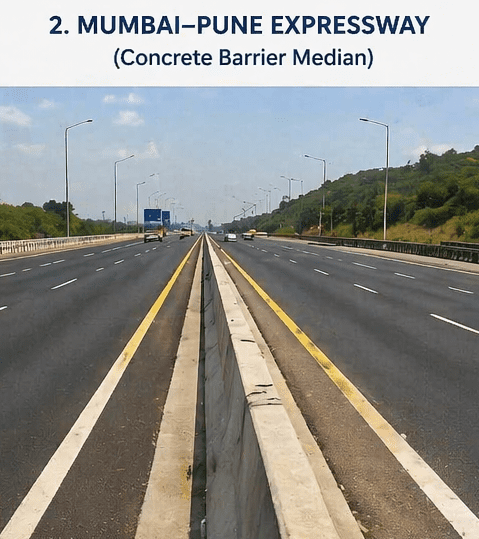
- The Mumbai-Pune Expressway also uses concrete barrier medians, which have virtually eliminated crossover accidents.
- Urban roads such as the Delhi Ring Road use raised medians with plantations, which improve safety as well as aesthetics.
Maintenance and Inspection
Median maintenance is as important as construction.
- Vegetation should be regularly trimmed to ensure clear visibility. Reflective markers and road studs must be maintained.
- Drainage systems must be kept clean to prevent water stagnation.
- Inspections must be conducted periodically on barrier medians so that workers can repair damage promptly.
Common Mistakes in Median Design
Many projects have median design flaws that impact safety.
- Providing medians that are too narrow is a common mistake, compromising safety.
- Improper plantation also creates problems, especially when trees block visibility.
- Ignoring drainage systems is also a major issue, leading to waterlogging.
Advanced Design Aspects of Highway Median
- Modern highway engineering uses several advanced techniques to make median design more effective. Basic separation is no longer sufficient; a smart and sustainable design approach is essential.
- Mediation lighting is an important aspect, especially on urban highways and expressways. Proper lighting improves night driving safety and ensures a clearly visible median. Many projects install median lighting poles to provide illumination to both carriageways.
- In addition, glare screens can also be part of median design. On high-speed roads, headlights from opposite traffic can disrupt driver visibility. To mitigate this, projects install shrub plantations or artificial glare screens in the median.
- Cable barrier systems also enhance safety on some advanced highways. These flexible barriers absorb impact energy and reduce accident severity. This technology is gradually gaining popularity in India as well.
Median Openings and Access Control
- Proper planning of median openings is crucial when designing medians. These openings serve U-turns, emergency vehicles, and local access.
- However, excessive openings can increase accident risk. Therefore, we should maintain controlled spacing as per IRC guidelines. On high-speed highways, we should minimize median openings and prefer grade-separated intersections.
- On urban roads, we provide median openings near signalized intersections to manage traffic smoothly. On expressways, designers generally adopt a fully access-controlled median design.
Practical Site Challenges
- Median construction on real construction sites presents several challenges. Land acquisition poses a major issue, especially in urban expansion projects. Limited space forces engineers to adopt narrow median designs.
- In addition, utility shifting such as water pipelines, power cables, and drainage lines also impacts median construction. Often, teams must adjust median alignment to accommodate these utilities.
- Maintenance challenges are also common. If regular maintenance is not performed, vegetation can become uncontrolled and create safety issues.
To get details about Structural article, click on given link.
How to Calculate HPC Concrete Quantity step by step
Future Trends in Median Design
- Median design in future highways is set to become even more advanced. Smart highways could integrate sensors and smart lighting systems into the median.
- Some countries are also experimenting with installing solar panels in the median to generate renewable energy.
- With the advent of autonomous vehicles, median design will also undergo changes, with greater emphasis on safety barriers and digital infrastructure.
Conclusion
In highway infrastructure design, the median is a crucial safety element; it not only separates traffic moving in opposite directions but also enhances the overall efficiency and safety of the road network. Proper median design on modern highways, expressways, and urban roads is considered essential for accident prevention, effective traffic management, and driver comfort.
Depending on specific road conditions and traffic requirements, various types of dividers—such as raised, depressed, flush, and barrier types—are employed. Their selection is based on factors like design speed, traffic volume, land availability, and safety needs. A well-designed separation system minimizes head-on collisions, reduces headlight glare, and ensures smoother traffic flow.
Adherence to Indian Roads Congress (IRC) and MoRTH guidelines regarding width, drainage, landscaping, and safety barriers significantly strengthens road user safety. Furthermore, regular maintenance—including vegetation control, upkeep of reflective markers, and periodic inspections—is just as critical as the initial construction.
Today, advanced technologies such as smart highways, cable barriers, glare screens, and intelligent lighting systems are making road design safer and more sustainable. With the future development of autonomous vehicles and digital transportation infrastructure, the role of road separation systems is set to become even more significant.
Therefore, a deep understanding of this subject is essential for civil engineers, highway designers, and construction professionals. Whether in the context of competitive examinations or actual site execution, proper design and maintenance play a vital role in ensuring road safety, traffic efficiency, and long-term infrastructure performance.
If you’re a civil engineer or work on highway projects, a proper understanding of median design is crucial. This is essential knowledge not only for exams but also for actual site execution.
About the Author
My name is Susanta Kumar Mohapatra. I am a civil engineering professional with over 11 years of practical experience in the construction and infrastructure sectors. I hold a B.Tech degree in Civil Engineering and an M.E. degree in Construction Management.
Throughout my career, I have worked in various areas such as road construction, bridge projects, quality control, material testing, quantity surveying, project planning, and site management. I am passionate about sharing practical knowledge related to highway engineering, laboratory testing, and construction management with engineers, students, and construction professionals.
I am the founder of CivilGuruHub.com, where I share technical articles, field experiences, laboratory test procedures, guidelines based on IRC and IS codes, and practical construction knowledge related to civil engineering. My aim is to explain civil engineering concepts in simple language and provide useful, reliable information to industry professionals.
You can connect with me through CivilGuruHub.com and my YouTube channel, “The Civil Site,” where I regularly share civil engineering tutorials and practical site knowledge.
Frequently Asked Questions (FAQs)
1. What is a highway median?
A highway median is the section in the middle of the road that separates traffic moving in opposite directions. Its primary objective is to enhance road safety and prevent head-on collisions.
2. What is the primary function of a highway median?
The main functions of a median are to separate opposing traffic, reduce the risk of accidents, control glare, and maintain traffic discipline.
3. What are the different types of highway medians?
The main types of highway medians include Raised Medians, Depressed Medians, Flush Medians, and Barrier Medians. Their selection depends on factors such as road speed, traffic volume, and available space.
4. What is the difference between a raised median and a depressed median?
A raised median is elevated above the road surface and constructed with kerbs, whereas a depressed median sits below the road level and is typically covered with grass or vegetation.
5. How does a median improve road safety?
A median keeps vehicles traveling in opposite directions apart, thereby reducing the likelihood of head-on collisions. It also reduces glare and facilitates smoother traffic flow.
6. What should be the minimum width of a median according to IRC standards?
According to IRC guidelines, the minimum width of a median on urban roads should be approximately 1.2 meters, while greater widths are preferred for highways and expressways.
7. What is a barrier median?
A barrier median is a physical safety barrier constructed using concrete, metal crash barriers, or cable barriers. It is particularly useful on high-speed highways and expressways.
8. Why is plantation in the median important?
Plantation in the median helps reduce glare, improves the environment, and enhances the road’s aesthetics. However, the plantation should be such that it does not obstruct the driver’s sight distance.
9. What is the significance of median openings?
Median openings are provided to facilitate U-turns, access for emergency vehicles, and access for local traffic. Their spacing and location are designed in accordance with IRC standards.
10. Which type of median is most commonly used on expressways?
Barrier medians or wide depressed medians are generally used on expressways because they provide maximum safety and help prevent crossover accidents.

Pingback: 5 Phases of Project Life Cycle (Easy Guide)