
Table of Contents
The subgrade is the natural soil or prepared soil layer upon which the entire road structure is built. It is the base of the road and supports all the loads.
introduction:
The subgrade bed is the most important foundation part of road construction. If workers do not prepare the bed properly, the entire pavement system can fail—no matter how strong the material used on top.
Therefore, engineers and site supervisors must understand the correct process for subgrade preparation.
In this article, we will explain the complete practical process of subgrade bed preparation in detail—from site clearing to final compaction and testing—so that you can confidently use it on your site.
What is a subgrade? (Basic Understanding)
It is the lowest layer of a road structure, made of natural or prepared soil. Its primary function is to safely carry the load of the layers above (GSB, WMM, DBM, BC, etc.).
If the subgrade is weak, it will:
- Settlement will occur
- Cracks will develop
- The road’s life will be reduced
Therefore, its preparation must be scientific and with proper compaction.
Importance of Subgrade Preparation
The quality of the subgrade directly affects the life of the road. If compaction is not proper or moisture control is inadequate, the road will experience problems.
The main objectives are:
- Provide uniform support.
- Proper load distribution
- Control settlement
- Increase pavement life
Complete Process of Subgrade Preparation
Now let us understand the step-by-step practical process that is followed on the site.
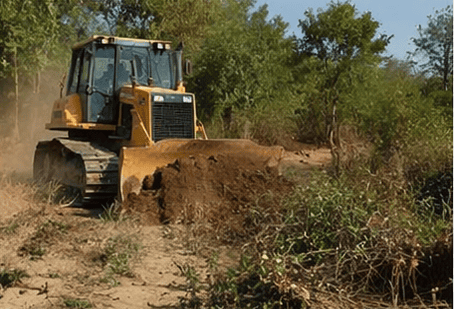
Step-1:Site Clearing and Grubbing
At first, the site must be completely cleaned.
In this process:
- Grass, bushes, and trees are removed.
- Roots and organic material are removed.
- Top soil (generally 150 mm) is removed.
This step is important because organic material is weak and cannot support the load.
Step-2:Stripping of Top Soil
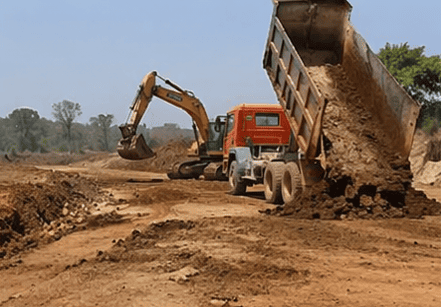
Topsoil contains organic material that is not suitable for engineering purposes.
Therefore:
- Top soil is removed and stockpiled to the side.
- It can later be used for landscaping or slope dressing.
Step-3:Cutting and Filling (Earthwork)
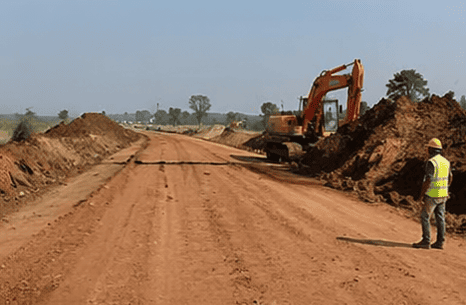
- In this stage, the level is created according to the road alignment.
- If the ground is high, cutting is done.
- If the ground is low, filling is done.
- Generally, suitable soil is used for filling, which:
- Plasticity is controlled,
- No organic material is present,
- Has proper gradation.
Step-4:Layer-wise Filling (If Filling Required)
Filling does not occur all at once. This impairs proper compaction.
The proper process for filling are:
- The soil have to spread layer wise.
- CBR (California Bearing Ratio) must be above 8 as given in Design.
- Each layer Each layer should not be more than 250 mm thick. (MoRTH section 300)
- Each layer is compacted separately.
- It is important to establish a compaction pattern to determine the required number of plain passes, low vibration passes, and high vibration passes needed to achieve the desired density.
- Testing the density layer by layer is very important, and only if it meets the required standards should we prepare the next layer.
- Proper care must be taken to maintain the camber and gradient in each layer.
- This process is repeated until the required level and FDD is achieved.
For better Knowledge about camber and gradient the click on given link.
What is Gradient: in Civil Engineering?
Moisture Conditioning
Moisture plays a very important role in compaction.
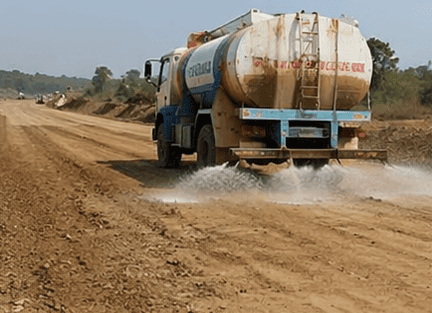
- If the soil is dry: Water is sprinkled.
- If the soil is wet: The soil is allowed to dry.
- The target is to achieve OMC (Optimum Moisture Content).
- OMC (Optimum Moisture Content) are obtained during the lab density test
For better Knowledge about FDD test the click on given link.
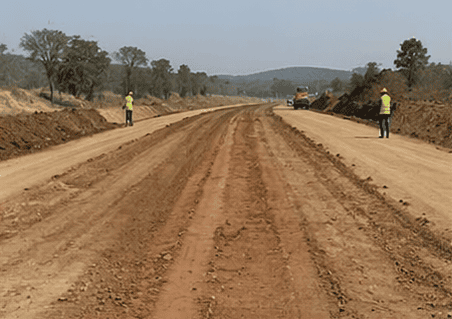
Leveling and Dressing
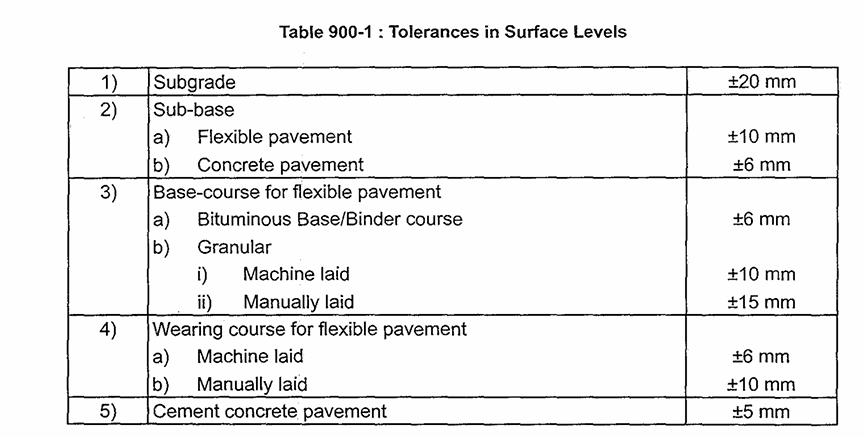
It is very important to level the bed properly and according to the tolerance as per MoRTH section 900 and table no. 900-1 before compaction.
This involves:
- Proper camber (cross slope) is provided
- Uneven surfaces are smoothed
- Proper gradient is maintained
- Design level is checked
Camber is important for drainage.
Compaction Process
This is the most important step.
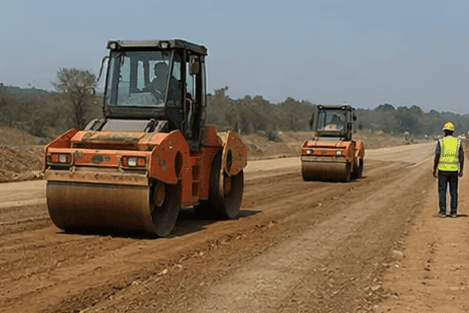
The following are used for compaction:
- Smooth wheel roller
- Sheep foot roller
- vibratory roller
The objective of compaction is:
To achieve maximum dry density
Generally required compaction for subgrade is:
97% to 100% of MDD (according to Modified Proctor Test)
Field Density Test (FDD Test)
A Field Dry Density Test (FDD) checks compaction on site.
Its purpose is: To check whether the required compaction has been achieved.
If compaction is low: Re-rolling is performed.
Final Inspection
In the final stage, the engineer checks:
- Level and alignment
- compaction result
- surface finish
- Drainage slope
If all parameters are satisfied, then the team starts the next layer (GSB).
Practical Site Tips for Subgrade Preparation
Based on site experience, some important points:
- Never compact on wet soil.
- Overcompaction can also weaken the soil.
- Control the thickness of each layer.
- Maintain proper drainage during rainy season.
- Perform FDD tests at regular intervals.
Common mistakes that should be avoided
Many times, engineers make mistakes on site that create problems later:
- Not removing top soil
- Uneven compaction
- Ignoring moisture control
- Filling in thick layers
- Skipping testing
These mistakes are a major cause of road failure.
Types of Subgrade (Short Overview)
It can be of different types:
- Natural : The original ground is used.
- Prepared : The soil is improved and then used.
- Stabilized : Lime, cement, or chemicals are added to the soil.
Reasons for subgrade failure
Problems that occur if the subgrade is not properly prepared include:
- Settlement
- Rutting
- Cracks
- Potholes
- Pavement failure
Therefore, the subgrade should not be taken lightly.
Important points according to the work
According to Indian Roads Congress (IRC) guidelines:
- The engineers must properly compact the bed.
- Minimum compaction should be 97%.
- Drainage systems must be effective.
- Design must satisfy CBR values.
Conclusion
Subgrade preparation is one of the most critical activities in road construction because it forms the foundation of the entire pavement structure. No matter how strong the upper layers such as GSB, WMM, DBM, or Bituminous Concrete are, the overall performance and durability of the road largely depend on the quality. A properly prepared subgrade provides uniform support to the pavement, distributes traffic loads effectively, minimizes settlement, and helps increase the service life of the road.
The complete process of preparation includes site clearing, removal of topsoil, earthwork, layer-wise filling, moisture conditioning, leveling, compaction, and quality control testing. Each stage must be carried out carefully according to project specifications and relevant standards such as IRC and MoRTH guidelines. Maintaining the correct moisture content, controlling layer thickness, and achieving the required field density are essential for obtaining a stable and durable foundation.
Regular inspections and tests, such as the Field Dry Density (FDD)(2720-28) Test and CBR evaluation, help ensure that the required standards are achieved before proceeding to the next pavement layer. Engineers and site supervisors should also pay special attention to drainage, camber, and gradient so that water does not weaken the soil structure over time.
A well-compacted layer significantly reduces the chances of pavement distress such as rutting, cracking, potholes, and premature failure. On the other hand, neglecting proper subgrade preparation can lead to costly repairs and reduced road performance in the future. Therefore, every civil engineer should treat subgrade construction as a systematic engineering process rather than a routine earthwork activity.
In summary, a strong and properly compacted subgrade is the key to a long-lasting road. Investing time and effort in quality subgrade preparation ensures better pavement performance, improved safety, lower maintenance costs, and a longer service life for the entire road structure.
About the Author
My name is Susanta Kumar Mohapatra. I am a Civil Engineering professional with over 11 years of practical experience in the construction and infrastructure sectors. I hold a B.Tech degree in Civil Engineering and an M.E. degree in Construction Management.
Throughout my professional career, I have worked in various areas such as road construction, highway projects, bridge construction, quality control, material testing, quantity surveying, project planning, billing, and site management. I have a keen interest in conveying practical civil engineering concepts to engineers, students, and construction professionals in a simple and useful manner.
I am the founder of CivilGuruHub.com, where I share technical articles related to civil engineering, laboratory test procedures, construction methodologies, quantity calculation guides, information based on IRC and IS codes, and practical site experiences. My objective is to provide reliable, practical, and field-oriented knowledge to industry professionals and civil engineering students.
I believe that civil engineering should not be limited to theory alone; understanding it through practical site applications is equally essential. With this perspective, I regularly publish educational content that is useful for those working in the construction field.
You can connect with me via CivilGuruHub.com and my YouTube channel, “The Civil Site,” where I regularly share civil engineering tutorials, site execution methods, quality control tests, and practical construction knowledge.
Frequently Asked Questions (FAQs)
1. What is the subgrade in road construction?
The subgrade is the bottom-most soil layer of the road; it supports the entire pavement structure and transfers loads from above to the ground.
2. Why is subgrade preparation important?
Proper subgrade preparation ensures uniform support for the road, minimizes settlement, extends pavement life, and reduces the risk of road failure.
3. What should be the minimum CBR value for the subgrade?
Generally, according to road design standards, the CBR value should be 8% or higher. The exact value depends on project requirements.
4. What should be the maximum thickness of a single layer during filling?
According to MoRTH specifications, the thickness of a single layer before compaction should generally not exceed 250 mm.
5. What is OMC (Optimum Moisture Content)?
The purpose of the FDD (Field Dry Density) test is to check the density of compacted soil at the site to verify whether the required compaction has been achieved.
6. What level of compaction is required for the subgrade?
Generally, achieving 97% to 100% compaction (based on the Modified Proctor Test) is required for the subgrade.
7. What problems can arise if the subgrade is not properly compacted?
Poor compaction can lead to serious issues such as settlement, rutting, cracks, potholes, and pavement failure.
8. What are the most common mistakes made during subgrade preparation?
Failing to remove topsoil, ignoring moisture control, filling in thick layers, uneven compaction, and skipping testing are the most common mistakes.
9. What are the different types of subgrade?
There are primarily three types of subgrade: Natural, Prepared, and Stabilized. Their selection depends on site conditions and design requirements.
10. Which layer comes after the subgrade in road construction?
Construction of the GSB (Granular Sub-Base) layer usually begins after the subgrade preparation and testing are completed.

Pingback: What is a Median in Highway? Full Engineerin Guide
Pingback: What is a Median in Highway? Full Engineer Guide
Pingback: What is Gantt Chart? 7 Simple Ways to Use It