
Table of Contents
How to select and finalize a borrow area? This guide helps you understand the complete process, including soil quality, lead distance, and practical site tips.
introduction:
Borrow area selection is a very critical process for road construction or any infrastructure project. The borrow area provides the place from where we take soil, which we use for road embankment, subgrade or filling.
If the borrow area is not selected correctly, the entire project can fail from the point of view of quality and durability.
In this article, we will explain the complete practical process, field tips, and engineering approach of borrow area selection – without unnecessary theory, based on real site experience.
What is a Borrow Area?
The borrow area is the location where suitable soil is taken for construction. This soil is used in different layers of the road, such as:
- Embankment
- Subgrade
- Shoulder filling
Therefore, the quality and suitability of the soil is very important.
Why is Borrow Area Selection Important?
If the soil is not correct:
- Settlement may occur in the road
- Cracks may develop
- Water retention may increase
- Compaction may not be achieved
Therefore, an engineer must consider many factors when finalizing a borrow area.
Complete Process of Borrow Area Selection
Site Investigation (Field Visit)
The first step is site investigation. The engineer should personally inspect potential borrow areas.
During the field visit:
- Identify the soil type (clay, sand, silt, gravel)
- Examine the area’s topography
- Check nearby water bodies or drainage conditions
Always inspect multiple locations to choose the best option.
Soil Quality Check (Visual + Practical Understanding)
The quality of the soil in the borrow area is the most important factor.
Basic checks in the field:
- Hold the soil in your hand to feel its texture.
- If the soil is sticky, it may have a high clay content.
- If the soil crumbles easily, it may be sandy.
A good borrow soil should:
- Compact easily.
- Avoid excessive plasticity.
- Control water retention.
Lead Distance (Transport Distance)
The distance of the Borrow area from the construction site is also very important.
If the distance is too far:
- Transportation costs increase
- Time delays occur
- Fuel consumption increases
The Borrow area should be close to the site, but quality should not be compromised.
Accessibility (Road and Movement Conditions)
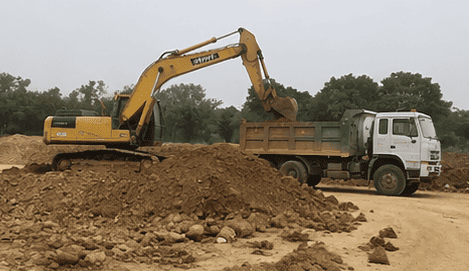
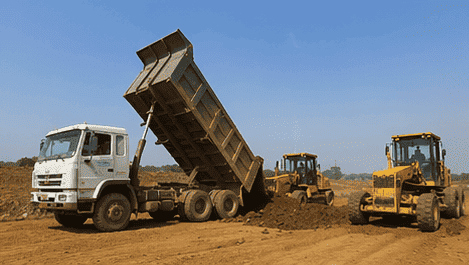
It’s important to check whether the borrow area is accessible by machinery.
Check:
- Can trucks and dumpers move easily?
- Is access possible even during rainy weather?
- Is the approach road strong?
If access is difficult, operational problems will arise.
Environmental Considerations
It’s also important to consider the environment when selecting a borrow area.
Avoid:
- Agricultural land
- Forest areas
- Areas near water bodies.
And ensure:
- The land can be restored after excavation
- Drainage is not disturbed
Soil sampling from Borrow area
Once a potential borrow area is identified, engineer collects soil samples from there. Sampling is not random, but from the appropriate depth of 1.5 meter and minimum offset 10 meter as per MoRTH clause 305.2.2.2
In the field, the engineer can perform some basic tests, such as:
- Is the soil plastic or non-plastic?
- Checking cohesiveness with a hand test.
- Checking moisture conditions.
lab test to finalize the borrow area soil:
Proctor Compaction Test
This test determines Maximum Dry Density (MDD) and Optimum Moisture Content (OMC).
- Standard Proctor → IS 2720 Part 7
- Modified Proctor → IS 2720 Part 8
This test is very important for setting field compaction targets.
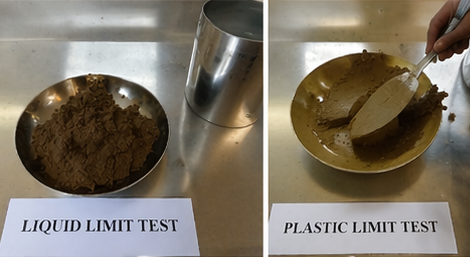
Atterberg Limits Test
This test determines Plasticity of the soil:
- Liquid Limit (LL)
- Plastic Limit (PL)
- Plasticity Index (PI)
Atterberg Limits → IS 2720 Part 5
Grain Size Analysis (Sieve Analysis)
This determines soil gradation.
We determine sand, silt, and clay proportions.
Standard: IS 2720 Part 4
Free Swell Index Test
This test identifies expansive soils (black cotton soils).
Standard: IS 2720 Part 40
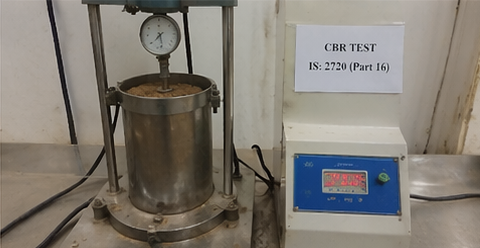
CBR Test (California Bearing Ratio)
The CBR test measures soil strength.
Engineers conduct it as per IS 2720 Part 16
A CBR value of above 8% is typically acceptable for subgrade soil
To get better knowledge about different quality control test, click below link.
FDD test: what is it? complete process and calculation.
Types of Cement in Civil Engineering: A Complete Guide
IRC and MORTH Guidelines (Very Important)
It is mandatory to follow the guidelines of the Indian Roads Congress (IRC) and the Ministry of Road Transport and Highways (MORTH) for B/A selection.
According to MoRTH Clause 305:
- The B/A should not be on agricultural land (unless unavoidable)
- The depth should generally not exceed 1.5 m
- Offsets of pit not less than 10 m
- Proper drainage must be maintained
- Restoration of the land after excavation is mandatory
IRC Guidelines
According to IRC:10:
- Avoid waterlogging areas
- Minimize environmental impact
- Ensure haul road condition is good
Trial Excavation (Practical Testing on Site)
It is very important to conduct a trial excavation before making a final decision.
In this process:
- A small amount of soil is excavated
- Its compaction ability is checked
- Its behavior is observed
This gives an idea of real conditions, which is not possible through theory.
Finalization Process
When lab test results are satisfactory and site conditions are suitable, the team finalizes the borrow area.
Finalization includes the following steps:
- Test report approval
- Engineer-in-charge permission
- Quantity calculation
- Haul road planning
- Agreement with the landowner
- Borrow Area map
After this, excavation work begins.
Common Mistakes in Selection Process
Engineers often make some common mistakes:
- Selecting an area based solely on distance
- Ignoring soil quality
- Not conducting a proper field investigation
- Ignoring accessibility
These mistakes increase both project costs and failure risk.
Practical Site Tips (Engineering Experience)
- Always shortlist multiple borrow areas
- Consider the impact of the rainy season
- Don’t judge by just looking at the soil; understand its behavior
- Get feedback from local workers and operators
- Follow safety and environmental norms
- Always remove the top soil (150–300 mm)
- Do not mix soil from different layers
- Maintain moisture control
- Avoid excavation during rainy season
conclusion
The selection of a suitable soil source is one of the most important decisions in any road construction project because it directly affects the strength, stability, and long-term performance of the pavement structure. Even when high-quality materials and modern construction techniques are used, poor-quality fill material can lead to settlement, cracking, excessive moisture retention, and premature pavement failure. Therefore, engineers must follow a systematic and practical approach while choosing a soil source for embankment, subgrade, and shoulder construction.
A proper selection process begins with detailed site investigation, where multiple locations are inspected and evaluated based on soil characteristics, accessibility, drainage conditions, and environmental impact. Field observations should always be supported by laboratory testing such as Proctor Compaction Test, Atterberg Limits Test, Grain Size Analysis, Free Swell Index Test, and CBR Test. These tests help determine whether the soil can achieve the required density, strength, and performance standards specified in project requirements.
In addition to soil quality, factors such as lead distance, transportation cost, machinery access, haul road condition, and land restoration requirements must also be considered. Compliance with IRC and MoRTH guidelines is essential to ensure that excavation activities do not create environmental problems or affect surrounding land and drainage systems. Trial excavation and practical field evaluation further help engineers understand the actual behavior of the material before large-scale excavation begins.
A well-planned Borrow Area not only reduces construction costs but also improves project efficiency and quality control. By combining field experience, laboratory testing, environmental responsibility, and engineering standards, project teams can ensure the availability of suitable soil throughout the construction period. Ultimately, careful planning and scientific evaluation during the selection stage contribute significantly to building durable, safe, and long-lasting roads that perform effectively throughout their design life.
About the Author
My name is Susanta Kumar Mohapatra. I am a Civil Engineering professional with over 11 years of practical experience in the construction and infrastructure sectors. I hold a B.Tech degree in Civil Engineering and an M.E. degree in Construction Management.
Throughout my professional career, I have worked in various areas such as road construction, highway projects, bridge construction, quality control, material testing, quantity surveying, project planning, billing, and site management. I have a keen interest in conveying practical civil engineering concepts to engineers, students, and construction professionals in a simple and useful manner.
I am the founder of CivilGuruHub.com, where I share technical articles related to civil engineering, laboratory test procedures, construction methodologies, quantity calculation guides, information based on IRC and IS codes, and practical site experiences. My objective is to provide reliable, practical, and field-oriented knowledge to industry professionals and civil engineering students.
I believe that civil engineering should not be limited to theory alone; understanding it through practical site applications is equally essential. With this perspective, I regularly publish educational content that is useful for those working in the construction field.
You can connect with me via CivilGuruHub.com and my YouTube channel, “The Civil Site,” where I regularly share civil engineering tutorials, site execution methods, quality control tests, and practical construction knowledge.
Frequently Asked Questions (FAQs)
1. What is a Borrow Area?
A Borrow Area is a site from which suitable soil is excavated for use in road embankments, subgrades, and general filling. The quality of the soil from this area directly impacts the durability and strength of the road project.
2. What is the most important factor when selecting a Borrow Area?
Soil quality is the most critical factor. It is essential to assess the soil’s compaction capacity, plasticity, moisture behavior, and strength to ensure optimal road performance.
3. At what depth is the soil sample collected from a Borrow Area?
According to MoRTH Clause 305.2.2.2, soil samples are typically collected from a depth of approximately 1.5 meters, and the borrow pit must maintain a minimum offset of 10 meters.
4. What should be the lead distance between the Borrow Area and the construction site?
A shorter lead distance results in lower transportation costs and reduced fuel consumption. However, the area should not be selected based on distance alone; soil quality must also be prioritized.
5. Which laboratory tests are conducted on Borrow Area soil?
Key tests performed on Borrow Area soil include the Proctor Compaction Test, Atterberg Limits Test, Grain Size Analysis, Free Swell Index Test, and CBR Test.
6. What is the significance of the CBR Test in Borrow Area selection?
The CBR Test measures soil strength. For suitable subgrade soil, the CBR value should generally exceed 8%.
7. Can agricultural land be used as a Borrow Area?
MoRTH guidelines advise against using agricultural land as a Borrow Area. It is utilized only in unavoidable situations.
8. Why is trial excavation conducted before finalizing a Borrow Area?
Trial excavation reveals the soil’s actual field performance, compaction behavior, and moisture response. This minimizes the risk of errors during the final selection process.
9. Why is it necessary to remove topsoil from the borrow area?
Topsoil contains high levels of organic matter, which can affect compaction and strength. Therefore, 150–300 mm of topsoil is typically removed first.
10. What are the most common mistakes engineers make when selecting a borrow area?
Selecting an area based solely on distance, failing to conduct soil testing, ignoring accessibility, and overlooking environmental factors are the most common mistakes; these can impact both project quality and cost.