
Table of Contents
Introduction:
Typical Cross Section is a very important drawing in civil engineering, especially in Highway engineering. Whether you’re a site engineer, student, or quantity surveyor, knowing how to read a TCS correctly is essential.
In this guide, we will explain step-by-step what a TCS is, how to read it, and how someone uses it on a practical site.
what is typical cross section :
A drawing that shows a side view (cut section) of a road or structure is a typical cross-section.
It provides details of the road’s full width, layers, slope, drainage, and structures.
In simple terms: A TCS represents a cut-section of the road and we view it from the side.
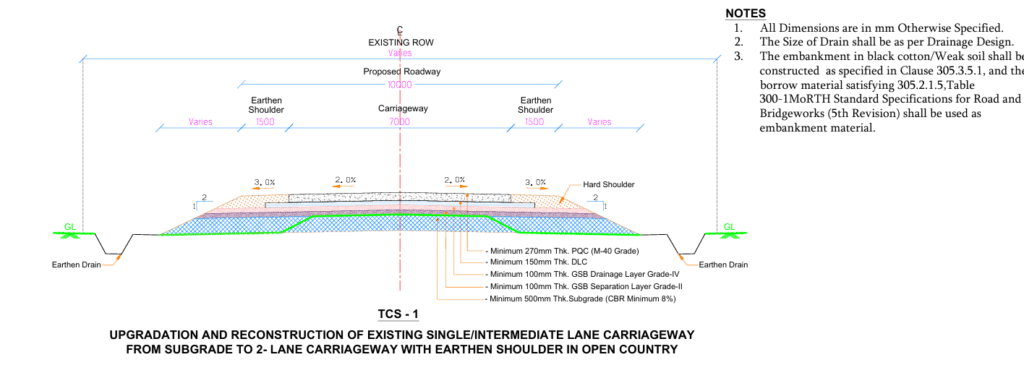
Lets understand The given TCS-1:
- Main Carriage way (MCW) = 7 m
- Earthen shoulder = 1.5 m each side
- Camber percentage = 2% (Variable)
- Camber of Earthen shoulder = 3% (From edge of MCW)
- Slope = 1:2
- Required CBR (California Bearing Ratio) = 8% for Subgrade
Note: Read carefully the instruction given above drawing
- Subgrade Thickness = 500 mm
- GSB 1st layer (Separation Layer grade – II) = 100 mm
- GSB 2nd layer (Drainage Layer grade – IV) = 100 mm
- DLC = 150 mm
- PQC = 270 mm
Layer-wise Analysis of the Given Typical cross section:
Subgrade Layer:
crust thickness = PQC + DLC + GSB = 270 + 150 + 100 + 100 =620 mm
Slope = 1:2
We know, Subgrade bottom = Embankment Top
Hence embankment top have to calculate.
crust thickness + Subgrade thickness = 620 + 500 = 1120 mm or 1.12 m
Embankment Top width half section = (MCW half section + side shoulder one side) + (Slope X thickness)
Top width = (3.5 + 1.5) + ( 2 X 1.12) =7.24 m
For Both side = 7.24 X 2 = 14.48 m
Similarly you can calculate Embankment 1st layer to Top layer Toe width by using the same formula but the thickness will vary.
Now,
Subgrade 1st layer Top width
crust thickness + Subgrade Top layer thickness(maximum 250 mm) = 620 + 250 = 870 mm or 0.870 m
Subgrade 1st layer half width = (3.5 + 1.5) + (2 X 0.870) = 6.74 m
Subgrade 1st layer Top width = 6.74 X 2 = 13.48 m
Here we got the Top width of 13.48 m, but the toe width for Subgrade 1st = 14.48 m(Embankment Top width)
Subgrade Top layer Top width
Top layer half width = (3.5 + 1.5) + (2 X 0.620) = 6.24 m
Subgrade Top layer full width = 6.24 X 2 = 12.48 m
Here we got the Top width of 13.48 m, but the toe width for Subgrade Top = 13.48 m(Embankment Top width)
Remember The top width of the Subgrade layer = Top width of Subgrade top layer = 12.48 m
The Toe of Subgrade layer = Bottom width of Subgrade layer/ Top width of embankment layer = 14.48 m
Analysis
Here,
- Top width of embankment Top layer = 14.48 m
- Top width of Subgrade 1st layer = 13.48 m
- Toe width of Subgrade 1st layer = 14.48 m
- Top width of Subgrade Top layer = 12.48 m
- Toe width of Subgrade 1st layer = 13.48 m
For better idea regarding Highway engineering click on below link.
what is Superelevation in road: complete guide
potholes in road: causes, damages and methods of repairing
What is camber : Complete Guide for Beginners
GSB (Granular Sub Base) Layer:
GSB 1st layer
(Crust thickness – GSB 1st layer thickness) = 620 – 100 = 520 mm or 0.520 mm
GSB 1st layer half width = (3.5 + 1.5) + (2 X 0.52) = 6.04 m
Full width = 6.04 x 2 = 12.08 m
Similarly, GSB Top layer
(Crust thickness – GSB 1st layer thickness – GSB Top Layer Thickness) = 620 – 100 – 100 = 420 mm or 0.420 m
GSB Top layer half width = (3.5 + 1.5) + (2 X 0.420) = 5.84 M.
Full width = 5.84 X 2 =11.68
Analysis
Here,
- Top width of GSB 1st layer = 12.08 m
- Toe width of GSB 1st later= 12.48 m
- Top width of GSB Top layer = 11.68 m
- Toe width of GSB Top later= 12.48 m
DLC (Dry Lean Concrete) Layer
As given,
DLC have no slope and having some offset.
So generally offsets are taken as per engineers. may be 0.250 or 0.300 m
Assume it is 0.250 mm
So DLC width = half width of MCW + 0.300 = 3.500 + 0.300 = 3.800
For Both side = 3.8 X 2 =7.6 m
PQC (Pavement Quality Concrete) Layer
As given ,
PQC have no slope and having some offset.
So MCW width = PQC Top and Bottom width = 7 m (Bothside)
How TCS is used on site (Practical Understanding)
- When you work on site, the TCS is not just a drawing but becomes a complete execution guide. The site engineer first fixes the center line as per the TCS and then marks the required width on both sides.
- After this, the team completes the work layer by layer. First, the crew prepares the embankment, then they create the subgrade, then they lay GSB, DLC, and finally they install PQC.
- During each layer, the site team verifies the width, thickness, and slope as per the TCS. If they find a deviation at any stage, they must correct it immediately; otherwise, the entire structure may become weak.
Use of TCS in Quantity Calculation
- TCS is most commonly used in quantity surveys.
- The width and thickness of each layer determine the volume of earthwork, GSB, DLC, and PQC.
- For example, if someone knows the length and calculates the cross-sectional area, they can easily calculate the total volume.
- This is very important for both estimation and billing.
Common Mistakes Engineers Make
- Engineers often fail to interpret TCS correctly, leading to on-site mistakes.
- The most common mistake is ignoring slope. People simply look at the top width, even though the bottom width is greater.
- Second mistake is mistaking the thickness for loose thickness, when it is actually compacted thickness.
- Third mistake is not marking the offset correctly, resulting in inaccurate alignment.
- These small mistakes can damage the entire road structure.
Home Work:
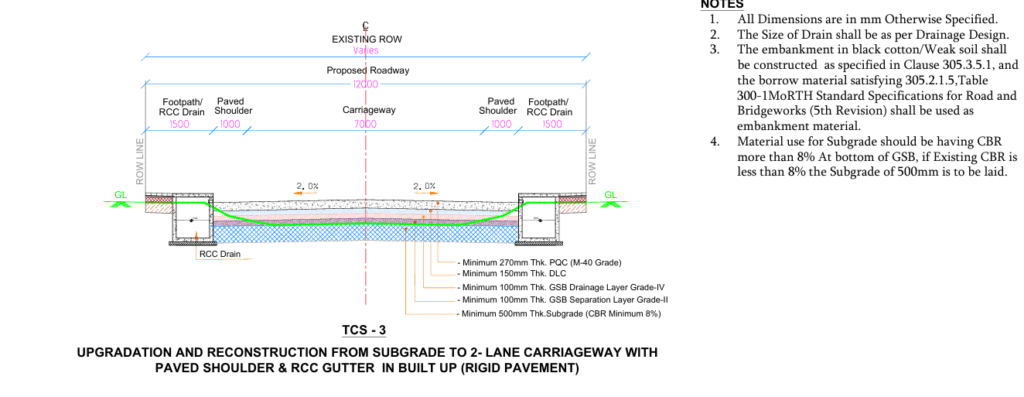
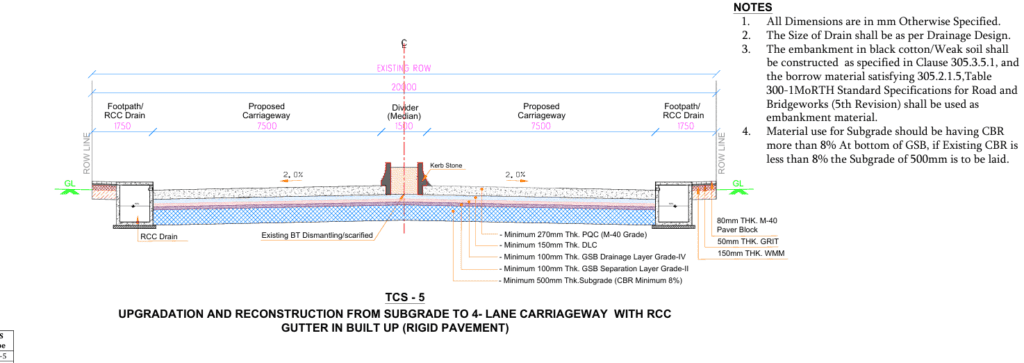
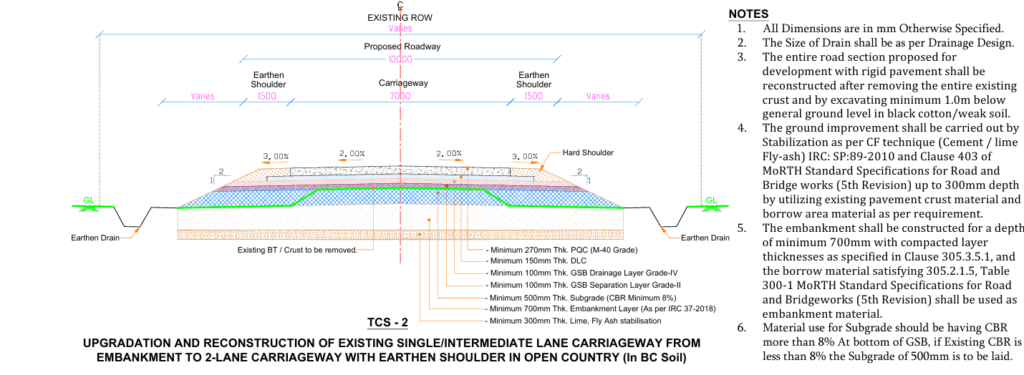
Comment if you solve these 3 tasks
For better Understand See the video
Conclusion
The Typical Cross Section is a crucial concept in civil and highway engineering, serving as the foundation for the planning, execution, and quality control of any road project. Correct interpretation of the TCS is essential for understanding the width, thickness, slope, camber, and structural arrangement of each layer during road construction. When an engineer accurately reads and analyzes the TCS, tasks such as site marking, level checking, layer construction, and quantity calculation become significantly easier.
In this article, we explored step-by-step how to read a Typical Cross Section drawing and understood the practical significance of the dimensions provided within it. We examined the width calculations for embankment, subgrade, GSB, DLC, and PQC layers in detail. We also looked at the significant impact that slope and layer thickness have on road geometry. During actual site execution, the TCS serves as a comprehensive guide for engineers, enabling every construction activity to be implemented in accordance with the design.
The TCS is also highly valuable from the perspective of quantity surveying and billing, as it forms the basis for calculating cross-sectional areas and material quantities. Therefore, whether you are a civil engineering student, a site engineer, a quality engineer, or a quantity surveyor, a solid understanding of the TCS strengthens your technical skills.
In conclusion, this is not merely a drawing but a practical tool for the execution of road construction. The more you analyze and practice with various TCS drawings, the better you will be able to relate the design to field conditions and evolve into a competent civil engineering professional.
To get knowledge more in civil engineering, click below link
About the Author
My name is Susanta Kumar Mohapatra. I am a Civil Engineering professional with over 11 years of practical experience in the construction and infrastructure industry. I hold a B.Tech degree in Civil Engineering and an M.E. degree in Construction Management.
Throughout my professional career, I have worked in various areas such as Highway Engineering, Road Construction, Bridge Projects, Quality Control, Material Testing, Quantity Surveying, Project Planning, Contract Management, and Site Execution. I have a keen interest in conveying practical civil engineering concepts to engineers, students, and construction professionals in simple, easy-to-understand language.
I am the founder of CivilGuruHub.com, where I share technical articles related to Civil Engineering, site experiences, laboratory test procedures, estimation and costing, guidelines based on IRC and IS Codes, and practical construction knowledge. My objective is to provide engineers and students with reliable, field-oriented information that aids their careers and professional growth.
Additionally, through my YouTube channel “The Civil Site,” I regularly share civil engineering tutorials, site execution methods, quantity calculation techniques, material testing procedures, and practical knowledge regarding construction management.
My goal is to create a reliable learning platform for the Civil Engineering community where practical field experience is easily accessible alongside theoretical knowledge.
FAQs
1. What is the full form of TCS?
The full form of TCS is Typical Cross Section. It is an engineering drawing that illustrates the width, thickness, slope, drainage, and layer arrangement of a road or structure.
2. What is the importance of TCS in highway engineering?
TCS is crucial for site execution, quantity calculation, and quality control. Without it, accurately implementing the road width, slope, and layer thickness becomes difficult.
3. How is a TCS read?
To read a TCS, one must first identify the road width, shoulder width, slope, camber, and layer thickness. Subsequently, the top width and toe width of each layer are calculated.
4. What does MCW mean in a TCS?
MCW stands for Main Carriageway. It is the primary traffic-bearing section of the road where vehicles travel.
5. What does a 1:2 slope mean in a TCS?
A 1:2 slope means that for every 1 meter of vertical height, there is a horizontal distance of 2 meters. It is used to calculate embankment and subgrade widths.
6. Why is camber provided in a TCS?
Camber is provided to drain rainwater off the road surface to the sides. This minimizes water stagnation and extends the pavement’s lifespan.
7. What role does TCS play in quantity calculation?
TCS helps determine the cross-sectional area of each layer. By multiplying this area by the road length, the quantities of earthwork, GSB, DLC, and PQC are calculated.
8. What are Subgrade, GSB, DLC, and PQC in a TCS?
Subgrade is the road’s foundation layer. GSB stands for Granular Sub-Base layer. DLC is the Dry Lean Concrete base layer, and PQC (Pavement Quality Concrete) is the final riding surface.
9. How is TCS practically used at the site?
Based on the TCS, the site engineer carries out tasks such as fixing the centerline, marking widths, checking slopes, and executing layer-wise construction. Quality is maintained by verifying dimensions at every stage.
10. What is the most common mistake engineers make when dealing with TCS?
The most common mistakes are ignoring the slope, confusing compacted thickness with loose thickness, and incorrectly marking offsets. These errors impact both quantities and construction.

Pingback: What is Gradient in Civil Engineering- civilguruhub.com
Pingback: FDD test: what is it? complete gprocess and calculation.
Pingback: What is a Median in Highway? Full Engineering Guide
Pingback: 5 Phases of Project Life Cycle (Easy Guide)