
Last Updates: July 2026
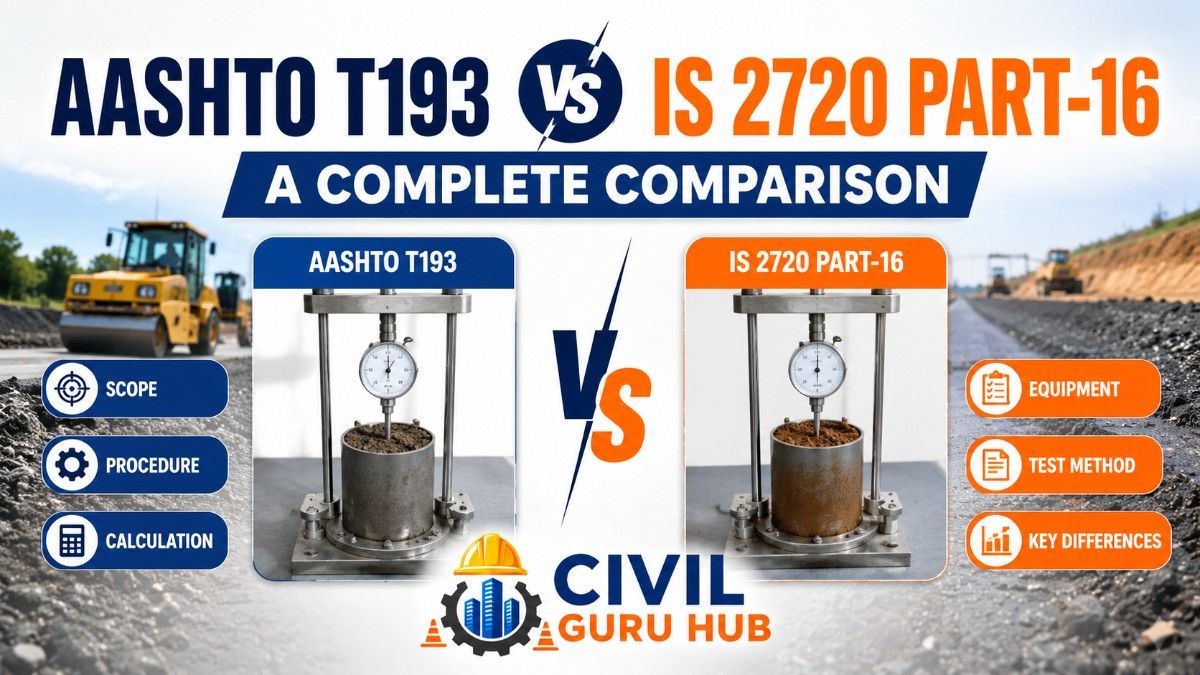
Table of Contents
AASHTO T193 vs IS 2720 Part-16
Whenever a highway, expressway, airport runway, industrial road, or heavy-duty pavement is designed, the primary question is: how strong is the subgrade soil? If the soil’s bearing capacity is not evaluated correctly, then—no matter how well the pavement is designed—defects such as cracks, rutting, settlement, and potholes begin to appear within just a few years.
The California Bearing Ratio (CBR) test is used globally to measure this strength. However, when an engineer has to work on both Indian and international projects, a common point of confusion arises: AASHTO T193 versus IS 2720 Part-16. While both standards define the CBR test, there are significant practical differences regarding their objectives, testing philosophies, documentation styles, reporting requirements, and applications.
Many junior engineers are aware only that AASHTO is the American standard and IS is the Indian standard. However, this knowledge is insufficient for fieldwork. To comprehend tender documents, Detailed Project Reports (DPRs), consultant specifications, and client requirements, an engineer must understand the practical comparison between the two standards.
In this article, we will go beyond mere definitions. Adopting the perspective of an experienced highway engineer, we will explore:
- The purpose behind the development of both standards.
- How they are actually utilized in field projects.
- The situations in which AASHTO T193 is selected versus when IS 2720 Part-16 is preferred.
- The real differences between them from a practical engineering standpoint.
If you wish to first understand the complete concept of the CBR test, you can refer to the articles “IS 2720 Part-16 CBR Test Guide” and “10-30-65 Method in CBR Testing” published on CivilGuruHub. In this article, we will not repeat those topics but will instead focus on the comparison.
How Does The 10-30-65 Method Work In CBR Testing? Complete Guide
IS 2720 Part 16 CBR Test: Everything You Need to Know in 2026
What is AASHTO T193?
In civil engineering, AASHTO T193 is considered a crucial laboratory testing standard, particularly for international-level highway projects, airport pavements, and overseas infrastructure projects. The full name of this standard is:
“Standard Method of Test for The California Bearing Ratio.”
This standard is published by the American Association of State Highway and Transportation Officials (AASHTO). Its primary objective is to evaluate the bearing capacity of soil in a laboratory setting, enabling pavement thickness design to be based on scientific principles.
AASHTO T193 is not limited to a single test procedure; it also defines requirements for sample preparation, surcharge application, soaking conditions, penetration rate, load measurement, reporting, and quality assurance. Consequently, international consultants and transportation agencies place significant importance on this standard.
Practical project experience shows that tender documents for projects in the Middle East, USA, Canada, and various multinational EPC projects frequently reference AASHTO standards directly. If an Indian contractor participates in an overseas project, the laboratory may be required to conduct testing in accordance with AASHTO T193.
Another important aspect is that AASHTO T193 is not limited solely to laboratory testing; its results can also serve as input parameters for flexible pavement design when project specifications require it.
For a field engineer, this means that if a consultant’s report specifies “CBR as per AASHTO T193,” simply noting the CBR value is insufficient. The engineer must also verify whether the sample preparation, surcharge weight, soaking duration, and reporting format adhered to AASHTO requirements.
For these reasons, AASHTO T193 is regarded as one of the most widely accepted CBR testing standards globally.
What is IS 2720 Part-16?
When it comes to determining the bearing strength of soil in India, IS 2720 (Part-16) is the most commonly used laboratory standard.
This standard is published by the Bureau of Indian Standards (BIS) and is titled:
“Methods of Test for Soils – Laboratory Determination of California Bearing Ratio.”
Almost every geotechnical laboratory involved in Indian highway projects utilizes this standard. Laboratory reports for National Highways, State Highways, PMGSY roads, industrial roads, rural roads, and government infrastructure projects are predominantly prepared in accordance with this standard.
However, for an experienced engineer, simply knowing that this is an Indian Standard is not enough. The standard holds great significance because various IRC documents and MoRTH specifications for flexible pavement design in India—whether directly or indirectly—reference CBR values.
Field experience shows that discrepancies often arise between the results from a contractor’s laboratory and those from a third-party laboratory. Investigations frequently reveal that the issue lies not with the soil itself, but with sample preparation or moisture control. Therefore, IS 2720 Part-16 is not merely a testing procedure; it is also a crucial document for quality assurance.
This standard plays a pivotal role in geotechnical investigation reports, DPR preparation, pavement design, and quality control activities for Indian projects. Consequently, every site engineer, QA/QC engineer, and laboratory technician should possess a practical understanding of it.
It is also worth noting that IS 2720 Part-16 and AASHTO T193 share the same objective: determining the CBR. However, the two standards differ in their presentation, documentation, and certain procedural requirements. We will explore this comparison in detail in this article.
AASHTO T193 vs. IS 2720 Part-16: History and Development
Today, the CBR test is considered a routine laboratory test. However, understanding the background of AASHTO T193 Vs IS 2720 Part-16 reveals that the development of the CBR test was a significant milestone in the history of road engineering.
The concept of the California Bearing Ratio (CBR) originated in the United States when the need arose to evaluate subgrades for a rapidly expanding highway network. Traditional soil classification systems struggled to accurately predict pavement performance; consequently, engineers developed a practical, strength-based testing approach.
Subsequently, the CBR concept was standardized and incorporated into the American transportation testing framework. This development promoted a uniform testing methodology across various states and transportation agencies. Today, comparing AASHTO T193 Vs IS 2720 Part-16 is crucial for understanding this historical evolution, as both standards provide widely recognized frameworks for CBR testing.
As highway infrastructure development accelerated in India, international engineering practices were adapted to suit local conditions. The Bureau of Indian Standards (BIS) developed the IS 2720 series for soil testing, with Part-16 specifically covering the Laboratory CBR Test. In this context, comparing AASHTO T193 Vs IS 2720 Part-16 proves highly beneficial for Indian pavement engineers, students, and laboratory professionals.
Indian testing standards were tailored to the local engineering ecosystem by accounting for factors such as climatic conditions, the monsoon, expansive soils (including black cotton soil), and regional construction practices. As a result, differences may be observed between AASHTO T193 Vs IS 2720 Part-16 regarding testing procedures, specimen preparation, loading arrangements, and reporting requirements. That is why, if you are working on an Indian government project today, a consultant will generally refer to IS standards, whereas international projects might utilize AASHTO specifications. Consequently, when adhering to project specifications, it is crucial to understand the differences between AASHTO T193 Vs IS 2720 Part-16.
For an experienced pavement engineer, understanding the history goes beyond mere academic knowledge. Grasping the historical evolution of AASHTO T193 Vs IS 2720 Part-16 clarifies that both standards developed within the context of distinct engineering environments and regional requirements. Naturally, this leads to differences in their documentation, testing philosophies, and implementation approaches.
The comparison between AASHTO T193 Vs IS 2720 Part-16 should not be viewed merely as a simple standard-to-standard comparison. Underlying this comparison is a history spanning decades of development in road construction, subgrade evaluation, and pavement design. Understanding this historical background helps in gaining a better grasp of the practical application of the CBR test.
What is the main objective of both standards?
At a surface level, the objective of both AASHTO T193 Vs IS 2720 Part-16 appears to be the same: determining the CBR (California Bearing Ratio). However, from an engineering perspective, the purpose goes beyond merely generating a numerical value.
The CBR value directly influences pavement thickness design, subgrade evaluation, and construction quality control. An incorrect CBR determination can impact the entire pavement design.
Therefore, the primary objective of both AASHTO T193 Vs IS 2720 Part-16 is to accurately measure the soil’s bearing resistance within a controlled laboratory environment. The test must be repeatable and reliable, yielding comparable results across different laboratories.
Consider a practical site example.
Suppose a contractor changes the borrow area for a National Highway project. While the soil may appear visually similar, the laboratory CBR tests show a value of only 5%, whereas the Detailed Project Report (DPR) had assumed a CBR of 9%. In such a scenario, the pavement thickness might need to be revised, or soil improvement measures might be required.
Similarly, in airport runway projects, subgrade strength directly affects pavement performance. If the laboratory test is unreliable, long-term maintenance costs could escalate significantly.
In essence, the true objective of AASHTO T193 Vs IS 2720 Part-16 is not just testing, but ensuring that engineering decision-making is scientific, repeatable, and reliable. While both standards assist in evaluating soil strength through CBR testing, there may be differences in test procedures, specimen preparation, and testing requirements—making a detailed comparison between AASHTO T193 Vs IS 2720 Part-16 crucial for engineers.
AASHTO T193 vs IS 2720 Part-16: Basic Comparison
| Parameter | AASHTO T193 | IS 2720 Part-16 |
|---|---|---|
| Publishing Organization | American Association of State Highway and Transportation Officials (AASHTO) | Bureau of Indian Standards (BIS) |
| Country of Origin | United States | India |
| Test Purpose | Laboratory CBR Determination | Laboratory CBR Determination |
| Main Application | International Highway & Transportation Projects | Indian Highway & Infrastructure Projects |
| Widely Used In | USA, Middle East, International EPC Projects | India, NHAI, State PWD, PMGSY |
| Standard Type | Transportation Standard | Indian National Standard |
| Used For | Pavement Design, Soil Evaluation | Pavement Design, Soil Evaluation |
| Engineering Focus | International Specification Compliance | Indian Specification Compliance |
What is the Biggest Difference in Sample Preparation?
If you ask an experienced QA/QC engineer about the most critical stage of the CBR test, most would answer sample preparation. Many people believe the machine determines the result, but in reality, the machine merely applies the load. Accurate results are obtained only when the soil specimen is prepared correctly.
A comparison between AASHTO T193 Vs IS 2720 Part-16 also clarifies that specimen preparation is a critical aspect of CBR testing. Both standards highlight the importance of properly controlling specimen preparation, moisture conditioning, compaction, and the testing procedure. However, some differences are observed in practical implementation.
International laboratories generally maintain moisture conditioning, density control, and compaction energy through documented processes. Proper records are kept for every step to ensure complete traceability for future audits or dispute resolutions.
Indian laboratories also have these requirements, but the most common mistake at the field level occurs during moisture adjustment. Often, soil from the borrow area is compacted directly without ensuring uniform moisture distribution. This results in varying densities between the upper and lower portions of the specimen, which in turn affects the CBR value.
Sample preparation cannot be overlooked when comparing AASHTO T193 Vs IS 2720 Part-16 in practice. Consider a practical example from a highway widening project: a contractor used the same soil source, but testing was conducted by two different laboratories. One laboratory mixed the moisture uniformly and allowed the specimen a resting period, whereas the other laboratory proceeded with compaction immediately. The CBR values in the two reports differed significantly. An investigation revealed that the discrepancy stemmed from sample preparation rather than soil quality.
Therefore, a Site Engineer should not be satisfied merely by looking at the final CBR value. They should also verify laboratory records, such as:
- Whether moisture conditioning was performed correctly.
- Whether compaction was carried out under controlled conditions.
- Whether specimen dimensions were maintained according to the standards. Whether specimen handling prior to testing was correct.
- Whether the required density and moisture conditions were achieved.
Ultimately, when comparing AASHTO T193 Vs IS 2720 Part-16, focusing solely on the equipment or the final CBR value is insufficient. Sample preparation, moisture control, the compaction procedure, and proper documentation are equally important for the reliability of the results.
In practical engineering, accurate specimen preparation forms the foundation of a reliable pavement design.
Equipment Comparison – What is Similar and What is Different Between the Two Standards?
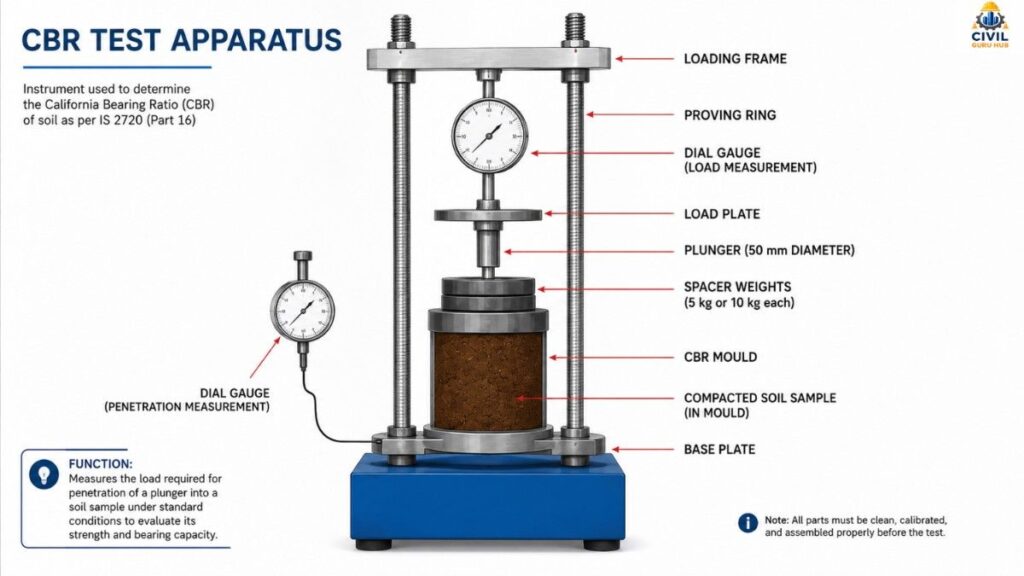
Since the basic objective of the CBR test is the same, the fundamental testing equipment used in AASHTO T193 and IS 2720 Part-16 is largely similar. Both standards determine the California Bearing Ratio (CBR) by evaluating the soil’s penetration resistance. However, when comparing AASHTO T193 Vs IS 2720 Part-16 in practice, merely looking at the names of the equipment is insufficient; calibration, testing procedures, and documentation are equally important.
The following equipment is typically used in a standard laboratory:
| Equipment | AASHTO T193 | IS 2720 Part-16 |
|---|---|---|
| CBR Loading Machine | Required | Required |
| Penetration Plunger | Required | Required |
| CBR Mould | Required | Required |
| Dial Gauge / Digital Gauge | Required | Required |
| Surcharge Weights | Required | Required |
| Soaking Tank | Required | Required |
| Loading Frame | Required | Required |
| Moisture Content Equipment | Required | Required |
Similarity in Basic Equipment
The most significant similarity in the comparison between AASHTO T193 Vs IS 2720 Part-16 is that both methods utilize the CBR mould, loading machine, penetration plunger, dial gauge, surcharge weights, and moisture-related testing equipment. Therefore, the basic apparatus in a properly equipped CBR laboratory can generally be suitable for both standards, provided the equipment meets the required specifications and calibration criteria.
Practical Difference: Quality Assurance Over Equipment
However, the actual practical difference between AASHTO T193 Vs IS 2720 Part-16 lies not in the equipment itself, but in the quality assurance process. International quality systems place a comparatively more structured emphasis on equipment calibration, traceability, documentation, and test records.
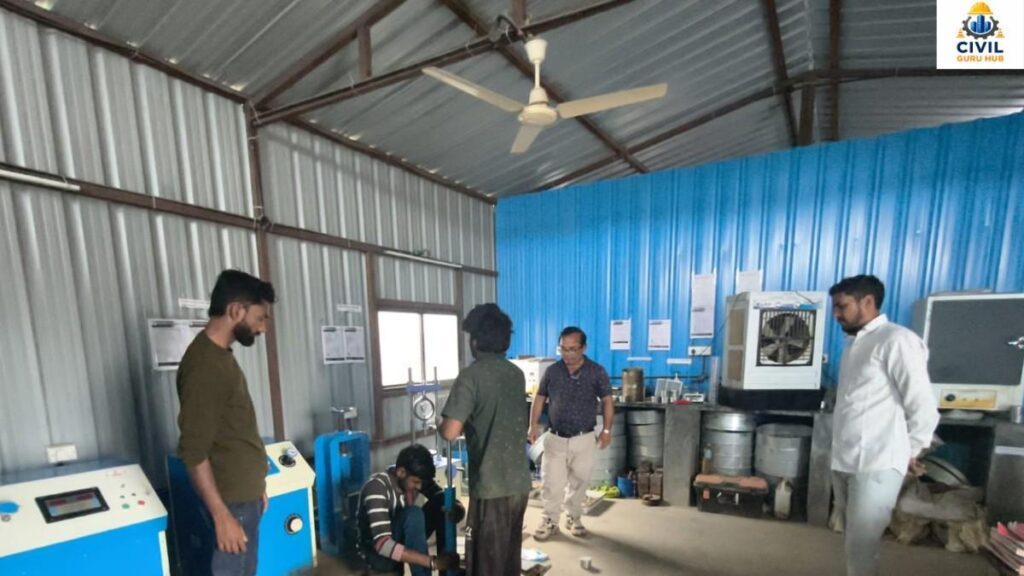
In international laboratories, calibration schedules for loading frames and measuring instruments are strictly adhered to, and every calibration certificate is meticulously maintained. If the calibration due date for critical equipment passes, laboratory procedures may dictate that testing be temporarily halted until the equipment is recalibrated. In Indian projects, NABL-accredited laboratories generally follow systematic calibration and documentation procedures. However, in smaller or less organized laboratories, calibration records, equipment history, and maintenance documentation may sometimes be incomplete. Therefore, when comparing AASHTO T193 Vs IS 2720 Part-16, the laboratory’s quality management system should also be considered.
Plunger Alignment and Surcharge Placement
An important practical point often overlooked by junior engineers is the alignment of the penetration plunger. If the plunger is not properly aligned with the center of the specimen, eccentric loading can occur. This prevents uniform penetration of the soil specimen, meaning the resulting CBR value may not accurately reflect the soil’s actual resistance.
Similarly, the correct placement of surcharge plates is crucial. Surcharge weights or plates must be placed properly and uniformly on the mold to ensure that stress distribution across the specimen remains as uniform as practicable.
Field Inspection Lesson
When comparing AASHTO T193 Vs IS 2720 Part-16, simply inspecting the machine during field or laboratory visits is insufficient. Engineers should also verify the following points:
- Current calibration status of the loading machine
- Calibration of the dial gauge or digital gauge
- Condition and alignment of the penetration plunger
- Physical condition of the CBR mold
- Proper placement of surcharge weights
- Condition of the soaking tank
- Calibration certificates and equipment records
- Competence of the test operator
- Previous test records and documentation
Final takeaway:
While the basic CBR testing equipment for AASHTO T193 and IS 2720 Part-16 may be largely similar, factors such as equipment accuracy, calibration, alignment, maintenance, and documentation are equally vital for reliable test results. Therefore, when evaluating any laboratory, one should assess the complete quality assurance process alongside the equipment comparison of AASHTO T193 Vs IS 2720 Part-16.
Practical Comparison of Testing Procedures
This section covers the most critical aspect of the comparison of AASHTO T193 Vs IS 2720 Part-16. While the fundamental principles of both standards are identical, there may be differences in practical execution, testing protocols, and documentation requirements.
In comparing AASHTO T193 Vs IS 2720 Part-16, the general testing sequence for both standards is broadly as follows:
- Selecting a representative soil sample.
- Achieving the required moisture condition.
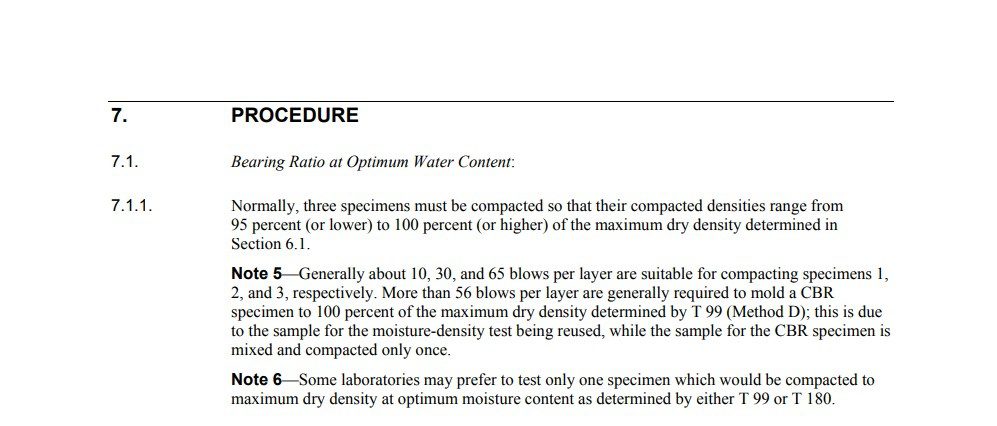
- Preparing the specimen using controlled compaction.
- Conducting the test under soaked or unsoaked conditions, as required.
- Applying the surcharge.
- Applying the load at a standard penetration rate.
- Recording load and penetration readings.
- Calculating the CBR value.
- Preparing the final test report.
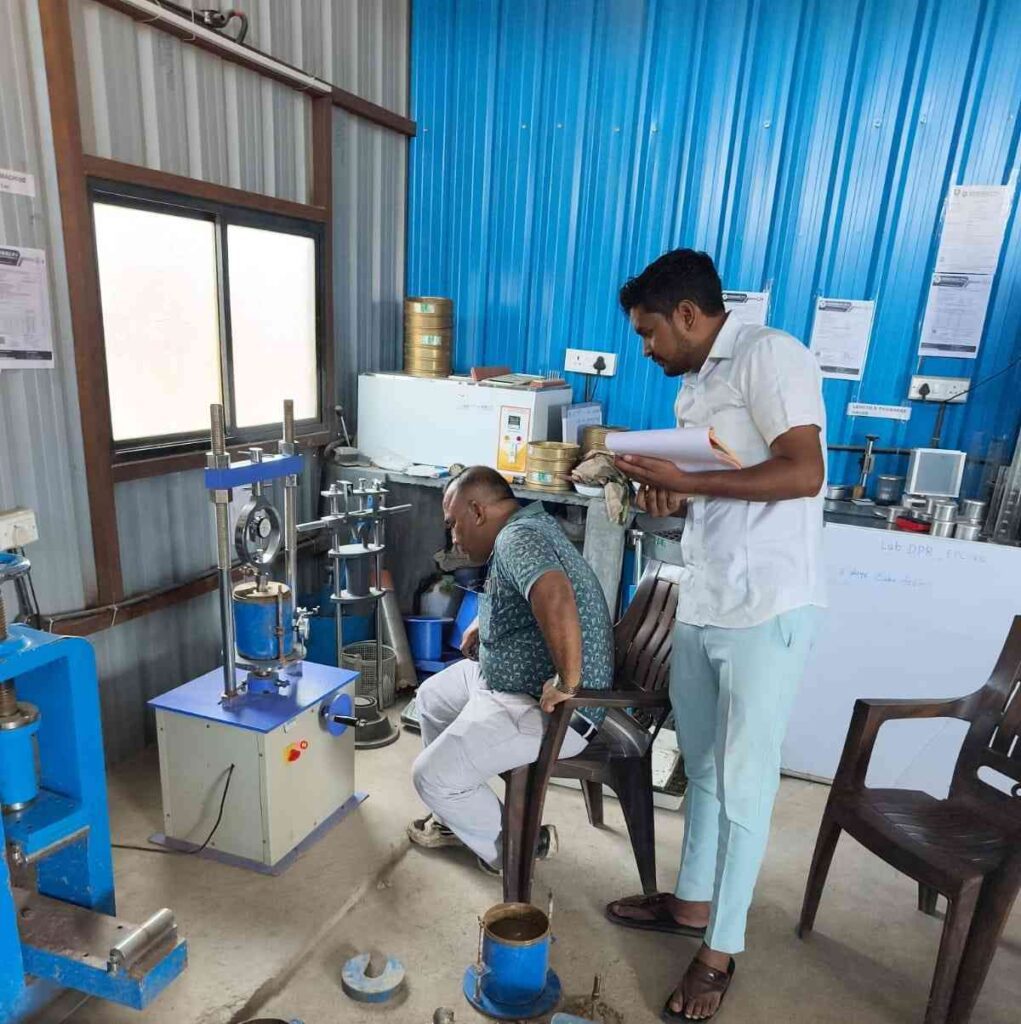
Practical differences arise when consultants or project authorities introduce additional requirements. The reporting format is another crucial factor in the AASHTO T193 vs. IS 2720 Part-16 comparison. For international projects, reporting formats can be highly detailed; laboratories may be required to include specimen identification, dry density, moisture content, compaction details, operator information, equipment calibration references, and special remarks.
Documentation is equally important for Indian government projects, though reporting formats may vary based on the project authority, department, and contract specifications. Therefore, comparing AASHTO T193 Vs IS 2720 Part-16 solely based on the numerical CBR value is technically insufficient. One must also verify test conditions, specimen preparation, soaking conditions, surcharge arrangements, and reporting requirements.
An experienced engineer would never approve a report based merely on a “CBR = 8%” figure. They would verify the entire testing history including the sample source, moisture condition, compaction method, soaking conditions, penetration recording procedures, and the validity of equipment calibration.
Thus, the practical conclusion of the AASHTO T193 vs. IS 2720 Part-16 comparison is that, rather than focusing merely on the standard’s name, one should evaluate the complete testing methodology, project specifications, and documentation requirements in conjunction.
Why is it important for an engineer to understand load-penetration data?
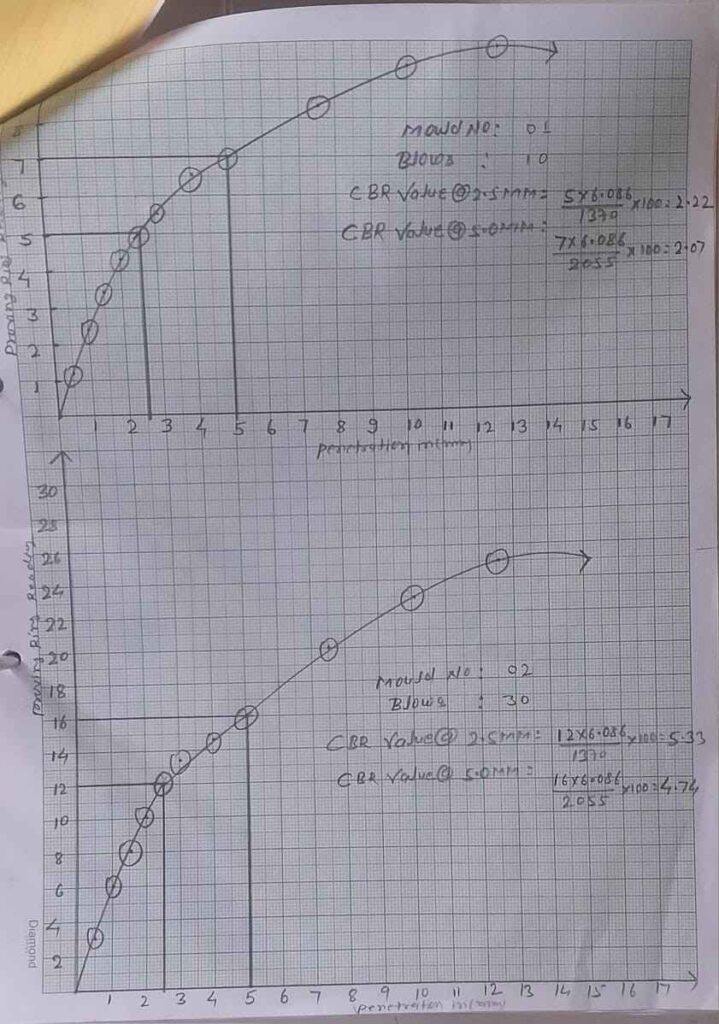
Many junior engineers simply look at the last page of the laboratory report and note down the final CBR percentage. However, an experienced pavement engineer carefully analyzes the Load vs. Penetration curve alongside the test report.
This is precisely what makes the comparison between AASHTO T193 Vs IS 2720 (Part-16) practically significant. Under both standards, it is essential to understand the testing behavior and observations in addition to the numerical CBR result.
The load-penetration curve reveals whether the soil is exhibiting the expected behavior. When comparing AASHTO T193 Vs IS 2720 (Part-16), an engineer should consider the complete load-penetration response, not just the final CBR value.
If the initial portion of the curve appears abnormal, possible reasons include:
- The specimen surface was uneven.
- The plunger was not in proper contact.
- The sample was disturbed.
- Operator error occurred.
- The loading alignment was incorrect.
- There could be a mechanical issue with the testing machine.
Often, a sudden jump or irregularity appears in the graph. If an engineer accepts the report without analyzing this, the pavement design could be based on incorrect assumptions.
For this reason, testing observations should not be ignored when making a practical comparison between AASHTO T193 Vs IS 2720 (Part-16). While the standard’s name may differ, engineering judgment remains crucial in both scenarios.
Upon receiving the laboratory report at the site, the load-penetration curve should not be overlooked in the context of AASHTO T193 Vs IS 2720 (Part-16).
Engineering Significance of the CBR Formula and Calculation
The basic principle for calculating CBR follows a broadly similar engineering concept when comparing AASHTO T193 and IS 2720 Part-16.
CBR Formula
CBR (%) = (Test Load / Standard Load) × 100
From an engineering perspective, the formula appears quite simple; however, actual accuracy depends on the reliability of the measured load.
When comparing AASHTO T193 and IS 2720 Part-16, the following points should be verified prior to calculation:
- The dial gauge has been properly zeroed.
- Penetration readings have been recorded accurately.
- The machine calibration is valid.
- The operator has not missed any readings.
- The test load has been recorded correctly.
- The load-penetration data has been plotted properly.
Verifying raw observation data is highly useful for understanding the technical differences between AASHTO T193 Vs IS 2720 Part-16.
Practical site experience indicates that errors are more likely to occur during the observation stage than during the calculation phase. Therefore, an experienced engineer always cross-checks the raw observation sheet, machine details, and the final calculation.
To read more articles, check the following guides:
The Ultimate Concrete Nominal mix: 8 Proven Grades with Calculations
What Are Atterberg Limits in Soil Testing? Easy Procedure in 9 Simple Steps
how to perform Proctor Test: 10 Easy Steps (Complete Guide)
Result Interpretation – Looking Only at the CBR Value Is Not Enough
The percentage value is not the only critical part of a CBR report. When interpreting results—especially in the context of comparing AASHTO T193 Vs IS 2720 Part-16. it is essential to consider the test conditions as well.
Engineers should check the following points:
- Under what moisture condition was the soil tested?
- Was the sample in a soaked or unsoaked condition?
- What was the laboratory density?
- Was the sample representative?
- From which location was the sample collected?
- Are there any abnormal observations mentioned in the remarks section?
Example:
Project A: CBR = 8%
Project B: CBR = 8%
However, the soil for Project A was tested in a soaked condition, while the soil for Project B was tested in an unsoaked condition.
Are the two results equivalent?
Practical answer: No.
That is why, when comparing AASHTO T193 Vs IS 2720 Part-16, simply comparing the final CBR percentage is not scientifically sufficient.
If one report is prepared according to AASHTO T193 and the other according to IS 2720 Part-16, one must verify the test conditions, specimen preparation, compaction conditions, and project specifications before making a direct comparison.
This is the reason why, in discussions comparing AASHTO T193 Vs IS 2720 Part-16, the “same CBR value” does not always imply the “same engineering condition.”
Common Mistakes Site Engineers Frequently Make
Certain mistakes are repeatedly observed in practical projects. Many of these arise from a lack of proper understanding regarding the differences between AASHTO T193 and IS 2720 (Part 16).
Common mistakes:
- Looking only at the final CBR percentage.
- Failing to verify the raw observation sheet.
- Not checking the calibration certificate.
- Failing to properly record the sample source.
- Ignoring laboratory density.
- Not attaching importance to moisture conditions.
- Directly comparing reports based on different standards.
- Assuming that the test requirements for AASHTO T193 and IS 2720 (Part 16) are identical.
- Granting approval without reading the consultant’s specifications.
- Comparing soaked and unsoaked test results on the same basis.
Directly comparing different laboratory reports without understanding the distinctions between AASHTO T193 Vs IS 2720 (Part 16) can impact engineering decisions.
These mistakes can prove very costly later during investigations into pavement failure.
Site Engineer Checklist
Follow the checklist below before approving the CBR report:
- Sample location is clearly mentioned.
- Test standard is clearly mentioned — the applicable standard (AASHTO T193 vs. IS 2720 Part-16) has been identified.
- Laboratory accreditation is available.
- Calibration certificate is valid.
- Specimen details are complete.
- Moisture condition is mentioned.
- Soaked/Unsoaked condition is clearly stated.
- Load-Penetration graph is attached.
- Final observations are complete.
- Authorized signatory is present.
- The correct testing standard (AASHTO T193 vs. IS 2720 Part-16) has been followed in accordance with project specifications.
- Test method and calculation procedure are clearly defined in the report.
This simple checklist can help avoid future disputes to a significant extent.
Tips for engineers
Keep the following practical points in mind when approving CBR data for highway projects:
- Never rely blindly on a single CBR report.
- If the results seem questionable, have the testing repeated.
- Conduct fresh laboratory testing whenever the borrow area changes.
- Learn to correlate field conditions with laboratory conditions.
- Always review the project specifications before approving the report.
- Confirm the applicable testing standard for the project (AASHTO T193 vs. IS 2720 Part-16).
- Always prioritize the consultant’s standards and contract specifications.
- Do not directly compare results from different laboratories without considering the context of AASHTO T193 versus IS 2720 Part-16.
- Maintain QA/QC records systematically.
- Verify sample history, moisture conditions, and density details.
- Check the complete test conditions when interpreting results from AASHTO T193 or IS 2720 Part-16.
- Laboratory quality forms the foundation of pavement design.
- Do not approve unusual CBR values without verifying the testing history.
- Cross-check the applicable procedure (AASHTO T193 vs. IS 2720 Part-16) against the project documents.
- Consider further investigation if the CBR value does not align with field conditions.
The comparison between AASHTO T193 Vs IS 2720 Part-16 should be understood not merely as a comparison of keywords, but from the perspective of practical laboratory testing and decision-making in pavement engineering.
For an experienced engineer, the CBR test signifies more than just a final percentage value; factors such as the test method, sample preparation, moisture conditions, density, the load-penetration curve, calibration, and project specifications are all equally important.
Therefore, a correct understanding of the differences between AASHTO T193 Vs IS 2720 Part-16 is crucial for site engineers, laboratory engineers, and pavement designers.
The foundation of pavement design lies in laboratory quality, and the foundation of reliable laboratory quality is the use of correct testing procedures.
AASHTO T193 vs IS 2720 Part-16 – Detailed Comparison Table
The comparison site given below can be useful as a quick reference for engineers, QA/QC engineers, consultants and students.
| Parameter | AASHTO T193 | IS 2720 Part-16 |
|---|---|---|
| Standard Organization | AASHTO | BIS |
| Country | USA | India |
| Test Type | Laboratory CBR | Laboratory CBR |
| Primary Purpose | Pavement Design | Pavement Design |
| Main Users | International Highway Agencies | Indian Highway Agencies |
| Common Projects | Overseas Roads, Airports | NHAI, PWD, PMGSY |
| Soil Strength Evaluation | Yes | Yes |
| Sample Preparation | Standardized | Standardized |
| Moisture Control | Required | Required |
| Compaction Requirement | Required | Required |
| Surcharge Load | Required | Required |
| Penetration Method | Standard Procedure | Standard Procedure |
| Load Measurement | Required | Required |
| Result Reporting | Detailed Laboratory Format | BIS Format |
| Calibration Requirement | Essential | Essential |
| QA Documentation | High Importance | High Importance |
| Use Tender | International Projects | Indian Projects |
| Pavement Input | Yes | Yes |
| Government Acceptance | Depends on Country | India |
| Engineering Objective | Reliable CBR Determination | Reliable CBR Determination |
It is clear from this table that the scientific objective of both the standards is the same. The biggest difference is in their adoption region, project specification and documentation framework.
Which Standard Should Be Chosen and When?
This question is frequently asked in interviews and is also crucial in real-world projects.
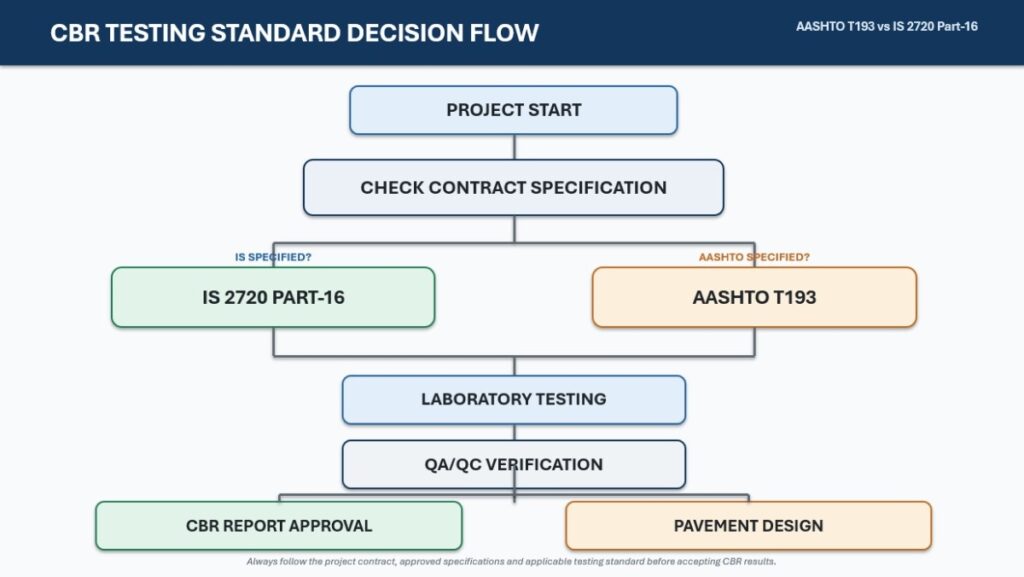
If the project belongs to an Indian government department—such as NHAI, State PWD, or PMGSY—or is an infrastructure project where the contract documents reference BIS standards, then IS 2720 Part-16 is the appropriate standard.
On the other hand, if the project is being executed under an international consultant, an overseas client, or a multinational EPC contract, and the tender document clearly specifies AASHTO standards, then AASHTO T193 should be followed.
An experienced engineer never selects a standard based merely on personal preference. The final authority always rests with the following documents:
- Contract Agreement
- Technical Specifications
- Tender Conditions
- Consultant Requirements
- Employer Specifications
This constitutes professional engineering practice.
Decision Flow
Interview Questions (15)
- To which test does AASHTO T193 relate?
- What is the primary objective of IS 2720 Part-16?
- What is the common purpose of both standards?
- Why is the CBR value important in highway projects?
- What is the practical difference between soaked and unsoaked testing?
- Why is sample preparation considered a critical stage?
- What is the importance of calibration?
- What does the engineer verify before approving the CBR report?
- What is the role of consultant specifications?
- Why is laboratory documentation important?
- What should be done if the borrow area changes?
- What are the responsibilities of a QA/QC engineer?
- What is the use of the load-penetration graph?
- Which standard is commonly used in Indian government projects?
- Which standard is frequently referred to in international EPC projects?
About the Author
My name is Susanta Kumar Mohapatra. I am a Civil Engineering professional with over 11 years of practical experience in the construction and infrastructure sectors. I hold a B.Tech degree in Civil Engineering and an M.E. degree in Construction Management. Throughout my professional career, I have worked in key areas such as road construction, bridge projects, quality control, material testing, concrete mix design, highway engineering, quantity estimation, project planning, site execution, and construction management.
I launched CivilGuruHub.com with the aim of sharing my passion for Civil Engineering and my practical knowledge with a wider audience. The primary objective of this website is to provide practical, industry-oriented information in simple language to Civil Engineering students, site engineers, quality engineers, quantity surveyors, contractors, and construction professionals. Here, I publish detailed, original, and research-based articles on topics such as construction technology, concrete technology, highway engineering, structural engineering, material testing, IS codes, IRC codes, quantity surveying, estimation and costing, project management, tendering, and Civil Engineering calculators.
Alongside the website, I also run a YouTube channel named “The Civil Site,” where I explain practical site experiences, laboratory tests, construction techniques, engineering calculations, software tutorials, and technical concepts through easy-to-understand videos. My goal is to ensure that every student and engineer understands not just the theory, but also its practical application.
Additionally, I share educational content related to general knowledge, quizzes, and competitive exam preparation through my YouTube channel, “Daily IQ Hub.” The aim of this channel is to enhance viewers’ knowledge and strengthen their exam preparation.
I believe that a successful engineer is one who is always ready to learn and continuously updates their practical knowledge. With this mindset, I always strive to provide high-quality, reliable, practical, and industry-standard content through CivilGuruHub.com and my YouTube channels, enabling every reader and viewer to excel in their careers.
Thank you sincerely for your trust and support. I am confident that CivilGuruHub.com and my educational platforms will prove to be reliable companions in your learning journey and professional growth. If you wish to take your knowledge in the field of Civil Engineering to the next level, please continue to follow our articles and videos regularly. We will keep bringing you fresh, practical, and industry-focused content.
Conclusion
A comparison between AASHTO T193 Vs IS 2720 (Part 16) reveals that the core objective of both standards is to provide a reliable assessment of subgrade soil bearing strength via the California Bearing Ratio (CBR) test. Differences primarily lie in the issuing authority, regional adoption, and specific project requirements.
For a competent civil engineer, it is essential not to view one standard as inherently “better” than the other. The professional approach is to adhere to the appropriate standard as dictated by contract documents, consultant specifications, and applicable codes. Furthermore, aspects such as sample preparation, equipment calibration, documentation, and report verification require as much attention as the final CBR value itself.
Whether you are a Site Engineer, QA/QC Engineer, Highway Engineer, or a Civil Engineering student, a practical understanding of both standards will enable you to confidently interpret laboratory reports, comprehend consultant observations, and make informed decisions regarding pavement design. This practical knowledge transforms you from an engineer who merely reads reports into a professional capable of technically evaluating them in the field.
Frequently Asked Questions (FAQs)
What is the difference between AASHTO T193 Vs IS 2720 Part-16?
The primary difference between AASHTO T193 Vs IS 2720 Part-16 lies in their publishing authority and project applicability. AASHTO T193 is published by the American Association of State Highway and Transportation Officials, whereas IS 2720 Part-16 is published by the Bureau of Indian Standards (BIS). The objective of both is to determine soil bearing strength through the California Bearing Ratio (CBR) test.
Are AASHTO T193 and IS 2720 Part-16 used for the same CBR test?
Yes. Both AASHTO T193 and IS 2720 Part-16 are standards for the California Bearing Ratio (CBR) test. Both aim to evaluate the strength of subgrade soil for pavement design, though their application depends on project specifications.
Which standard—AASHTO T193 Vs IS 2720 Part-16—is more commonly used in India?
IS 2720 Part-16 is predominantly used in Indian government highway projects, as well as those under NHAI, State PWD, and PMGSY. AASHTO T193 is primarily used in international or overseas infrastructure projects.
Which standard—AASHTO T193 Vs IS 2720 Part-16—is followed in international projects?
International EPC projects, overseas highways, and airport projects generally follow AASHTO T193 or the standard specified in the contract document. The choice of standard is always determined by the tender specifications.
Is one standard—AASHTO T193 Vs IS 2720 Part-16—better than the other?
No. There is no concept of one being “better” or “worse” between AASHTO T193 and IS 2720 Part-16; both are internationally accepted engineering standards. The correct standard to use is the one specified in the project contract and consultant specifications.
What should a junior engineer learn first regarding AASHTO T193 Vs IS 2720 Part-16?
A junior engineer should first understand the practical differences between AASHTO T193 and IS 2720 Part-16, as well as laboratory testing procedures, sample preparation, report interpretation, and QA/QC documentation. With this knowledge, they will be able to not only read laboratory reports but also evaluate them from a technical perspective.