
Table of Contents
Introduction
The construction industry is considered one of the largest and most complex industries in the world. Whether it involves building a small residential house, a multi-story commercial building, a national highway, a railway bridge, a metro project, or an airport terminal, the success of any project does not depend solely on sound engineering and quality materials. The true foundation of any project is its construction contract.
Even today, many site engineers, civil engineering students, junior engineers, contractors, and new builders focus primarily on drawings, estimation, and execution. However, when payments stall midway, the scope of work expands, disputes arise between the contractor and the client, or the project faces delays, the very first document consulted is the construction contract.
A robust construction contract is not merely an agreement regarding payment; it legally defines every phase of the project. It clearly outlines the contractor’s and client’s responsibilities, payment processes, quality standards, project duration, penalties for delays, dispute resolution mechanisms, safety requirements, and conditions for completion.
Starting a project without a proper construction contract significantly increases the risk of future misunderstandings, financial losses, legal disputes, and project failure. This is why major infrastructure projects worldwide place immense importance on contract drafting.
In the civil engineering profession, professionals must have knowledge of contracts just as they must have technical expertise. Engineers frequently face challenges in project management due to a lack of understanding regarding contract clauses, even if they are technically proficient. Therefore, every site engineer and project manager should possess both a basic and advanced understanding of construction contracts.
In this article, we will explore the ten most important types of construction contracts in detail. We will explain the advantages, disadvantages, practical applications, real-life examples, and common pitfalls associated with each contract type in simple language. Additionally, we will provide an overview of Indian contract laws, CPWD guidelines, MoRTH provisions, and international practices, enabling you to gain both theoretical and practical knowledge.
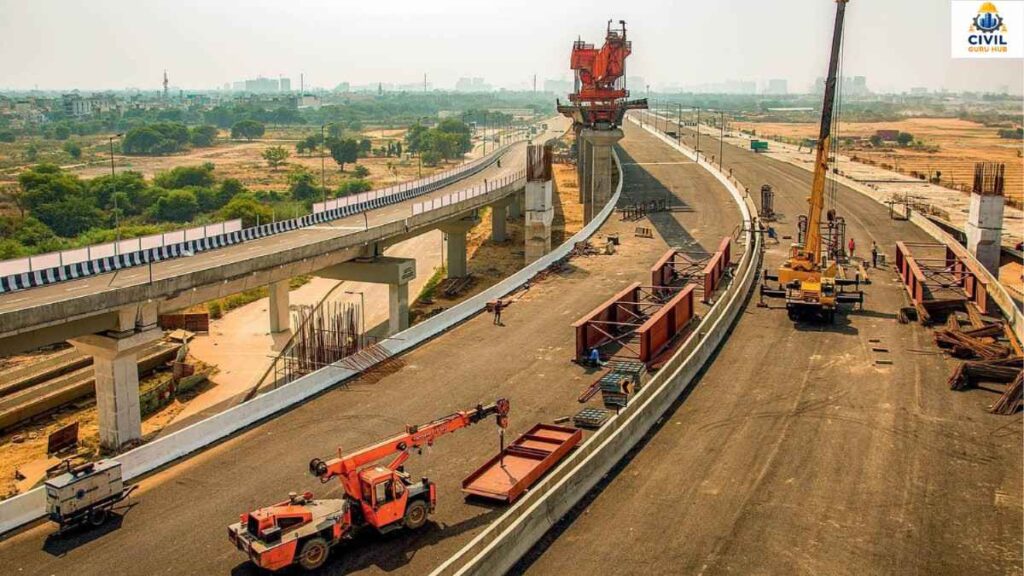
What is a Construction Contract?
Simply put, a construction contract is a legal agreement executed between two or more parties. The primary purpose of this agreement is to complete the project in accordance with predefined conditions.
Generally, a construction contract involves two primary parties:
The first party is the Employer or Owner, who owns the project and makes the payment for it.
The second party is the Contractor, who executes the project according to the agreed-upon conditions.
In many projects, consultants, architects, structural engineers, PMCs (Project Management Consultants), quantity surveyors, and government authorities also become indirect participants in the contract.
A standard construction contract typically includes the following information:
| Contract Component | Description |
|---|---|
| Scope of Work | Defines the work, services, and responsibilities the contractor is required to perform. |
| Contract Value | Specifies the total project cost or the agreed payment basis between the client and contractor. |
| Project Duration | States the project start date, completion date, and overall contract period. |
| Technical Specifications | Describes the required quality standards, materials, workmanship, and technical requirements. |
| Payment Terms | Explains the payment schedule, including Running Bills (RA Bills), milestone payments, and the Final Bill. |
| Defect Liability Period (DLP) | Defines the contractor’s responsibility to repair or rectify defects after project completion for a specified period. |
| Penalty Clause | Specifies the penalties or liquidated damages applicable if the contractor fails to complete the work on time. |
| Arbitration Clause | Outlines the procedure for resolving disputes between the parties through arbitration. |
| Termination Clause | States the conditions under which either party can terminate the contract before completion. |
The larger the construction project, the more detailed the construction contract tends to be. In highway projects, for instance, contract documents can run into thousands of pages, with drawings, BOQ (Bill of Quantities), technical specifications, quality control manuals, safety manuals, and special conditions attached separately.
Therefore, merely signing the contract is not enough; understanding every clause and adhering to them during actual execution is even more critical.
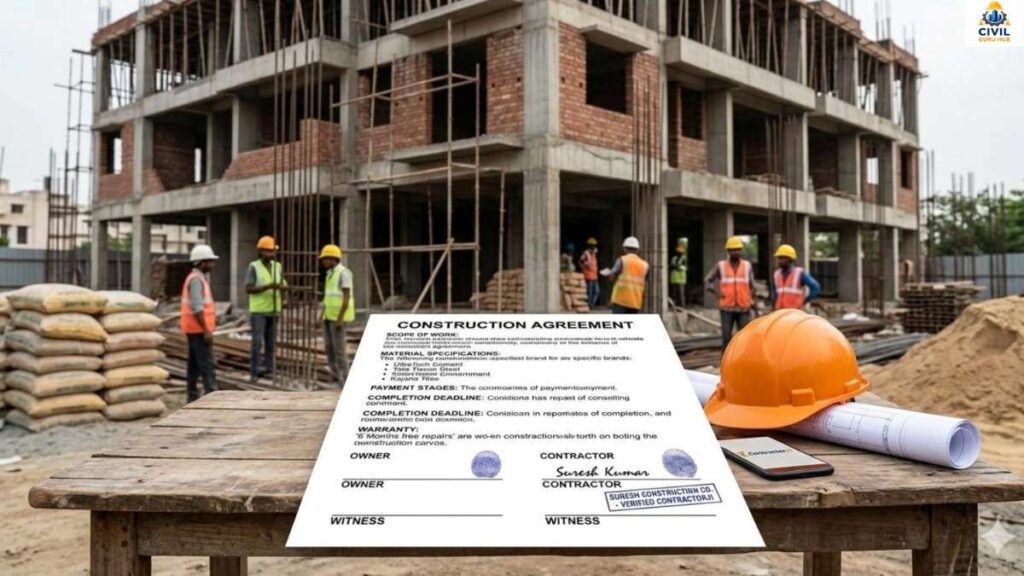
What is the importance of a construction contract?
Many people think that a contract is merely a legal formality. However, in the practical construction industry, this is far from the truth.
A robust construction contract serves as the project’s roadmap. It defines how the project will be executed and outlines the specific responsibilities of each party under various circumstances.
Consider a bridge construction project with an estimated cost of ₹250 crore. The contractor begins work, but the contract lacks a proper clause regarding variation orders. Midway through construction, the owner decides to increase the width of the bridge. The contractor then demands additional payment, while the owner might refuse to pay the extra amount. This is precisely the kind of situation that leads to a dispute.
Had the contract clearly defined the variation clause, this problem would never have arisen.
Similarly, a construction contract provides legal protection for the project in situations such as payment delays, price escalations, rising rates for cement and steel, labor shortages, natural disasters (floods, cyclones), pandemics, or delays in land acquisition.
The major benefits of a professionally prepared construction contract include:
- Clear definition of responsibilities for both parties.
- Reduction in payment disputes.
- Control over project delays.
- Legal protection.
- Maintenance of quality standards.
- Pre-defined risk allocation.
- Easier financial planning.
- A simplified arbitration process.
- Enhanced trust between the contractor and the employer.
For these reasons, no major infrastructure project at the international level executes without a proper construction contract.
What factors should be considered before drafting a construction contract?
A good construction contract cannot be created simply by copying a template. Every project differs in terms of nature, location, cost, duration, and risk; therefore, the contract must be tailored to the specific project.
First, the team must define the complete scope of the project. The contractor needs to know exactly what the boundaries of their work are. If the scope is unclear, disputes regarding variations and payments become almost inevitable.
Another crucial factor is the accuracy of the BOQ (Bill of Quantities). An incorrect BOQ leads to an inaccurate quotation from the contractor and increases the likelihood of future claims.
The payment schedule must be practical. The project team should clearly define terms regarding advance payments, Running Account (RA) bills, milestone payments, and the final bill from the outset.
The time schedule should be realistic. Setting an overly aggressive completion deadline could lead the contractor to compromise on quality.
Quality specifications should clearly reference relevant standards such as IS Codes, IRC Codes, MoRTH Specifications, CPWD Specifications, or project-specific standards.
The contract should clearly define responsibilities regarding insurance, labour safety, environmental compliance, and statutory approvals.
The ‘Force Majeure’ clause should not be overlooked, as natural disasters or unforeseen circumstances can impact any project.
Most importantly, you should seek advice from a legal expert and an experienced contract engineer during the drafting process, as this is highly beneficial.
The Relationship Between the Indian Contract Act, 1872 and Construction Contracts
In India, the legal foundation for almost all construction contracts is the Indian Contract Act, 1872. This Act defines the fundamental principles of contracts and outlines how a valid contract is formed.
In the construction industry, not only the Indian Contract Act but also various other laws and standard documents are followed.
| Law / Standard | Purpose | Importance in Construction Industry |
|---|---|---|
| Indian Contract Act, 1872 | Governs the formation and validity of contracts | Provides the legal foundation for construction agreements between clients, contractors, and consultants. |
| Arbitration and Conciliation Act, 1996 | Provides an alternative dispute resolution mechanism | Helps resolve construction disputes quickly without lengthy court proceedings. |
| Specific Relief Act, 1963 | Enables enforcement of contractual obligations | Allows parties to seek specific performance when contractual terms are not fulfilled. |
| CPWD Works Manual | Standard procedures for government construction projects | Serves as a practical guide for planning, tendering, execution, quality control, and project management in government works. |
| MoRTH Specifications (Latest Revision) | Technical specifications for road and highway construction | Defines material quality, workmanship, testing methods, and execution standards for highway projects. |
| General Conditions of Contract (GCC) | Establishes standard contractual terms | Clearly defines the rights, responsibilities, payment terms, risk allocation, and dispute resolution process between contracting parties. |
| FIDIC Contract Conditions | International standard forms of construction contracts | Widely used in international infrastructure projects, ensuring globally recognized contract management practices. |
| Indian Stamp Act | Regulates stamp duty on legal documents | Ensures construction contracts are legally enforceable after payment of the applicable stamp duty. |
Some important principles of the Indian Contract Act that every civil engineer should know:
- Free Consent
- Offer and Acceptance
- Lawful Consideration
- Competent Parties
- Lawful Object
- Performance of Contract
- Breach of Contract
- Compensation for Damages
If a construction project does not consider these basic legal principles, someone could legally challenge the contract in the future. That is why a successful engineer is not only proficient in concrete design, reinforcement detailing, and quantity estimation but also thoroughly understands the legal and commercial aspects of construction contracts.
To read more articles on Project Management, check the following guides:
The Secret to Reduce Construction Costs Without Affecting Quality
What Are the Duties of a Project Manager in Construction? Complete Guide 2026
What Makes Green Roads Sustainable? 10 Secrets
1. Lump Sum Construction Contract
A Lump Sum Construction Contract also goes by the name Fixed Price Contract. In this type of contract, the parties determine the total cost of the project beforehand. This means the contractor and the employer agree on a fixed amount before the project begins, and the contractor must complete the entire project within that specific sum.
For instance, suppose a company wants to construct a G+2 office building. The contractor has already finalized the drawings, structural design, Bill of Quantities (BOQ), and specifications. The contractor prepares an estimate and quotes ₹3 crore to complete the entire project, and the employer accepts this quotation. Unless the contract includes variations, the contractor must complete the project for this agreed-upon amount.
It is crucial to understand one key point here: if the prices of materials like cement, steel, or diesel rise during the project and the contract does not include a ‘Price Escalation Clause,’ the contractor must bear the additional cost. Consequently, the contractor shoulders a significant portion of the risk in a Lump Sum Construction Contract.
This type of construction contract is ideal when the project scope is clearly defined—meaning the contractor finalizes drawings, completes designs, and minimizes the likelihood of future changes. If the scope changes frequently, the contractor significantly increases the chances of disputes arising under a Lump Sum Contract.
In practice, contractors find Lump Sum Contracts quite common for private residential buildings, schools, office complexes, warehouses, and factory sheds. Employers often prefer this contract for small to medium-sized projects because it allows them to know the total project cost upfront.
However, preparing the estimate challenges the contractor highly. If an error occurs in estimation or if material wastage exceeds expectations, the contractor’s profit margin could shrink, or they could even incur a loss.
An experienced contractor will thoroughly study the site conditions, soil investigation report, drawings, BOQ, and technical specifications before signing a Lump Sum Construction Contract. This process helps significantly in avoiding future claims and disputes.
Advantages of a Lump Sum Construction Contract
| Advantage | Description |
|---|---|
| Fixed Project Cost | The employer knows the total project cost in advance, making financial commitments more predictable. |
| Easy Budget Planning | Budget preparation and financial planning become simpler because the contract price is fixed. |
| Reduced Measurement Work | Frequent measurement and verification of quantities during execution are generally not required. |
| Faster Payment Process | Since the contract amount is predetermined, payment processing is usually quicker and more straightforward. |
| Better Cost Control | A fixed-price contract helps the employer maintain better control over the overall project budget. |
Disadvantages of a Lump Sum Construction Contract
| Disadvantage | Description |
|---|---|
| High Contractor Risk | The contractor bears the risk of price increases in materials, labor, and other project costs throughout the contract period. |
| Variation Disputes | Any changes to the project scope may lead to disagreements regarding additional costs and payment adjustments. |
| Accurate Cost Estimation Required | An incorrect cost estimate can result in significant financial losses for the contractor. |
| Unforeseen Site Conditions | Unexpected ground conditions, weather, or other site-related issues can increase project costs and cause delays. |
Key Clauses to Consider in a Lump Sum Contract
- Scope of Work
- Variation Clause
- Payment Terms
- Time Extension Clause
- Liquidated Damages
- Defect Liability Period
- Performance Guarantee
If these clauses are not clearly defined, a lump sum construction contract can lead to legal disputes in the future.
2. Item Rate Construction Contract
The Item Rate Contract is the most widely used construction contract for government projects in India. Agencies such as the CPWD, PWD, NHAI, Railways, and many others utilize this system.
In this type of contract, the total project cost is not fixed upfront. Instead, a rate is determined for each individual item, and payment is made based on the actual quantity of work executed.
For instance, suppose the Bill of Quantities (BOQ) specifies an earthwork quantity of 10,000 cubic meters, and the contractor quotes a rate of ₹250 per cubic meter. However, upon execution, the actual quantity turns out to be 11,200 cubic meters. In this scenario, the contractor receives payment based on the 11,200 cubic meter figure.
For this reason, the Item Rate Construction Contract is considered the most flexible type of contract.
The primary advantage of this contract is that payment is linked to the actual work performed. If the quantity increases, the contractor receives payment for the additional work; conversely, if the quantity decreases, the employer avoids making unnecessary payments.
However, this system relies heavily on the Measurement Book (MB), joint measurements, Running Account (RA) bills, and quantity verification. Even a minor error in measurement can result in a financial discrepancy amounting to lakhs of rupees.
Item Rate Construction Contracts predominantly serve road projects, bridge construction, canal works, irrigation projects, and the construction of government buildings.
Under this contract, the site engineer must maintain coordination between the BOQ, drawings, and actual site measurements. Consequently, the Quantity Surveyor and Billing Engineer play critically important roles.
Another practical aspect is that handling variations is relatively easier in an Item Rate Contract. If stakeholders approve additional work, the system processes payment based on the measured quantity of that work.
Advantages of Item Rate Construction Contracts
| Advantages | Description |
|---|---|
| Payment Based on Actual Quantities | The contractor is paid according to the actual quantity of work executed and measured on site. |
| Flexible Contract Structure | This contract allows modifications to the scope of work without significant contractual issues. |
| Fair and Transparent Payment System | Payments are calculated based on measured work, ensuring fairness for both the employer and the contractor. |
| Widely Used in Government Projects | Item Rate Contracts are the most commonly adopted contract type in government |
Challenges of Item Rate Construction Contracts
| Challenge | Description |
|---|---|
| Measurement Errors | Incorrect measurements can lead to payment disputes, cost overruns, and project delays. |
| Billing Delays | The measurement, verification, and approval process may take time, resulting in delayed contractor payments. |
| Quantity Variations | Actual executed quantities may differ from the estimated quantities, affecting the |
In Item Rate Construction Contracts, accurate site measurement and proper documentation are the most critical factors for successful project management.
3. Percentage Rate Construction Contract
The Percentage Rate Construction Contract enjoys popularity among government departments. In this type of contract, the contractor does not provide a new rate for every individual item; instead, they quote a percentage either above or below the government’s Schedule of Rates (SOR).
For example, if the CPWD or State PWD schedule rate for a specific item is ₹1,000 and the contractor quotes “8% Below,” they calculate payment for that item at ₹920. If the contractor quotes “12% Above,” they calculate the payment at ₹1,120.
The biggest advantage of this system is transparency. The employer does not need to verify the rate for every single item because the base rate is already available in the government schedule.
Percentage Rate Construction Contracts suit projects where the government’s Standard Schedule of Rates updates regularly.
However, the contractor must be very careful when quoting the percentage. Quoting an excessively low percentage without proper market analysis can lead to financial losses during the project.
Nowadays, many government departments utilize Percentage Rate Contracts through e-tendering. The lowest responsive bidder (L1) receives the contract, but the lowest rate is not the sole criterion for selection; evaluators also consider technical qualifications, financial capability, and previous experience.
It is important for a site engineer to understand this type of construction contract because all calculations regarding billing, variations, and payments rely on the SOR and the quoted percentage.
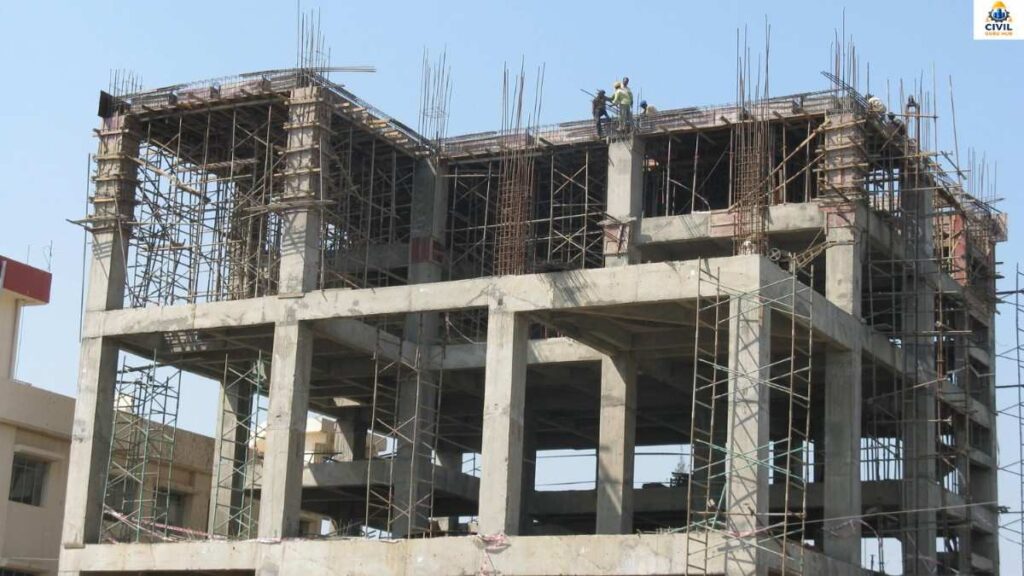
Advantages of Percentage Rate Construction Contracts
| Limitation | Description |
|---|---|
| Regular SOR Updates Required | Schedule of Rates (SOR) must be updated regularly, as outdated rates may not reflect current market prices for materials and labor. |
| Risk of Low Bidding | Quoting a very low percentage below the SOR can reduce profit margins and may even result in financial losses for the contractor. |
| Impact of Market Price Fluctuations | Sudden increases in the prices of construction materials, fuel, or labor can significantly affect project costs and profitability. |
Limitations of Percentage Rate Construction Contracts
| Limitation | Description |
|---|---|
| Regular SOR Updates Required | Schedule of Rates (SOR) must be updated regularly, as outdated rates may not reflect current market prices. |
| Risk of Low Bidding | Quoting an excessively low percentage below the estimated cost can lead to financial losses for the contractor during project execution. |
| Market Price Fluctuations | Unexpected increases in the prices of construction materials, labor, or equipment can significantly impact the overall project cost and profitability. |
4. Cost-Plus Construction Contract
A Cost-Plus Construction Contract is an agreement wherein the contractor is paid the actual cost incurred on the project, plus a pre-determined profit or service fee. This means the contractor does not receive merely a fixed sum; instead, they are reimbursed for genuine project expenses and receive an additional payment on top of that.
This type of construction contract is utilized when it is difficult to accurately estimate the project’s cost beforehand—such as in the case of research buildings, defense projects, heritage structure renovations, emergency repairs, industrial plants, or disaster rehabilitation projects.
Consider the rehabilitation of an old bridge. The extent of internal damage, the weakness of the foundation, or the amount of reinforcement requiring replacement cannot always be accurately determined in advance. If such a project were awarded under a Lump Sum Contract, the contractor might submit a very high quote. Consequently, the employer opts for a Cost-Plus Construction Contract.
Under this contract, the contractor maintains proper records of every expense. Documentary proof must be provided for all costs, including cement, steel, labor, machinery, fuel, transportation, testing, temporary works, and site overheads. The employer verifies these documents and subsequently releases payment, including the agreed-upon percentage or fixed fee.
Transparency is crucial in a Cost-Plus Construction Contract. Failure by the contractor to maintain accurate records can lead to payment disputes. Therefore, the Site Engineer and Quantity Surveyor are required to regularly update the Daily Progress Report, Material Consumption Register, and Labor Records.
This contract benefits the employer when the project scope is uncertain. However, without proper monitoring, the final project cost can significantly exceed the expected budget.
Often, a Guaranteed Maximum Price (GMP) clause is included in Cost-Plus contracts. Under this clause, a maximum cost limit is established for the project. If the actual cost remains below this limit, both parties may benefit; if the cost exceeds the limit, responsibility is determined according to the terms of the agreement.
Advantages of Cost-Plus Construction Contracts
| Advantage | Description |
|---|---|
| Flexible Costing | Payment is based on the actual cost incurred during the project, making it suitable for projects with uncertain expenses. |
| Improved Quality | Contractors are not forced to compromise on material quality to stay within a fixed budget, resulting in better construction standards. |
| Ideal for Uncertain Projects | This contract type is suitable when the project scope is not fully defined, allowing work to begin without finalizing every detail. |
| Easy to Accommodate Design Changes | Modifications, additional work, and design changes can be incorporated easily during project execution without major contractual issues. |
Disadvantages of Cost-Plus Construction Contracts
| Disadvantage | Description |
|---|---|
| Uncertain Final Cost | The employer cannot determine the exact total project cost before the work is completed. |
| Extensive Documentation | Every expense must be properly recorded and supported with bills, invoices, and other relevant documents. |
| Continuous Monitoring | The employer must regularly monitor and audit project expenses to ensure cost control and transparency. |
| Risk of Cost Overruns | If the project is not effectively monitored, actual costs may exceed the estimated budget, leading to higher overall expenses. |
Key Clauses in This Contract
- Cost Verification Clause
- Audit Rights
- Fee Structure
- Maximum Cost Limit (GMP)
- Payment Certification
- Change Order Clause
5. Time and Material Construction Contract
The Time and Material Construction Contract—often referred to simply as a T&M Contract—is used for projects where the exact scope cannot be defined beforehand. Payment under this contract is based on two factors:
First, the actual time spent by labor, and second, the actual cost of materials.
This means the contractor is paid based on the number of hours labor worked and the quantity of materials consumed.
This type of construction contract is very common for maintenance, repairs, renovations, emergency restoration, and small-scale modification projects.
For example, suppose a plumbing pipeline leaks inside a hospital building. The extent of the damage cannot be determined until the wall is broken open and inspected. In such a situation, a Time and Material Contract is the most suitable option.
Under this contract, the hourly rate for each labor category is determined in advance—for instance, different rates for masons, carpenters, electricians, and supervisors.
Similarly, material costs are calculated based on actual purchase invoices.
It is the Site Engineer’s responsibility to maintain proper records of daily labor attendance, machinery utilization, and material consumption.
If documentation is inadequate, payment disputes may arise between the contractor and the employer.
Transparency and trust are the most critical factors in a Time and Material Construction Contract.
The employer should also monitor daily progress to prevent unnecessary labor hours or material wastage.
Many organizations include a “Maximum Time Limit” or “Maximum Budget” clause in this contract to ensure the project cost does not escalate uncontrollably.
Advantages of Time and Material Construction Contract
| Advantages | Description |
|---|---|
| Flexible Payment Structure | Payment is made based on the actual quantity of work completed, ensuring fair and accurate billing. |
| Ideal for Emergency Projects | Highly suitable for repair, maintenance, and urgent construction projects where the scope is uncertain. |
| Easy Scope Modification | Additional work items can be included during the project without requiring major contract changes. |
| Fair and Transparent System | Provides a practical and transparent payment method that benefits both the client and the contractor. |
Disadvantages of Time and Material Construction Contract
| Disadvantage | Description |
|---|---|
| Difficult to Estimate Final Cost | Since payment is based on the actual work completed, the total project cost cannot be accurately determined in advance. |
| Requires Continuous Supervision | The client or employer must regularly monitor the work to ensure accurate measurement, quality, and progress. |
| Extensive Documentation | Daily work records, measurements, labor details, and material usage must be properly documented for payment verification. |
| Risk of Project Delays | Poor planning, inefficient resource management, or slow work execution can increase the overall project duration. |
Important Contract Clauses
- Labor Rate Schedule
- Material Rate Verification
- Daily Time Sheet
- Work Approval Process
- Maximum Budget Limit
- Payment Certification
6. EPC (Engineering, Procurement and Construction) Contract
The EPC construction contract is considered one of the most advanced and professional contract models in the world.
The full form of EPC is:
- Engineering
- Procurement
- Construction
Under this contract, the Employer does not need to appoint separate entities for design consultancy, material supply, and construction.
A single EPC contractor assumes responsibility for the entire project.
Engineering entails creating designs and drawings.
Procurement involves purchasing cement, steel, machinery, equipment, and all other necessary materials.
Construction involves executing and completing the entire project at the site.
For this reason, the EPC construction contract is also known as a “Single Point Responsibility Contract.”
In India, EPC contracts are widely used for projects such as National Highways, solar power plants, metro rail systems, water treatment plants, oil and gas projects, thermal power plants, and industrial infrastructure.
Suppose the government wants to build a 100 km expressway.
If a traditional contract were used, separate entities would need to be appointed for design consultancy, procurement, and construction.
However, under an EPC contract, a single contractor completes the entire project, from design to final commissioning.
This significantly reduces coordination issues.
The Employer only needs to monitor progress.
However, the responsibility of the EPC contractor increases substantially.
If there are design errors, delays in material procurement, or poor construction quality, the EPC contractor bears the responsibility.
Consequently, clauses such as Performance Security, Bank Guarantees, Liquidated Damages, and Defect Liability Periods are crucial in EPC contracts.
Many highway projects under MoRTH and NHAI are being executed using the EPC mode because it ensures comparatively faster and more organized project delivery.
Advantages of EPC Construction Contract
| Advantages | Description |
|---|---|
| Single Point of Responsibility | A single contractor is responsible for the entire project, including both design and construction, ensuring clear accountability. |
| Faster Project Completion | Better coordination between the design and construction teams reduces delays and speeds up project delivery. |
| Improved Quality Control | Since one organization manages the complete project, maintaining consistent quality standards becomes easier. |
| Reduced Risk for the Client | Most design, construction, and coordination risks are transferred to the contractor, minimizing the client’s overall project risk. |
Disadvantages of EPC Construction Contract
| Disadvantage | Description |
|---|---|
| High Contractor Risk | In an EPC contract, the contractor is responsible for the entire project, including engineering, procurement, construction, quality, safety, cost, and timely completion. This significantly increases the contractor’s overall risk. |
| Higher Initial Cost | Hiring an experienced EPC contractor may require a higher upfront investment. However, this often helps reduce delays, cost overruns, and coordination issues during project execution. |
| Complex Contract Documentation | EPC contracts are legally detailed and require careful drafting, negotiation, and review. Poorly written contract terms can lead to disputes, claims, or project delays. |
| Requires Experienced Contractors | EPC projects demand strong technical expertise, financial stability, and effective project management. Only qualified and experienced contractors can successfully execute large EPC projects. |
Important Clauses in EPC Contract
| Engineering Contract Clause | Purpose / Description |
|---|---|
| Scope of Engineering | Defines the contractor’s design responsibilities, engineering deliverables, and project scope. |
| Procurement Specification | Specifies material standards, technical requirements, quality control, and approval procedures. |
| Construction Milestones | Establishes the project schedule, key milestones, and completion deadlines. |
| Performance Guarantee | Ensures the completed project meets the required performance, safety, and quality standards. |
| Liquidated Damages (LD) | Specifies the financial penalties imposed for delays in project completion. |
| Defect Liability Period (DLP) | Defines the contractor’s responsibility to repair defects after project handover for a specified period. |
| Commissioning & Handover | Describes the testing, final inspection, documentation, and formal transfer of the completed project to the client. |
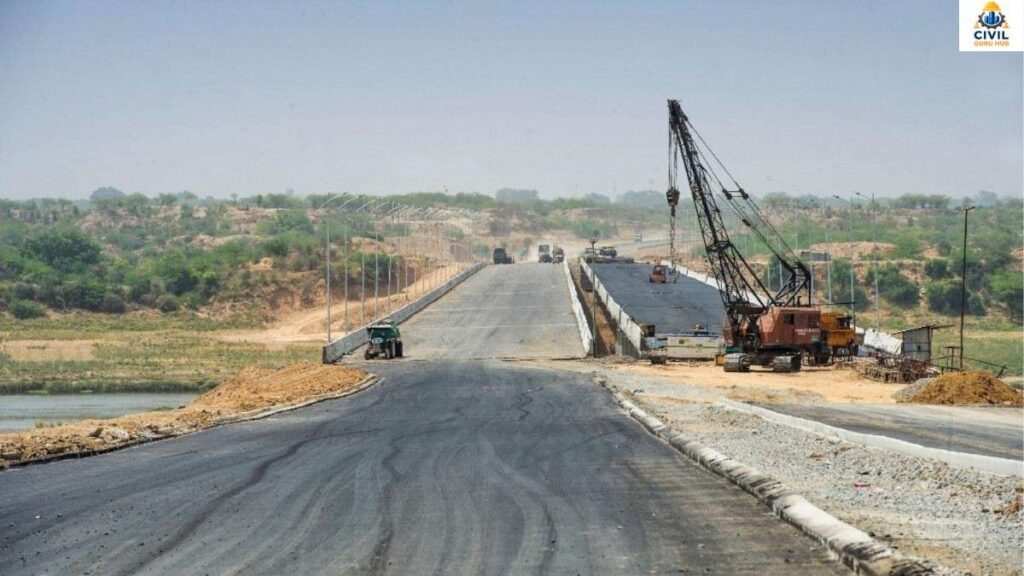
7. Design-Build Construction Contract
A Design-Build Construction Contract is also known as a DB Contract. In this system, the responsibility for both design and construction rests with a single contractor or organization.
In a traditional contract system, the employer first engages a consultant to create the design and subsequently appoints a contractor for construction. However, in a Design-Build contract, a single agency handles both tasks.
For this reason, this type of contract is also referred to as a “Single Responsibility Contract.”
Consider a scenario where a private university intends to build a new engineering college campus.
If the traditional method were followed, an architect would be appointed first, followed by a structural consultant, an MEP consultant, and finally, a construction contractor.
However, if a Design-Build Construction Contract is adopted, a single company would complete everything—including the campus master plan, structural design, architectural design, procurement, and construction.
The greatest advantage of this system is coordination.
Since the design and construction teams operate under the same organization, communication gaps are significantly minimized.
If a change to a drawing is required during construction, decisions can be made very quickly.
Consequently, project completion is comparatively faster.
Design-Build contracts also offer considerable freedom for innovation.
The contractor can suggest superior construction methods, the latest technologies, and cost-effective materials.
However, the employer must exercise great care when selecting the contractor.
If the contractor lacks technical competence, both the quality of the design and the construction could be compromised.
Therefore, the pre-qualification process is crucial in Design-Build Construction Contracts.
Today, the use of the Design-Build model is rapidly increasing in India across projects such as hospitals, educational campuses, commercial complexes, industrial buildings, and smart city initiatives.
Advantages of Design-Build Construction Contract
| Advantage | Explanation |
|---|---|
| Single Point of Responsibility | The contractor is responsible for both the design and construction phases, ensuring better accountability and smoother project execution. |
| Faster Project Completion | Integrated design and construction processes reduce delays, allowing faster decision-making and shorter project timelines. |
| Improved Communication | Designers, engineers, and construction teams work together from the beginning, minimizing misunderstandings and improving collaboration. |
| Cost Optimization | Value engineering can be implemented more effectively during the design stage, helping reduce overall project costs without compromising quality. |
| Reduced Disputes | Since one contractor manages both design and construction, conflicts between designers and builders are significantly reduced, leading to smoother project delivery. |
Limitations of Design-Build Construction Contract
| Limitation | Description |
|---|---|
| Contractor Selection is Critical | The success of a Design and Build project depends heavily on selecting an experienced and qualified contractor with proven design and construction expertise. |
| Reduced Employer Control | The contractor is responsible for most design decisions, giving the employer less direct control over detailed design and technical aspects. |
| Independent Design Review May Be Required | In complex or high-value projects, an independent design review may be necessary to ensure quality, compliance with standards, and project safety. |
Important Clauses
- Design Responsibility
- Technical Performance Standards
- Design Approval Procedure
- Construction Milestones
- Defect Liability
- Professional Indemnity Insurance
To read more articles on Project Management, check the following guides:
What Are the 15 Most Important Project Management Skills for Civil Engineers in 2026?
What is PERT in Project Management? 8 Practical Ways to Control Project Time and Cost
What is Time Management? 10 Proven Project Management Tips
8. Turnkey Construction Contract
A Turnkey Construction Contract is used for projects where the Employer wants the project handed over in a fully ready-to-use condition.
The term “Turnkey” simply means the project is so complete that the Owner needs only to turn the key to begin operations.
Under this contract, the Contractor does not merely construct the building; they assume full responsibility for everything from Design, Procurement, and Construction to Testing, Commissioning, and Final Handover.
For example, suppose a pharmaceutical company wants to build a new manufacturing plant.
The company’s primary focus is manufacturing medicines, not managing construction.
Therefore, they appoint an experienced EPC (Engineering, Procurement, and Construction) Contractor through a Turnkey Construction Contract.
The Contractor completes everything, including the plant building, machinery foundations, electrical systems, fire-fighting systems, HVAC, utility networks, water supply, and testing.
Once the project is ready, the Contractor hands over the plant to the Employer in an operational condition.
The biggest benefit of a Turnkey Contract for the Employer is convenience.
They do not have to coordinate with multiple vendors and contractors.
However, the responsibility on the Contractor increases significantly.
If the project is not completed on time or fails to achieve the required performance standards, the Contractor may face Liquidated Damages (LD).
Turnkey Construction Contracts are widely used for industrial plants, water treatment plants, sewage treatment plants, solar plants, hospitals, and data centers.
Advantages of Turnkey Construction Contracts
| Advantages of EPC Contract | Description |
|---|---|
| Complete Project Solution | A single contractor handles the entire project, from engineering and design to procurement, construction, testing, and final commissioning. |
| Single Point of Responsibility | The client communicates with only one contractor, ensuring clear accountability for quality, cost, schedule, and project performance. |
| Faster Project Execution | Better coordination between design, procurement, and construction reduces delays and helps complete the project on time. |
| Reduced Employer Workload | The contractor manages day-to-day project activities, allowing the employer to focus on monitoring overall progress instead of handling multiple contractors. |
Disadvantages of Turnkey Construction Contracts
| Disadvantage | Explanation |
|---|---|
| High Initial Cost | Design-Build contracts often have a higher upfront cost because contractors include contingency amounts to cover design, construction, and project risks. |
| Requires Experienced Contractors | Successful execution depends on skilled and experienced contractors who can effectively manage both the design and construction phases. |
| Complex Contract Documentation | Design-Build agreements require detailed contract clauses, technical specifications, performance standards, and clearly defined responsibilities to avoid disputes. |
Important Clauses
- Commissioning Procedure
- Performance Test
- Acceptance Criteria
- Training of Owner’s Staff
- Warranty Period
- Final Handover Certificate
9. BOT (Build-Operate-Transfer) Construction Contract
The full form of BOT is Build-Operate-Transfer.
It is considered one of the most successful construction contract models for infrastructure development worldwide.
Under this contract, a private company designs the project, arranges the financing, completes the construction, and operates the project for a certain number of years.
Once the operation period concludes, the project is transferred to the government.
In India, many expressways, toll roads, bridges, and infrastructure projects have been developed using the BOT model.
For example, suppose the total cost of constructing a 150 km expressway is ₹10,000 crore.
The government does not wish to invest the entire amount upfront.
Therefore, a private company constructs the project under a BOT construction contract.
After construction is complete, the company collects tolls for a period of 20 to 30 years.
It recovers its investment and earns a profit from this toll revenue.
Upon the completion of the contract period, the expressway is transferred to the government.
The biggest benefit of the BOT model for the government is the reduction of the initial financial burden.
It also incorporates the efficiency of the private sector into the project.
However, if traffic estimates prove incorrect or expected revenue is not realized, the private company may face financial losses.
For this reason, a Detailed Project Report (DPR), traffic survey, and financial feasibility study are conducted very carefully before signing a BOT construction contract.
Advantages of BOT Construction Contracts
| Advantage | Description |
|---|---|
| Reduced Government Investment | Minimizes the initial financial burden on the government by allowing private investment in infrastructure projects. |
| Higher Private Sector Efficiency | Encourages faster project execution, improved operational efficiency, and better management practices through private sector participation. |
| Long-Term Maintenance | Ensures that the private partner is responsible for maintaining the infrastructure throughout the concession period, resulting in better asset quality. |
| Improved Asset Utilization | Keeps infrastructure assets functional, well-maintained, and operational, providing reliable services to users over the long term. |
Challenges of BOT Construction Contracts
| Challenge | Explanation |
|---|---|
| Revenue Risk | Actual toll revenue may be lower than projected due to reduced traffic volume or lower-than-expected toll collections, affecting the project’s profitability. |
| Long-Term Contract | BOT projects typically involve concession agreements lasting 20–30 years, requiring long-term financial and operational commitments from the concessionaire. |
| Financial Risk | Recovering the initial investment is uncertain because it depends on future traffic demand, toll income, maintenance costs, and overall economic conditions. |
| Traffic Forecast Dependency | Incorrect traffic projections can significantly impact project revenue, making it difficult to recover costs and achieve expected returns on investment. |
10. PPP (Public-Private Partnership) Construction Contract
PPP, or Public-Private Partnership, is a construction contract model where the government and the private sector collaborate to develop an infrastructure project.
The objective of this model extends beyond mere construction; it also encompasses long-term operation, maintenance, and the improvement of public services.
PPP is not a single type of contract; rather, it encompasses various models such as BOT, BOOT, DBFO, HAM, and other hybrid models.
In India, the PPP model is widely utilized for projects involving national highways, metro rail systems, airports, smart cities, hospitals, bus terminals, and water supply infrastructure.
Consider a scenario where a new international airport is to be built in a city.
The government provides the land and policy support.
The private company arranges the financing, constructs the airport, and manages its operations for a specified period in accordance with the agreement.
In this process, the responsibilities of both the government and the private company are clearly defined within the contract.
Risk sharing is a crucial concept in PPP construction contracts.
Risks that the government is better equipped to handle remain with the government.
Conversely, risks that the private company can manage efficiently are assigned to the private partner.
This balanced approach is why PPP projects are considered sustainable.
However, drafting contracts for PPP projects is a highly detailed process.
It is essential to clearly define aspects such as the financial model, revenue sharing, land acquisition, dispute resolution, and performance standards.
Advantages of PPP Construction Contracts
| Advantages of Public-Private Partnership (PPP) | Description |
|---|---|
| Shared Investment | Both the government and private sector share the financial investment, reducing the burden on public funds. |
| Advanced Technology | Private companies bring modern technology, innovation, and efficient project management practices. |
| Long-Term Asset Management | Private partners are responsible for operation and maintenance, ensuring better performance and longer asset life. |
| Improved Public Services | PPP projects enhance the quality, efficiency, and accessibility of public infrastructure and services. |
| Faster Project Completion | Private sector expertise helps complete infrastructure projects on time and minimizes delays. |
| Cost Efficiency | Better planning and resource management reduce overall project costs and improve value for money. |
| Risk Sharing | Project risks such as construction, financial, and operational risks are shared between public and private partners. |
| Higher Service Quality | Performance-based contracts encourage private companies to maintain high service standards. |
| Economic Growth | PPP project |
Challenges of PPP Construction Contracts
| Challenge | Description |
|---|---|
| Contract Complexity | PPP contracts require detailed legal drafting to clearly define the roles, responsibilities, risk allocation, and obligations of both public and private partners. |
| Revenue Sharing Issues | A transparent and well-structured revenue-sharing agreement is essential to prevent disputes and ensure long-term financial sustainability. |
| Government Policy Changes | Changes in government regulations, taxation, or infrastructure policies can significantly affect the viability and profitability of PPP projects. |
| Long-Term Performance Monitoring | Continuous monitoring, regular audits, and performance evaluations are necessary to ensure the project meets quality standards and contractual obligations throughout its lifecycle. |
Master Comparison of 10 Construction Contract Types (Complete Guide)
Construction contracts define the legal relationship between the project owner and the contractor. Choosing the right contract type is essential for controlling project cost, quality, time, and risk. Different contracts are suitable for different types of construction projects, such as residential buildings, highways, bridges, industrial plants, and government infrastructure.
This guide compares the 10 most commonly used construction contract types based on payment method, risk allocation, advantages, disadvantages, and practical applications.
| Contract Type | Payment Method | Risk Level | Best Suitable For | Main Advantage | Main Disadvantage | Commonly Used In |
|---|---|---|---|---|---|---|
| Lump Sum Contract | Fixed Total Price | High (Contractor) | Residential & Commercial Buildings | Budget certainty for the owner | Contractor bears cost overrun risk | Private Building Projects |
| Item Rate Contract | Actual Quantity × Item Rate | Medium (Shared) | Government Civil Works | Payment based on actual work executed | Requires continuous measurement | Roads, Bridges, Buildings |
| Percentage Rate Contract | Schedule of Rates ± Percentage | Medium | Government Tenders | Transparent bidding process | Depends on updated Schedule of Rates | PWD, CPWD Projects |
| Cost Plus Contract | Actual Cost + Agreed Profit | High (Owner) | Projects with Uncertain Scope | High flexibility for design changes | Final project cost is uncertain | Renovation, Restoration, Research Projects |
| Time and Material Contract | Labour Time + Material Cost | Medium | Repair & Maintenance Work | Flexible for emergency works | Cost control is difficult | Maintenance & Renovation |
| EPC Contract | Fixed EPC Price | High (Contractor) | Mega Infrastructure Projects | Single-point responsibility | Requires an experienced EPC contractor | Highways, Power Plants, Metro Projects |
| Design-Build Contract | Fixed or Negotiated Price | Medium | Fast-Track Projects | Design and construction under one contractor | Limited owner involvement in design | Campuses, Hospitals, Commercial Buildings |
| Turnkey Contract | Fixed Contract Price | High (Contractor) | Fully Ready-to-Use Facilities | Complete project handover | Initial contract value may be higher | Industrial Plants, Hospitals |
| BOT (Build-Operate-Transfer) | Revenue During Operation Period | High (Private Developer) | Toll Roads & Bridges | Reduces government investment | Revenue depends on traffic volume | Expressways, Bridges |
| PPP (Public-Private Partnership) | Shared Investment & Revenue | Shared | Large Public Infrastructure | Shared investment and risk | Complex legal and financial agreements | Airports, Metro Systems, Smart Cities |
Quick Selection Guide: Which Construction Contract Type Should You Choose?
| If Your Project Is… | Recommended Contract Type | Why It’s Suitable |
|---|---|---|
| Small Residential Building | Lump Sum Contract | Best for projects with a fixed scope and budget. |
| Government Building Project | Item Rate Contract | Ideal when quantities may vary during execution. |
| PWD/CPWD Tender | Percentage Rate Contract | Commonly used in government tenders based on Schedule of Rates (SOR). |
| Renovation or Restoration | Cost Plus Contract | Suitable when the exact scope of work is uncertain. |
| Emergency Repair Work | Time and Material Contract | Allows immediate work without waiting for a fixed estimate. |
| Expressway or Metro Project | EPC (Engineering, Procurement & Construction) Contract | A single contractor handles design, procurement, and construction for faster delivery. |
| Fast-Track Commercial Project | Design-Build Contract | Design and construction are managed under one contract, reducing project duration. |
| Factory or Industrial Plant | Turnkey Contract | The contractor delivers a fully completed, ready-to-operate facility. |
| Toll Highway Project | BOT (Build-Operate-Transfer) Contract | The contractor finances, operates, and later transfers the project to the government. |
| Airport, Metro, or Smart City Project | PPP (Public-Private Partnership) Contract | Government and private companies share investment, risk, and project responsibilities. |
Important Construction Contract Clauses Every Engineer Should Know
The strength of any construction contract is determined by its clauses. If the clauses are clear and balanced, the project proceeds smoothly. However, if they are incomplete or confusing, even a minor issue can escalate into a major legal dispute.
The first clause is the Scope of Work. It clearly outlines the tasks the contractor must perform and specifies what falls outside their scope. If the scope is unclear, disputes regarding variation claims and requests for extra payment are almost inevitable.
The second important clause is the Contract Price. This defines the basis of payment—whether the contract is Lump Sum, Item Rate, EPC, or based on another model.
The third clause covers Payment Terms. This outlines the rules for advance payments, Running Account Bills (RA Bills), interim payments, final bills, and security deposits.
Next is the Time for Completion clause. The project completion date must be clearly defined in the contract.
If the contractor causes a delay, the Liquidated Damages (LD) clause applies. However, if the delay is caused by the employer, the contractor may be granted an Extension of Time (EOT).
The Variation Clause is crucial in the construction industry. Additional work arising from site conditions or design changes is common, and this clause governs the approval process for such extra work.
Every construction contract also includes a Defect Liability Period (DLP). If defects in workmanship or materials are discovered during this period, the contractor is required to rectify them at no additional cost.
Nowadays, clauses such as Performance Bank Guarantee, Retention Money, Insurance, Safety, Force Majeure, Termination, and Arbitration are becoming mandatory in large infrastructure projects.
Summary of Important Contract Clauses
| Contract Clause | Purpose | Why It Is Important |
|---|---|---|
| Scope of Work | Clearly defines the contractor’s responsibilities, tasks, and deliverables. | Prevents misunderstandings and disputes by specifying exactly what work is included in the contract. |
| Contract Price | Specifies the total contract value and the pricing method (Lump Sum, Item Rate, Cost Plus, etc.). | Ensures transparency in project costs and helps control the construction budget. |
| Payment Terms | Explains the payment schedule, billing process, milestones, and retention amount. | Maintains healthy cash flow and minimizes payment-related disputes. |
| Time for Completion | States the project commencement date, completion deadline, and project duration. | Helps monitor progress and ensures timely project delivery. |
| Extension of Time (EOT) | Defines the conditions under which additional time may be granted due to delays beyond the contractor’s control. | Protects both parties from unfair penalties caused by unforeseen circumstances. |
| Liquidated Damages (LD) | Specifies the predetermined compensation payable for project delays. | Encourages timely completion and compensates the employer for losses caused by delays. |
| Variation Clause | Describes the procedure for approving changes in scope, quantities, or specifications. | Ensures all additional work is properly documented, approved, and paid. |
| Defects Liability Period (DLP) | Defines the period during which the contractor must repair defects after project completion. | Guarantees construction quality and protects the client from post-completion defects. |
| Performance Guarantee | Requires the contractor to provide a bank guarantee or security for satisfactory project performance. | Provides financial security to the client in case of contractor default. |
| Arbitration Clause | Establishes the process for resolving contractual disputes through arbitration. | Offers a faster and more cost-effective alternative to court litigation. |
Important Indian Laws in Construction Contracts
What legal provisions have to be kept in mind while executing any construction contract in India? Only Indian Contract Act is not enough. Depending on the nature of the project, different Acts and Rules may also be applicable.
Important Laws
| Law / Act | Purpose |
|---|---|
| Indian Contract Act, 1872 | Establishes the legal framework for contract formation, validity, obligations, breach of contract, and remedies. |
| Arbitration and Conciliation Act, 1996 | Provides a legal mechanism for resolving disputes through arbitration and conciliation without lengthy court proceedings. |
| Specific Relief Act, 1963 | Allows courts to enforce contractual obligations through specific performance and other legal remedies. |
| Indian Stamp Act, 1899 | Requires construction contracts to be executed on appropriate stamp paper, ensuring legal admissibility and compliance. |
| Registration Act, 1908 | Specifies when certain agreements must be registered to become legally enforceable and protect ownership rights. |
| Building and Other Construction Workers (Regulation of Employment and Conditions of Service) Act, 1996 | Protects construction workers by regulating employment conditions, health, welfare, and workplace safety. |
| Employees’ Compensation Act, 1923 | Ensures financial compensation to workers or their families in case of workplace injury, disability, or death. |
| Environment (Protection) Act, 1986 | Regulates environmental compliance, pollution control, waste management, and sustainable construction practices. |
Apart from these, CPWD Works Manual, General Conditions of Contract (GCC), MoRTH Specifications, NHAI Standard EPC Documents and department-specific tender conditions are also followed in Government Projects.
The Role of CPWD, MoRTH, and FIDIC in Construction Contracts
The same contract format is not used for every project.
For CPWD building projects, the CPWD General Conditions of Contract and the CPWD Works Manual are generally followed.
MoRTH specifications and NHAI contract documents are used for National Highway projects.
For international projects, the FIDIC Conditions of Contract is the most widely accepted standard.
The full form of FIDIC is:
International Federation of Consulting Engineers
Various FIDIC contract books are available, such as the Red Book, Yellow Book, and Silver Book.
International contractors and consultants use these documents extensively because they provide a globally accepted contract framework.
Common Mistakes Made When Signing Construction Contracts
Many disputes in the construction industry arise simply because basic errors are overlooked during the contract signing process.
The most common mistake is signing the contract without reading it in its entirety.
Many contractors focus solely on the contract value while ignoring the scope of work or special conditions.
Another major error is failing to understand the variation procedure.
If written approval for additional work is not obtained, payment claims may be rejected later.
Failing to maintain proper records for time extensions is also a common mistake.
Site instructions, hindrance registers, daily progress reports, and correspondence serve as crucial evidence in the event of future disputes.
Ignoring insurance and safety requirements can also create financial risks.
Similarly, failure to properly maintain records regarding material approvals and quality documentation can lead to payment and quality-related issues for the contractor.
Best Practices Every Civil Engineer Should Follow
A successful site engineer not only executes, but also ensures contract compliance.
- Use the latest revision of every drawing.
- Record site instructions in written form.
- Do not execute variation work without written approval.
- Regularly update the measurement book.
- Safely maintain material testing reports.
- Prepare running bills in accordance with contract terms.
- Immediately issue written notice of delays.
- Preserve the minutes of meeting (MOM) for every meeting.
These small practices protect the project from future claims and disputes.
Recommended Tools for Construction Professionals
If you are a site engineer, civil engineering student, quantity surveyor, or contractor, the tools listed below can make your daily site work easier and more professional. Using these products helps improve measurement accuracy, calculations, and site documentation. You can check them out based on your specific requirements.
| Product | Best For | SEO-Friendly Description |
|---|---|---|
| Auto Level Machine | Site Engineers & Surveyors | An Auto Level Machine is an essential surveying instrument used for accurate leveling, elevation measurement, and construction layout. It ensures precision in road, bridge, and building projects. |
| Measuring Wheel | Road Construction & Survey Work | A Measuring Wheel provides quick and accurate distance measurements for highways, roads, land surveys, and construction projects. It is lightweight, portable, and easy to use on-site. |
| Scientific Calculator | Civil Engineering Students & Professionals | A Scientific Calculator is indispensable for solving engineering formulas, trigonometry, structural analysis, and quantity calculations. It is ideal for exams and daily engineering tasks. |
| Safety Helmet | Construction Workers & Site Engineers | A Safety Helmet protects workers from falling objects, impacts, and head injuries, making it mandatory personal protective equipment (PPE) on construction sites. |
| Reflective Safety Jacket | Site Engineers & Construction Staff | A Reflective Safety Jacket improves visibility in low-light and high-traffic work areas, reducing the risk of accidents and ensuring compliance with workplace safety standards. |
| Engineering Field Notebook | Civil Engineers & Site Supervisors | An Engineering Field Notebook helps engineers record site measurements, observations, calculations, and daily progress efficiently, ensuring proper project documentation. |
Affiliate Disclaimer
Some product links included in this article may be affiliate links. If you purchase a product through these links, we may earn a small commission at no extra cost to you. This commission helps us create more original, high-quality, and free Civil Engineering content on Civilguruhub.com.
We only recommend tools, books, and construction-related products that are useful for Civil Engineering students, site engineers, contractors, and construction professionals. Before purchasing any product, please verify its features, specifications, customer reviews, and warranty to ensure it meets your needs.
Your support motivates us to create even better educational content. Thank you!
Conclusion
In today’s modern construction industry, technical engineering knowledge alone is not enough. A professional civil engineer must also possess a technical, commercial, and legal understanding of construction contracts.
No single contract type is suitable for every project. A ‘Lump Sum Contract’ might be effective for a small residential project, whereas an EPC or BOT model could be more appropriate for a highway project. Similarly, ‘Item Rate’ and ‘Percentage Rate’ contracts are practical choices for government works.
Most importantly, before signing a contract, it is crucial to carefully read every clause, clearly understand the scope of work, verify payment conditions, and analyze risk allocation.
A good construction contract is not merely a legal document; it serves as the foundation for successful project management. When a contract is transparent, balanced, and professionally drafted, the project is completed on time, quality is maintained, and the interests of both the contractor and the employer are safeguarded.
Therefore, whether you are a civil engineering student, site engineer, quantity surveyor, contractor, or project manager, a deep understanding of construction contracts can give your career a new direction and help you avoid costly mistakes.
About the Author
My name is Susanta Kumar Mohapatra. A Civil Engineer with over 11 years of practical experience in the construction industry. I have worked on various infrastructure projects, including road construction, bridge projects, building construction, quality control, material testing, quantity surveying, project planning, and site management.
I am the founder of CivilGuruHub.com, where my mission is to provide original, research-based, and industry-focused information to Civil Engineering students, site engineers, junior engineers, and construction professionals in simple, practical language. All my articles are based on real-site experience, engineering standards, and practical knowledge, ensuring that readers gain a solid understanding of both theory and field operations.
If you wish to learn about the latest Civil Engineering updates and topics such as Highway Engineering, Building Construction, Estimation, Quantity Surveying, Material Testing, IRC Codes, IS Codes, and Project Management in detail, please visit Civilguruhub.com regularly.
You can also subscribe to my YouTube channel, The Civil Site, where I share practical videos, site knowledge, and technical explanations related to Civil Engineering. Additionally, do check out my other YouTube channel, Daily IQ Hub, where I upload informative videos daily covering General Knowledge (GK), quizzes, and content related to competitive exams.
My goal is to make practical Civil Engineering knowledge accessible to every student and professional through simple and easy-to-understand language, helping them achieve greater success in their careers.
Frequently Asked Questions (FAQs)
Q1. What is a Construction Contract?
Answer: A construction contract is a legal agreement between the Employer and the Contractor that defines the project’s scope, cost, quality, payment terms, and responsibilities.
Q2. Which construction contract is most commonly used?
Answer: The ‘Item Rate Contract’ is most frequently used in government projects in India, whereas the ‘Lump Sum Contract’ is quite common in private projects.
Q3. What is the full form of an EPC Contract?
Answer: Engineering, Procurement, and Construction.
Q4. What is the difference between BOT and PPP?
Answer: BOT is a specific project delivery model, whereas PPP is a broader partnership framework that encompasses various models, including BOT.
Q5. Which is the most important clause in a construction contract?
Answer: The Scope of Work, Payment Terms, Variation Clause, Time for Completion, and Arbitration Clause are considered the most important clauses.
Q6. On which law are Indian construction contracts based?
Answer: The legal foundation of the majority of construction contracts is the Indian Contract Act, 1872; additionally, other applicable laws and project-specific conditions are followed.