
Table of Contents
Introduction
Now a days, road and highway construction is no longer merely a task of moving earth or laying asphalt. Modern highway construction is a highly planned engineering process in which speed, accuracy, durability, and safety all play a pivotal role. When we look at a new expressway, national highway, bypass, or city road, the engineers and laborers contribute to its creation; rather, it also relies on the operation of various types of powerful construction equipment.
The success of a highway project depends, to a significant extent, on which specific equipment is utilized at each particular stage. If the wrong machinery is employed, the quality of the project may suffer, costs may escalate, and the completion timeline may face delays. For this reason, it is crucial to have a thorough understanding of the machines used in highway construction.
During road construction, the process typically begins with land clearing, followed by excavation, grading, compaction, material transport, paving, and finishing. Each distinct stage requires specific machinery. Some machines perform heavy cutting, others level the terrain, some compact the materials, while others ensure the final road surface is smooth and durable.
In this comprehensive guide, we will delve into the details of 10 essential pieces of highway construction equipment. We will cover—in a practical and accessible manner—the specific function of each machine, the stage at which it is utilized, and its overall significance within highway construction projects.
1. Excavator (Construction Equipment)
The initial phase of highway construction often begins with excavation, and the moment excavation is mentioned, the first Construction Equipment that comes to mind is the excavator.
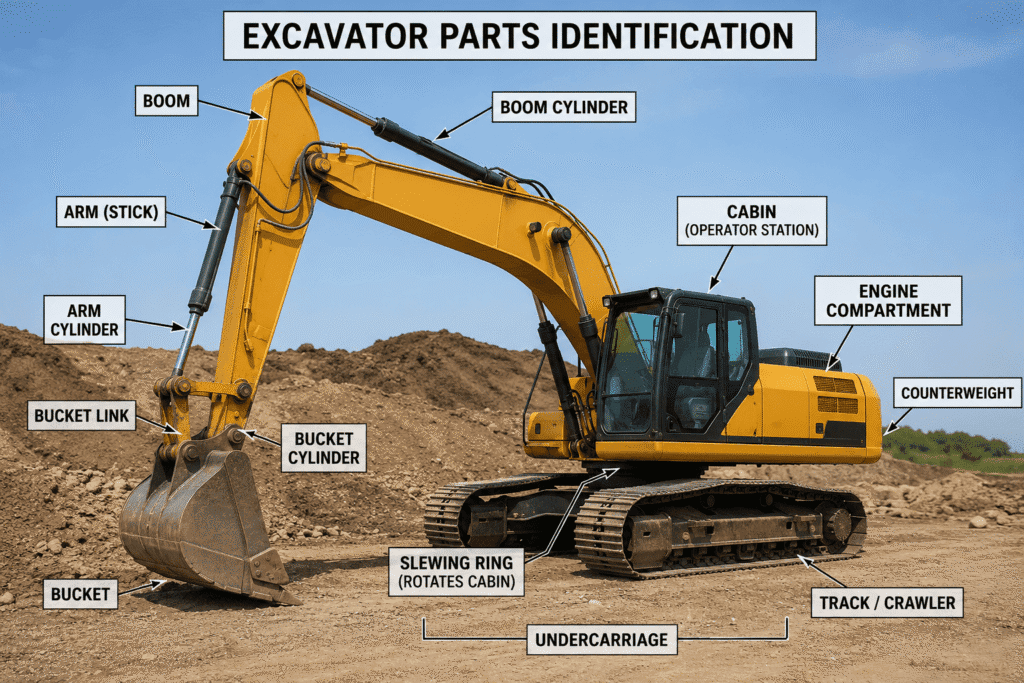
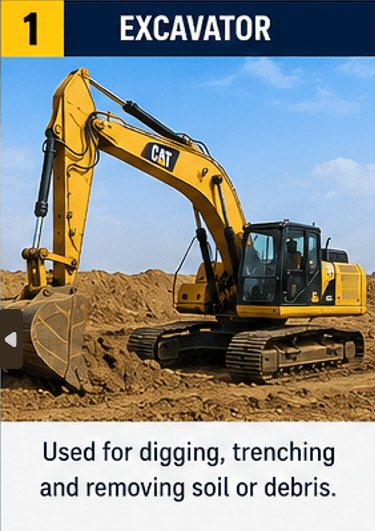
An excavator is a heavy-duty Construction Equipment featuring a rotating cabin, a boom, an arm, and a bucket. Its primary function is to dig and remove soil, rocks, debris, and unwanted materials.
Once the alignment for a new highway is finalized, the construction team removes the topsoil in that specific area first. Excavators prove particularly useful in “cutting sections”—areas where the ground level needs to be lowered. They are capable of working effectively on both hard soil and soft rock.
A major advantage of the excavator is its versatility. In addition to the standard bucket, it can be fitted with various attachments such as breakers, augers, and grapples. Whether the task involves breaking rock, digging drainage trenches, or excavating foundations for culverts, the excavator serves a vital role in every scenario.
In highway projects, the precision of excavation is of paramount importance. If workers over-excavate, additional backfilling may be required, which inevitably drives up costs. Consequently, the role of the excavator—operated by a trained professional—is absolutely critical to the success of the project.
2. Bulldozer (Construction Equipment)
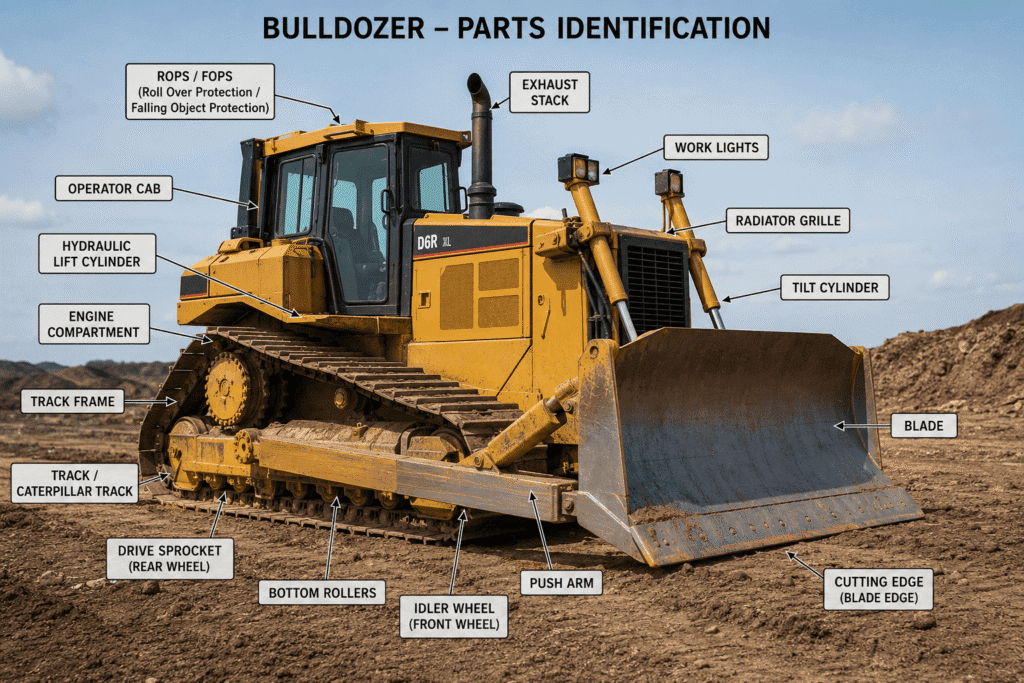
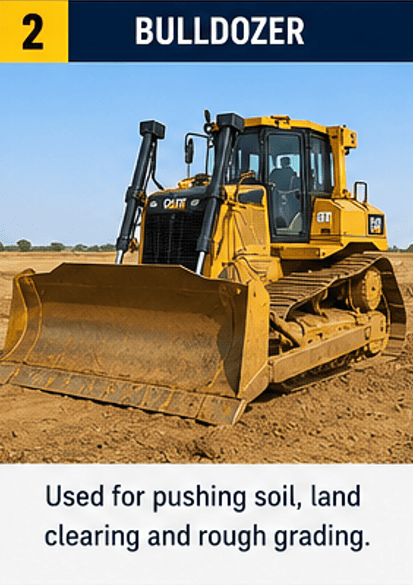
The bulldozer is considered a highly powerful piece of Construction equipment for highway. Located at the front of this machine is a large metal blade used to push soil, rocks, and debris.
Whenever a highway construction site features uneven terrain—or is obstructed by bushes, small trees, and surface obstacles—the bulldozer is the first Construction equipment to be deployed. Its primary functions are land clearing and rough grading.
A bulldozer can easily move heavy loads over short distances. It proves particularly useful during “cut and fill” operations; the bulldozer is highly efficient at pushing material from the cut area toward the fill area.
Bulldozers also assist during the construction of highway embankments. Their main role involves spreading soil and performing the initial shaping of the embankment. While they do not perform the final finishing work, they are absolutely essential for the initial formation of the structure.
To get Better knowledge about highway, click on below links.
What Are 9 Key Differences Between Flexible and Rigid Pavement?
What is a Median in Highway? Full Engineering Guide
What is Gradient: in Civil Engineering? Complete Explanation
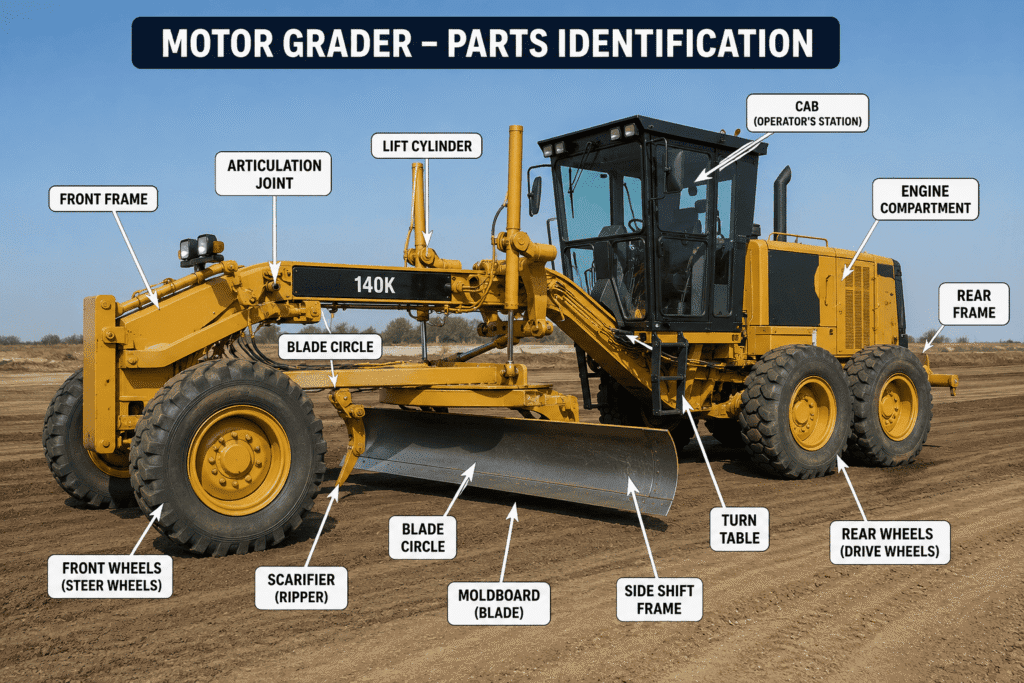
3. Motor Grader (Construction Equipment)
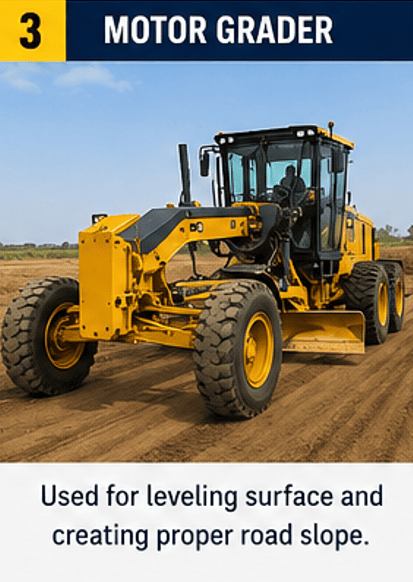
If a smooth and accurate surface is required in highway construction, a motor grader’s role becomes extremely important.
A motor grader features a long, adjustable blade positioned centrally beneath the machine. The primary function of this machine is to level and smooth the surface.
Operators utilize graders to establish the proper slope and level for the uneven terrain that remains following excavation and bulldozing operations. In highway design, cross-slopes and camber are critical elements, as they govern water drainage.
By adjusting the angle and depth of the blade, a motor grader operator can achieve a highly precise surface finish. Consequently, the work performed by a grader is absolutely critical during subgrade preparation.
Graders also operate after the base course has been spread to ensure that the aggregate is distributed uniformly and that the desired thickness is maintained.
When a grader operates correctly, the overall quality of the paving improves automatically. For this very reason, experts regard the motor grader as the specialized finishing machine in highway construction projects.
4. Wheel Loader (Construction Equipment)
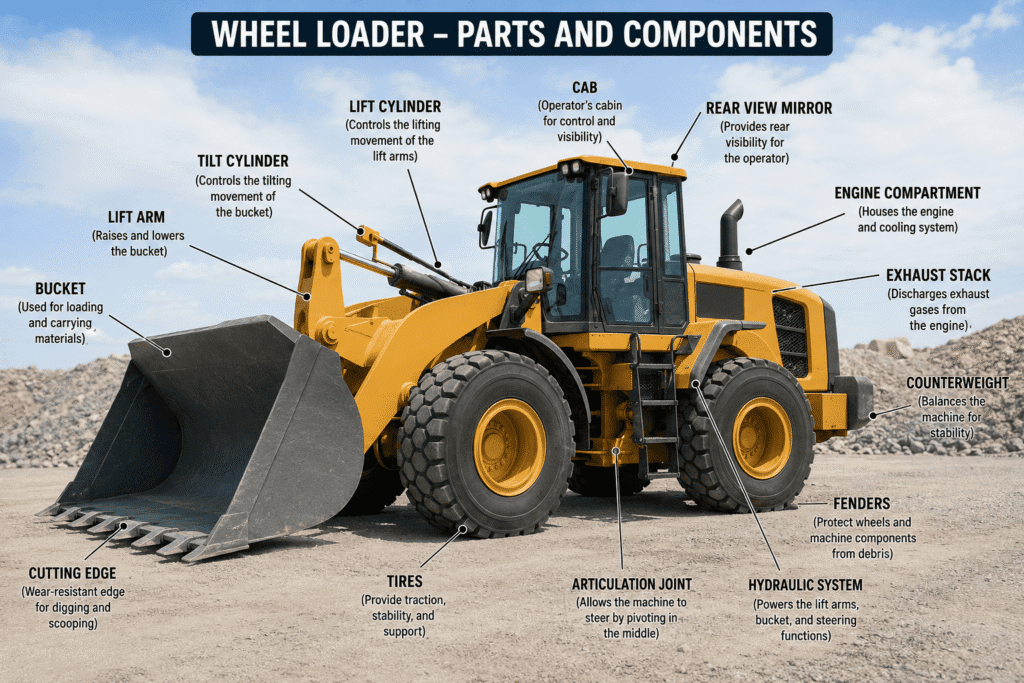
A wheel loader is a versatile construction equipment used for material handling.
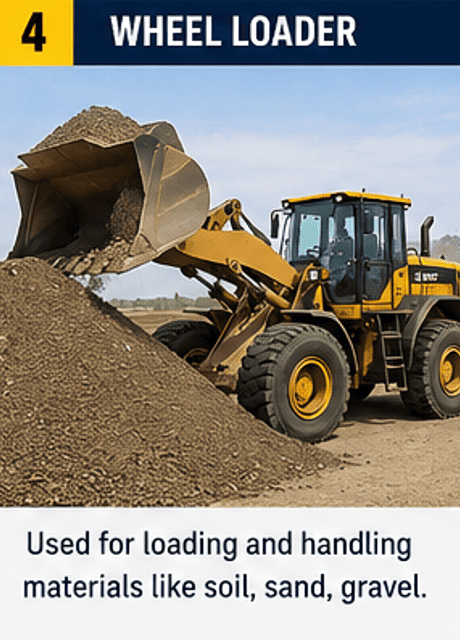
It features a large bucket at the front, which is utilized for loading soil, sand, gravel, crushed stone, and aggregates.
On highway construction sites, loading materials into trucks is a routine activity. The wheel loader performs this task with great speed. Its cycle time is quite short, resulting in high productivity.
If an excavator digs at the site while a loader fills trucks for material transport, the overall project efficiency increases significantly.
Wheel loaders also help in stockpile management. At aggregate and asphalt plants, a loader remains active almost continuously.
While this machine is not as suitable for excavation as an excavator, it excels in loading and shifting operations.
5. Dump Truck (Construction Equipment)
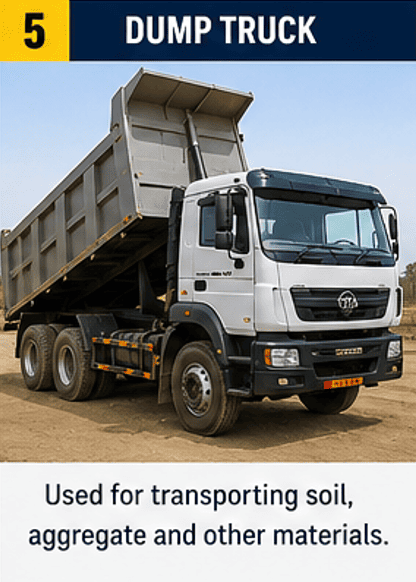
In highway construction, work is simply impossible without the transportation of materials, and the dump truck serves as the backbone of this process.
Dump trucks transport excavated material—including soil, sand, aggregates, GSB (Granular Sub-Base), WMM (Wet Mix Macadam), and asphalt mix—from one location to another.
If excavation work occurs at the site, workers transport the excavated soil to a designated disposal area using dump trucks. Similarly, trucks transport aggregates from quarries to the project site.
A hydraulic mechanism lifts the body of a dump truck, which makes the unloading process both fast and efficient.
The pace of a highway project depends significantly on the movement of these trucks. If materials do not reach the site in a timely manner, both paving and compaction operations can come to a halt.
In large-scale projects, dozens—and sometimes even hundreds—of dump trucks operate continuously. Their scheduling constitutes a major component of project management.
6. Soil Compactor / Roller (Construction Equipment)
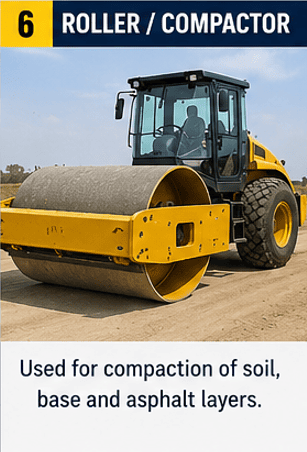
Compaction is one of the most critical processes in highway construction. If the soil is not properly compacted, it can lead to settlement, cracking, and pavement failure in the future.
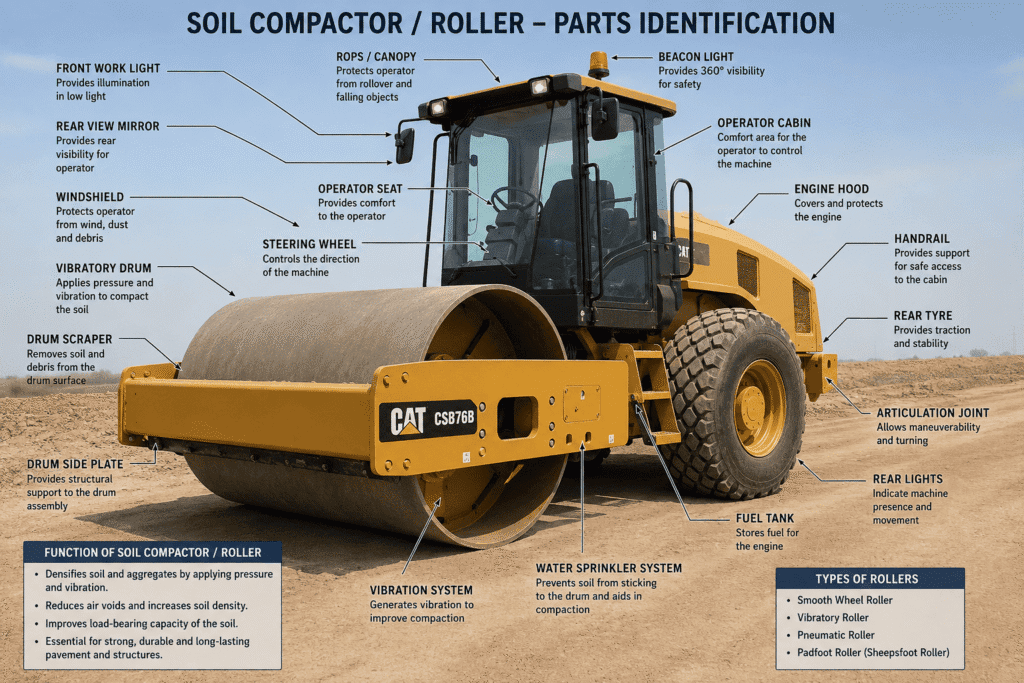
A construction equipment named roller or compactor functions to densify the soil and aggregates.
Workers utilize various types of rollers—including smooth-wheel rollers, vibratory rollers, pneumatic rollers, and padfoot rollers.
Operators commonly use vibratory rollers during subgrade compaction; they achieve this by packing soil particles tightly together through vibration.
The primary objective of compaction is to minimize voids and enhance the bearing capacity of the soil.
In highway projects, compaction involves more than just driving equipment over the surface; it also requires careful control over moisture content, layer thickness, and the number of passes performed.
When workers execute compaction properly, the lifespan of the road is significantly extended.
For Getting More Idea about Highway engineering Click on Given link.
How to prepare the subgrade bed:complete process
FDD test: what is it? complete process and calculation.
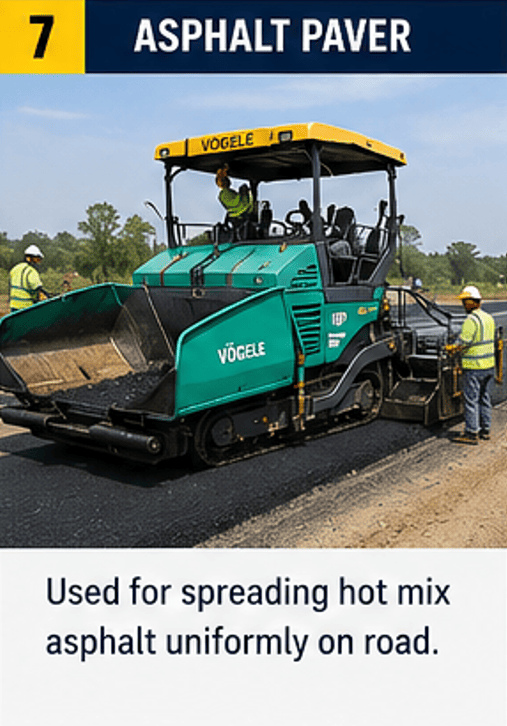
7. Asphalt Paver (Construction Equipment)
The role of the construction equipment asphalt paver begins when highway construction reaches its final stage.
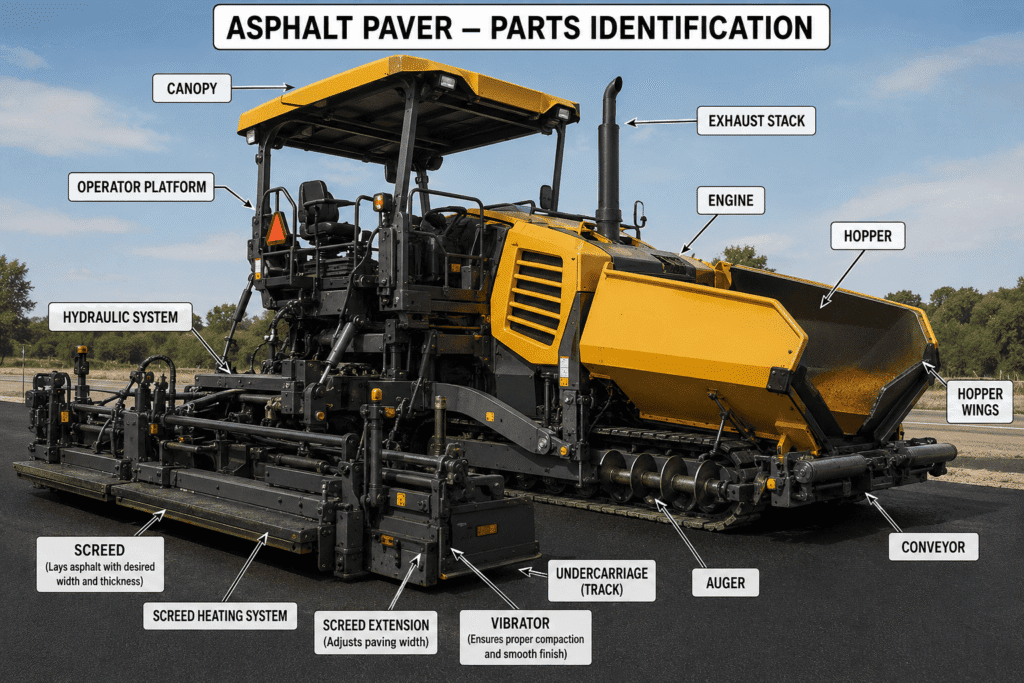
The function of the asphalt paver is to uniformly spread hot-mix asphalt across the road surface.
A dump truck unloads the asphalt mix into the paver’s hopper. The paver then spreads the material using a conveyor and an auger.
The most critical component of this machine is the screed, which lays down the asphalt layer with the desired width and thickness.
If asphalt were to be spread manually, maintaining uniformity would be difficult; the paver resolves this issue.
For modern highways, smooth ride quality and an even surface are paramount, making the asphalt paver an essential machine.
The more consistent the paver’s operation, the higher the quality of the finished road.
8. Bitumen Sprayer (Construction Equipment)
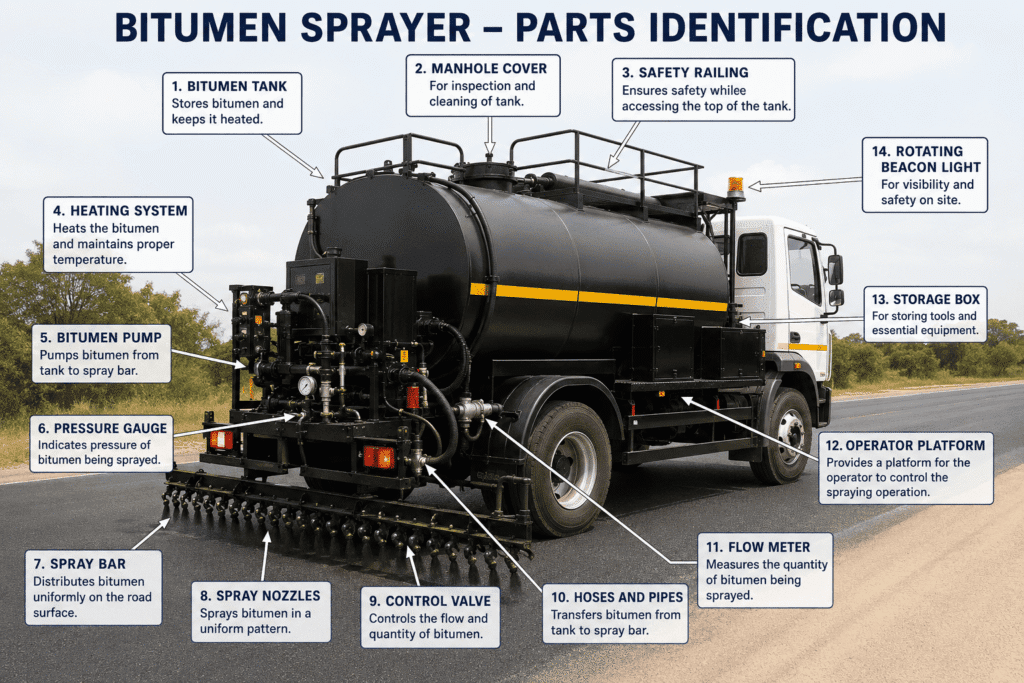
A bitumen sprayer sprays bitumen prior to asphalt paving. The function of this construction is to spray bitumen onto the road surface in a controlled quantity. Workers apply bitumen in the form of a tack coat and a prime coat.
The prime coat improves the bond between the granular base and the bituminous layer, whereas the tack coat establishes adhesion between the old and new layers. If workers do not spray the bitumen properly, the bonding between the layers may become weak, leading to premature road failure.
A bitumen sprayer ensures uniform distribution—something that manual methods cannot achieve. The durability of highway pavement depends significantly on proper bonding; for this reason, this machine is of great importance.
9. Concrete Mixer / Transit Mixer (Construction Equipment)
Not every highway is constructed using asphalt. Concrete is utilized for various highways, rigid pavements, and structures such as culverts, drains, retaining walls, and median barriers.
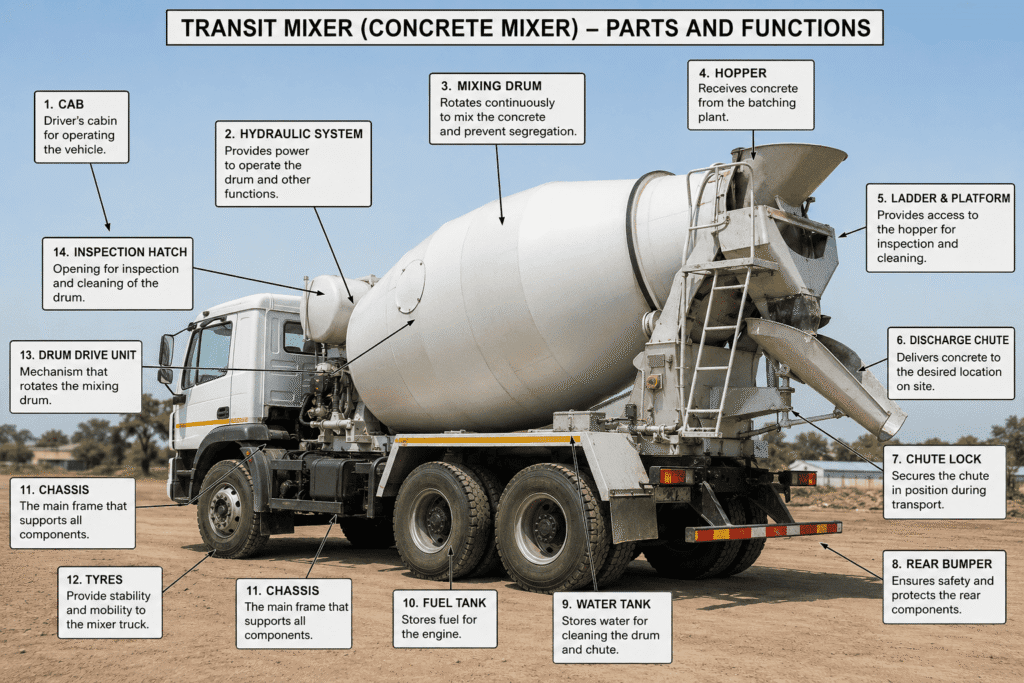
The function of a concrete mixer—or transit mixer—is to mix the concrete and deliver it to the site while it is still in a fresh state. Inside the drum of a transit mixer, the concrete continuously rotates, thereby preventing segregation. If the water-cement ratio or workability of the concrete is not properly controlled, the structural strength can be compromised.
High-quality concrete is absolutely essential for highway structures. Therefore, the role of transit mixers extends beyond mere transportation; it also encompasses the maintenance of quality.
10. Water Tanker (Construction Equipment)
People often underestimate the function of water tankers in highway construction, yet in practical terms, their role is extremely important.
Achieving proper compaction requires an optimum moisture content; if the soil is dry, effective compaction is simply not possible.
The water tanker sprays the required amount of water onto the surface.
They also utilize it for dust control. Dust pollution is a common issue at large highway construction sites, and the tanker plays a key role in keeping it under control.
Frequently, companies also employ water tankers for curing purposes, particularly in concrete-related works.
Despite appearing to be a simple piece of machinery, its contribution to maintaining the quality of highways is quite significant.
How is highway construction equipment selected?
Not every project utilizes the same construction equipment. Machine selection depends on a variety of factors.
First and foremost, the size of the project is taken into consideration. Large expressway projects require high-capacity machinery, whereas compact equipment suffices for smaller road projects.
Terrain is also a major factor. Rocky terrain necessitates heavy excavators and breakers, whereas standard machinery is sufficient for flat areas.
The project schedule also influences equipment selection. A greater number of machines are deployed for fast-track projects.
Cost is another important factor. The contractor must strike a balance between equipment productivity and operating costs.
Professional Comparison of Highway Construction Equipment
| Equipment | When It Is Used | Main Function | Typical Capacity / Output | Importance in Highway Projects |
|---|---|---|---|---|
| Excavator | During the initial excavation stage | Digging and removing soil, rock, and debris | 0.8–2.5 cubic meter bucket capacity | Prepares the base for earthwork operations |
| Bulldozer | During land clearing and rough grading | Pushing soil and shaping uneven ground | 150–400 HP | Essential for initial site preparation |
| Motor Grader | During subgrade and base course finishing | Accurate leveling and creating road camber | 3–5 meter blade width | Critical for smooth surface and proper drainage |
| Wheel Loader | During material loading and stockpile handling | Loading soil, sand, and aggregates | 1.5–6 cubic meter bucket capacity | Improves material handling productivity |
| Dump Truck | Whenever material transportation is required | Carrying soil, aggregates, and asphalt mix | 10–30 cubic meter load capacity | Maintains continuous material supply on site |
| Roller / Compactor | During compaction of every layer | Densifying soil and aggregate layers | 8–20 ton operating weight | Essential for pavement strength and durability |
| Asphalt Paver | During asphalt paving operations | Spreading hot mix asphalt uniformly | 2.5–12 meter paving width | Directly affects final riding quality |
| Bitumen Sprayer | Just before paving operations | Applying prime coat and tack coat | 4,000–10,000 liter tank capacity | Creates strong bonding between pavement layers |
| Transit Mixer | During concrete works and rigid pavement construction | Mixing and transporting fresh concrete | 4–8 cubic meter drum capacity | Helps maintain concrete quality and consistency |
| Water Tanker | During compaction, curing, and dust control | Spraying water in controlled quantity | 5,000–15,000 liter tank capacity | Maintains proper moisture and site conditions |
Conclusion
Highway construction is a systematic process in which every machine plays a specific role. From excavators to pavers and rollers, each piece of construction equipment handles a critical stage of the project. When the right machine is utilized at the right place and at the right time, construction proceeds rapidly, quality improves, and overall costs remain under control.
In modern highway projects, the role of construction equipment has become even more critical, given the intense competition, tight timelines, and significantly heightened quality expectations. Therefore, whether you are a civil engineering student, a site engineer, a contractor, or simply interested in the construction industry, gaining an understanding of these 10 highway construction machines will prove to be highly beneficial.
About The Author
My name is Susanta Kumar Mohapatra. I am a civil engineering professional with over 11 years of practical experience in the construction and infrastructure sectors. I hold a B.Tech degree in Civil Engineering and an M.E. degree in Construction Management.
Throughout my career, I have worked in various areas such as road construction, bridge projects, quality control, material testing, quantity surveying, project planning, and site management. I am passionate about sharing practical knowledge related to highway engineering, laboratory testing, and construction management with engineers, students, and construction professionals.
I am the founder of CivilGuruHub.com, where I share technical articles, field experiences, laboratory test procedures, guidelines based on IRC and IS codes, and practical construction knowledge related to civil engineering. My aim is to explain civil engineering concepts in simple language and provide useful, reliable information to industry professionals.
You can connect with me through CivilGuruHub.com and my YouTube channel, “The Civil Site,” where I regularly share civil engineering tutorials and practical site knowledge.
FAQ
Q.1. Which construction equipment are most frequently used in highway construction?
The machines most frequently used in highway construction include excavators, rollers, dump trucks, and motor graders. These are utilized at various stages of almost every road project.
Q.2. What is the function of an excavator in highway construction?
The primary function of an excavator is to dig and remove soil, rocks, and debris. It is used for site clearing, trenching, and initial earthwork.
Q.3. What is the difference between a bulldozer and a motor grader?
A bulldozer is used for rough leveling and pushing soil, whereas a motor grader is used for precise leveling and giving the road surface its final shape.
Q.4. Why is the use of a roller essential in highway construction?
A roller compacts the soil and aggregates. Proper compaction increases the road’s structural strength and reduces the risk of future settlement or cracking.
Q.5. What is the function of an asphalt paver?
An asphalt paver spreads hot-mix asphalt evenly across the road surface. This ensures uniform road thickness and results in a smooth final surface.