
Table of Contents
Introduction
Soil is a vital part of civil engineering, agriculture, and environmental science. Every structure—be it a small house, a highway, or a large dam—depends on the soil beneath it. Soil behavior directly affects the structure’s stability, strength, drainage, and long-term performance.
Simply, soil is a mixture of minerals, organic matter, air, and water. But not all soils behave the same way. Some soils swell when water is applied, some drain water quickly, and some lose their strength when wet. For this reason, it’s crucial to understand different soil types.
In this complete guide, we will explain in detail the 7 major types of soil, their properties, behavior, advantages, disadvantages and real-life construction uses.
What is Soil Classification?
Soil classification involves grouping soils based on their properties, such as particle size, texture, plasticity, and composition. Engineers use this information to decide which soils are suitable for construction.
Common classification:
- Coarse-grained soils (gravel, sand)
- Fine-grained soils (silt, clay)
- Organic soils
- Mixed soils
Soil Types Overview Table
| Type | Particle Size | Permeability | Strength | Construction Suitability |
|---|---|---|---|---|
| Gravel | Large | High | Very High | Excellent |
| Sand | Medium | High | Moderate | Good |
| Silt | Fine | Medium | Low | Poor |
| Clay | Very Fine | Low | Variable | Risky |
| Peat | Organic | High | Very Low | Not Suitable |
| Chalk | Soft Rock | Medium | Moderate | Good (with care) |
| Loam | Mixed | Balanced | Moderate | Good |
Clay Soil
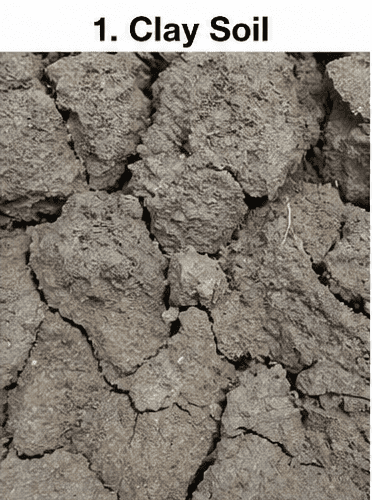
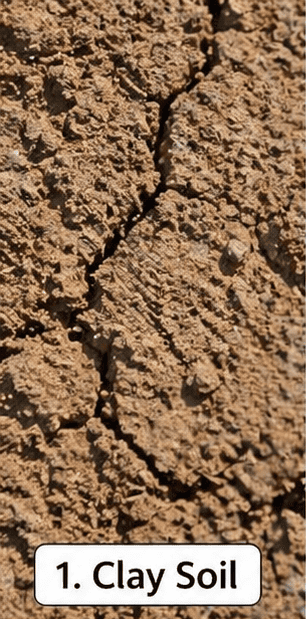
Clay soil is one of the most complex and problematic soil types. Its particles are very small and tightly packed. This results in very low permeability, meaning water does not pass through easily.
Clay’s most important property is its high plasticity. When wet, it becomes soft and sticky, and when dry, it becomes hard and cracked.
Clay soil is prone to swelling and shrinkage. When it absorbs water, it expands and pushes the foundation upward (heaving). When it dries, it shrinks, creating a gap, which leads to settlement.
From an engineering point of view, the bearing capacity of clay is low in wet conditions. Therefore, construction on it without treatment is risky.
To improve clay soil:
- Lime stabilization
- Cement stabilization
- Lime and Fly ash mixed stabilization
- Proper drainage
Sandy Soil
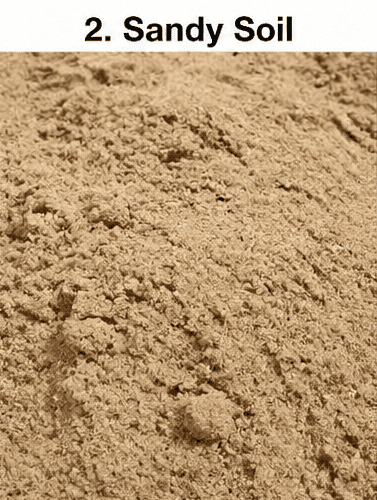
Sandy soil consists of medium-sized particles. Its main characteristic is high permeability, meaning water drains easily.
This soil has low cohesion, so the particles are not strongly adhered to each other. They can easily shift.
Advantages:
- Water drainage is good
- Expansion-shrinkage is absent
- Easy compaction
Disadvantages:
- Stability is low
- Risk of erosion is high
Improvement methods:
- Proper compaction
- Cement or clay mixing
Silt Soil
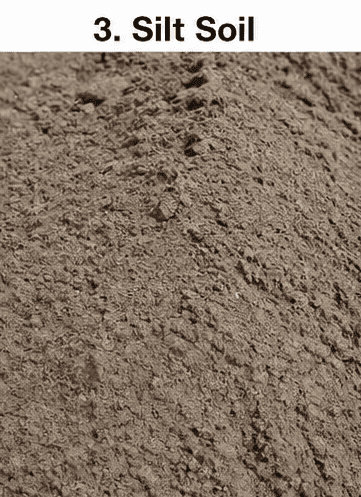
Silt soil particles are smaller than sand and larger than clay. They feel smooth and soft.
The biggest problem with silt is that it loses strength when wet. When water exposes it, it becomes weak and sometimes behaves like a liquid.
It also poses a high risk of erosion. Floods or heavy rain can easily wash it away.
Another problem is liquefaction, which occurs during earthquakes. In this condition, soil loses its strength.
Improvement:
- Compaction
- Sand or gravel mixing
- Drainage system
Gravel Soil
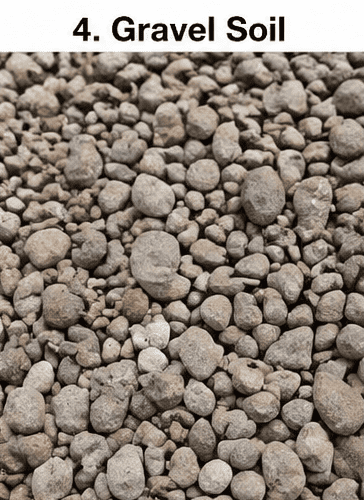
Gravel soil has large particles, making it one of the best types of soil to build on. It has excellent drainage capabilities and can withstand heavy weight, because of its high load-bearing capability.
Its large particle size allows water to quickly pass through gravel. This prevents water from pooling up and helps to prevent swelling and/or weakening of the soil.
Gravel has great stability, as it does not experience much volumetric change. It gives foundations a good base to rest on and is commonly used in:
- Road construction
- Foundation base layers
- Drainage systems
A gravel surface can frequently be mixed and/or co-mingled with an aggregate like sand to create a better compacted surface and help with drainage.
Another drawback to gravel or sand and gravel is the difficulty of excavating and moving large amounts of gravel, which would typically be accomplished with heavy machinery.
For these reasons, gravel is among the most readily available, preferred soils in the field of civil engineering because of its ability to support construction projects with strength and stability.
To get Better idea about how Borrow are soil has to sample then click on given link.
how to select Borrow Area: Complete Guide for Engineers
For more details about quality control click on link below.
what is Juran’s Trilogy of Quality : Explained Simply
what is Fly Ash:A complete guide step-by-step.
Types of Cement in Civil Engineering: A Complete Guide
Peat Soil (Organic Soil)
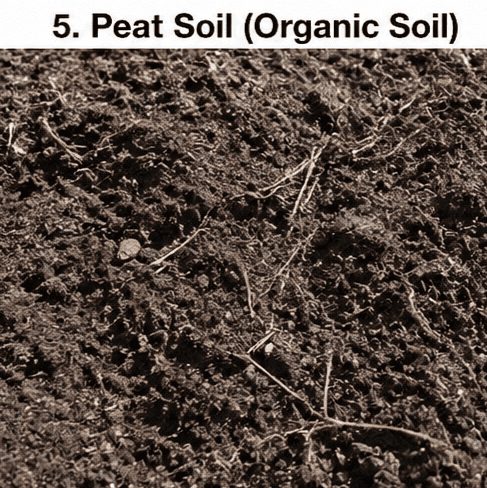
Peat includes dead, rotted vegetation, and has a high content of organic material. It is usually dark in colour and forms in marshy or swampy areas.
Peat has a high moisture content and low strength; therefore, it is very compressible when exposed to a load—meaning that it will compress significantly when loaded.
Because peat soil is so compressible and weak, it is not appropriate for building on.
- It has very low bearing capacity
- It undergoes excessive settlement
- It is unstable and unpredictable
Structures built on peat soil often experience sinking or tilting over time.
To use peat soil for construction, extensive ground improvement techniques are required, such as:
- Soil replacement
- Preloading
- Deep foundations like piles
Peat is commonly found in wetlands and coastal regions.
Chalk Soil
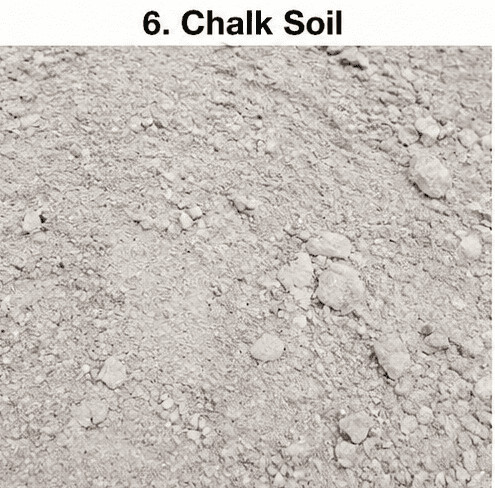
Chalk soil is a soft, rock-like soil composed of calcium carbonate. It is white in color and found in dry areas.
It has moderate strength and good drainage.
Problems:
- It can dissolve on contact with water.
- Voids can form.
However, construction on it is possible after proper investigation.
Loam Soil
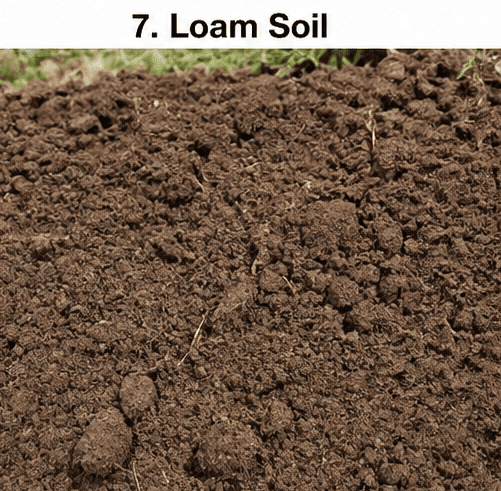
Loam has been recognized as the perfect soil type. This is due to its equal mix of sand, silt and clay, providing a blend of the advantages of each material.
The characteristics of loam include:
- Good drainage
- Moderate Strength
- Sufficient water retention
Because of its balanced combination, loam is a prime candidate for both agricultural and construction applications.
In engineering, loam can withstand continuous loading, providing stable support to structures, while behaving consistently without exhibiting large variances such as found in clay or sand.
Comparison Table
| Property | Clay | Sand | Silt | Gravel | Peat | Chalk | Loam |
|---|---|---|---|---|---|---|---|
| Drainage | Poor | Good | Medium | Excellent | High | Medium | Balanced |
| Strength | Low | Moderate | Low | High | Very Low | Moderate | Moderate |
| Stability | Low | Medium | Low | High | Very Low | Medium | High |
| Suitability | Risky | Good | Poor | Excellent | Not Suitable | Good | Good |
Importance of Soil Testing
Before starting any construction project, soil testing is essential. It helps determine:
- Bearing capacity
- Moisture content
- Soil type
- Compaction characteristics
Common soil tests include:
- Standard Penetration Test (SPT)
- Plate Load Test
- Atterberg Limits Test
- Maximum Dry Density Test
- Grain Size Analysis Test
- Free swell Index test
- California bearing Ratio test
- Direct shear Test etc.
Follow IS 1498(1970)
Conclusion
Understanding soil is a foundational step in any construction project—and this isn’t just limited to theory, but has a direct impact on real-life projects. Each soil type comes with its own unique identity and behavior. Some soils, such as gravel and sand, are inherently stable and construction-friendly, while soils like clay and peat create challenges for engineers.
If we look closely, no soil is “completely useless.” The only difference is that some soils can be used without treatment, and some require improvement. For example, stabilization techniques can make clay soils usable, and deep foundations or soil replacement can manage peaty soils. This means that engineering not only designs but also understands ground conditions and develops solutions accordingly.
Today, advanced technologies and ground improvement techniques have made even difficult soils usable. Techniques such as soil stabilization, geotextiles, chemical treatment, and deep foundation systems give engineers the flexibility to safely construct on almost every type of soil. Finally, it’s important to understand that a strong building isn’t just made of cement and steel—its true strength depends on the soil beneath it.
If the foundation is strong, the structure will be long-lasting and safe. So whether you’re a civil engineering student, a site engineer, or a land buyer—understanding soil types and their behavior will help you make better decisions. This knowledge will save you from costly mistakes and make your projects more durable, efficient, and safe.
About the Author
My name is Susanta Kumar Mohapatra. I am a civil engineering professional with over 11 years of practical experience in the construction and infrastructure sectors. I hold a B.Tech degree in Civil Engineering and an M.E. degree in Construction Management.
Throughout my career, I have worked in various areas such as road construction, bridge projects, quality control, material testing, quantity surveying, project planning, and site management. I am passionate about sharing practical knowledge related to highway engineering, laboratory testing, and construction management with engineers, students, and construction professionals.
I am the founder of CivilGuruHub.com, where I share technical articles, field experiences, laboratory test procedures, guidelines based on IRC and IS codes, and practical construction knowledge related to civil engineering. My aim is to explain civil engineering concepts in simple language and provide useful, reliable information to industry professionals.
You can connect with me through CivilGuruHub.com and my YouTube channel, “The Civil Site,” where I regularly share civil engineering tutorials and practical site knowledge.
FAQ
Q1. What are the 7 major types of soil?
The 7 major types of soil are clay, sand, silt, gravel, peat, chalk, and loam. Each soil type has different properties and behavior.
Q2. Which soil is best for construction?
Gravel and sandy soil are considered best for construction due to high strength, stability, and good drainage properties.
Q3. Why is clay soil not suitable for construction?
Clay soil expands when wet and shrinks when dry, causing foundation cracks and structural damage over time.
Q4. Can silt soil be used for construction?
Silt soil can be used after proper stabilization and drainage improvements, as it loses strength when wet.
Q5. What is the weakest type of soil?
Peat soil is the weakest due to its high organic content, low strength, and high compressibility.
Q6. Why is soil testing important before construction?
Soil testing helps determine bearing capacity, moisture content, and suitability for safe and durable construction.