
Table of Contents
Learn how to calculate HPC concrete quantity with step-by-step methods, formulas, and practical examples for accurate estimation at construction sites.
What is Hume Pipe Culvert (HPC):
A Hume Pipe Culvert is a type of drainage structure that passes water beneath a road. It consists of RCC pipe that workers lay in a culvert and then surround with concrete encasing (If required).
A minimum 600mm earth Cushion is required otherwise encasing have to do.
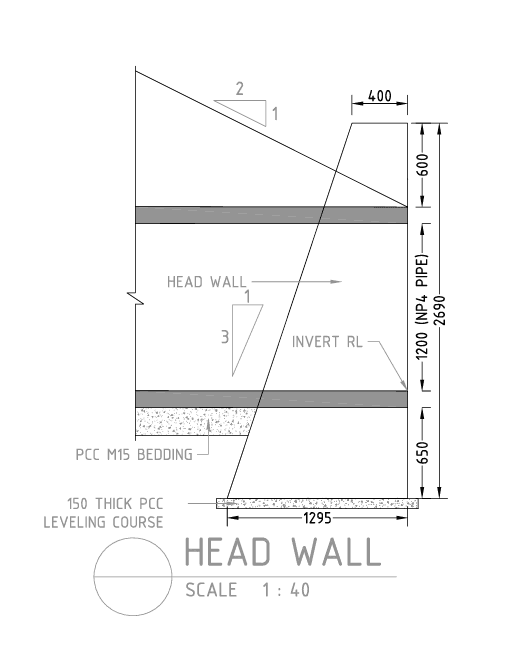
assume Given data :
- Length of the culvert = 12.5 m
- Diameter of Hume pipe = 1200 mm (1.2 m)
- Outer Diameter of Hume pipe = 1440 mm (1.44 m. 0.120 mm Collar)
- Invert Level (IL) = 521.325 m
- Ground Level (GL) = 522.141 m
- PCC Thickness = 150 mm
- Slope = 3:1
- Head wall Length = 7.520 m
- GL at center = 522.315 m
excavation quanity for HPC:
Excavation Quantity of Headwall (HPC):
IL = 521.325 m
GL = 522.141 m
Head wall 1st lift depth = 0.650 m
PCC thickness = 0.150 m
So excavation depth = GL – IL + (0.650 + 0.150)
excavation depth = 522.141-521.325+(0.650+0.150) = 1.616 m
Note: Always remember during excavation, minimum 500 mm offset each side of required length must required.
Now Quantity of excavation = L X B X D
Quantity of excavation = (7.520+0.1+0.1+0.5+0.5) X (1.295+0.1+0.1+0.5+0.5) X 1.616 = 35.158 Cum
Similarly Yo can calculate for Opposite side Headwall.
excavation quantity for pipe bedding area (HPC):
GL at center = 522.315 m
IL = 521.325 m
Collar = 0.120 m
Excavation level = 522.315 – 521.325 + 0.120 = 1.110 m
Note: Always remember during excavation, minimum 500 mm offset of required width must required.
Now Quantity of excavation = L X B X D
Quantity of excavation = (12.5-1.079-1.079) X (1.44+0.2+0.2+0.5+0.5) X 1.110 = 32.602 Cum
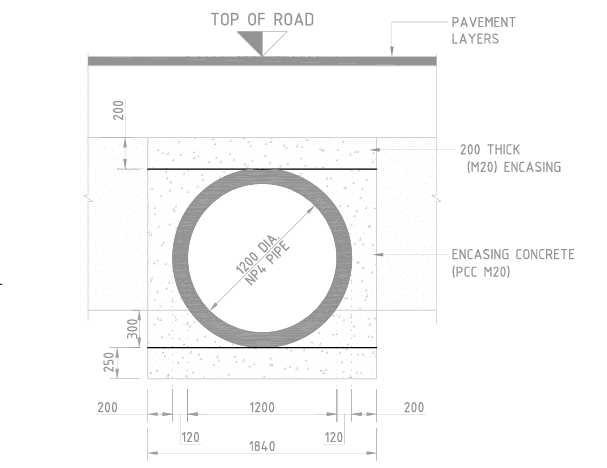
You can see in given diagram regarding encasing the pipe.
The get better information regarding cement, click on given link.
Types of Cement in Civil Engineering: A Complete Guide
concrete quantity calculation (HPC):
PCC Quantity for Headwall:
PCC for Headwall = L X B X D
Quantity = (7.52+0.1+0.1) X (1.295+0.1+0.1) X 0.15 = 1.73 cum
PCC Quantity for Pipe bedding area:
PCC for pipe bedding Area = L X B X D
Quantity = (12.50 – 1.079 – 1.079) X (1.44+0.2+0.2+0.1+0.1) X 0.250 = 5.27 cum
Headwall 1st lift concrete quantity:
We have the bottom width = 1.295 m
and slope give 3:1
So, Top width of Headwall 1st lift = Bottom width – (Height of Headwall 1st lift x (1/3))
Top width of Headwall 1st lift = 1.295 – (0.650 X 0.333) = 1.079 m
Concrete Quantity = 7.52 X ((1.295+1.079)/2) X 0.650 = 5.80 cum
Similarly you can calculate for Opposite side.
Headwall 2nd lift concrete quantity:
Now, we have the Top width of Headwall 1st lift = 1.079 m
So, Top width of Headwall 2nd lift = 1.079 – (1.440 X 0.333) = 0.600 m
Concrete Quantity = 7.52 X ((1.079+0.600)/2) X 1.440 = 9.09 cum
Now, its time to deduct the pipe :
Pipe volume at head wall area = (π/4) D² h
Volume = (3.14/4) X (1.44)² X 0.840 = 1.37 cum
Concrete Require = 9.09 – 1.37 = 7.72 cum
Similarly you can calculate for Opposite side.
To get better information regarding concrete slump, click on below link.
how to test slump for Concrete: Practical Site Guide
Headwall Final lift concrete quantity:
We have the Top width of Headwall 2nd lift = 1.079 m
And the Top width of Headwall given = 0.400 m
Concrete Quantity = 7.52 X ((0.600+0.400)/2) X 0.600 = 2.26 cum
Similarly you can calculate for Opposite side.
To get brief information regarding Toe wall and Retaining wall, click on below link.
Toe Wall in Civil engineering : A complete guide
what is Retaining Wall and Its Type: Complete Guide
For pipe culvert, follow the mentioned reference.
- MoRTH section 2900
- IRC:SP:13-2022
- IS 458 : 2003
- IS 783 : 1985
Common mistakes made in excavation
- While excavating on-site, sometimes small mistakes can become major problems in the future. For example, failing to provide the proper offset reduces working space.
- Sometimes, the excavation depth does not measure to the correct level, resulting in incorrect PCC and pipe alignment.
- Soft soil or loose material is not removed, which increases the likelihood of settlement.
- Therefore, workers should always use level instruments while excavating and check the IL (Invert Level) frequently.
Importance of Bedding and Alignment
- The most important task in a pipe culvert is proper bedding and alignment.
- If the bedding is uneven, the pipe experiences an unequal load, which can lead to cracks.
- If the alignment is not correct, water flow is disturbed and blockages may occur.
- Therefore, properly leveling and compacting the PCC bedding is important.
When is Concrete Encasing Required?
- Encasing isn’t required everywhere, but it’s mandatory in certain conditions.
- When the earth cushion is less than 600 mm, encasing is used to protect the pipe.
- Encasing is also necessary in high traffic load areas.
- Encasing provides stability to the structure even in weak soil conditions.
- It increases pipe life and improves load distribution.
How to verify measurement on site
- After quantity calculations, on-site verification remains crucial.
- Use a tape and level machine to verify length and depth.
- Check shuttering dimensions before you pour concrete.
- Record measurements for each lift separately to avoid billing errors.
- If possible, ask another engineer to verify for cross-checking.
Quality Control and Testing
- Slump testing is essential when pouring concrete to maintain workability.
- Cube testing is used to verify concrete strength.
- If the strength falls below the required limit, the structure may be unsafe.
- Therefore, testing should never be ignored.
Practical Site Tips (Engineer Level)
- Always check the drawing before starting work.
- When laying pipes, properly seal the collar joints to prevent leakage.
- Backfill layer-wise and with proper compaction.
- Work keeping the water flow direction in mind.
Safety Precautions during HPC Work
- Proper shoring or sloping ensures safety during excavation to prevent collapse.
- Workers should wear PPE such as helmets, gloves, and safety shoes.
- Deep excavations require safe entry and exit arrangements.
- Proper lighting ensures safety during night work.
To get calculated excel sheet for HPC, click on link below.
Conclusion:
Accurate quantity calculation is one of the most important aspects of successful culvert construction. Proper estimation helps engineers plan materials, labor, equipment, and project costs efficiently while reducing wastage and unexpected expenses. During the construction process, every component, including excavation, PCC bedding, pipe laying, concrete encasing, and headwall construction, must be calculated carefully to ensure the structure performs as intended.
A systematic step-by-step approach makes quantity estimation simple and reliable. The process begins with determining the required excavation dimensions based on ground level, invert level, and working space requirements. After excavation, PCC quantities are calculated to provide a stable foundation for the pipe. The next stage involves calculating the concrete required for headwalls and other structural elements, considering slopes, lift heights, and dimensional variations. Wherever pipes pass through concrete sections, the pipe volume should be deducted to obtain the actual concrete requirement.
Site engineers should always verify dimensions with approved drawings and perform regular level checks during execution. Proper alignment, adequate bedding preparation, and correct compaction are equally important because even small construction errors can affect the long-term performance of the culvert. Quality control measures such as slump testing, cube testing, and dimensional verification should be carried out throughout the construction process to maintain the desired standards.
The use of standard codes and specifications further improves accuracy and ensures compliance with engineering requirements. Following recommended practices not only increases structural durability but also minimizes maintenance issues in the future. By understanding each calculation stage and applying the correct formulas, engineers can confidently estimate material quantities and execute the work efficiently. A well-planned and accurately measured HPC ultimately results in a safe, durable, and cost-effective drainage structure that performs effectively throughout its service life.
About the Author
My name is Susanta Kumar Mohapatra. I am a Civil Engineering professional with over 11 years of practical experience in the construction and infrastructure sectors. I hold a B.Tech degree in Civil Engineering and an M.E. degree in Construction Management.
Throughout my professional career, I have worked in various civil engineering domains, including highway and bridge construction, quality control, material testing, quantity surveying, project planning, contract management, and site execution. I have a keen interest in sharing practical knowledge, field experience, and engineering concepts related to the construction industry in simple, easy-to-understand language.
I am the founder of CivilGuruHub.com, where I share technical articles, site execution guides, laboratory testing procedures, quantity calculation methods, guidelines based on IRC and IS codes, and practical construction knowledge. My goal is to provide reliable and useful technical information to engineers, students, site supervisors, and construction professionals.
I believe that the right blend of practical site knowledge and theoretical concepts is what makes a civil engineer successful. With this objective, I continuously create educational content to help civil engineering professionals strengthen their technical skills and field understanding.
You can connect with me through CivilGuruHub.com and my YouTube channel, “The Civil Site,” where I regularly share civil engineering tutorials, quantity estimation methods, quality control practices, site execution techniques, and practical construction knowledge.
FAQs about HPC
1. What is a Hume Pipe Culvert (HPC)?
A Hume Pipe Culvert is a drainage structure used to allow water to pass from one side of a road to the other. It utilizes RCC Hume pipes, and concrete encasing is provided when necessary.
2. How is the excavation quantity calculated for an HPC?
The formula Length × Width × Depth is used to calculate the excavation quantity. A minimum offset of 500 mm should be provided on each side for working space during excavation.
3. What is the thickness of PCC in an HPC?
The thickness of the PCC depends on the project drawings and design requirements. Typically, PCC with a thickness of 150 mm to 250 mm is provided beneath the pipe bedding and headwall.
4. When is concrete encasing necessary for a Hume Pipe Culvert?
Concrete encasing is required when the earth cushion is less than 600 mm or when the culvert is located in an area subject to heavy traffic loads. It provides additional protection and strength to the pipe.
5. What are Invert Level (IL) and Ground Level (GL)?
The Invert Level refers to the elevation of the lowest point inside the pipe, whereas the Ground Level refers to the elevation of the ground surface. Both levels are crucial for excavation and pipe laying.
6. What is the function of a headwall in an HPC?
A headwall is constructed at both ends of the culvert. It prevents soil erosion, supports the embankment, and guides the water flow in the proper direction.
7. What is the importance of pipe bedding?
Proper bedding provides uniform support to the pipe. If the bedding is uneven, the pipe may be subjected to unequal loads, potentially leading to cracks and settlement issues.
8. What are the most common mistakes made when calculating quantities for an HPC?
Common mistakes include incorrect excavation depth, failure to account for offsets, forgetting to deduct pipe volume, and not verifying drawing dimensions. These errors can impact both quantity and cost estimations.
9. What tests are conducted for quality control in HPC work?
Slump tests and cube compressive strength tests are performed to check concrete quality. These tests help verify the workability and strength of the concrete.
10. Which codes and standards are followed for HPC quantity calculation?
Standards such as MoRTH Section 2900, IRC:SP:13-2022, IS 458:2003, and IS 783:1985 are commonly followed for pipe culvert construction and quantity estimation.

Pingback: One Way Slab vs Two Way Slab: complete guide