
Table of Contents
what is superelevation?
Superelevation is an essential element of transportation design that facilitate safe and balanced Road travel. It is the difference in elevation from one side of a curve to another.
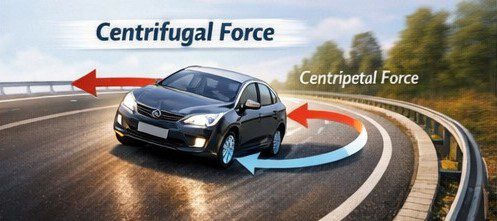
Curves cause vehicles to experience a centrifugal force that pushes them away from center of the curve. The outside shoulders of the curve have to raise to reduce these types of problems.
It is the transverse slope of the Road, which is provided especially in curved section.
It allows vehicle negotiating a curve to balance both force like centrifugal and centripetal in unison and helps decrease the possibility of vehicle skidding or rolling over.
Vehicles travelling at high speeds along roadways will have increase levels of superelevation.
To get knowledge about the Reasons of Pothole in Roads, Click below link.
potholes in road: causes, damages and methods of repairing
In addition to making driving easier, it also makes highways, expressways, and mountainous roadways safer and reduces their reliance on tire-to-road friction, thus enhancing the life and durability of the roadway.
Therefore, this is an integral part of the roadway design process, which enables roads to be built safely, equitably, and economically for people travelling on them, especially through bridges and other curves.
Why superelevation is required?
When a vehicle travels on a curved road, it experiences a specific force called centrifugal force. This force tends to push the vehicle outward from the center of the road.
If this force is not balanced, the vehicle is more likely to skid or even leave the road, which can lead to accidents.
That’s why it is used in road construction. it is a technique where the outer edge of the road is made slightly higher than the inner edge.
This creates a slope on the road, which helps maintain vehicle balance on turns.
When a vehicle approaches a curve, it allows the centrifugal force on the vehicle and the reaction force of the road to balance each other. This makes it easier to maintain control of the vehicle and safely navigate the curve.
It is especially used on highways, expressways, and hilly roads where vehicle speeds are high. This is not only reduces accidents but also makes driving more comfortable and safe.
Thus, it is an important road design technique that helps vehicles drive safely on curved roads and makes traffic flow more smoothly.
To read more articles on Highway, check the following guides:
What is camber : Complete Guide for Beginners
potholes on road:causes, damages and complete methods of repairing
TCS: How to Study Typical Cross Section – Complete Guide
formula to calculate superelevation
e = V² / (225 × R)
Where,
- e = Superelevation.
- V = Vehicle Speed/Design Speed (Km/H).
- R = Radius of the Curve (m)
The above said formula is used for calculating the Superelevation (e)
Examples of calculation
Example-1
If the radius of a road curve is 300 m. The design speed is 60 km/h. Find out Required Superelevation (e)?
Here Given Data:
- R = 300 m
- V = 60 km/h
e = (60 X 60)/ 225 x 300 = 3600 / 67500 = 0.0533 X 100
=5.33%
According to IRC:73 guidelines, the maximum superelevation is 7% in plain areas.
You can read an eBook regarding civil engineering. click below link
Road to Excellence-1: A Comprehensive Guide for Highway Engineers
types of superelevation in highway engineering:
Superelevation varies according to different conditions. Not every road or curve has the same design, so engineers design it according to the conditions.
- Full Superelevation: It is provided when the road curve is sharp and vehicles are travelling in high speed. In such cases the centrifugal force is high. So it is provided to balance it.
- Partial Superelevation: It is basically used in the situations where friction helps to balance the vehicle. This means the entire load is just not on the superelevation but tire – road friction also resist the force and this is the practically most common case.
- Zero Superelevation: It is used in areas with very low speeds, such as city roads or congested areas. Due to the low speed, the centrifugal force remains very low, so there’s no need to provide extra slope.
Relation Between Superelevation and Friction:
Superelevation does not work alone, but it acts in conjunction with friction to keep the vehicle safe.
e+f = V² / (127 × R)
In this Formula,
e = Superelevation and
f = Lateral friction
When the speed is high or the curve is sharp, more superelevation is needed. However, in practice, friction also contributes, so both factors influence the design.
If friction decreases (such as in rain or snow), the importance of superelevation increases.
Methods of Providing Superelevation:
Superelevation is not introduced suddenly, as it can jolt the driver and increase the risk of an accident. Therefore, it is introduced gradually.
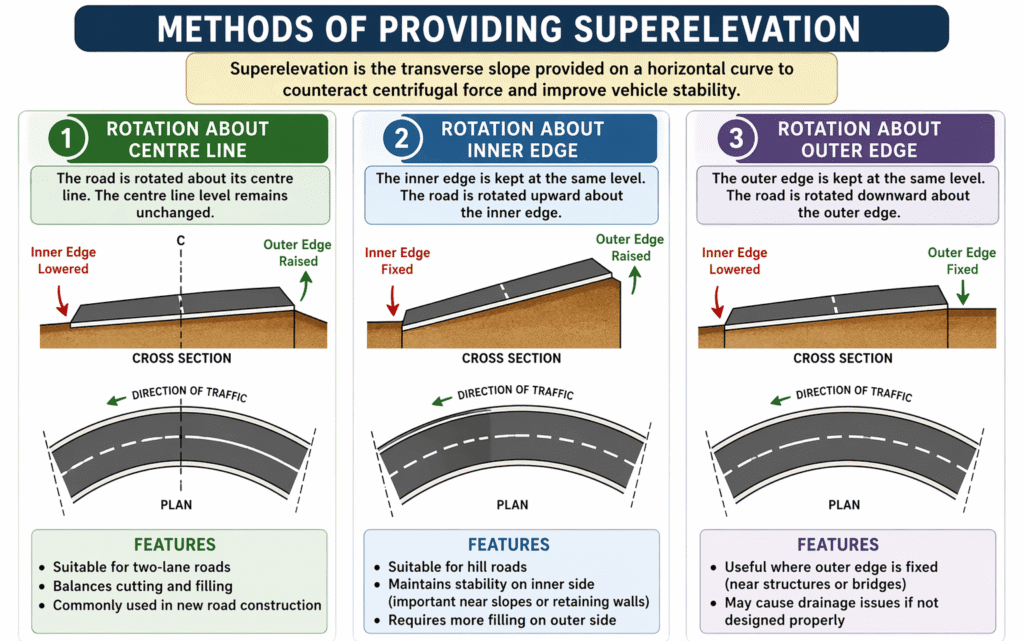
As per IRC 38: 1988 clause no 5.4, Three methods are used for providing superelevation.
- Rotation about the center line: In this, the center point of the road remains fixed and both sides rotate. This is the most common and practical method.
- Rotation about inner edge: In this, the inner edge remains fixed and someone raises the outer edge.
- Rotation about outer edge: In this, the outer edge remains fixed and the inner side goes down, but designers use this method less.
Superelevation and Transition Curve:
Designers do not apply it directly to circular curves, but introduce it gradually along a transition curve.
A transition curve is a section where the road gradually changes from straight to curved. In this section, superelevation also increased from zero to maximum.
This design aspect prevents the vehicle from experiencing a sudden change, provides comfort to the driver, and improves steering control. It is very important for highway safety.
Watch the full video for better Knowledge:
What Happens If Superelevation Is Not Provided?
If the required superelevation is not provided on a curved road, it directly impacts road safety and vehicle stability. When a vehicle enters a curve at high speed, centrifugal force pushes it towards the outer edge of the road. If It is not available to counteract this force, the driver must exert extra control over the steering.
The primary risk in this situation is vehicle skidding. During the rainy season, friction between the tires and the pavement decreases, making the vehicle prone to slipping. Similarly, there is an increased risk of heavy trucks and buses overturning.
The absence of superelevation leads to uneven tire wear. It also places additional stress on the road surface, causing cracks and rutting to develop more quickly. In the long run, maintenance costs also rise.
Therefore, in accordance with IRC and MoRTH standards, providing proper superelevation on every significant horizontal curve is considered a crucial aspect of highway safety.
Real Site Observation
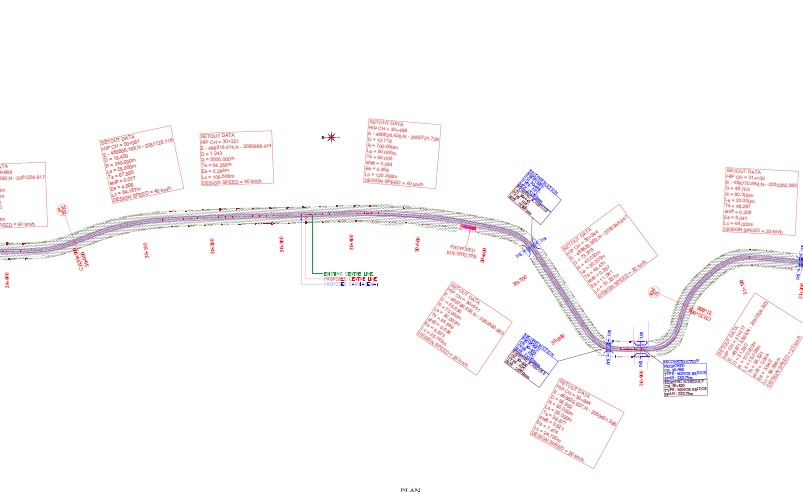
During practical highway projects, it is frequently observed that the required cross slope is not achieved at curves. This issue generally arises due to incorrect setting out, improper compaction, or inadequate level checking.
Site Engineers should verify the cross slope after the completion of each layer—such as GSB, WMM, DBM, and Bituminous Concrete. If an error persists in a lower layer, it tends to carry over to the subsequent upper layers.
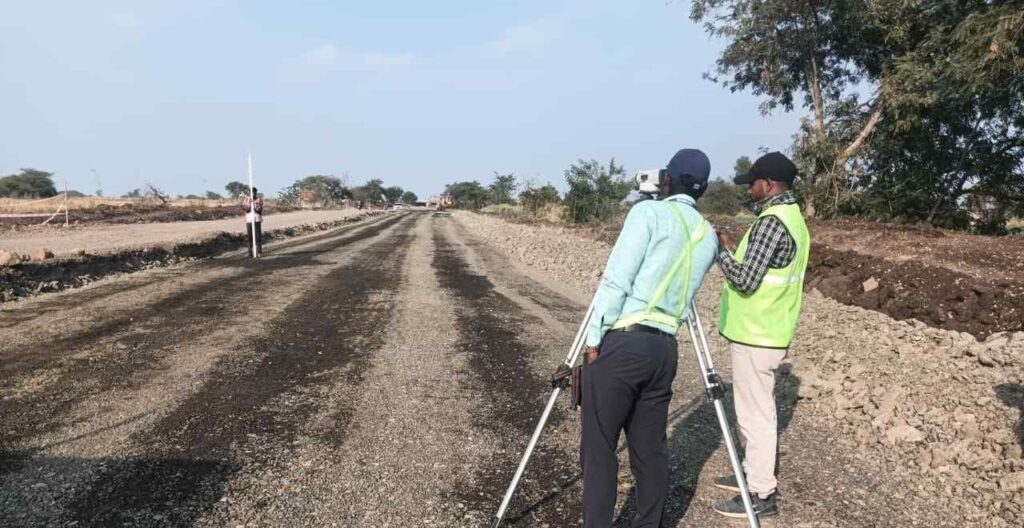
Verifying the superelevation using a Total Station or Auto Level after the final wearing course is considered good engineering practice.
Field Engineer Tips
If you are a highway site engineer, always keep a few important points in mind when providing superelevation.
- Never set levels without consulting the drawings.
- Verify the radius against the survey drawings.
- Achieve full superelevation only after the transition length is complete.
- Properly align the shoulder level with the carriageway.
- Do not overlook rainwater drainage.
- Verify the cross-slope for each layer individually.
- Maintain records of final levels in the QA/QC register.
- Conduct a joint inspection after construction is complete.
These small practices significantly reduce the likelihood of future defects.
How is Superelevation Constructed at the Site?
The process of providing superelevation at a construction site involves several stages, ranging from initial planning to the final inspection.
First, the design drawings and alignment are studied. Next, the chainage of the curve is identified, and the transition length is marked.
The survey team establishes the required reduced levels using instruments like a Total Station or Auto Level. Once the earthwork and subgrade are completed, each pavement layer is constructed gradually to achieve the required cross-slope.
After the bituminous layer is laid, a final level check is conducted to ensure the superelevation complies with the design drawings and IRC requirements.
This systematic process enhances both the quality and safety of the road
Quality Control Checklist for QA/QC Engineer
| Inspection Item | Status |
|---|---|
| Design Speed Verified | ✔ |
| Radius Verified | ✔ |
| Transition Length Checked | ✔ |
| Cross Slope Measured | ✔ |
| Shoulder Level Checked | ✔ |
| Surface Evenness Checked | ✔ |
| Drainage Verified | ✔ |
| Total Station Reading Recorded | ✔ |
| IRC Compliance Checked | ✔ |
| Final Approval Given | ✔ |
Factors Affecting Superelevation
The value is not the same for every road; several engineering factors directly influence it.
- Design Speed: The higher the speed at which a vehicle travels, the greater the centrifugal force generated. Consequently, a comparatively higher degree of superelevation is provided on high-speed highways.
- Radius of Curve: The sharper the curve, the greater the amount of superelevation required.
- Traffic Volume: Roads with heavy traffic require very careful design.
- Type of Vehicles: The behavior of trucks and trailers differs from that of cars.
- Terrain: The design varies depending on whether the area is plain, rolling, or mountainous.
- Friction: Friction levels differ between dry and wet pavement surfaces.
- Pavement Type: Design considerations may differ between flexible pavements and rigid pavements.
- Drainage: If drainage is poor, the benefits of superelevation will be diminished.
Advantages :
- Superelevation plays a vital role in road safety. When a vehicle negotiates a curve, it balances outward forces, reducing the risk of skidding or overturning.
- This offers passengers a comfortable ride as the vehicle stays stable. It also minimizes wear and tear on tires and the road surface.
- Superelevation on highways enables vehicles to safely negotiate curves even at higher speeds, resulting in smoother overall traffic flow.
Disadvantages :
Although superelevation is very useful but there are some limitations:
- It is difficult to implement in urban areas because of limited space and the high number of intersections. Drainage problems can also arise if proper slope design is not implemented.
- In areas with slow-moving traffic, engineers find that providing high superelevation is not practical because vehicles travel at low speeds and imbalances can occur.
Common Mistakes by Site Engineers
The following mistakes are frequently observed in highway projects:
- Ignoring transition length.
- Failing to verify drawings.
- Using an incorrect radius.
- Mismatch in shoulder levels.
- Failing to check the cross slope.
- Not recording Auto Level readings.
- Skipping Total Station verification.
- Ignoring rainwater drainage.
- Incorrect levels in the bituminous layer.
- Starting the next layer without QA/QC approval.
These mistakes increase future maintenance costs.
Conclusion
In road design, it is crucial to consider both safety and convenience. When a vehicle travels along a curve, it experiences an outward force that can affect its stability. To mitigate this issue, engineers employ specific design techniques that allow the vehicle to navigate the curve safely and in a balanced manner.
The importance of curve design is further heightened on highways, expressways, and hilly roads, where vehicle speeds are typically higher. Improper road design can increase the risk of skidding, overturning, and other accidents. Therefore, road alignment is determined by taking into account factors such as curve geometry, design speed, radius, and friction.
In this article, we explained the concept of superelevation—including its formula, calculation methods, IRC standards, types, advantages, and practical applications—in simple language. We also explored how transition curves are used to introduce the slope gradually, thereby maintaining driving comfort and safety.
Understanding this topic is vital for civil engineering students, site engineers, and highway professionals, as it forms a fundamental part of road geometric design. By adhering to correct calculations and standards, engineers can construct safer, more durable, and efficient road infrastructure. Ultimately, a well-designed curved road not only reduces the likelihood of accidents but also makes the journey smoother, more comfortable, and more reliable.
Important Viva Questions
- What is superelevation?
- What is the maximum value?
- What is the formula?
- What role does the radius play?
- What is a transition curve?
- What is the difference between camber and superelevation?
- What is the friction factor?
- What are the different rotation methods?
- Which IRC book is followed?
- Why is the outer edge raised?
About the Author
My name is Susanta Kumar Mohapatra. I am a Civil Engineering professional with over 11 years of practical experience in the construction and infrastructure sectors. I hold a B.Tech degree in Civil Engineering and an M.E. degree in Construction Management.
I have worked in various areas such as road construction, highway engineering, bridge projects, quality control, material testing, estimation, project planning, and site management. Through practical field experience, I have gained a deep understanding of key aspects like highway design, pavement engineering, soil testing, and construction management.
Through CivilGuruHub.com, my aim is to provide practical and technical knowledge to civil engineering students, site engineers, and construction professionals in simple, accessible language. My articles are based on industry standards, IRC codes, IS codes, and real-world project experience, ensuring that readers receive accurate and useful information.
You can visit CivilGuruHub.com for more information related to civil engineering, highway engineering, material testing, quantity surveying, and construction management.
FAQ – 10 Important Questions Related to Superelevation
1. What is superelevation?
Ans: It is a road design technique in which the outer edge of the road is raised slightly above the inner edge at a curve. This helps the vehicle navigate the curve safely and reduces the risk of skidding.
2. Why is superelevation provided in road design?
Ans: It is provided to counteract centrifugal force. This ensures the vehicle remains stable on the curve and reduces the likelihood of accidents.
3. What is the formula for superelevation?
Ans: The basic formula is:
e = V² / (225 × R)
Where,
e = Superelevation
V = Design Speed (km/h)
R = Radius of Curve (m)
4. What is the maximum superelevation according to IRC?
Ans: According to IRC:73, the maximum superelevation in plain and rolling terrain is generally set at 7% (1 in 15).
5. What is the difference between superelevation and camber?
Ans: Camber is provided on the road for water drainage, whereas superelevation is provided on curved roads to ensure vehicle stability and safety.
6. What is the unit of superelevation?
Ans: Superelevation is dimensionless and is expressed as a percentage (%) or a ratio (1 in n).
7. What are the main benefits of superelevation?
Ans: Superelevation prevents vehicle skidding, enhances driving comfort, improves road safety, reduces tire wear, and ensures smooth traffic flow.

Pingback: potholes in road: causes, dsmages and methods of repairing
Pingback: What is Camber: Complete guide for Beginners
Pingback: what is Retaining Wall and Its Type: Complete Guide
Pingback: Toe Wall in Civil engineering : A complete guide
Pingback: TCS: How to Study Typical Cross Section - civilguruhub.com
Pingback: What is Gradient in Civil Engineering- civilguruhub.com
Pingback: FDD test: what is it? complete gprocess and calculation.