

Table of Contents
What is the actual meaning of the “Safe Bearing Capacity” of soil?
On a civil engineering site, when a junior engineer asks, “Sir, what is the Safe Bearing Capacity of this soil?”, simply answering “200 kN/m²” or “20 t/m²” is not technically sufficient. Safe Bearing Capacity (commonly referred to as SBC) is a crucial geotechnical parameter in foundation design. However, to truly understand it, one must first grasp the distinctions between bearing capacity, ultimate bearing capacity, safe bearing capacity, and allowable bearing pressure.
Soil receives a load from the foundation and distributes it internally. If the pressure transmitted beneath the foundation significantly exceeds the soil’s capacity, the soil may undergo shear failure. In such a scenario, the foundation could settle, tilt, or fail—either suddenly or progressively. On the other hand, the soil might not fail in shear, yet excessive settlement could still lead to cracks in the building, differential settlement, uneven floors, or operational issues with doors and windows. Therefore, considering only shear strength is insufficient for practical foundation design.
In Indian bridge foundation practice, IRC:78 (Part 1)-2024 defines “allowable bearing pressure” as the maximum gross pressure under which—after applying an appropriate factor of safety—the soil does not fail in shear and settlement remains within permissible limits. This standard also distinguishes between concepts such as net ultimate bearing capacity, net safe bearing capacity, and gross safe bearing capacity.
In simple terms:
Safe Bearing Capacity = The allowable pressure on the soil that ensures the foundation remains safe against shear failure and keeps settlement within acceptable limits.
However, there is an important professional nuance here: Safe Bearing Capacity is not a fixed, inherent property of the soil. It can be influenced by factors such as foundation width, depth, shape, groundwater conditions, soil stratification, loading conditions, and settlement criteria.
For this reason, the applicable bearing pressure for a 1-meter-wide footing and a 3-meter-wide footing at the same site will not necessarily be the same. Similarly, the soil encountered at a depth of 1.0 meter may differ from that found at 2.5 meters. For Indian practice in 2026, IS 1892:2021 serves as a crucial reference for subsurface investigation; this standard covers the investigations required for foundation planning and design—specifically to determine soil/rock strata, engineering properties, groundwater conditions, the suitability of the founding stratum, ground improvement requirements, and other related subsurface factors.
Therefore, a site engineer should never assume the Safe Bearing Capacity (SBC) simply by observing that the “soil feels hard.” Safe Bearing Capacity is the result of a comprehensive process involving investigation, testing, engineering calculations, and settlement assessment.
What is the difference between Safe Bearing Capacity, Ultimate Bearing Capacity, Net SBC, and Gross SBC?
Confusion regarding terminology is very common in foundation engineering. On-site, people often use terms like “SBC,” “allowable pressure,” “safe pressure,” “net SBC,” and “gross SBC” interchangeably. However, clearly understanding these terms is crucial for design calculations.
Ultimate Bearing Capacity qu is the pressure at which the soil beneath the foundation reaches a state of shear failure. Beyond this point, the soil can no longer safely support the foundation load.
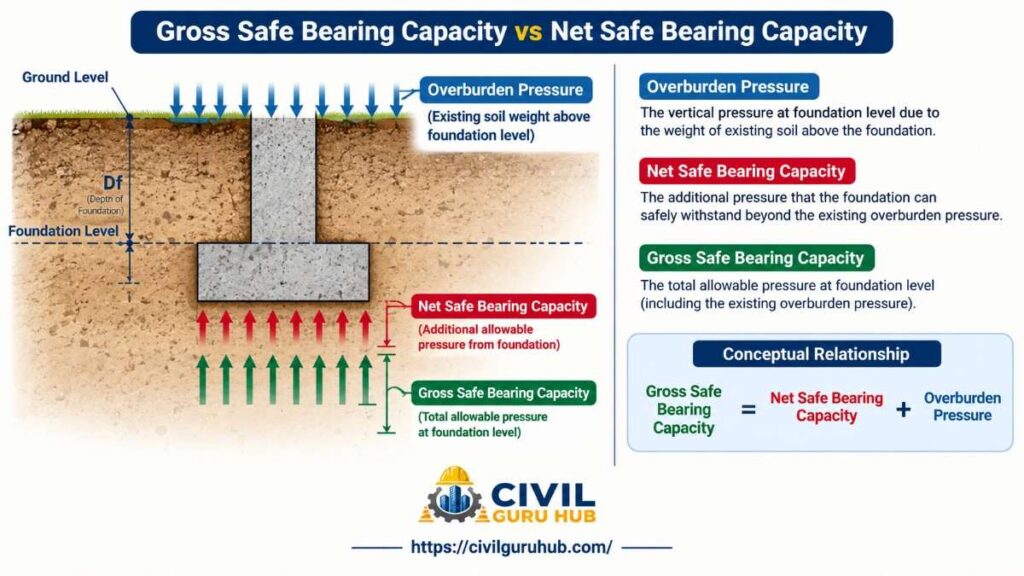
Net Ultimate Bearing Capacity expresses the additional pressure at the foundation level—leading to failure—by accounting for the original overburden pressure.
Net Safe Bearing Capacity is generally obtained by dividing the net ultimate bearing capacity by a suitable factor of safety:
qₙₛ = /FOS
where:
- qₙₛ = Net Safe Bearing Capacity
- = Net Ultimate Bearing Capacity
- FOS = Factor of Safety
Gross Safe Bearing Capacity includes the existing overburden pressure. Conceptually:
q₍gs₎ = q₍ns₎ + γD₍f₎
where:
- qgs = Gross Safe Bearing Capacity
- = Net Safe Bearing Capacity
- = soil unit weight
- = foundation depth
However, in practical design, terminology and calculation methods must adhere to the selected code and project requirements.
IRC:78 (Part 1)-2024 also defines gross safe bearing capacity based on the concept of net safe bearing capacity plus the original overburden intensity. Therefore, site engineers should clearly state in the report whether the reported value is net or gross and specify the foundation depth to which it applies. For example, suppose the investigation yields a net ultimate bearing capacity of 300 kPa and the selected factor of safety is 3:
= 300/3 = 100 kPa
If the foundation depth is 1.5 m and the soil unit weight is 18 kN/m³:
q = = 18 X 1.5 = 27 kPa
Conceptually, the gross safe pressure is:
q(gs) = 100+27 = 127 kPa
However, this example is intended solely to explain the terminology. In actual project design, the factor of safety and pressure definitions must be selected based on the applicable code, loading combinations, foundation type, and geotechnical design method.
An important habit of an experienced engineer is that they do not look merely at the SBC value in the geotechnical report; they also verify the basis of that value, the depth, groundwater conditions, test method, foundation size, settlement criteria, and whether the value represents gross or net pressure.
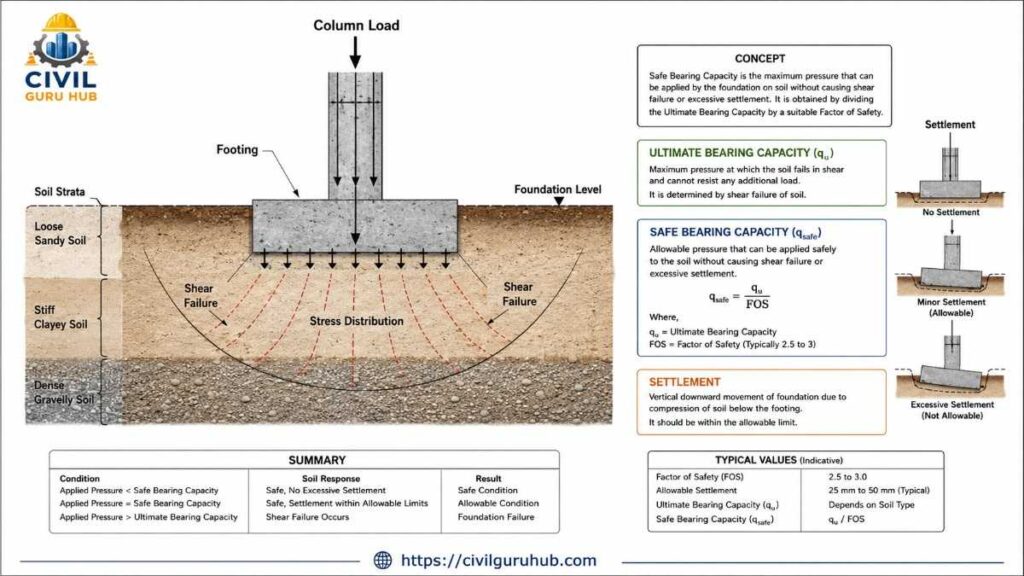
Why is soil investigation necessary before determining the SBC?
The load from the foundation is ultimately transferred to the soil; therefore, the quality of the foundation design depends directly on the quality of the subsurface investigation. It is generally not possible to determine an accurate SBC simply by observing the soil at the surface.
Suppose there is dense-looking brown soil on the surface of a residential plot. You excavate to a depth of 1.5 meters, observe the soil, and decide to place the foundation there. However, there could be a layer of soft clay at a depth of 2.5 meters. The foundation’s stress bulb could influence that deeper layer. Even if shear failure does not occur immediately, long-term consolidation settlement could still take place.
For this reason, IS 1892:2021 considers subsurface investigation an integral part of foundation planning and design. It covers aspects such as the sequence and extent of soil and rock strata, physical/chemical/engineering properties, groundwater location and seasonal variations, the suitability of the stratum for foundation support, and requirements for ground improvement.
A proper investigation is typically based on a combination of the following, depending on the nature of the project:
- boreholes,
- trial pits,
- SPT (Standard Penetration Test),
- disturbed/undisturbed sampling,
- laboratory classification,
- shear strength tests,
- consolidation tests,
- groundwater observations,
- and—where necessary—plate load or CPT-type investigations.
The purpose of the investigation is not merely to “calculate the SBC.” The actual objective of a professional geotechnical investigation is to identify the depth, the specific soil layer, and the type of foundation system that can safely support the structure.
IS 1892:2021 specifically includes the assessment of the suitability of shallow versus deep foundation systems within the scope of foundation investigation.
A site engineer should not look solely at the N-value in the borehole log. Soil description, changes in strata, groundwater levels, sample recovery, and test depths are equally important.
If the report states:
“SBC = 150 kN/m²”
…then the engineer should immediately ask:
At what depth is the SBC 150 kN/m²? For what footing size? Based on which test? Gross or net? Based on which settlement criterion? What was the groundwater level? Is there a weak layer underneath or not?
These are the very questions that distinguish the approach of an experienced engineer from that of an engineer who merely performs calculations.
Indian Standard Codes: Which IS Codes are important for Safe Bearing Capacity?
In India, no single code covers everything when determining Safe Bearing Capacity; different standards apply at various stages.
Key standards include IS 1892:2021 (Subsurface Investigation for Foundations), IS 6403:1981 (Code of Practice for Determination of Bearing Capacity of Shallow Foundations), IS 1080:1985 (Design and Construction of Shallow Foundations in Soils), IS 1904:2021 (General Requirements for Design and Construction of Foundations in Soils), and IS 1888:1982 (Method of Load Test on Soils).
According to BIS records, IS 1892:2021 is the active standard and represents the current second revision for foundation investigation.
IS 6403:1981 is the specific code for determining the bearing capacity of shallow foundations. BIS records list it as active and reaffirmed in 2021, with two amendments.
IS 1080:1985 covers the design and construction requirements for shallow foundations; the BIS listing shows it as active and reaffirmed in 2021.
IS 1904:2021 covers the general requirements for the design and construction of all types of foundations—shallow, deep, and special types.
IS 1888:1982 is relevant for field load tests on soils and specifies the load test method for estimating bearing capacity and settlement.
IS 1498:1970 is important for soil classification. According to the BIS preview, its scope is to provide a system for soil classification and identification for engineering purposes.
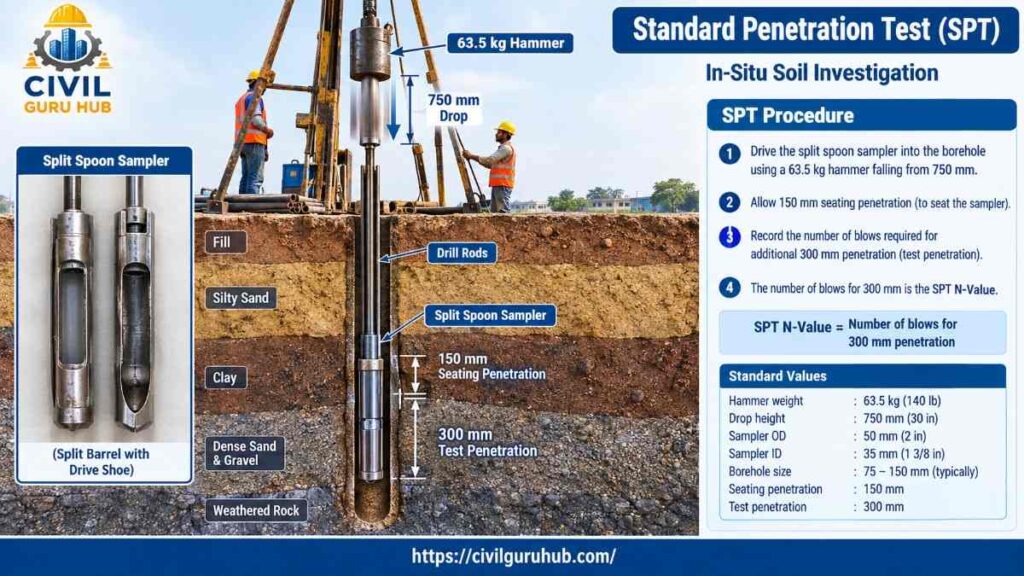
There is an important update regarding SPT: IS 2131:2025 is now the current standard, superseding the older IS 2131:1981. According to current BIS specifications, the test prescribes a hammer weight of 63.5 ± 0.5 kg and a drop height of 750 ± 10 mm; the number of blows required for a penetration of 300 mm—following an initial seating penetration of 150 mm—is determined as the measure of penetration resistance.
For settlement assessment, IS 8009 (Part 1) is relevant for estimating the settlement of shallow foundations subjected to symmetrical static vertical loads.
IRC:78 (Part 1)-2024 is also significant regarding bridge foundations. It covers foundations for road bridges, viaducts, culverts, and related bridge substructures, providing provisions for allowable bearing pressure, bearing capacity, and foundation stability.
What are the main tests used to determine Safe Bearing Capacity?
No single test is universally sufficient to determine Safe Bearing Capacity. A combination of different field and laboratory tests is used, depending on the soil type and project requirements.
The SPT (Standard Penetration Test) is one of the most widely used field tests, particularly in borehole investigations. In 2025, the BIS revised IS 2131 and published the current IS 2131:2025. The SPT primarily measures soil penetration resistance and is useful for assessing the strength and deformation parameters of cohesionless soils.
The Plate Load Test can be useful for evaluating the field response of shallow foundations. In India, IS 1888:1982 outlines the method for load tests on soils, covering field load testing to estimate soil bearing capacity and settlement.
Laboratory shear strength tests are useful for obtaining soil parameters such as (c) (cohesion) and (\phi) (angle of internal friction). Direct shear and triaxial tests can be selected based on soil behavior. IS 2720 Part 11 covers the determination of shear/compressive strength for saturated cohesive soil specimens under unconsolidated-undrained triaxial compression conditions.
The Unconfined Compression Test can be useful for assessing the undrained strength of cohesive soil. IS 2720 Part 10 is the relevant Indian Standard for this type of test.
The primary purpose of the Consolidation Test is not to calculate SBC, but it is crucial for assessing settlement. In soft clay, shear capacity may sometimes be adequate, yet consolidation settlement can govern the foundation design.
Grain size analysis, Atterberg limits, natural moisture content, density, and specific gravity are important supporting tests for soil identification and classification. IS 2720 Part 4 applies to grain size analysis; the BIS standard describes methods for sieving the coarse fraction and determining the finer fraction.
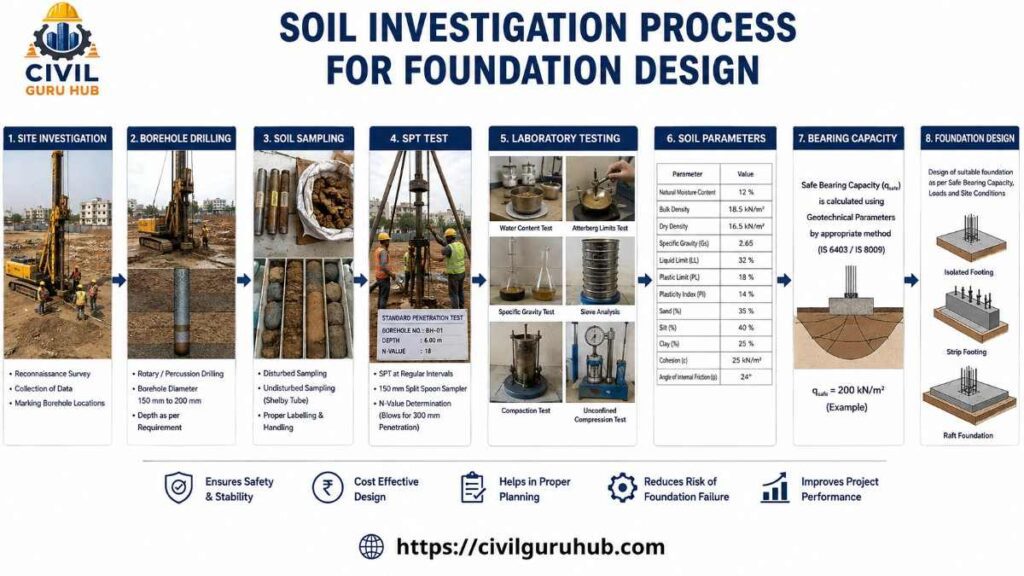
Therefore, a practical sequence could be:
Site investigation → borehole/trial pit → soil sampling → SPT/field test → laboratory classification → strength parameters → bearing capacity calculation → settlement check → recommendation for allowable/Safe Bearing Capacity.
Blindly accepting the value from a single test as the final SBC is not professional practice.
How is Safe Bearing Capacity determined using the SPT test?
Site engineers commonly refer to the SPT as the “N-value test.” However, an important clarification is needed here: the SPT N-value itself is not the Safe Bearing Capacity. The N-value is a parameter representing soil penetration resistance; it can be utilized to assess bearing capacity and settlement through appropriate correlations and engineering judgment.
According to the current IS 2131:2025 standard, the penetration procedure involves driving a split-spoon sampler using a 63.5 kg ± 0.5 kg hammer dropped from a height of 750 mm ± 10 mm. After an initial seating penetration of 150 mm, the number of blows required for the subsequent 300 mm of penetration is recorded as the penetration resistance.
Example:
Suppose the field record is:
| Penetration | Blow Count |
|---|---|
| 0–150 mm | 8 |
| 150–300 mm | 12 |
| 300–450 mm | 15 |
Standard penetration resistance:
N = 12 + 15 = 27
Here, N = 27.
However, an engineer should not simply state, “N=27, therefore SBC = 270 kPa.” Various empirical correlations depend on factors such as soil type, footing dimensions, groundwater conditions, and settlement assumptions.
Factors such as borehole diameter, sampler type, hammer energy, rod length, drilling method, groundwater conditions, and the quality of test execution are crucial when interpreting SPT data. In modern geotechnical practice, the N-value can also be interpreted as an energy-normalized value (such as (N_{60})); however, the correction methodology must align with project specifications and the adopted reference standards.
Another important point: The SPT can also be relevant for liquefaction assessment in loose, saturated fine sand or silt conditions, particularly in the context of seismic design. The landscape of Indian seismic codes has also been updated; IS 1893 Part 1:2025 covers the geotechnical aspects of earthquake-resistant design.
Therefore, one should not adopt an SBC value based solely on the N-value column in an SPT report. Experienced geotechnical engineer collectively interprets borehole log + N-values + soil classification + groundwater + sampling + laboratory data.
What is the basic calculation of bearing capacity of shallow foundation according to IS 6403?
IS 6403:1981 is a key reference in India for bearing capacity calculation of shallow foundation. According to BIS listing this standard is active for bearing capacity determination of shallow foundations and is reaffirmed in 2021.
In general bearing capacity theory, the ultimate capacity of the soil beneath the foundation is influenced by soil cohesion, friction angle, unit weight, foundation width, depth, shape, inclination and ground condition.
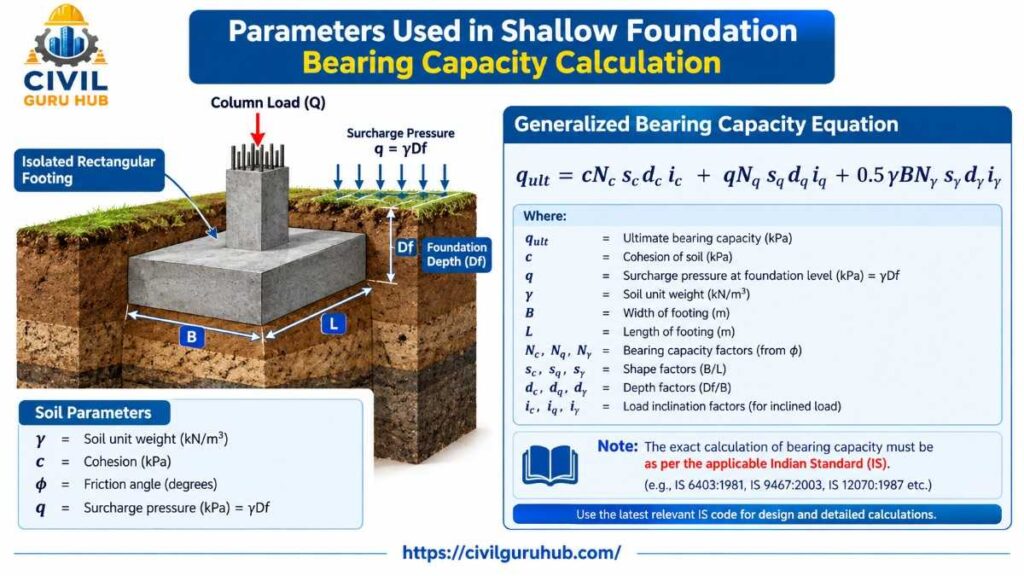
A commonly used generalized form can be represented at the conceptual level like this:
qu=c Nc sc dc ic + q Nq sq dq iq + 0.5γ BNγ sγ dγ iγ
Here
- qu = ultimate bearing capacity
- = cohesion
- = angle of internal friction
- = unit weight
- = foundation width
- = foundation depth
- = surcharge at foundation level
- = bearing capacity factors
- = shape factors
- = depth factors
- = load inclination factors
Exact equations, factors and applications should be used according to the provisions of the adopted code. IS 6403 covers generalized bearing capacity equations and allowable bearing pressure determination.
An important practical lesson: memorizing formulas is not engineering. The most important thing is to select correct input parameters.
If ϕ=30∘ is found from laboratory test, the engineer should immediately verify whether the test condition reasonably represents the foundation loading condition. Similarly, the difference in drained and undrained behavior for saturated clay cannot be ignored.
The design was not complete even after bearing capacity calculation. Settlement check has to be done separately. IS 8009 Part 1 is the relevant code for settlement estimation of shallow foundations.
Hence the final allowable pressure is generally controlled by both shear criterion and settlement criterion.
How does the approach to calculating Safe Bearing Capacity (SBC) differ between cohesive and cohesionless soils?
Understanding soil behavior is central to determining Safe Bearing Capacity.
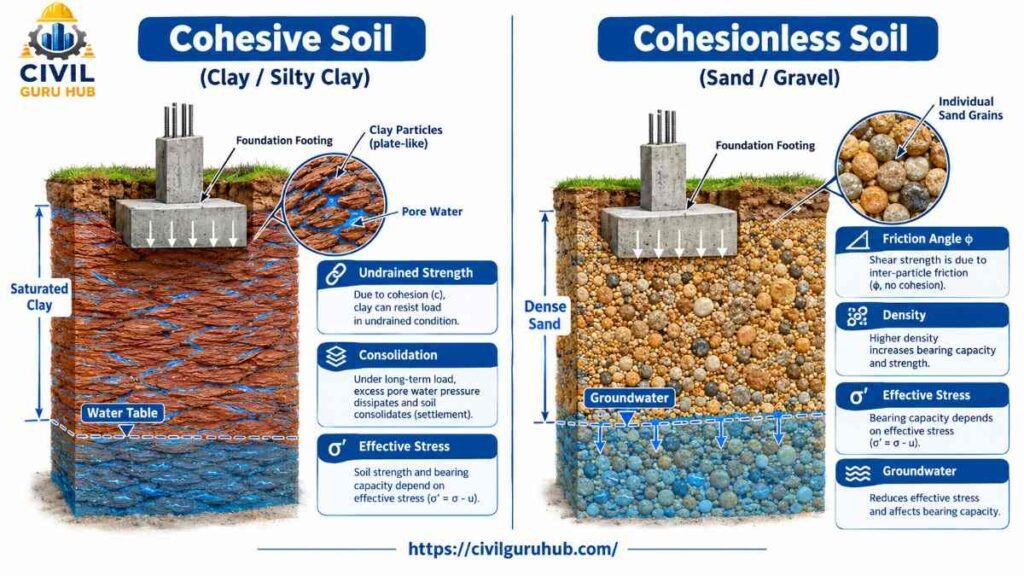
In cohesionless soils—such as clean sand and gravel—shear resistance is primarily governed by friction and effective stress. Consequently, parameters such as the angle of internal friction ϕ, density, groundwater level, and effective stress are crucial.
In cohesive soils (like clay), short-term undrained behavior and long-term drained behavior can differ significantly. For saturated clay, undrained shear strength cu may be critical for short-term foundation behavior, whereas effective stress parameters c’ and ϕ’ become relevant for long-term conditions.
For instance, field investigations of a saturated soft clay layer might reveal low undrained strength. If the foundation load is applied rapidly, undrained conditions could become critical. However, following long-term consolidation—as effective stress increases and pore water pressure dissipates—the soil’s behavior may change.
Similarly, ignoring the effect of the groundwater level in sand can be hazardous. If the water table lies within the foundation’s stress zone, the effective unit weight decreases; consequently, the calculation of bearing capacity must account for the appropriate submerged or effective unit weight.
While IS 2720 (Part 11) covers unconsolidated-undrained triaxial testing for saturated cohesive soils, laboratory results must be interpreted within the context of actual site conditions. The standard itself notes that the interpretation of test results depends on the nature of the soil and the methods used for sample acquisition and preparation.
In professional practice, an engineer must determine the following:
soil type → whether loading is short-term or long-term → drainage conditions → groundwater status → appropriate shear strength parameters → expected settlement.
A reliable SBC calculation is possible only by following this sequence of analysis.
How is the Safe Bearing Capacity determined using the Plate Load Test?
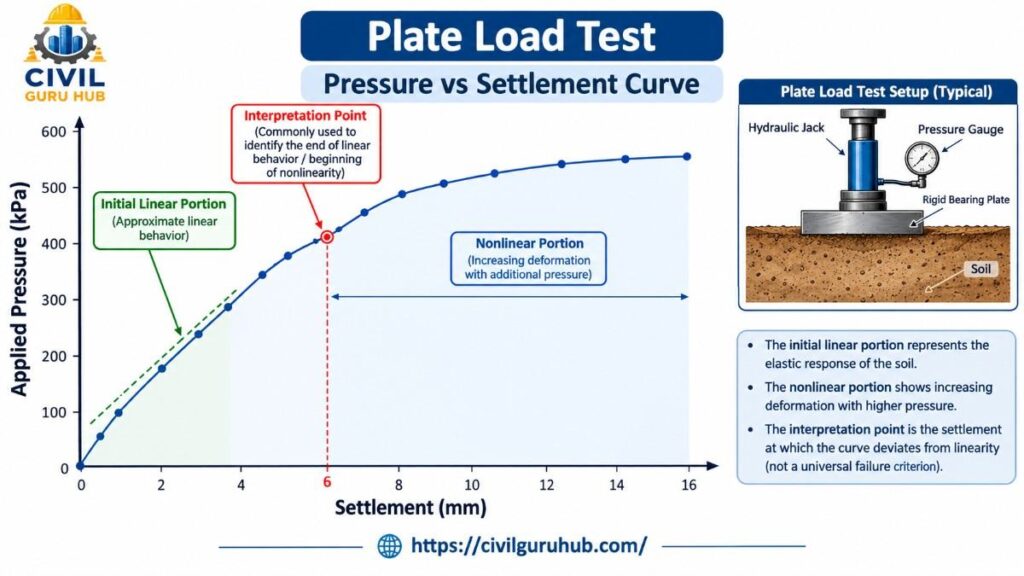
The Plate Load Test is a significant field test in which a rigid plate of a known size is placed on the soil surface or at the foundation level; incremental loads are applied, and the corresponding settlement is measured.
In India, the relevant standard is IS 1888:1982 – Method of Load Test on Soils. According to the BIS preview, its scope is to provide a load test method for estimating the soil’s bearing capacity and settlement.
The basic concept of the test is simple:
Apply load → measure settlement → plot the pressure-settlement curve → interpret the curve.
Let’s assume the plate area is:
A = 0.5 m2
And the applied load at a specific stage is:
P = 100 kN
Then the pressure is:
q = P/A
q = 100 / 0.5 = 200 kPa
If the measured settlement at this pressure is 8 mm, the corresponding point is plotted on the pressure-settlement curve.
However, the plate load test has a major limitation: the plate size and the actual foundation size may differ. The soil’s stress influence zone changes with the size of the actual footing. Therefore, it is inappropriate to mechanically equate “plate failure pressure” with the “actual footing’s Safe Bearing Capacity (SBC).”
Scale effects can also vary between soft clay and sand. The plate load test primarily represents the response of near-surface soil; if deeper weak layers within the stress influence zone are significant, a separate subsurface investigation is required.
The historical ASTM D1194 test for static load/spread footing bearing capacity has been withdrawn; ASTM records specifically show D1194 as withdrawn in 2003. In recent years, ASTM has also documented a new work item regarding a modernized static-loading test methodology.
Therefore, the outdated ASTM D1194 should not be presented as a current active standard when citing international codes.
To read more articles, check the following guides:
Major Types of Structural Cracks Explained with Practical Examples
How to Identify Structural Cracks? Types, Causes and Repair Methods
What Are the Types of Foundations? A Complete Guide to Shallow and Deep Foundation 2026
Practical calculation example of Safe Bearing Capacity
Now let’s combine the concepts with a simplified example.
Lets assume proposed isolated footing:
B = 2.0 m
L = 2.0 m
Df = 1.5 m
Soil parameters:
- c=20kPa
- ϕ=25∘
- γ=18kN/m3
Foundation level surcharge:
q=γDf
q=18×1.5=27kPa
According to IS 6403 methodology, the ultimate bearing capacity will be calculated by obtaining appropriate bearing capacity factors and correction factors. The purpose of illustrative calculation here in the article is to understand the methodology; The actual numerical factors should be taken directly from the adopted code provisions, not from some generic internet table.
Suppose after detailed calculation the engineer obtains:
qu=450kPa
If selected factor of safety:
FOS = 3
to simplified net safe component:
qsafe,net= 450/3 =150kPa
Foundation level overburden:
q=27kPa
Conceptually gross safe pressure:
qsafe,gross =150+27 =177kPa
But now comes the most important stage: settlement check.
Suppose after settlement analysis the allowable pressure for permissible settlement is only 140 kPa. Therefore, the final adopted allowable pressure will not be 177 kPa. The governing settlement criterion will be to consider lower value.
This is the reason why professional geotechnical reports often include both bearing-capacity calculation and settlement calculation.
IRC:78 (Part 1)-2024 also links the allowable bearing pressure to shear failure with excessive settlement criterion.
Remember a golden rule from this example:
SBC = not just ultimate bearing capacity ÷ factor of safety; The final allowable pressure has to be verified in the context of settlement and project-specific requirements.
How do you verify the Safe Bearing Capacity (SBC) report at the site?
When a junior engineer receives a geotechnical report, they should avoid the habit of looking straight at the final SBC figure. Instead, the report should be read sequentially.
First, check the project location, the proposed structure, and the foundation type. The recommended pressure for a residential building is not directly comparable to that for a bridge pier foundation.
Next, examine the borehole locations and the founding level. If the proposed footing is at a depth of 1.5 m but the recommended SBC in the report is based on soil at a depth of 3.0 m, clarification is required.
To read more articles, check the following guides:
AASHTO T193 Vs IS 2720 Part-16: A Complete Comparison
What Are the 12 Types of Drain? A Complete Guide
What Are the Types of Wearing Coat in Bridges? 10 Easy Explanations
Then, check the soil strata. Example:
| Depth | Soil |
|---|---|
| 0–0.8 m | Fill soil |
| 0.8–2.0 m | Medium dense sand |
| 2.0–5.0 m | Soft clay |
| 5.0 m | Dense sand |
If the footing is proposed at 1.5 m, the immediate bearing stratum is medium dense sand; however, the deeper soft clay layer could also be relevant for settlement analysis.
Next, check the following:
SPT N-values → groundwater → laboratory parameters → bearing capacity method → settlement calculation → final recommendation.
If the report lists an SPT N-value of 30 but recommends an SBC of 300 kPa, it is essential to review the basis of the calculation.
If a plate load test has been conducted, examine the load-settlement curve; do not rely solely on the final figure.
If the report states “Safe Bearing Capacity = 200 kN/m² at 1.5 m depth,” the engineer must also confirm whether the value is gross or net and for which footing dimensions it is applicable.
IS 1892:2021 adopts a comprehensive approach to site investigation, covering soil strata, groundwater, and foundation suitability.
What are the common mistakes made when determining Safe Bearing Capacity (SBC)?
- The most common mistake is assuming SBC to be a fixed property of the soil. In reality, the allowable pressure can vary based on foundation size, depth, soil conditions, and settlement criteria.
- A second mistake is calculating SBC solely based on the N-value. While the SPT N-value is a useful input, the N-value itself is not the SBC. The current IS 2131:2025 defines the method for determining SPT penetration resistance, whereas engineering interpretation is a separate process.
- A third mistake is confusing gross SBC with net SBC. If a consultant has provided the net safe bearing capacity but the structural engineer compares it against gross pressure, a calculation mismatch can occur.
- A fourth mistake is ignoring groundwater. If the water table is near the foundation depth, assumptions regarding effective stress and unit weight may need to be adjusted.
- A fifth mistake is skipping the settlement check. A high ultimate bearing capacity does not automatically guarantee acceptable settlement.
- A sixth mistake is placing a foundation on fill soil without proper verification. Mistaking construction fill, debris, organic material, or uncontrolled fill for a natural, competent stratum is risky.
- A seventh mistake is blindly applying the results from a single borehole to an entire large site. Soil conditions can vary spatially; the very purpose of investigation under IS 1892:2021 is to identify the sequence and extent of soil strata.
- An eighth mistake is citing an outdated code as the current one. It is important to recognize IS 2131:2025, particularly regarding SPT, in the context of 2026 standards.
How is the Safe Bearing Capacity (SBC) determined for bridge foundations according to IRC:78?
The approach to Safe Bearing Capacity in highway and bridge projects can differ from that of building foundations in certain situations, as factors such as scour, water pressure, seismic loads, eccentricity, lateral loads, and stability requirements are critical for bridge foundations.
IRC:78 (Part 1)-2024 covers the design and construction of foundations and substructures for road bridges, viaducts, culverts, and related structures. It defines allowable bearing pressure by considering both shear failure and excessive settlement.
For bridge foundations, the foundation must rest on a firm stratum, and requirements for removing or replacing loose material may also apply.
In the current 2024 edition of IRC:78, a factor of safety of 2.5 is specified for open foundations and well foundations resting on soil, specifically regarding allowable pressure derived from ultimate bearing capacity.
This is a crucial point because engineers should not mechanically apply the factor of safety used in general building practices to bridge projects; adhering to the project-specific governing code is a mandatory engineering principle.
Soil investigations for bridge foundations involve a collective assessment of SPT results, laboratory tests, groundwater conditions, scour levels, foundation levels, and loading conditions.
Therefore, in a highway project, if a consultant specifies the following in the drawing:
“Foundation founding level shall have SBC ≥ X kPa”
The site engineer must verify the actual exposed stratum after excavation against the geotechnical recommendations or drawing requirements. If the actual soil conditions differ, one should not simply proceed with the concrete pour after excavation; instead, the proper inspection, RFI (Request for Information), and geotechnical approval processes must be followed.
A Site Engineer’s practical checklist for Safe Bearing Capacity
The following sequence can be used as a practical quality-control checklist during foundation excavation.
Step 1: Verify whether the approved geotechnical report is available.
Step 2: Check the required founding level and dimensions specified in the foundation drawing.
Step 3: Identify the founding stratum recommended in the geotechnical report.
Step 4: Visually inspect the actual soil at the bottom of the excavation.
Step 5: Check for loose fill, organic soil, debris, soft pockets, or waterlogged conditions.
Step 6: Confirm the required bearing pressure from the drawing or geotechnical report.
Step 7: Note the groundwater or seepage conditions.
Step 8: If the actual soil differs from the report, immediately inform the Engineer or Geotechnical Consultant.
Step 9: Do not commence PCC/RCC work on weak soil without approved soil treatment.
Step 10: Maintain records of the foundation bottom inspection and approval.
A crucial habit for an experienced site engineer is avoiding the assumption that “excavation complete” equals “foundation ready.”
The foundation bottom serves as a critical engineering inspection point.
If the geotechnical report specifies “dense sand” as the founding stratum but loose silty sand is encountered during excavation, the engineer must raise a query.
Similarly, if the drawing specifies a founding depth of 1.5 m but soft clay is found at that level—while the geotechnical report identifies a competent layer at 2.5 m—an engineering decision regarding revising the foundation depth or improving the soil may be required.
Conclusion: The Correct Engineering Approach to Determine Safe Bearing Capacity
Determining the safe bearing capacity of soil is not a task accomplished by a single formula or a solitary soil test. For a reliable foundation design, investigation, field testing, laboratory testing, bearing-capacity analysis, and settlement assessment must be viewed as an integrated process.
A practical workflow can be summarized as follows:
Site Reconnaissance → Subsurface Investigation → Borehole/Trial Pit → Soil Sampling → SPT/Field Tests → Laboratory Tests → Soil Parameters → Bearing Capacity Calculation → Settlement Analysis → Groundwater Assessment → Final Allowable/Safe Bearing Pressure → Foundation Design → Site Verification
IS 6403:1981 is the key Indian Standard for calculating the bearing capacity of shallow foundations, while IS 1892:2021 serves as the fundamental reference for subsurface investigation. Relevant references include IS 1080:1985 for shallow foundation design and construction, IS 1904:2021 for general foundation requirements, IS 1888:1982 for field load testing, IS 1498:1970 for soil classification, and IS 8009 (Part 1) for settlement evaluation.
From a 2026 perspective, a particularly important update is that IS 2131:2025 is the current standard for the Standard Penetration Test (SPT) method; therefore, the current edition of the standard should be verified for SPT-based geotechnical investigations.
For bridge and highway infrastructure projects, IRC:78 (Part 1)-2024 is a crucial reference regarding foundation bearing pressure, foundation stability, and soil/rock foundation requirements.
The most important engineering principle is this:
A foundation cannot be deemed safe simply because the calculated bearing capacity exceeds the applied load. Ensuring the final safety of the foundation requires satisfying criteria related to shear capacity, settlement, groundwater conditions, soil variability, foundation geometry, loading conditions, and applicable code requirements. If a junior site engineer were to remember just one practical lesson from this entire article, it should be this:
“Never view the SBC figure in isolation. Always ask—for which soil layer, at what depth, for what foundation size, based on which test and calculation method, is it gross or net, and has the settlement check been performed?”
This approach transforms the Safe Bearing Capacity from a mere theoretical geotechnical value into a real, defensible foundation-design parameter.
About the Author
My name is Susanta Kumar Mohapatra. I am a Civil Engineering professional with over 11 years of practical experience in the construction and infrastructure sectors. I hold a B.Tech degree in Civil Engineering and an M.E. degree in Construction Management. Throughout my professional career, I have worked in key areas such as road construction, bridge projects, quality control, material testing, concrete mix design, highway engineering, quantity estimation, project planning, site execution, and construction management.
I launched CivilGuruHub.com with the aim of sharing my passion for Civil Engineering and my practical knowledge with a wider audience. The primary objective of this website is to provide practical, industry-oriented information in simple language to Civil Engineering students, site engineers, quality engineers, quantity surveyors, contractors, and construction professionals. Here, I publish detailed, original, and research-based articles on topics such as construction technology, concrete technology, highway engineering, structural engineering, material testing, IS codes, IRC codes, quantity surveying, estimation and costing, project management, tendering, and Civil Engineering calculators.
Alongside the website, I also run a YouTube channel named “The Civil Site,” where I explain practical site experiences, laboratory tests, construction techniques, engineering calculations, software tutorials, and technical concepts through easy-to-understand videos. My goal is to ensure that every student and engineer understands not just the theory, but also its practical application.
Additionally, I share educational content related to general knowledge, quizzes, and competitive exam preparation through my YouTube channel, “Daily IQ Hub.” The aim of this channel is to enhance viewers’ knowledge and strengthen their exam preparation.
I believe that a successful engineer is one who is always ready to learn and continuously updates their practical knowledge. With this mindset, I always strive to provide high-quality, reliable, practical, and industry-standard content through CivilGuruHub.com and my YouTube channels, enabling every reader and viewer to excel in their careers.
Thank you sincerely for your trust and support. I am confident that CivilGuruHub.com and my educational platforms will prove to be reliable companions in your learning journey and professional growth. If you wish to take your knowledge in the field of Civil Engineering to the next level, please continue to follow our articles and videos regularly. We will keep bringing you fresh, practical, and industry-focused content.
Frequently Asked Questions about Safe Bearing Capacity
Are Safe Bearing Capacity and allowable bearing pressure the same?
While these terms are often used interchangeably in practical discussions, project documentation should adhere to the adopted terminology and code definitions. IRC:78 defines allowable bearing pressure in terms of gross pressure intensity, ensuring that both shear failure and excessive settlement are avoided.
Can SBC be assumed without a soil test?
For minor works, local building regulations or approved design practices may permit the use of specific presumptive values; however, for engineering projects, verifying actual soil conditions is a much safer approach. Foundation investigation requirements should be established based on the project and the risk associated with the structure.
Does the SPT provide SBC directly?
No. The SPT provides penetration resistance data. Appropriate correlations or analyses are required to determine bearing capacity and settlement.
Is the Plate Load Test the best test?
There is no universally “best” test. While the plate test provides useful field information, factors such as plate size, test depth, scale effects, and deeper soil layers must be considered.
Does SBC depend on footing size?
Yes; factors such as foundation width, shape, and depth can influence the bearing capacity equation. Therefore, a single value should not be blindly applied to every footing size.
Does a low water table always result in high SBC?
Groundwater conditions generally influence bearing capacity calculations, but equating a low water table directly with high SBC is an oversimplification. Soil type and actual effective-stress conditions must be assessed.
Can black cotton soil support high SBC?
Swelling-shrinkage and volume-change behavior are significant concerns with black cotton soil. The foundation system should not be finalized based solely on the bearing capacity value.
Can a foundation be built on fill soil?
It is essential to distinguish between controlled engineered fill and uncontrolled fill. Uncontrolled fill may contain variable densities, debris, and weak zones.
Are SBC and soil pressure the same?
SBC represents the allowable capacity; Soil pressure is the pressure actually transmitted from the foundation. In the design, the actual foundation pressure must remain within the allowable limit.
Can the Safe Bearing Capacity be increased?
Yes, soil or foundation performance can be improved through suitable ground improvement, compaction, replacement, grouting, stabilization, or modification of the foundation system. However, the method must be determined based on geotechnical investigation and design.