
Table of Contents
Introduction
Highway construction projects do not achieve success solely through machinery and manpower; rather, accurate planning and proper quantity management also determine the quality and profitability of a project. For this very reason, a well-structured Quantity Survey Checklist has become an extremely important component of every highway project. Whether the project involves a small rural road or a multi-lane highway, a professional Quantity Survey Checklist ensures that project execution remains organized and financially controlled.
Highway engineers prepare detailed quantity estimates for components such as earthwork, subgrade, GSB, WMM, DBM, BC, drainage systems, culverts, and road furniture. If engineers do not prepare a proper Quantity Survey Checklist, they create problems like measurement errors, excessive material consumption, billing disputes, and project delays. Therefore, experienced engineers always maintain an accurate Quantity Survey Checklist to manage site execution and project documentation smoothly.
An effective Quantity Survey Checklist also significantly simplifies tasks such as contractor billing, BOQ verification, rate analysis, material reconciliation, and the preparation of Interim Payment Certificates (IPCs). Through this checklist, engineers can easily track the discrepancies between actual site quantities and planned quantities. This checklist also proves highly useful during the audit process, as maintaining proper records helps mitigate future disputes and financial claims.
While digital measurement systems and surveying software are on the rise in modern highway projects, ground-level verification remains equally critical. Therefore, a detailed Quantity Survey Checklist assists field engineers in maintaining measurement accuracy. For long-term project success, cost control, and quality assurance, a reliable Quantity Survey Checklist has become an essential document for every civil engineering team.
Highway Quantity Survey Flow Process
Project Drawing
↓
Site Investigation
↓
BOQ Verification
↓
Quantity Calculation
↓
Material Reconciliation
↓
Billing & Cost Control
↓
Final Audit & Documentation
Important IRC & IS Codes for Highway Quantity Survey
| Work Item | Relevant Code |
|---|---|
| Road Design | IRC 37 |
| Earthwork | IS 1200 Part 1 |
| Concrete Work | IS 456 |
| Bituminous Work | IRC 111 |
| Drainage | IRC SP 42 |
| Road Signs | IRC 67 |
| Pavement Evaluation | IRC 115 |
| Quality Control | IRC SP 11 |
Highway construction work breakdown
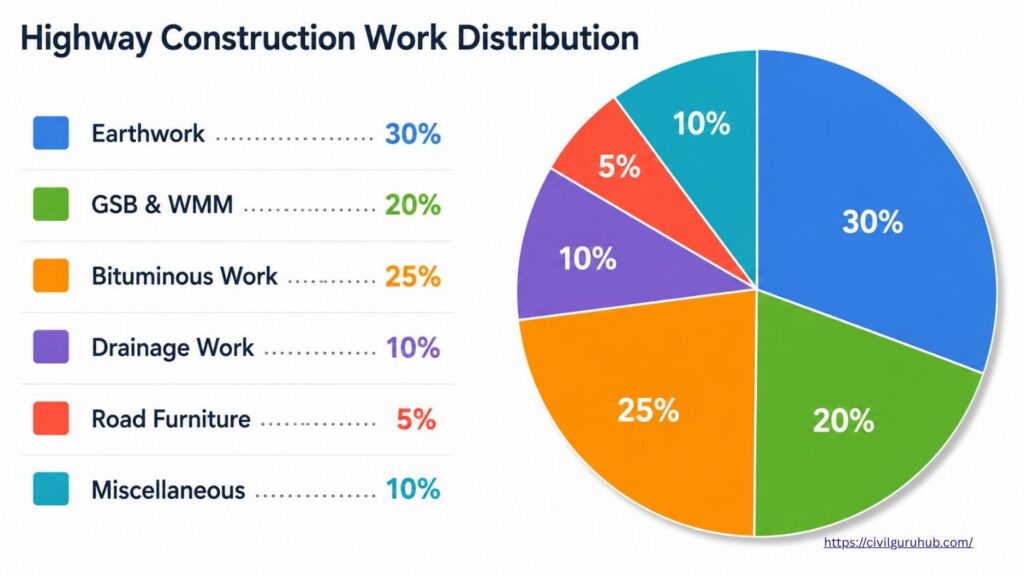
1. Why It Is Essential to Study Project Drawings in Detail
The successful execution of any highway project depends on accurate planning and proper quantity verification. For this reason, it is crucial to analyze the project drawings in depth before construction begins. A professional Quantity Survey Checklist always commences with the drawing verification process. If the drawings do not receive careful study during the initial stages, major issues—such as quantity mismatches, billing disputes, and execution delays—may arise in the future.
In highway construction, it is essential to properly cross-reference the alignment drawings, longitudinal sections (L-sections), cross-sections, and drainage layouts. At every chainage, the carriageway width, shoulder width, median dimensions, and pavement thickness must be verified. Experienced engineers understand that even a minor discrepancy in the drawings can compromise the entire quantity calculation. Consequently, an accurate Quantity Survey Checklist plays a pivotal role in maintaining the financial integrity of the project.
During earthwork calculations, the engineers must meticulously check the comparison between the Existing Ground Level (EGL) and the Finished Road Level (FRL). If the survey data proves to be inaccurate, the calculated quantities for cutting and filling could change drastically. To streamline this process, engineers maintain a detailed Quantity Survey Checklist. This checklist typically includes provisions for benchmark verification, centerline confirmation, and the verification of survey reference points.
In highway projects, maintaining a proper record of revised drawings is equally important. It often happens that site execution proceeds based on outdated drawings, while the team processes billing based on the revised versions. Such scenarios frequently lead to major financial disputes. Therefore, a professional Quantity Survey Checklist should clearly document the drawing revision history, approval status, and issue dates.
A robust system of documentation and verification constitutes the true strength of any highway project. A well-prepared Quantity Survey Checklist not only ensures accurate quantity calculations but also facilitates the smooth execution of audits, billing, and overall project monitoring.
| Drawing Type | Purpose in Quantity Verification | Important Checks |
|---|---|---|
| Alignment Drawing | Road centerline verification | Chainage, curve details, road width |
| Cross Section Drawing | Quantity calculation for earthwork | Formation width, slope, pavement layers |
| L-Section Drawing | Level comparison | EGL, FRL, gradient |
| Drainage Layout | Drainage quantity estimation | Culverts, side drains, outlets |
| Pavement Drawing | Pavement quantity calculation | Layer thickness, material specification |
| Revised Drawings Register | Drawing control and audit | Revision number, approval date |
2. Do Not Overlook BOQ Verification (Quantity Survey Checklist)
BOQ verification is a critical process in every highway project, as it is at this stage that the accuracy of project quantities and costs is determined. If the verification of the BOQ and drawings is not conducted properly, the entire Quantity Survey Checklist could be rendered inaccurate. For this reason, experienced billing engineers and quantity surveyors prioritize comparing the tender BOQ against the approved drawings. A professional Quantity Survey Checklist invariably begins with BOQ verification.
Frequently, discrepancies arise between the site drawings and the BOQ specifications. For instance, the BOQ might specify a Granular Sub-Base (GSB) thickness of 200 mm, whereas the approved cross-section drawing indicates 150 mm. If the engineer fails to identify this discrepancy, the estimation, billing, and overall project costing—all three—are adversely affected. Consequently, engineers must compare drawings to ensure an accurate Quantity Survey Checklist.
In professional highway projects, it is essential to cross-check the item code, unit, specification, and quantity for every single BOQ item. Items such as culverts, retaining walls, shoulder works, and drainage components often lead to duplicate entries. An up-to-date Quantity Survey Checklist aids in identifying such duplication errors and helps minimize unnecessary billing disputes.
| BOQ Verification Parameter | Importance |
|---|---|
| Item Code Verification | Prevents incorrect item selection |
| Quantity Cross Check | Ensures accurate billing and estimation |
| Drawing Comparison | Identifies specification mismatches |
| Unit Verification | Reduces measurement and calculation errors |
| IS Code Reference | Ensures compliance with standard measurement rules |
| Common BOQ Error | Project Impact |
|---|---|
| Thickness Mismatch | Extra project cost |
| Duplicate Items | Double billing risk |
| Wrong Unit | Quantity calculation error |
| Missing Item | Variation claim issue |
| Incorrect Lead Distance | Rate analysis impact |
A robust Quantity Survey Checklist assists a contractor in managing variations, approving extra items, and maintaining project profitability. For this very reason, large infrastructure companies update their Checklists on a daily basis to ensure that project execution remains smooth and financially controlled.
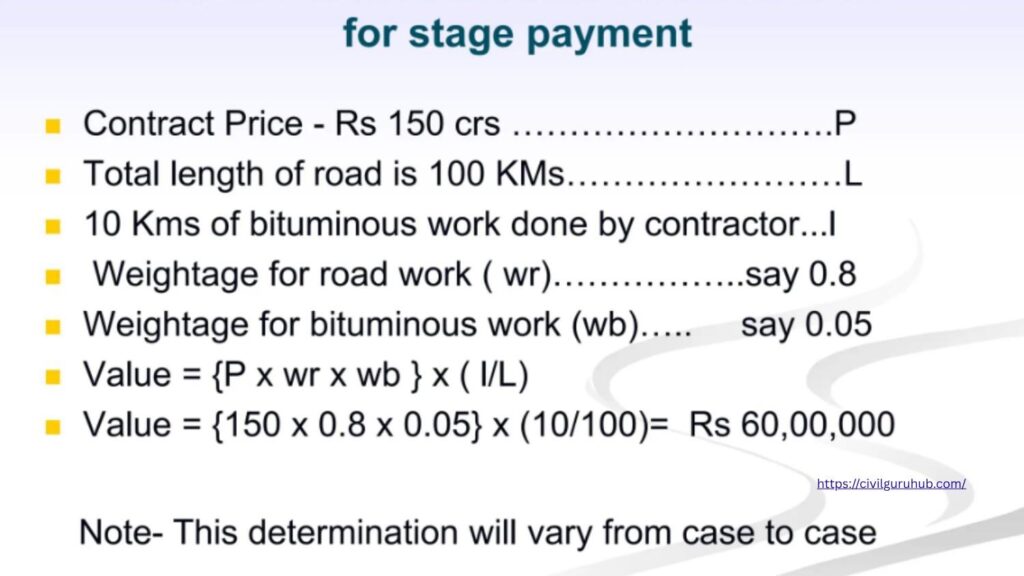
3. Perform Chainage-Wise Quantity Calculations (Quantity Survey Checklist)
In highway construction projects, accurate quantity calculation is crucial for both project profitability and execution. Consequently, every survey engineer and billing engineer must prepare a detailed Quantity Survey Checklist as a primary responsibility. When engineers calculate quantities on a chainage-wise basis, site monitoring, IPC (Interim Payment Certificate) billing, reconciliation, and material control become significantly easier. Professional highway construction firms invariably adhere to a systematic Checklist to prevent measurement errors and avoid issues related to overbilling.
Typically, in highway projects, crews maintain chainage records at intervals of every 25 meters or 50 meters. During this process, they meticulously record the Existing Ground Level (EGL), Finished Road Level (FRL), and values for cutting and filling. An organized Quantity Survey Checklist assists the engineer in comparing actual site conditions against the data provided in the project drawings. If the chainage records are inaccurate, significant discrepancies may arise in the calculated quantities for both embankment and excavation works.
For earthwork calculations, the “Average End Area Method” predominates; this method is recognized as an accepted standard in accordance with IRC and IS guidelines. For this reason, a professional Checklist must clearly and accurately specify the chainage intervals, cross-sectional areas, and cumulative quantities. Furthermore, this systematic process enhances transparency in contractor billing procedures.
| Chainage | Existing RL (m) | Finished RL (m) | Cutting/Filling |
|---|---|---|---|
| 0+000 | 101.20 | 102.00 | Filling |
| 0+050 | 100.80 | 101.90 | Filling |
| 0+100 | 102.50 | 101.80 | Cutting |
| 0+150 | 101.90 | 102.10 | Filling |
Quantity Calculation Summary
| Activity | Calculation Method | Purpose |
|---|---|---|
| Earthwork Excavation | Average End Area Method | Cutting Quantity |
| Embankment Filling | Cross Section Analysis | Filling Quantity |
| Level Verification | RL Comparison | Accuracy Check |
| Billing Verification | Chainage Matching | Prevent Overbilling |
A smart engineer always maintains an Excel-based auto-calculation sheet, which makes the Checklist even more accurate. Maintaining a proper Quantity Survey Checklist facilitates reconciliation and helps avoid future disputes.
4. Scientifically Measure Earthwork Quantities (Quantity Survey Checklist)
In highway construction projects, stakeholders consider earthwork the most expensive and technically sensitive activity. Even a minor calculation error in excavation or embankment quantities can have a significant financial impact on the project cost. For this reason, professionals must maintain an accurate and professionally prepared Quantity Survey Checklist. In modern highway projects, engineers utilize technologies such as Total Station Surveys, DGPS, and Drone Mapping—alongside traditional manual methods—to minimize measurement errors.
A reliable Checklist can only exist when a proper comparison is made between the Existing Ground Level (EGL) and the Finished Formation Level (FFL). Based on the survey data, professionals prepare cross-sections, and they subsequently calculate the excavation or filling quantities. However, theoretical volume calculation alone is not sufficient; the behavior of the soil is equally important. Since the volume of loose soil differs from that of compacted soil, every professional Quantity Survey Checklist must clearly specify the bulking factor and the shrinkage factor.
According to IRC specifications, construction teams must conduct layer-wise compaction testing during embankment construction. The quantity documentation should attach the field density test results for each layer. This practice proves beneficial for both payment verification and future audits. Engineers consider incorporating separate entries for borrow area quantities, disposal quantities, lead distances, and compaction status within a detailed Quantity Survey Checklist a best engineering practice.
Earthwork Survey Process
Existing Level Survey
↓
Cross Section Preparation
↓
Excavation / Filling Calculation
↓
Compaction Verification
↓
Final Quantity Approval
Important Earthwork Measurement Parameters
| Parameter | Purpose | Importance |
|---|---|---|
| Existing Ground Level (EGL) | Original site level measurement | Accurate base data preparation |
| Finished Formation Level (FFL) | Final designed road level | Quantity comparison |
| Bulking Factor | Increase in loose soil volume | Excavation adjustment |
| Shrinkage Factor | Reduction after compaction | Embankment accuracy |
| Density Test Record | Compaction verification | IRC compliance |
| Borrow Area Quantity | Imported soil measurement | Payment verification |
| Disposal Quantity | Waste soil calculation | Cost control |
A scientifically prepared Quantity Survey Checklist improves project transparency, reduces disputes, and provides accurate quantity verification to both the contractor as well as the client.
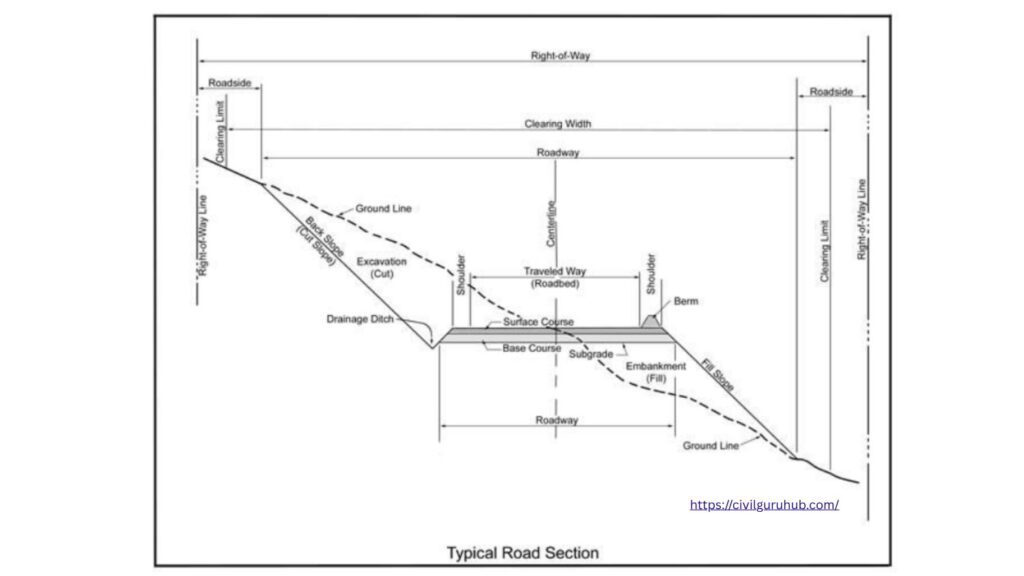
5. Verify GSB and WMM Layer Thickness (Quantity Survey Checklist)
In highway construction, the GSB (Granular Sub-Base) and WMM (Wet Mix Macadam) layers serve as the backbone of the pavement structure. If the thickness of these layers is not maintained in accordance with the project drawings, serious issues—such as settlement, rutting, cracking, and eventual pavement failure—may arise in the future. For this reason, the verification of GSB and WMM layer thickness is accorded the highest priority within a professional Checklist. Only accurate measurement can ensure proper billing, effective quality control, and the long-term durability of the project.
Many site engineers make a common error by considering the loose thickness while performing calculations. A standard Quantity Survey Checklist, however, always adheres to the compacted thickness, as both the final payment and the calculated executed quantity are based on compacted dimensions. Therefore, it is crucial to measure the actual compacted thickness after the rolling process has been completed. An experienced billing engineer updates the Quantity Survey Checklist on a daily basis by conducting on-site verifications, thereby preventing future disputes and issues related to excess billing.
Standard Pavement Layer Thickness
| Layer | Standard Thickness |
|---|---|
| GSB | 150–200 mm |
| WMM | 250 mm |
| DBM | 50–100 mm |
| BC | 30–40 mm |
During the verification of the WMM layer, the moisture content and compaction factor are equally critical parameters. If the appropriate moisture level is not maintained, the required density cannot be achieved. Consequently, density test reports and field compaction records must be attached within an effective Quantity Survey Checklist. It is also essential to compare the actual executed width on-site against the drawing width, as “edge loss” frequently occurs in highway construction projects.
Important Verification Parameters
| Verification Item | Importance |
|---|---|
| Compacted Thickness | Accurate quantity calculation |
| Density Test Report | Quality assurance |
| Executed Width Check | Prevent edge loss errors |
| Layer Approval Record | Future dispute prevention |
| Before & After Rolling Measurement | Correct billing quantity |
A detailed Quantity Survey Checklist fosters transparency for both the contractor and the client. An accurate determination of the executed quantity is possible only when measurements are recorded both before and after the rolling process. It is precisely because of this practical approach that professionals regard the Checklist as an indispensable part of the mandatory documentation process in highway construction projects.
To get more article regarding Quantity survey, click the given link below.
What is Gradient: in Civil Engineering? Complete Explanation
camber:what it is? Complete Guide for Beginners
How to Calculate HPC Concrete Quantity step by step
6. Perform Accurate Calculations for Bituminous Work (Quantity Survey Checklist)
In highway construction projects, they consider bituminous work one of the most expensive activities. For this reason, every site engineer and quantity engineer must possess a proper Quantity Survey Checklist. If the quantities of DBM (Dense Bituminous Macadam) and BC (Bituminous Concrete) are not calculated accurately, they can severely compromise project cost control. A well-planned Quantity Survey Checklist safeguards the project against financial losses and material discrepancies.
When calculating bituminous quantities, simply considering the road’s length and width is not sufficient. Factors such as thickness, layer density, mix design percentages, bitumen content, and compaction factors are equally important. Professional engineers invariably utilize a detailed Checklist in which they meticulously record chainage-wise measurements and layer-wise calculations. This process ensures transparency in both billing and reconciliation procedures.
Comparing the asphalt plant’s production output with the actual quantity laid at the site is also a critical step. Frequently, they observe variations between plant production figures and actual site consumption, which can lead to audit observations. Consequently, an advanced Quantity Survey Checklist clearly documents daily plant output, tipper movements, paving records, and wastage percentages. This practice is extremely vital for effective highway quality control.
They should also append records of core cutting tests to the quantity documentation. In accordance with IRC standards, they make verification of thickness and density checks mandatory requirements. A reliable Quantity Survey Checklist assists the engineer in ensuring that the executed work strictly adheres to the prescribed design specifications.
Bitumen reconciliation constitutes the most sensitive section of a highway audit. It is mandatory to compare tanker receipts, the plant issue register, and site consumption. For this very reason, experienced professionals maintain a detailed Quantity Survey Checklist for every project, ensuring that the records of both the contractor and the client remain accurate and free from disputes.
7. Inspect Culvert and Drainage Works in Detail
In highway projects, the drainage system directly impacts the durability and performance of the road. Therefore, every site engineer and QS (Quantity Surveying) team should maintain a detailed Quantity Survey Checklist. If drainage works are not verified accurately, serious issues—such as waterlogging, pavement damage, settlement, and shoulder failure—may arise in the future.
A professional Quantity Survey Checklist should properly record all relevant items, including pipe culverts, box culverts, side drains, catch pits, and cross-drainage structures. It is mandatory to verify the excavation depth, PCC (Plain Cement Concrete) thickness, RCC (Reinforced Cement Concrete) quantity, reinforcement weight, and formwork area in strict accordance with the project drawings. Drainage works often involve the highest proportion of “hidden quantities”; consequently, accurate measurement and the maintenance of daily records are of paramount importance.
| Drainage Item | Measurement Unit |
|---|---|
| Excavation | Cum |
| PCC | Cum |
| RCC | Cum |
| Reinforcement | Kg |
| Formwork | Sqm |
An effective Quantity Survey Checklist also incorporates details regarding reinforcement cutting lengths, bend allowances, and lap lengths. Furthermore, it is essential to verify the drainage slope and invert levels using appropriate surveying instruments. Any discrepancy in the invert levels can disrupt the proper flow of water. For this reason, it is recommended that survey reports, inspection records, and site photographs be attached to every Quantity Survey Checklist. A well-maintained Checklist also serves to significantly reduce future disputes and claims regarding quantity variations.
8. Maintain a Material Reconciliation Sheet
Material reconciliation serves as the backbone of highway quantity surveying. It is mandatory to maintain a reconciliation record for cement, steel, bitumen, and aggregates. It is through this very process that an accurate Quantity Survey Checklist is prepared.
The quantity of material issued must be compared against the quantity actually executed. It is essential to immediately identify any instances of excess consumption. A professional Quantity Survey Checklist also incorporates a daily stock report.
Material Issue
↓
Site Consumption
↓
Balance Verification
↓
Reconciliation Report
↓
Cost & Wastage Analysis
Material Reconciliation Table
| Material Type | Issued Quantity | Site Consumption | Balance Stock | Variation Status |
|---|---|---|---|---|
| Cement | 500 Bags | 480 Bags | 20 Bags | Acceptable |
| Steel | 12 MT | 11.7 MT | 0.3 MT | Acceptable |
| Bitumen | 60 MT | 58 MT | 2 MT | Needs Verification |
| Aggregate | 1500 m³ | 1470 m³ | 30 m³ | Normal |
9. Link the Daily Progress Report to quantities.
In highway construction projects, the Daily Progress Report (DPR) plays a crucial role in ensuring accurate billing and quantity verification. A well-maintained Quantity Survey Checklist proves effective only when its data is properly cross-referenced with the daily progress at the site. Therefore, every site engineer should maintain the DPR and the Quantity Survey Checklist simultaneously.
The Daily Progress Report should clearly document the daily chainage, quantity of work executed, machinery deployment, manpower strength, and site activities. When these details are recorded accurately, the actual executed quantity can be easily verified using the Quantity Survey Checklist. If the DPR is not maintained, issues such as quantity mismatches, over-measurement, or missing work items may arise during the billing process.
In professional highway projects, engineers cross-check the DPR data against the Quantity Survey Checklist on a daily basis. This process ensures transparency in work progress and results in accurate contractor billing. It is also beneficial to attach site photographs, weather conditions, and details regarding equipment utilization as reference documents to the Quantity Survey Checklist. Productivity may decline during the rainy season or due to traffic diversions, which has a direct impact on the quantity of work executed.
For this reason, in modern infrastructure projects, engineers consider the daily synchronization of the DPR and the Quantity Survey Checklist an essential quality control practice.
10. Properly Record Variation Items
In highway construction projects, teams encounter variation items at almost every stage. For this reason, maintaining a robust Quantity Survey Checklist becomes essential. Whenever someone revises drawings, alters specifications, or expands the project scope, they must calculate and document the updated quantities immediately. A professional Quantity Survey Checklist helps protect both the contractor and the client from financial disputes.
Frequently, teams receive urgent work instructions on-site, leading them to execute extra work without obtaining prior approval. This practice can give rise to future payment-related issues. Therefore, someone should record every variation item through a proper approval process. A detailed Quantity Survey Checklist should clearly outline revised drawings, client approvals, site instructions, rate analyses, and the impact on quantities. This ensures transparency is maintained and facilitates a smooth billing process.
A well-structured Quantity Survey Checklist also serves as a vital tool for safeguarding project profitability. If someone does not update variation quantities in a timely manner, the contractor may face significant financial losses. Consequently, experienced quantity surveyors systematically track every variation item. An organized Quantity Survey Checklist enhances project control, simplifies claim management, and plays a pivotal role in the professional execution of highway construction projects.
11. Use AutoCAD and Excel Automation.
In modern highway and infrastructure projects, both speed and accuracy are of paramount importance. Consequently, engineers today are utilizing software-based Quantity Survey Checklists rather than relying on manual calculations. A well-structured Quantity Survey Checklist—facilitated by tools such as AutoCAD Civil 3D and advanced Excel formulas—renders the process of quantity calculation fast, organized, and error-free.
Manual methods carry a higher risk of calculation errors, duplicate entries, and measurement discrepancies. In contrast, an automated Quantity Survey Checklist systematically manages project data and streamlines the billing process. By leveraging features such as linked sheets, automated formulas, conditional formatting, and reconciliation tools within Excel, the efficiency of a Quantity Survey Checklist can be further enhanced.
For site engineers and quantity surveyors, a digital Quantity Survey Checklist proves invaluable for daily progress monitoring, the preparation of Interim Payment Certificates (IPCs), and material reconciliation. A smartly designed Quantity Survey Checklist saves time, minimizes human error, and ultimately boosts overall project productivity.
12. Cross-verify the survey data.
In highway construction projects, survey data’s accuracy directly impacts project quantities and billing. Therefore, site personnel must adhere to a proper Quantity Survey Checklist. Even a minor error in survey readings can render excavation quantities, embankment calculations, and pavement levels completely inaccurate. Professional site engineers invariably cross-verify Total Station and Auto Level readings against the Quantity Survey Checklist to ensure that they identify any level discrepancies immediately.
An effective Quantity Survey Checklist must mandatorily include benchmark verification, coordinate checking, and reduced level comparison. Whenever they detect a shift in benchmarks, they must rectify it instantly; otherwise, the entire chainage calculation could be compromised. Experienced engineers conduct weekly survey audits and systematically review every Quantity Survey Checklist. This disciplined approach ensures accurate measurements, correct billing quantities, and high-quality construction. For the long-term success of a project, site personnel must adhere to a detailed Quantity Survey Checklist, which is of paramount importance.
13. Keep Contractor Billing Audit-Ready
Billing documents must be audit-ready. A robust Quantity Survey Checklist should include attached measurement sheets, level sheets, and copies of approvals.
During an audit, the highway authority requires chainage-wise proof. Therefore, maintaining supporting documents is mandatory.
Billing transparency strengthens the contractor-client relationship.
14. Use Site Photographs as Evidence
Photographs serve as strong proof for quantity verification. Therefore, include geo-tagged photos in the Quantity Survey Checklist.
Maintain photographs taken before, during, and after the completion of the work. These prove useful in dispute resolution.
In professional projects, drone photography is also utilized.
15. nclude Quality Test Reports in the Checklist
Both quantity and quality are interconnected. Therefore, it is mandatory to attach quality reports to the Quantity Survey Checklist.
Maintain reports for density tests, core cutting, slump tests, and cube tests. Adhere to the prescribed testing frequency in accordance with IRC standards.
Billing claims may be rejected in the absence of proof of quality.
16. Keep Rate Analysis Updated
Diesel, bitumen, and steel prices constantly change. Therefore, maintaining an updated rate analysis is essential.
A professional quantity survey checklist also includes market rate comparisons. This is useful in escalating claims.
Accurate rate analysis increases contractor profitability.
17. Maintain Proper Client Communication
Disputes in highway projects primarily arise due to communication gaps. Therefore, ensure that communication records are maintained within every Quantity Survey Checklist.
Preserve site instructions, email approvals, and meeting Minutes of Meeting (MOM). These serve as evidence for future claims.
Professional communication helps reduce project delays.
18. Perform Final Quantity Reconciliation
Final reconciliation is very important at project completion. At this stage, the actual executed quantity and billed quantity are compared.
The Professional Quantity Survey Checklist includes the final material balance and variation summary.
Final reconciliation avoids audit objections.
19. Utilize a Digital Documentation System
Modern highway projects are shifting towards digital documentation. Cloud-based Quantity Survey Checklists are secure and easily accessible.
Make use of Google Drive, ERP systems, and project management software. This minimizes the risk of data loss.
Digital quantity records also prove useful for future maintenance and claim settlements.
Final Conclusion
In highway construction projects, accuracy and meticulous planning are the most critical factors; consequently, a well-structured Quantity Survey Checklist serves as the backbone of project management. When engineers systematically manage tasks such as drawing verification, BOQ validation, chainage-wise quantity calculation, cross-section checking, material reconciliation, and billing records, project execution remains remarkably smooth and financially controlled. A professional Quantity Survey Checklist serves not merely as a tool for calculating quantities but also ensures the technical reliability and audit-readiness of the project.
In today’s competitive infrastructure sector, every highway engineer must adhere to an updated Quantity Survey Checklist. Accurate quantity tracking leads to reduced material wastage, fewer contractor disputes, and enhanced billing transparency. Furthermore, maintaining documentation in strict accordance with IRC and IS standards is equally vital for ensuring long-term project quality and regulatory compliance.
In modern highway projects, the utilization of drone surveys, digital estimation software, GPS-based measurements, and automated reporting systems witnesses rapid growth. When integrated with these advanced technologies, a technically robust Quantity Survey Checklist directly influences project profitability. If a site engineer consistently updates the Quantity Survey Checklist, they can significantly mitigate execution errors, payment delays, and audit-related risks.
Ultimately, a detailed and audit-ready Quantity Survey Checklist constitutes the true foundation of a successful highway construction project, ensuring financial stability, technical accuracy, and enduring project performance.
FAQ – Quantity Survey Checklist
1. Why is a Quantity Survey Checklist important in a highway project?
A Quantity Survey Checklist is crucial in highway construction projects because it facilitates accurate quantity calculation, billing verification, and cost control. With the aid of a professional Quantity Survey Checklist, precise measurement of earthwork, GSB, WMM, DBM, BC, and drainage works becomes possible. This helps minimize project delays, overbilling, and audit-related issues.
2. What should be included in an ideal Quantity Survey Checklist?
A robust Quantity Survey Checklist should encompass drawing verification, BOQ checking, chainage-wise quantity calculation, material reconciliation, survey data, quality reports, and billing records. Furthermore, it is essential to include references to relevant IRC and IS codes. A professional Quantity Survey Checklist enhances project transparency and financial accuracy.
3. Which IRC and IS codes are utilized when creating a Quantity Survey Checklist?
When preparing a Quantity Survey Checklist for highway projects, key codes such as IRC 37, IRC 111, IRC 67, IS 1200, and IS 456 are utilized. These codes establish the standards for measurement rules, pavement design, and construction quality. A technically sound Quantity Survey Checklist invariably adheres to approved standards.
4. What is the role of material reconciliation within a Quantity Survey Checklist?
Material reconciliation serves as the backbone of highway quantity surveying. It is essential to compare the issued quantities of materials—such as cement, steel, bitumen, and aggregates—against the actual quantities consumed. An accurate Quantity Survey Checklist ensures effective waste control, theft prevention, and audit compliance. It also aids in analyzing contractor profitability.
5. What are the benefits of using a Digital Quantity Survey Checklist?
Utilizing a Digital Quantity Survey Checklist makes quantity calculations faster, more accurate, and more secure. With the aid of Excel automation, AutoCAD, and cloud-based documentation, the processes of billing and reconciliation become significantly easier. In modern highway projects, a Digital Quantity Survey Checklist offers substantial time savings and provides documentation that is fully prepared for auditing.