
Table of Contents
Introduction
In today’s modern construction and project management industry, simply initiating work is not enough; the greatest challenge involves successfully completing the project within the stipulated time and budget. Whether it includes highway construction, bridge projects, irrigation works, software development, or setting up a manufacturing plant, a common problem appears across all sectors, delays and cost overruns. To mitigate this issue, project managers employ a powerful planning technique known as PERT or the Program Evaluation and Review Technique.
This project management methodology is particularly useful for projects where the exact duration of specific activities is not clearly defined in advance. PERT assists in estimating project completion times under uncertain conditions and empowers managers to make better-informed decisions.
PERT was developed in the 1950s, a time when scheduling complex military projects was becoming increasingly difficult. Since then, industries have extensively adopted this technique across construction, research, software development, defense, and infrastructure projects. The primary objective of this method is to understand the interdependencies between project activities, identify critical tasks, and minimize potential delays.
In today’s competitive landscape, technical expertise alone is no longer sufficient for contractors and project managers. They must also possess a robust understanding of planning, monitoring, and scheduling. Consequently, civil engineers, project planners, and quantity surveyors find a firm grasp of PERT indispensable.
In this blog post, we will describe the details of what PERT entails, how it functions, its underlying formulas, how to construct a network diagram, and how practitioners apply it during practical site execution. Additionally, we will discuss eight practical strategies that project managers can utilize to effectively control both project timelines and costs.
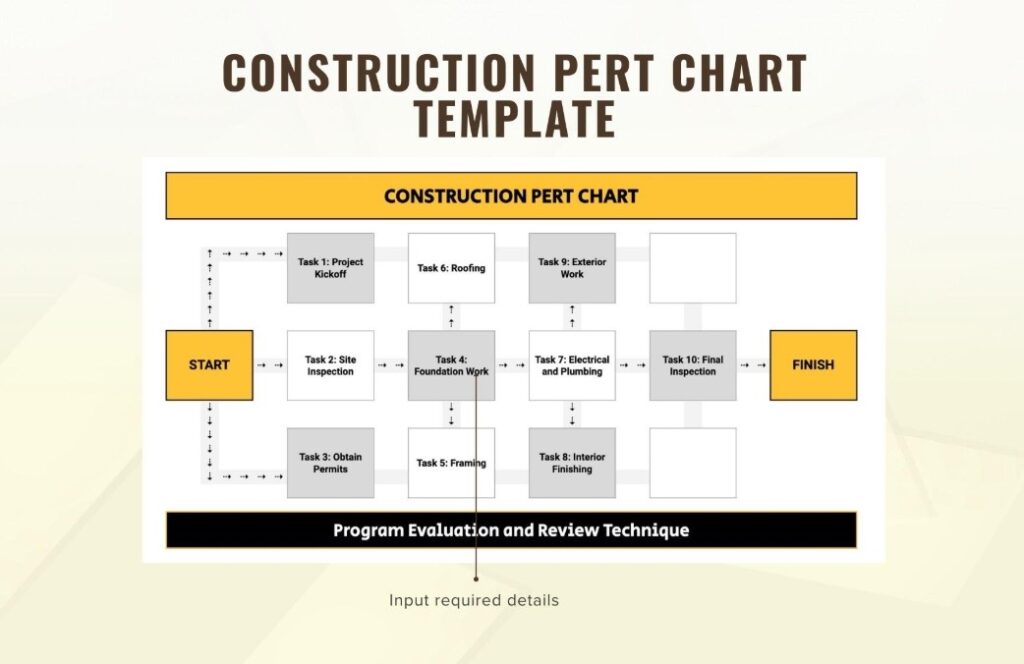
What is PERT
The full form of PERT is Program Evaluation and Review Technique. It is a statistical project management tool that aids in project scheduling by estimating the duration of uncertain activities.
Simply, PERT is a planning technique in which a project manager breaks down a project into smaller activities, and the possible completion time for each activity is estimated. Through this method, a project manager can easily identify which activities have the potential to delay the project and which ones require close monitoring.
The most significant feature of PERT is that it does not rely on a single time estimate. Instead, three time estimates are utilized for each activity:
| Time Estimate | Meaning |
|---|---|
| Optimistic Time (O) | Minimum possible time |
| Most Likely Time (M) | Normal expected time |
| Pessimistic Time (P) | Maximum possible time |
The expected duration is calculated using these three values.
Formula for Expected Time:
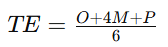
Here:
- TE = Expected Time
- O = Optimistic Time
- M = Most Likely Time
- P = Pessimistic Time
This formula takes practical conditions into account, thereby making the planning process more realistic.
What is a PERT network diagram?
In the PERT technique, a project is represented in a graphical form known as a PERT Network Diagram. In this diagram, activities and events are depicted using arrows and nodes.
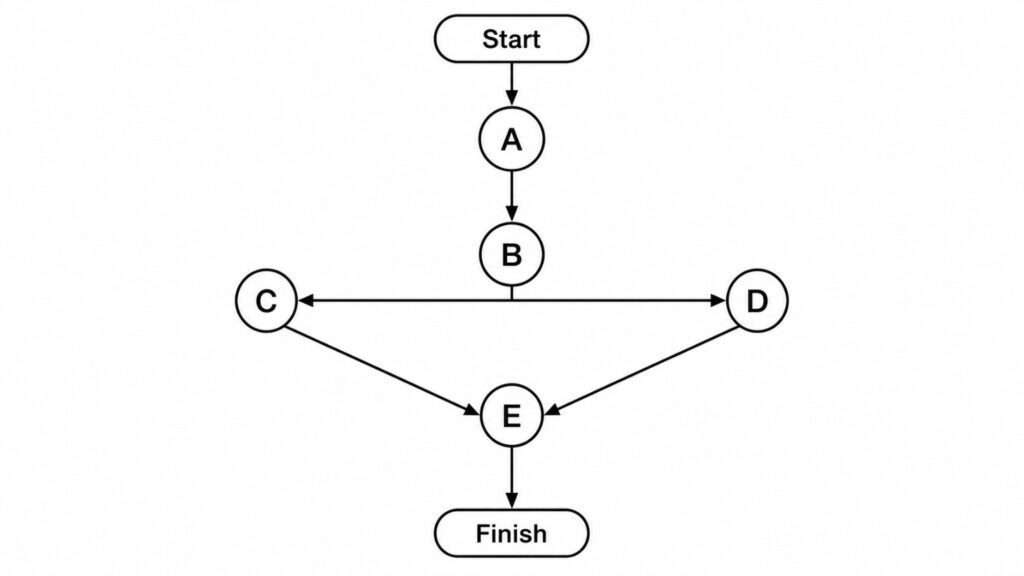
This type of diagram clarifies the sequence of activities and their dependencies. A project manager can easily understand which activity must be completed before the next task can begin.
The primary objective of this diagram is to visually understand the project flow and identify the critical path.
1. Time Control in Pert from Proper Activity Sequencing
The greatest advantage of PERT is proper activity sequencing. When project activities are arranged logically, unnecessary delays are avoided.
In construction projects, a common issue is that work often cannot commence. Despite resources being available on-site. because a preceding dependency has not yet been completed. For instance, in a road project, the Granular Sub-Base (GSB) cannot be laid until the subgrade is complete. Similarly, in bridge construction, the construction of piers is only possible after the foundation has been completed.
A PERT network diagram clearly defines the relationships between various activities. This provides the engineer with a precise understanding of exactly what work needs to be performed, when, and in what specific order.
If the activity sequencing is incorrect, manpower may sit idle, machinery may remain unused, and overall project costs may escalate. Proper sequencing leads to:
- Reduced rework
- Reduced idle time
- Improved equipment utilization
- Enhanced site coordination
PERT planning renders project execution systematic, thereby significantly reducing the overall project completion time.
2. Delay Prevention from Critical Path Identification
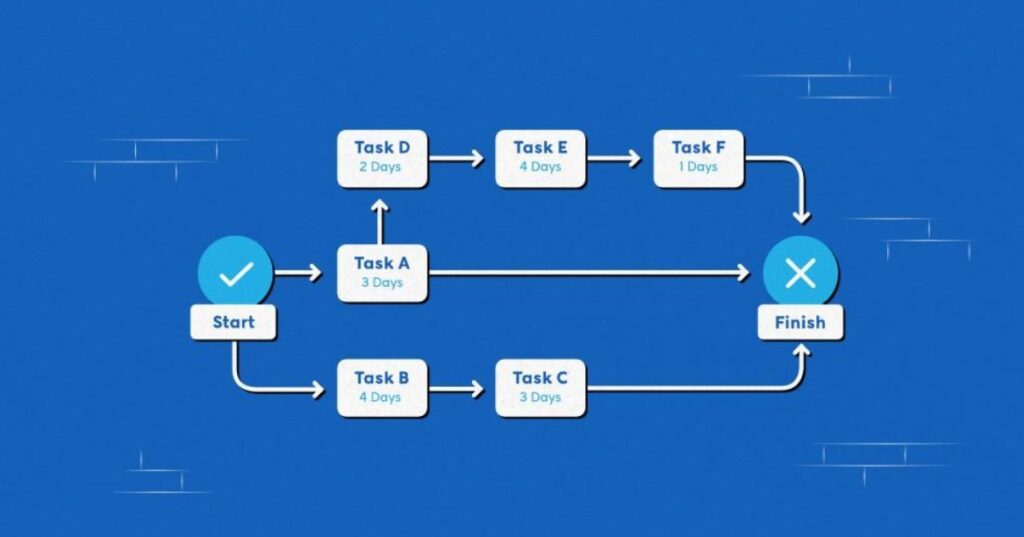
A key feature is identifying the critical path. The critical path is the sequence of activities where any delay results in a delay of the entire project.
Critical Path Formula Concept:
Critical Path = The Longest Duration Path in the Network
For example, in a highway project, if earthwork, GSB (Granular Sub-Base), WMM (Wet Mix Macadam), and bituminous work are a series of continuously dependent activities, then a delay in any of these will directly impact the project’s completion.
PERT analysis enables a project manager to identify which activities are critical and require extra monitoring. This allows management to take proactive measures.
For critical activities, the following steps are generally taken:
- Additional manpower is deployed.
- Backup machinery is arranged.
- Daily monitoring is conducted.
- Material availability is ensured.
This practical approach significantly reduces the risk of project delays.
To know more about Project Management click on below given link
What is CPM in Project Management?
What is Time Management? 10 Proven Project Management Tips
3. Cost Control through Improved Resource Planning
A major portion of the project cost depends on manpower, machinery, and materials. If resources are not properly planned, unnecessary expenditure will increase.
PERT scheduling helps in allocating resources in an optimized manner. This provides the contractor with a prior insight into the resource requirements at each stage.
Example:
| Activity | Required Resource |
|---|---|
| Excavation | Excavator + Dumpers |
| GSB Work | Grader + Roller |
| Concrete Work | Batching Plant + Vibrator + Transit Mixer |
If scheduling is properly executed, machinery does not remain idle, and fuel costs are reduced.
By utilizing this, managers can:
- Plan labor shifts
- Maximize equipment utilization
- Reduce material storage costs
- Control overtime expenses
In long-term projects, these savings are highly significant.
4. Better decision making through risk management
Every project involves uncertainty. Weather issues, material shortages, labor problems, and machinery breakdowns are common challenges.
PERT analyzes uncertainty by utilizing optimistic, pessimistic, and most likely duration estimates. This enables the project manager to evaluate multiple scenarios.
Variance Formula:
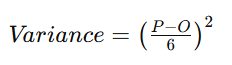
This calculation indicates which specific activities carry a higher level of risk.
For instance, during the rainy season, the duration of earthwork activities is uncertain. PERT analysis makes effective contingency planning possible.
Benefits of Risk Management:
- The probability of delays is reduced.
- Budget control is improved.
- Alternative planning becomes feasible.
- Client coordination is enhanced.
For these reasons, PERT is extensively utilized in mega infrastructure projects.
5. Making Monitoring and Progress Tracking Easy
During project execution, it is crucial to compare actual progress against planned progress.
PERT scheduling provides a baseline against which project monitoring can be conducted.
Example:
| Activity | Planned Duration | Actual Duration |
|---|---|---|
| Earthwork | 10 Days | 12 Days |
| GSB | 5 Days | 5 Days |
| WMM | 7 Days | 9 Days |
This comparison allows for the immediate identification of areas experiencing delays.
Improved monitoring leads to:
- Faster corrective action
- Simplified client reporting
- Systematic billing planning
- Enhanced productivity
This technique is highly beneficial for site engineers, as it provides them with support in tracking daily progress.
6. Better Coordination Between Departments
In large-scale projects, multiple departments work simultaneously. Weak coordination among planning, procurement, quality control, and execution teams leads to delays and disputes.
A PERT network provides a clear workflow, ensuring that every department knows exactly when their role begins and when it is scheduled to conclude.
For example:
- The procurement team will arrange for cement in a timely manner.
- The QA/QC team will keep inspections ready.
- The execution team will mobilize the necessary manpower.
This synchronization results in a smooth workflow.
Poor coordination has a direct impact on project costs. Idle labor and waiting machinery create an unnecessary financial burden. PERT scheduling significantly mitigates this problem.
7. Improving Client Confidence and Reporting
Professional planning plays a crucial role in building client confidence.
When a contractor submits a detailed PERT schedule, the client gains a clear understanding that the project will be executed in a systematic manner.
PERT reports typically clearly outline the following:
- Activity sequence
- Expected completion date
- Critical activities
- Risk of delays
- Resource planning
This enhances project transparency and helps minimize disputes.
Scheduling reports are also becoming mandatory in government infrastructure projects. Therefore, it is essential for civil engineers to possess practical knowledge of PERT.
8. Predict Probability of Project Completion
The most unique advantage of PERT is the ability to calculate the probability of project completion.
Probability Concept:

Through this analysis, a project manager can estimate the probability of completing the project within a given deadline.
For example, if the expected project duration is 100 days and the client sets a target of 95 days, PERT probability analysis can be used to assess feasibility.
This feature is particularly important for:
- Mega projects
- Government contracts
- Time-bound infrastructure works
- Defense projects
This helps in avoiding unrealistic commitments.
To know more about Project Management click on below given link
How to Create WBS: 8 Practical Steps Explained
What is Gantt Chart? 7 Simple Ways to Use It
5 Phases of Project Life Cycle (Easy Guide)
Practical Example of PERT Calculation
| Activity | O | M | P |
|---|---|---|---|
| Excavation | 4 | 6 | 8 |
| PCC Work | 2 | 3 | 5 |
| Reinforcement | 5 | 7 | 9 |
Excavation Expected Time:

Realistic scheduling is prepared using these types of calculations.
Advantages of PERT
| Advantage | Benefit |
|---|---|
| Better Planning | Organized workflow |
| Delay Control | Faster completion |
| Risk Analysis | Improved decisions |
| Cost Optimization | Reduced wastage |
| Monitoring | Better tracking |
Limitations of PERT
| Limitation | Description |
|---|---|
| Complex Network | Difficult in large projects |
| Time Consuming | Requires detailed analysis |
| Accuracy Dependence | Incorrect estimates affect the results |
| Frequent Updates Needed | Revisions required in dynamic projects |
Conclusion
PERT enhances planning and scheduling under uncertain project conditions. It serves not merely as a theoretical concept but as a practical execution tool capable of significantly reducing project delays and cost overruns.
In today’s infrastructure and construction industry, intense competition exists. Contractors and engineers must possess not only execution knowledge but also an understanding of advanced planning techniques. PERT fulfills precisely this requirement.
In this blog, we explored how proper sequencing, critical path analysis, resource optimization, risk management, and progress monitoring can effectively control project time and costs.
If civil engineers and project managers implement PERT at a practical level, they can significantly improve project productivity, client satisfaction, and profitability, all three. For this very reason, experts regard PERT as an essential tool in modern project management.
About The Author
My name is Susanta Kumar Mohapatra. I am a civil engineering professional with over 11 years of practical experience in the construction and infrastructure sectors. I hold a B.Tech degree in Civil Engineering and an M.E. degree in Construction Management.
Throughout my career, I have worked in various areas such as road construction, bridge projects, quality control, material testing, quantity surveying, project planning, and site management. I am passionate about sharing practical knowledge related to highway engineering, laboratory testing, and construction management with engineers, students, and construction professionals.
I am the founder of CivilGuruHub.com, where I share technical articles, field experiences, laboratory test procedures, guidelines based on IRC and IS codes, and practical construction knowledge related to civil engineering. My aim is to explain civil engineering concepts in simple language and provide useful, reliable information to industry professionals.
You can connect with me through CivilGuruHub.com and my YouTube channel, “The Civil Site,” where I regularly share civil engineering tutorials and practical site knowledge.
FAQ – PERT in Project Management
1. What is the full form of PERT?
The full form of PERT is Program Evaluation and Review Technique. It is a project management technique used for project scheduling and time estimation.
2. What is the main purpose of PERT?
The main purpose of PERT is to estimate a realistic completion time for project activities and to control project delays.
3. What is the Critical Path?
The Critical Path is the path with the longest duration within a project. If any activity along this path is delayed, the entire project gets delayed.
4. What is the formula for variance?
Variance = ((P-O)/6)2