
Table of Contents
Preface
Rigid pavement serves as a crucial component of highway engineering, with construction primarily involving cement concrete. This type of pavement boasts high load-carrying capacity, long service life, and low maintenance requirements. Engineers extensively utilize rigid pavements on national highways, industrial roads, airport runways, and heavy-traffic corridors because they efficiently distribute heavy axle loads. However, despite its inherent strength, rigid pavement does not remain entirely immune to failure. Even minor deficiencies in design, construction, drainage, material quality, or maintenance can lead to the development of various types of pavement failures.
Rigid pavement failures develop gradually, initially manifesting as minor defects. If engineers do not identify and repair these failures in a timely manner, they can escalate into major structural damage, thereby compromising riding quality, increasing vehicle operating costs, and reducing the overall service life of the road. Frequently, due to poor construction practices and inadequate curing, even newly constructed concrete pavements begin to exhibit signs of distress within just a few years.
Experts generally attribute rigid pavement failures to factors such as repetitive loading, temperature fluctuations, moisture intrusion, a weak subgrade, improperly constructed joints, and poor workmanship. Understanding these failures holds paramount importance for civil engineers, highway engineers, and site supervisors, as taking timely corrective action under actual site conditions serves as the key to significantly extending the service life of the pavement.
In this article, we will explore in detail the 10 major causes of rigid pavement failures and their practical solutions. The article explains the symptoms, underlying causes, and repair techniques for each type of failure from a practical construction perspective, aiming to provide both site engineers and students with valuable real-world field knowledge.
Rigid Pavement Failure Overview Table
| Sr. No. | Failure Type | Primary Cause | Effect on Pavement |
|---|---|---|---|
| 1 | Cracking | Load stress and temperature variation | Structural weakness in slab |
| 2 | Faulting | Differential settlement between slabs | Uneven riding surface |
| 3 | Pumping | Water pressure beneath the slab | Loss of subgrade support |
| 4 | Spalling | Joint and edge deterioration | Damage at slab edges |
| 5 | Scaling | Surface layer deterioration | Rough and damaged surface |
| 6 | Corner Break | Heavy wheel loading | Failure of slab corners |
| 7 | Blow-up | Thermal expansion of concrete | Sudden uplift of pavement |
| 8 | Settlement | Weak or poorly compacted foundation | Uneven pavement surface |
| 9 | Joint Failure | Improper joint sealing | Water infiltration into pavement |
| 10 | Polishing | Continuous traffic wear | Reduced skid resistance |
1. Cracking Failure in Rigid Pavement
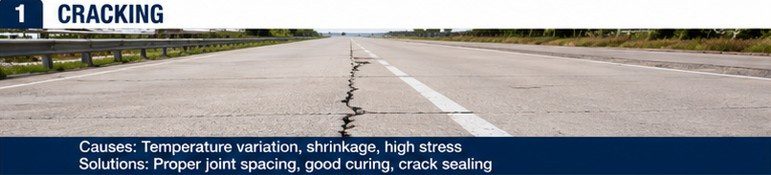
Cracking is considered the most common and dangerous form of failure in rigid pavements. The primary reason for the development of cracks in concrete slabs is tensile stress that exceeds the slab’s structural strength. Factors such as traffic loading, temperature variations, shrinkage, and weak support conditions generate this stress. Initially, cracks appear as hairline fissures, but over time, they widen and evolve into major forms of structural distress.
In rigid pavements, transverse, longitudinal, and diagonal cracks are commonly observed. Transverse cracks generally develop as a result of a combination of temperature-induced shrinkage and wheel loading. Longitudinal cracks appear parallel to the lane centerline and serve as an indication of poor lane construction or inadequate reinforcement. Corner stresses predominantly cause diagonal cracks.
The most significant disadvantage of cracking is that it initiates water infiltration into the pavement structure. When water penetrates down to the subgrade, the underlying support begins to weaken, leading to the onset of “pumping”—the expulsion of water and fine materials through the cracks under traffic load. This process accelerates the overall deterioration of the pavement. Furthermore, cracks amplify the impact loads that vehicles exert, resulting in a degradation of the riding quality.
Practical Solutions
To prevent cracking, a proper pavement thickness design is crucial. The slab thickness must be maintained in strict accordance with IRC guidelines and established design standards. It is essential to utilize high-quality concrete with an appropriate water-cement ratio. Proper curing should be carried out for a minimum duration of 14 days to effectively prevent shrinkage cracks.
To repair existing cracks, techniques such as epoxy injection and crack sealing are employed. For wider cracks, a full-depth repair constitutes an effective solution. Additionally, contractors may install dowel bars to improve load transfer efficiency across the cracks.
2. Faulting Failure in Rigid Pavement
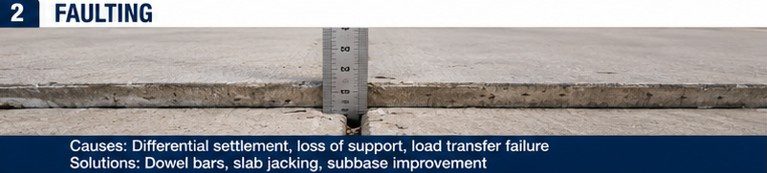
Faulting is a type of pavement failure characterized by the development of an elevation difference between adjacent concrete slabs. This means that one slab becomes elevated or depressed relative to the adjacent slab. This condition is commonly observed near joints and cracks, and it tends to be more severe on roads subjected to heavy traffic.
Faulting is primarily caused by repetitive wheel loading and the erosion of subgrade material. When water infiltrates through pavement joints, the pressure exerted by moving vehicles causes fine particles within the subgrade to be washed away. Gradually, the support beneath the slab becomes uneven, leading to differential settlement of the slab.
Faulting renders vehicle movement uncomfortable and increases impact loading. When heavy vehicles traverse uneven joints, the rate of pavement deterioration accelerates. This condition also generates noise and vibrations, thereby compromising driving comfort on highways.
Practical Solutions
To control faulting, it is essential to provide an efficient drainage system. Pavement joints must be properly sealed to prevent water infiltration. The proper alignment of dowel bars improves load transfer and minimizes differential movement between slabs.
To repair existing faulting, the diamond grinding technique is employed to restore a smooth riding surface. In severe cases, slab replacement or the mud jacking technique—involving the injection of grout to restore slab support—is adopted.
To know More about Highway, Read some Important articles and Click on given Link
What Are Flexible Pavement Failures? 10 Major Causes and Practical Solutions
What Are 10 Highway Construction Equipment? Complete Guide
What Are 9 Key Differences Between Flexible and Rigid Pavement? complete guide
camber:what it is? Complete Guide for Beginners
3. Pumping Failure in Rigid Pavement
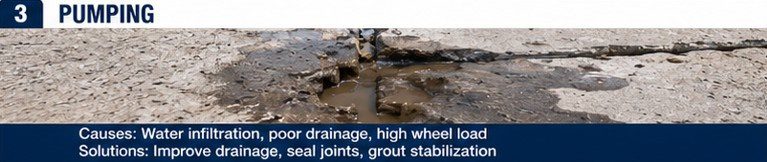
Pumping is a serious structural failure in rigid pavements characterized by the expulsion of water and fine soil particles through slab joints and cracks. When heavy wheel loads act upon the slab, water pressure builds up, exerting an upward force that pushes against the subgrade particles.
This type of failure is predominantly observed in poorly drained pavements. Continuous pumping leads to the formation of voids beneath the slab, thereby weakening the pavement’s structural support. Under these conditions, bending stresses within the slab increase, and cracks begin to develop.
Pumping has a direct and detrimental impact on the service life of the pavement. If left unchecked during its early stages, it can ultimately lead to the complete collapse of the pavement structure. In highway projects, the primary causes of pumping are poor drainage and excessive moisture.
Practical Solutions
Improving drainage is the most effective method for preventing pumping. The installation of edge drains and longitudinal drains is highly recommended. Furthermore, the use of a granular sub-base helps to enhance the stability of the pavement support system.
In areas where pumping is already occurring, pressure grouting techniques are employed to fill the voids that have formed beneath the slab. Resealing of joints and correcting drainage deficiencies are also critical repair measures.
4. Spalling Failure in Rigid Pavement
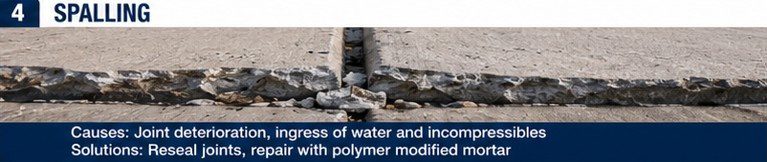
Spalling is a form of surface deterioration failure in which pieces of concrete at pavement joints and edges break off and separate from the main structure. It typically develops at the corners of joints, and improper joint construction causes the primary issue.
As a result of spalling, joints weaken, allowing water to easily penetrate the interior of the pavement structure. Freeze-thaw cycles and repeated wheel impacts further exacerbate this problem.
If spalling goes unaddressed, it can lead to pavement edge failure and faulting. It also compromises riding quality and increases maintenance costs.
Practical Solutions
Proper joint cutting and sealing constitute the most critical step in preventing spalling. High-quality sealant materials should be utilized—specifically those capable of withstanding temperature fluctuations.
Minor spalling can be rectified through patch repairs. In cases of severe damage, workers employ a partial-depth repair technique, wherein they remove the damaged concrete and replace it with fresh concrete.
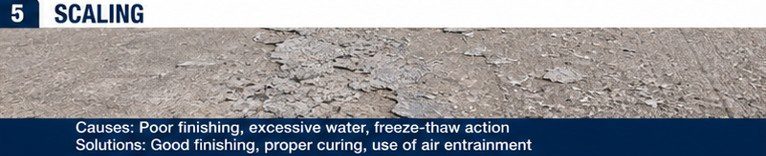
5. Scaling Failure in Rigid Pavement
Scaling is a progressive deterioration of a concrete surface in which the upper layer begins to flake or peel away. Poor-quality concrete and inadequate curing primarily cause this.
Freeze-thaw cycles and de-icing chemicals majorly cause scaling. Weak surface concrete absorbs moisture, and repeated cycles of expansion and contraction lead to surface damage.
Initially, scaling may appear to be merely a cosmetic defect; however, it gradually diminishes the durability of the pavement. Increased surface roughness also adversely affects the riding quality.
Practical Solutions
A proper mix design and a low water-cement ratio are crucial for preventing scaling. Adequate curing enhances the strength of the concrete.
For repairs, methods such as thin bonded overlays and surface resurfacing employ. Protective sealers may also apply.
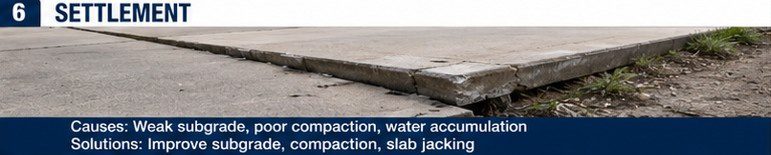
6. Settlement Break Failure in Rigid Pavement
Settlement occurs due to weaknesses in the pavement foundation. If the subgrade is not adequately compacted, the slab begins to settle unevenly.
Poor drainage and water saturation also exacerbate settlement. Settlement leads to the development of cracks, faulting, and an uneven riding surface.
Practical Solutions
Proper compaction and soil stabilization are essential for preventing settlement. It is crucial to achieve the required CBR values.
Among repair methods, slab lifting and pressure grouting are commonly employed.
7. Blow-up Failure in Rigid Pavement
A “blow-up” is a sudden pavement uplift failure caused by thermal expansion. Under high-temperature conditions, concrete slabs expand; if the joints are insufficient, compressive stress develops.
When this compressive force increases excessively, the slab buckles upward. This phenomenon occurs primarily during the summer season and can create hazardous accident conditions on highways.

Practical Solutions
Providing proper expansion joints is the primary solution for preventing blow-ups. Joint spacing must be maintained in accordance with design standards.
For repairs, the damaged slab is removed and the section is reconstructed with a new joint arrangement.
8. Corner Break Failure in Rigid Pavement
A corner break is a structural failure in rigid pavements where the corner portion of the slab cracks and separates. This failure typically develops in the area where joints intersect.
Heavy wheel loads and a loss of support primarily cause a corner break. When voids develop beneath the pavement corner, stress concentration increases, leading to the cracking of the slab.
This condition poses a hazard to traffic safety because the broken slab may begin to shift. Water infiltration also increases rapidly.

Practical Solutions
The proper installation of load transfer devices is essential for preventing corner breaks. A strong sub-base and improvements to drainage are also crucial.
For repairs, workers commonly employ full-depth patch repair. They remove the damaged portion of the slab and place fresh reinforced concrete in its stead.
9. Joint Failure in Rigid Pavement
Joints are a critical component of rigid pavements, facilitating slab movement. If joints are not properly constructed or maintained, pavement distress develops rapidly.
When joint seals become damaged, water infiltration begins, which exacerbates pumping and faulting.

Practical Solutions
The use of high-quality sealants and regular joint maintenance are essential. Periodic inspections and timely resealing should be conducted.
10. Polishing Failure in Rigid Pavement
Polishing refers to the smoothing of the pavement surface, which results in a reduction in skid resistance. Continuous abrasion caused by traffic is the primary cause of this type of failure.
A polished surface increases the risk of accidents during rainy conditions because tire grip is compromised.

Practical Solutions
Textured concrete surfaces and skid-resistant aggregates should be utilized. For existing pavements, grooving and surface texturing methods can be applied.
a few important tables are given below to clarify all the points regarding rigid pavement
Practical Repair Techniques Table
| Failure Type | Recommended Repair Method |
|---|---|
| Cracking | Crack sealing, epoxy injection |
| Faulting | Diamond grinding, mud jacking |
| Pumping | Pressure grouting, drainage improvement |
| Spalling | Partial depth repair |
| Scaling | Overlay resurfacing |
| Corner Break | Full depth patch repair |
| Blow-up | Slab reconstruction |
| Settlement | Slab lifting |
| Joint Failure | Joint resealing |
| Polishing | Surface texturing |
Preventive Measures for Rigid Pavement Failures
| Preventive Measure | Benefit |
|---|---|
| Proper drainage system | Reduces water infiltration |
| Adequate curing | Improves concrete strength |
| Quality materials | Increases pavement durability |
| Joint maintenance | Prevents cracking and pumping |
| Proper compaction | Controls settlement |
| Timely maintenance | Increases pavement life |
Important IS Codes and IRC Codes for Rigid Pavement Failures
In given Table a few Links of IS and IRC codes are given from different sources only for references.
| Sr. No. | Code Number | Code Title | Use in Rigid Pavement |
|---|---|---|---|
| 1 | Indian Roads Congress: 58 | Guidelines for the Design of Plain Jointed Rigid Pavements for Highways | Most important code for rigid pavement design |
| 2 | Indian Roads Congress: 15 | Standard Specifications and Code of Practice for Construction of Concrete Roads | Concrete road construction procedures |
| 3 | Indian Roads Congress: SP:62 | Guidelines for Design and Construction of Cement Concrete Pavements for Low Volume Roads | Used for low-volume rigid pavement projects |
| 4 | Indian Roads Congress: SP:83 | Guidelines for Maintenance, Repairs and Rehabilitation of Rigid Pavements | Pavement repair and rehabilitation methods |
| 5 | Indian Roads Congress: 57 | Recommended Practice for Sealing of Joints in Concrete Pavements | Joint sealing standards |
| 6 | Indian Roads Congress: 44 | Guidelines for Cement Concrete Mix Design for Pavements | Pavement concrete mix design |
| 7 | Indian Roads Congress: 78 | Standard Specifications and Code of Practice for Road Bridges, Section VII | References for concrete durability and loading |
| 8 | Bureau of Indian Standards 456:2000 | Plain and Reinforced Concrete – Code of Practice | Concrete quality and reinforcement standards |
| 9 | Bureau of Indian Standards 10262 | Concrete Mix Proportioning Guidelines | Concrete mix proportion design |
| 10 | Bureau of Indian Standards 383 | Specification for Coarse and Fine Aggregates | Aggregate quality requirements |
| 11 | Bureau of Indian Standards 1199 | Methods of Sampling and Analysis of Concrete | Concrete testing methods |
| 12 | Bureau of Indian Standards 516 | Methods of Tests for Strength of Concrete | Compressive and flexural strength testing of concrete |
| 13 | Bureau of Indian Standards 5816 | Splitting Tensile Strength of Concrete | Tensile strength evaluation |
| 14 | Bureau of Indian Standards 2720 | Methods of Test for Soils | Subgrade soil testing |
| 15 | Bureau of Indian Standards 2386 | Methods of Test for Aggregates | Testing of aggregate physical properties |
IRC Codes for Common Rigid Pavement Failures and Repairs
| Failure Type | Recommended IRC / IS Code | Main Purpose |
|---|---|---|
| Cracking | IRC: 58, IRC: SP:83 | Crack prevention and repair |
| Faulting | IRC: SP:83 | Diamond grinding and slab correction |
| Pumping | IRC: 58 | Drainage and sub-base design |
| Spalling | IRC: 57 | Joint sealing and edge repair |
| Scaling | IS 456 | Concrete durability requirements |
| Corner Break | IRC: 58 | Load transfer design |
| Blow-up | IRC: 57 | Expansion joint guidelines |
| Settlement | IS 2720 | Soil compaction and testing |
| Joint Failure | IRC: 57 | Joint maintenance |
| Polishing | IRC: 15 | Surface texture standards |
Important Material Testing Standards for Rigid Pavement
| Material/Test | Relevant IS Code | Purpose |
|---|---|---|
| Cement Testing | Bureau of Indian Standards 4031 | Cement quality testing |
| Aggregate Impact Test | Bureau of Indian Standards 2386 Part 4 | Aggregate toughness |
| Slump Test | Bureau of Indian Standards 1199 | Concrete workability |
| Flexural Strength Test | Bureau of Indian Standards 516 | Pavement concrete strength |
| Soil Compaction Test | Bureau of Indian Standards 2720 Part 8 | Maximum dry density |
| CBR Test | Bureau of Indian Standards 2720 Part 16 | Subgrade strength |
| Water Absorption Test | Bureau of Indian Standards 2386 | Aggregate durability |
| Concrete Cube Test | Bureau of Indian Standards 516 | Concrete compressive strength |
Recommended Concrete and Construction Parameters
| Parameter | Recommended Value | Reference Code |
|---|---|---|
| Minimum Concrete Grade | M40 | IRC: 15 |
| Water Cement Ratio | 0.40 – 0.45 | IS 456 |
| Minimum Curing Period | 14 Days | IRC: 15 |
| Flexural Strength | 4.5 MPa Minimum | IRC: 58 |
| Dowel Bar Diameter | 25–38 mm | IRC: 58 |
| Joint Spacing | 4.5–5 m | IRC: 58 |
| Subgrade CBR | Minimum 8% | IRC: 58 |
| Pavement Camber | 2–2.5% | IRC Guidelines |
Conclusion
Rigid pavement experts consider it a durable and long-lasting solution for highways and industrial roads; however, improper design, poor drainage, a weak subgrade, and inadequate maintenance can lead to various types of failures within it. Failures such as cracking, faulting, pumping, spalling, and settlement directly impact pavement performance; if timely repairs are not undertaken, the situation can escalate to the point of complete structural damage.
Under practical field conditions, engineers cannot completely eliminate pavement failures; however, proper engineering practices and preventive maintenance can significantly reduce them. High-quality construction materials, proper joint design, an effective drainage system, and adequate curing serve as essential factors for the long-term durability of rigid pavement.
Site engineers and project managers should place special emphasis on early identifying pavement distress and implementing timely corrective measures. A regular inspection and maintenance schedule extends the service life of the pavement and reduces rehabilitation costs. In modern highway construction projects, advanced repair techniques—such as epoxy injection, pressure grouting, and diamond grinding—make rigid pavement maintenance even more effective.
Therefore, for successful rigid pavement performance, strong concrete alone is not sufficient; rather, proper planning, execution, and maintenance are equally important.
FAQ
1. What constitutes rigid pavement failure?
Rigid pavement failure refers to the development of defects or damages in a concrete road that compromise the pavement’s strength, durability, and riding quality. These failures manifest in the form of cracking, faulting, pumping, spalling, and settlement. If timely repairs are not undertaken, the service life of the pavement can be significantly reduced.
2. What is the most common type of failure in rigid pavements?
The most common failure in rigid pavements is cracking. It develops in the form of transverse cracks, longitudinal cracks, and corner cracks. Overloading, temperature-induced stresses, and a weak subgrade are the primary causes for this.
3. What are the main causes of rigid pavement failures?
The major causes of rigid pavement failures include poor drainage, improper joint construction, inadequate curing, a weak subgrade, heavy axle loads, temperature variations, and poor-quality concrete. Often, the quality of construction workmanship also plays a significant role.
4. What is pumping failure?
Pumping is a type of failure in which water and fine soil particles are ejected through the slab joints and cracks. This occurs primarily due to water infiltration combined with repeated heavy wheel loads. Consequently, voids develop beneath the concrete slab.
5. How does faulting occur in rigid pavements?
Faulting occurs when a difference in elevation develops between adjacent concrete slabs. This is caused by differential settlement and erosion of the subgrade. Under these conditions, the road surface becomes uneven.
6. What is spalling failure?
Spalling is a form of surface damage failure in which pieces of concrete begin to break away from the pavement’s joints and edges. Poor joint sealing and repeated impacts from traffic are the primary causes of this failure.
7. Which IRC code is important for rigid pavements?
For the design and construction of rigid pavements, the most important code is considered to be IRC:58—Guidelines for the Design of Plain Jointed Rigid Pavements for Highways. For repair and rehabilitation purposes, the IRC:SP:83 guidelines—specifically Guidelines for Maintenance, Repairs and Rehabilitation of Rigid Pavements—are utilized.
8. What is the average lifespan of a rigid pavement?
With proper design and maintenance, the average lifespan of a rigid pavement can range from 30 to 40 years. High-quality construction and timely repairs further enhance its durability.