
Table of Contents
Introduction
Pavement Quality Concrete (PQC) is played a pivotal role in highway construction and rigid pavement projects by it. Since the traffic load is directly borne by the PQC surface, it is imperative that durability and freedom from cracks are remained.
However, under practical site conditions, it is frequently observed that the development of cracks begins on the surface just a few hours or days after the laying of the PQC.
These cracks are not merely an aesthetic issue; long-term durability, riding quality, resistance to water penetration, and the overall service life of the pavement are also adversely impacted by them.
If identification and repair of these PQC Surface cracks are not carried out during their incipient stages, major defects—such as spalling, pumping, faulting, and slab failure—may be developed in the future.
For this very reason, a thorough understanding of PQC cracks is crucial for highway engineers, QA/QC engineers, site supervisors, and contractors.
In this article, the nine major types of PQC Surface cracks , along with their underlying causes, preventive measures, and practical repair techniques will be examined in detail by us.
Additionally, key references from IRC and IS codes that are commonly utilized in highway and rigid pavement projects will be covered by us.
What Is PQC in Rigid Pavement?
The full form of PQC is Pavement Quality Concrete. The top wearing layer of a rigid pavement is constituted by it, designed to withstand direct traffic loads and environmental stresses.
Typically, high-strength concrete is produced using PQC, incorporating a controlled water-cement ratio, proper aggregate grading, and admixtures.
In rigid pavement construction, a layer of DLC (Dry Lean Concrete) is generally laid at the base, followed by the PQC layer being placed on top. The service life of the pavement is directly influenced by the quality of the PQC.
If any errors occur during the placement, compaction, finishing, curing, or joint cutting of the PQC, the likelihood of crack formation is increased significantly.
Important IRC and IS Codes for PQC surface Cracks
| Code | Description |
|---|---|
| IRC:15-2017 | Guidelines for Construction of Jointed Plain Concrete Pavements |
| IRC:58-2015 | Guidelines for Design of Plain Jointed Rigid Pavements |
| IRC:SP:83 | Guidelines for Maintenance and Repair of Concrete Pavements |
| IS 456 | Code of Practice for Plain and Reinforced Concrete |
| IS 1199 | Methods of Sampling and Analysis of Concrete Workability |
| IS 516 | Methods of Tests for Strength of Concrete |
| IS 4926 | Specifications for Ready Mixed Concrete |
For Reference some of the codes link are given, only for study purpose.
1. Plastic Shrinkage Cracks on PQC Surface
Plastic shrinkage cracks are the most common type of early-age cracks observed on PQC surfaces. These cracks develop when moisture evaporates very rapidly from the surface of fresh concrete before the concrete has attained sufficient strength.
Generally, these cracks appear within 1 to 6 hours of concreting and manifest on the surface in irregular or parallel patterns. The risk of such cracks significantly increases during the summer season, or in conditions characterized by high wind velocity, low humidity, and high ambient temperatures.
When the rate of evaporation exceeds the rate of bleeding, the concrete surface begins to shrink. However, the underlying concrete remains in a plastic state; this disparity generates tensile stress, ultimately leading to the formation of cracks.
Under practical site conditions, this problem worsens when:
- Concreting is performed during the afternoon hours
- Wind barriers are not utilized
- PQC Surface curing is delayed
- Excessive finishing operations are carried out
Plastic shrinkage cracks are typically shallow; however, if left unaddressed, they can lead to water ingress and compromise the long-term durability of the structure.
Practical Prevention Measures
- Initiate curing immediately
- Employ fogging or use evaporation-reducing agents
- Avoid concreting during periods of high temperature
- Utilize wind shields
- Avoid over-finishing the concrete surface
Practical Repair Methods
If the cracks are hairline:
- Rub the PQC surface with cement slurry
- Apply surface sealing compounds
- Inject low-viscosity epoxy
If the cracks are wider:
- Cut a V-groove along the crack
- Fill with polymer-modified mortar
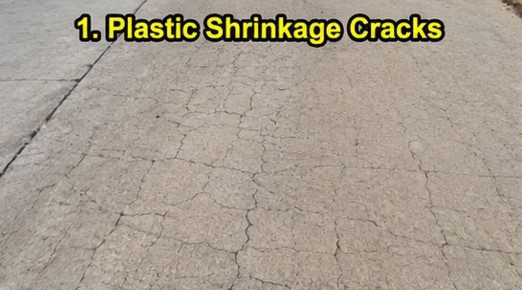
1. Plastic Shrinkage Cracks on PQC Surface
2. Drying Shrinkage Cracks on PQC Surface
Drying shrinkage cracks on PQC Surface develop in hardened concrete due to the loss of moisture. A reduction in volume occurs when concrete gradually loses water after the hydration process is complete. If the concrete is restrained from free movement, tensile stresses are generated, leading to the onset of cracking.
These cracks typically develop after a few days or weeks and appear on the surface in a random pattern. High cement content, an excessive water-cement ratio, and improper curing are the primary causes of such cracks.
In practical projects, contractors sometimes add extra water at the site to improve workability. This significantly increases shrinkage and heightens the risk of future cracking.
The long-term impact of drying shrinkage cracks can be quite serious, as they allow water and chemicals to penetrate the pavement structure, potentially leading to reinforcement corrosion and freeze-thaw damage.
Practical Prevention Methods:
- Maintain a low water-cement ratio.
- Ensure proper curing for a minimum of 14 days.
- Utilize shrinkage-reducing admixtures.
- Maintain proper joint spacing.
Practical Repair Methods
- Surface epoxy sealing.
- Polymer grout filling.
- Crack stitching for wider cracks.
- Joint resealing, if required.
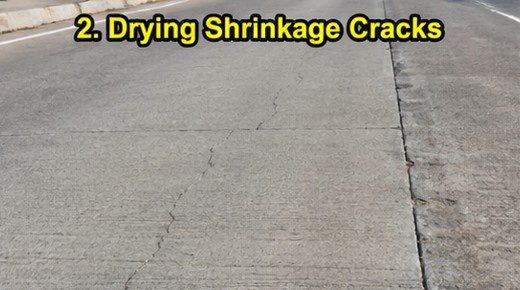
2. Drying Shrinkage Cracks on PQC Surface
To get more idea about both Flexible and Rigid Pavement, Read the article link Given below.
What Are 9 Key Differences Between Flexible and Rigid Pavement? complete guide
What Are Flexible Pavement Failures? 10 Major Causes and Practical Solutions
What Are Rigid Pavement Failures? 10 Major Causes and Practical Solutions
3. Longitudinal Cracks on PQC Surface
Longitudinal cracks on PQC Surface develop in a direction parallel to the road alignment. These cracks may appear along the lane center or within the wheel paths.
The primary causes for these cracks include differential settlement, an improper lane construction sequence, inadequate compaction, and weak subgrade support. Occasionally, improper placement of tie bars can also lead to longitudinal cracking.
If workers perform the concreting of adjacent lanes at different times and do not achieve proper bonding, stress concentration occurs. Similarly, an uneven DLC (Dry Lean Concrete) surface can also compromise the support provided to the concrete slab.
Engineers consider longitudinal cracks dangerous because, under the influence of traffic loads, they gradually widen over time, thereby increasing the rate of water infiltration.
Practical Prevention Measures:
- Ensure uniform subgrade compaction.
- Install tie bars with proper alignment.
- Install tie bars with proper alignment.
- Execute lane joint construction with meticulous care.
Practical Repair Methods:
- Hairline longitudinal crack: Epoxy pressure grouting.
- Medium crack: Routing and sealing.
- Structural crack: Partial-depth repair.
- Severe crack: Full slab replacement.
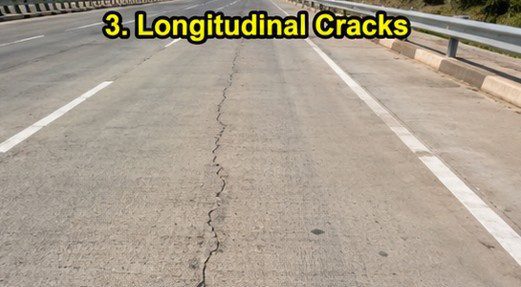
3. Longitudinal Cracks on PQC Surface
4. Transverse Cracks on PQC Surface
Transverse cracks develop across the width of the pavement and contractors consider them a fairly common defect in rigid pavement projects. The primary causes for these cracks include thermal stress and delayed saw cutting. Concrete expands and contracts in response to temperature fluctuations. If contractors do not cut contraction joints in a timely manner, the slab may crack at random locations.
At actual project sites, contractors often delay saw cutting, or issues regarding machine availability arise. Consequently, uncontrolled transverse cracking develops.
Heavy axle loads and inadequate slab thickness also accelerate the formation of transverse cracks.
Practical Prevention
- Perform groove cutting in a timely manner.
- Maintain joint spacing in accordance with IRC standards.
- Monitor temperature levels.
- Ensure proper curing.
Practical Repair Methods
- Minor cracks: Epoxy sealing
- Working cracks: Flexible joint sealant
- Structural transverse cracks: Full-depth repair
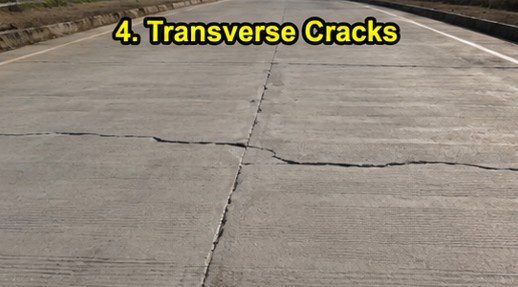
4. Transverse Cracks on PQC Surface
5. Corner Cracks on PQC Surface
Corner cracks develop diagonally from the corners of a slab. They serve as a significant indicator of load-induced distress in rigid pavements.
Insufficient support beneath the slab corner primarily causes this. When a heavy wheel load acts upon the slab corner—and a void or weak base exists underneath—the corner deflects, leading to the development of a tensile crack.
Poor drainage and water accumulation also contribute to a loss of support.
Practical Prevention
- Maintain a proper drainage system.
- Improve DLC compaction.
- Ensure strong edge support.
Practical Repair Methods
- Partial-depth corner repair.
- Full-depth slab replacement.
- Undersealing grout injection.
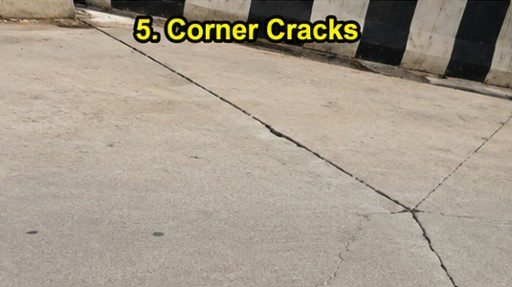
5. Corner Cracks on PQC Surface
6. Map Cracking or Crazing on PQC Surface
Map cracking is also referred to as crazing. It appears on the surface as a pattern of small, interconnected polygons.
While it is primarily a cosmetic defect, it indicates poor surface quality. The main causes include excessive finishing, the presence of a rich mortar layer, and rapid surface drying.
Occasionally, inexperienced laborers sprinkle extra water during the finishing process; this leads to the formation of a weak laitance layer, triggering the onset of crazing.
Practical Prevention
- Avoid excessive troweling.
- Do not add water to the surface.
- Ensure proper curing.
Practical Repair Methods
- Surface grinding.
- Silane/siloxane sealing.
- Thin polymer overlay.
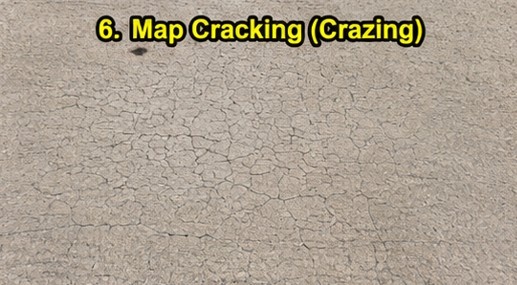
6. Map Cracking or Crazing on PQC Surface
7. Settlement Cracks on PQC Surface
Settlement cracks develop when the support beneath a slab settles unevenly. A weak subgrade, poor compaction, and waterlogging are common causes of this phenomenon.
These cracks typically develop in irregular patterns and, at times, can even result in differential levels across the slab.
Settlement cracks are hazardous because they are often accompanied by riding discomfort and issues regarding load transfer.
Practical Prevention
- Proper soil compaction
- CBR testing
- Water drainage control
- Removal of weak pockets
Practical Repair Methods
- Slab jacking
- Pressure grouting
- Full-depth repair in severe cases
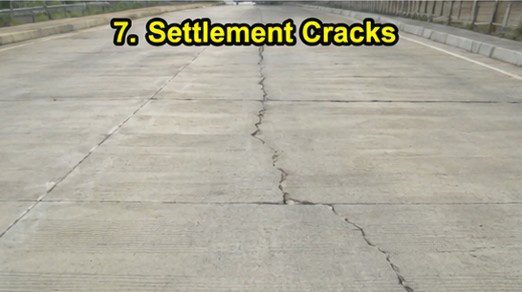
7. Settlement Cracks on PQC Surface
8. Structural Cracks on PQC Surface
Structural cracks are the most serious category of cracks. These directly affect the structural capacity of the slab.
Overloading, insufficient slab thickness, poor concrete strength and severe support failure are its major causes.
Structural cracks are usually full-depth and deteriorate rapidly with traffic loading.
Practical Prevention
- IRC design compliance
- Proper concrete strength control
- Axle load regulation
- Quality assurance testing
Practical Repair Methods
- epoxy injection
- Dowel bar retrofit
- Full-depth slab replacement
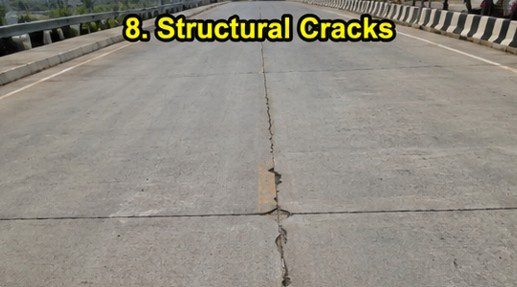
8. Structural Cracks on PQC Surface
9. Joint-Related Cracks on PQC Surface
Joint-related cracks on PQC Surface mostly develop due to improper joint construction. Incorrect joint spacing, poor sealant quality and dowel bar misalignment are common reasons.
If joints are not properly functioning the slab resists thermal movement and random cracking develops.
Practical Prevention
- Correct joint spacing
- Proper dowel bar alignment
- Timely joint sealing
Practical Repair Methods
- joint resealing
- Dowel bar retrofit
- joint reconstruction
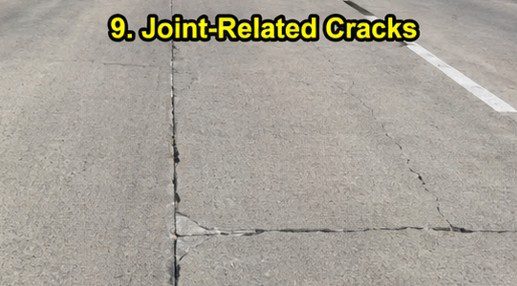
9. Joint-Related Cracks on PQC Surface
Practical Site Checklist for PQC Crack Prevention
| Inspection Item | What to Check |
|---|---|
| Water-Cement Ratio | Excess water should be avoided |
| Curing | Ensure immediate and continuous curing |
| Groove Cutting | Perform timely joint cutting |
| Temperature | Monitor high temperature conditions |
| DLC Surface | Surface should be uniform and well compacted |
| Compaction | Ensure proper vibration and compaction |
| Joint Alignment | Maintain correct joint spacing and depth |
General Repair Materials Used in PQC Crack Repair
| Material | Use |
|---|---|
| Epoxy Resin | Crack injection |
| Polymer Mortar | Surface repair |
| Joint Sealant | Flexible crack sealing |
| Non-Shrink Grout | Structural repair |
| Bonding Agent | Repair bonding |
Conclusion
Surface cracks in PQC (Pavement Quality Concrete) constitute a major practical challenge in rigid pavement construction. However, if proper mix design, curing, joint cutting, and construction quality standards are maintained, these cracks can be prevented to a significant extent.
Not all cracks are of the same nature; some are merely cosmetic, while others serve as indicators of potential pavement failure. For this reason, the accurate identification of crack types is of paramount importance.
In practical highway projects, it is essential for engineers not only to carry out repairs but also to identify the root cause of the issue. If the underlying cause is not addressed, cracks may redevelop even after repairs have been completed.
Through proper inspection, adherence to IRC guidelines, and timely maintenance, the service life of rigid pavements can be significantly extended, and long-term maintenance costs can be substantially reduced.
About The Author
My name is Susanta Kumar Mohapatra. I am a civil engineering professional with over 11 years of practical experience in the construction and infrastructure sectors. I hold a B.Tech degree in Civil Engineering and an M.E. degree in Construction Management.
Throughout my career, I have worked in various areas such as road construction, bridge projects, quality control, material testing, quantity surveying, project planning, and site management. I am passionate about sharing practical knowledge related to highway engineering, laboratory testing, and construction management with engineers, students, and construction professionals.
I am the founder of CivilGuruHub.com, where I share technical articles, field experiences, laboratory test procedures, guidelines based on IRC and IS codes, and practical construction knowledge related to civil engineering. My aim is to explain civil engineering concepts in simple language and provide useful, reliable information to industry professionals.
You can connect with me through CivilGuruHub.com and my YouTube channel, “The Civil Site,” where I regularly share civil engineering tutorials and practical site knowledge.
FAQ
1. What are PQC surface cracks?
PQC surface cracks are visible fractures that develop on the surface of concrete pavements, caused by factors such as shrinkage, temperature variations, improper curing, overloading, or poor construction quality. These cracks can range from hairline fissures to full-depth structural damage.
2. What is the most common type of crack in PQC Surface?
Plastic shrinkage cracks and transverse cracks are considered the most common defects. Plastic shrinkage cracks develop rapidly in fresh concrete, whereas transverse cracks typically occur due to delayed saw cutting and temperature-induced stresses.
3. What causes plastic shrinkage cracks?
These cracks develop when water evaporates too rapidly from the surface of fresh concrete. High temperatures, strong winds, low humidity, and delayed curing are the primary causes.
4. Are hairline cracks dangerous?
Not every hairline crack is dangerous; however, if left unaddressed, they can lead to water ingress and durability issues in the future. Therefore, timely sealing and monitoring are crucial.
5. How can PQC cracks be prevented?
PQC cracks can be largely prevented by ensuring a proper mix design, maintaining a low water-cement ratio, performing timely curing, executing correct saw cutting, ensuring proper compaction, and maintaining an effective drainage system.
6. For how many days should PQC curing be performed?
Typically, it is recommended to perform PQC curing for a minimum of 14 days. Proper curing enhances both the strength and durability of the concrete while simultaneously reducing shrinkage cracks.
7. Why do longitudinal cracks develop?
Longitudinal cracks primarily develop due to poor subgrade support, differential settlement, improper placement of tie bars, and uneven compaction.
8. What is the difference between structural cracks and normal cracks?
Normal cracks may be superficial or non-structural in nature, whereas structural cracks compromise the load-carrying capacity of the concrete slab. Structural cracks are generally deep and extend through the full depth of the slab.
9. What materials are used for PQC crack repair?
Common repair materials include epoxy resin, polymer-modified mortar, non-shrink grout, crack sealants, and bonding agents.