
Table of Contents
Introduction
When it comes to the topic of slab design for civil engineering, it is highly relevant, as it relates to the majority of residential, commercial, and infrastructure projects that are constructed worldwide.
The slab is the primary structural component of a structure; therefore, it provides support to the floors and roofs of a structure, carrying all of the loads from the roof down through to the foundations.
There are two primary types of slabs that are used in construction: one-way slabs and two-way slabs.
Many individuals are not familiar with the differences between one-way and two-way slabs and, therefore, do not understand which type of slab to use in which application type.
Additionally, many individuals, including site engineers, hold misconceptions regarding the illuminative nature, cost, and safety of each type of design.
In this blog post,
We will provide the most thorough comparison between one-way slabs and two-way slabs, including a description of the fundamentals of their use. the behaviors and design principles associated with each, and the various ways in which slabs should be designed for use.
What is a slab?
A slab is a horizontal, flat structural component that transfers load from beams and columns to the ground. It consists of reinforced cement concrete (RCC) along with steel reinforcement bar to resist tensile loads.
Slabs serve three main functions:
- Carrying live loads (i.e., logs, furniture, or vehicles).
- Supporting dead loads (i.e., the weight of the slab itself).
- Distributing loads safely to structural members.
What is a one way slab?
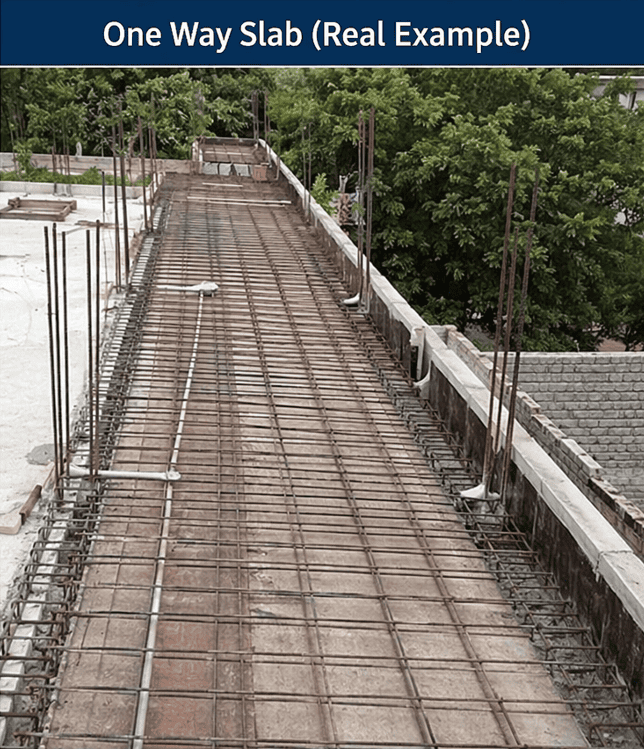
A one-way slab is a slab in which the load is primarily transferred in one direction. This means that the slab bends in a single direction.
The simple rule for this is:
When the longer span / shorter span ratio of the slab is greater than 2, the slab behaves one-way.
Example:
If the slab size is 6m x 2.5m:
6 / 2.5 = 2.4 (>2)
Then it is a one-way slab.
Behavior
In this type of slab:
- Load transfers in the direction of the shorter span.
- Main reinforcement is provided along the shorter span.
- Distribution steel is provided along the longer span.
Practical Use
One-way slabs generally used in:
- Corridors
- Verandas
- Narrow rooms
- Footpaths and small bridges
What is a two Way slab?
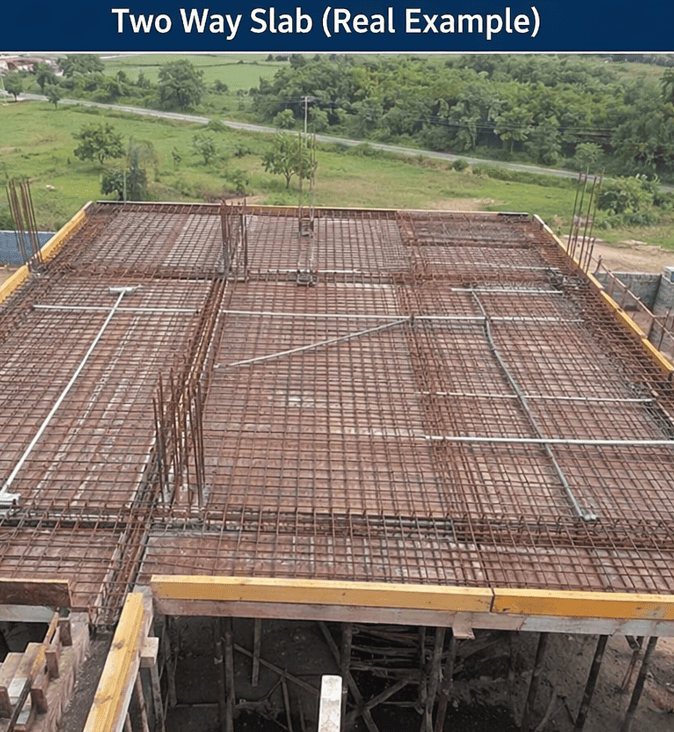
A two-way slab transfers the load in both directions. This means the slab bends in both directions.
The rule for this is:
When the longer span / shorter span ratio is less than or equal to 2, the slab behaves two-way.
Example
If the slab size is 4m x 3m:
4 / 3 = 1.33 (<2)
Then it is a two-way slab.
Behavior
In this type of slab:
- Load is distributed in both directions
- Reinforcement is provided in both directions
- Torsion reinforcement is also provided at the corners
Practical Use
Generally, two way slabs are used for:
- Square or nearly square rooms
- Residential buildings
- Office floors
- Shopping malls
Some articles regarding structure, if you want to read, then click on link below.
How to Calculate HPC Concrete Quantity step by step
Toe Wall in Civil engineering : A complete guide
what is Retaining Wall and Its Type: Complete Guide
Detailed Analysis of Structural Behavior
One Way Slab Behavior
To understand a one-way slab, you can imagine it as a beam. The slab bends across the shorter span. Longer spans have minimal effect.
This means:
- The slab carries the load in one direction.
- Steel also primarily requires placement in one direction.
- The design is relatively simple.
Two-Way Slab Behavior
A two-way slab behaves like a plate that resists bending in both directions. Therefore, its load distribution is complex.
Here:
- Load is evenly distributed
- Stress distribution is uniform
- Deflection is less compared to a one-way slab
Reinforcement Difference
One Way Slab Reinforcement
- Main bars with short spans
- Distribution bars with long spans
- Steel content is relatively low
Two-way slab reinforcement
- Main reinforcement in both directions
- Additional torsional steel at corners
- Steel content is high
Load Distribution Difference
In a one-way slab, the load is distributed only on two opposite sides of the beams, whereas in a two-way slab, the load is distributed on all four sides.
This has a direct impact on:
- Beam design
- Column load
- Foundation design
Thickness (Depth) Difference
Generally:
- One-way slabs have a slightly greater thickness because the load is applied in one direction.
- Two-way slabs may have a smaller thickness because the load is distributed.
- But the actual thickness depends on the design codes and loading conditions.
Cost Comparison
When comparing costs, consider the entire structural system, not just steel or concrete.
One-Way Slab
- Steel requires less
- Formwork is simple
- Design is easy
- Economical for narrow spans
Two-Way Slab
- Steel requires more
- Formwork is a little more complex
- Design is complex
- Economical for square rooms
Important Codes for Slab Design (India)
The most important codes for slab design in India are:
IS 456:2000 (Plain and Reinforced Concrete Code)
This code covers:
Example 1: Corridor
A building has a 2m wide and 8m long corridor.
Ratio = 8 / 2 = 4 (>2)
→ A one-way slab will be used.
Example 2: Room
A room is 4m x 4m in size.
Ratio = 4 / 4 = 1 (<2)
→ A two-way slab will be used.
One Way Slab vs Two Way Slab (Advantages & Disadvantages)
| Category | One Way Slab | Two Way Slab |
| Advantages | 1. The design is simple 2. Construction is fast 3. Best for narrow spaces 4. Cost-effective | 1. Loads are evenly distributed 2. Deflection is minimal 3. Structural stability is high 4. Suitable for large rooms |
| Disadvantages | 1. Deflection is high 2. Load distribution is limited 3. Not suitable for large rooms | 1. The design is complex 2. Steel consumption is high Construction is somewhat difficult |
One Way Slab vs Two Way Slab (Direct Comparison)
| Basis of Comparison | One Way Slab | Two Way Slab |
| Load Transfer | Load is transferred in one direction | Load is transferred in Both directions |
| Support Condition | Usually supported on 2 opposite sides | Supported on 4 opposite sides |
| Span Ratio (Ly/Lx) | Ly/Lx ≥ 2 | Ly/Lx < 2 |
| Bending Behavior | Bending occurs in one direction | Bending occurs in both direction |
| Main Reinforcement | Bars are provided in one direction | Main Reinforcements are provided in both directions |
| Distribution Steel | Distribution bars are provided in the other direction | Both directions have equal importance. |
| Deflection | More | Less |
| Steel Requirement | Require Less steel | Require More steel |
| Design Complexity | Has a simple design | Has a complex design |
| Construction Speed | Fast | Little slow construction process |
| Cost | Cost effective | Expensive |
| Suitable For | Narrow rooms, corridors, small spans | Large rooms, halls, heavy loads |
| Structural Stability | Low stability | High stability |
Important Tips for Site Engineers
If you’re working on-site, keep these points in mind:
- Always check the span ratio
- Place reinforcement according to the drawing
- Maintain the cover
- Ensure proper compaction and curing
- Don’t ignore torsion reinforcement (in two-way slabs)
Common Mistakes
Some common mistakes often occur on site that should be avoided:
- Selecting the wrong slab type
- Providing the wrong reinforcement direction
- Failing to maintain proper spacing
- Ignoring concrete curing
These mistakes affect both the life and safety of the structure.
conclusion
Selecting the right structural design is crucial in building construction, as the strength, durability, and long-term performance of any structure depend on it. Both One-Way and Two-Way systems possess distinct structural behaviors, reinforcement arrangements, and load transfer mechanisms. Therefore, when selecting between them for a project, factors such as the span ratio, loading conditions, architectural requirements, and overall project cost must be considered.
The One-Way system is considered more suitable for areas with a high length-to-width ratio, such as corridors, verandas, and narrow rooms. Its design is relatively simple and requires less reinforcement, allowing the construction process to be completed more quickly. On the other hand, the Two-Way system is better suited for square or nearly square rooms, as it distributes the load in both directions and offers superior structural efficiency.
During the design phase, factors such as reinforcement detailing, concrete cover, spacing, compaction, and curing should never be overlooked. Even a minor detailing error can lead to cracks, excessive deflection, and maintenance issues in the future. Consequently, site engineers and designers must strictly adhere to approved drawings and relevant design codes.
In conclusion, selecting the appropriate slab system is vital for any RCC structure. Both One-Way and Two-Way systems are equally useful in their respective applications. A competent engineer is one who understands the project’s practical requirements, selects the most suitable option, and executes the construction in compliance with proper quality standards. This approach ensures the structure’s safety, cost-effectiveness, and longevity.
About the Author
My name is Susanta Kumar Mohapatra. I am a civil engineering professional with over 11 years of practical experience in the construction and infrastructure sectors. I hold a B.Tech degree in Civil Engineering and an M.E. degree in Construction Management.
Throughout my career, I have worked in various areas such as road construction, bridge projects, quality control, material testing, quantity surveying, project planning, and site management. I am passionate about sharing practical knowledge related to highway engineering, laboratory testing, and construction management with engineers, students, and construction professionals.
I am the founder of CivilGuruHub.com, where I share technical articles, field experiences, laboratory test procedures, guidelines based on IRC and IS codes, and practical construction knowledge related to civil engineering. My aim is to explain civil engineering concepts in simple language and provide useful, reliable information to industry professionals.
You can connect with me through CivilGuruHub.com and my YouTube channel, “The Civil Site,” where I regularly share civil engineering tutorials and practical site knowledge.
Frequently Asked Questions (FAQs)
1. What is the main difference between a One-Way Slab and a Two-Way Slab?
In a One-Way Slab, the load is primarily transferred in one direction, whereas in a Two-Way Slab, the load is transferred in both directions. Consequently, the reinforcement and design for both types of slabs differ.
2. How do you determine whether a slab is One-Way or Two-Way?
The longer span (Ly) of the slab is divided by the shorter span (Lx). If the Ly/Lx ratio is greater than 2, the slab is classified as One-Way; if the ratio is 2 or less, it is classified as Two-Way.
3. In which direction is the main reinforcement provided in a One-Way Slab?
In a One-Way Slab, the main reinforcement is always placed in the direction of the shorter span, as the slab resists bending primarily in that direction.
4. Why is torsion reinforcement provided in a Two-Way Slab?
Torsional stresses develop at the corners of a Two-Way Slab. Torsion reinforcement is provided at the corners to resist these stresses.
5. Which slab is more suitable for residential buildings?
Most rooms in residential buildings are square or rectangular; therefore, Two-Way Slabs are commonly used because they efficiently distribute the load in both directions.
6. Is a Two-Way Slab always more expensive than a One-Way Slab?
Generally, Two-Way Slabs require more steel reinforcement and involve a more complex design, which can result in a slightly higher cost. However, for square rooms, they often prove to be more economical.
7. Where are One-Way Slabs most commonly used?
One-Way Slabs are frequently used in corridors, verandas, footpaths, narrow rooms, and small bridge decks.
8. What are the advantages of a Two-Way Slab?
Two-Way Slabs offer better load distribution, reduced deflection, and greater structural stability; they are considered more suitable for large rooms or halls.
9. Which code is followed for slab design in India?
In India, the IS 456:2000 code is primarily followed for RCC slab design; it provides guidelines for the design and detailing of reinforced concrete structures.
10. What are the most common mistakes made during slab construction at the site?
Mistakes such as incorrect reinforcement orientation, improper spacing, inadequate concrete cover, insufficient curing, and the selection of the wrong slab type are frequently observed at construction sites; these can impact the structure’s durability and safety.