
Table of Contents
Introduction
In the context of hill roads, retaining structures, slope protection, and highway engineering projects, engineers, supervisors, and students very commonly utilize both “Toe Walls” and “Breast Walls.” However, in the field, many engineers, supervisors, and students often confuse these two terms because the primary function of both is to provide support to the slope and the soil. In reality, the location, purpose, loading conditions, design concepts, construction methods, and failure mechanisms of Toe Walls and Breast Walls differ significantly from one another.
Whenever construction teams undertake projects in areas involving hill cutting, embankment protection, retaining structures, or regions prone to landslides, slope stability emerges as the most critical factor. If a contractor does not properly stabilize a slope, serious issues such as soil erosion, landslides, road failures, pavement settlement, and retaining wall collapses may arise. To mitigate these problems, engineers employ various types of protective walls in civil engineering, among which Toe Walls and Breast Walls play a pivotal role.
Contractors typically construct a Toe Wall at the bottom or “toe” of a slope to control soil slippage, erosion, and embankment movement. Conversely, builders construct a Breast Wall along the front face of a slope to provide support against loose soil and rock fragments descending from the hillside. While both structures may appear similar in appearance, their actual engineering purposes are entirely distinct.
In this detailed article, we will explore 12 major differences between Toe Walls and Breast Walls, illustrated with practical examples. Furthermore, we will discuss their construction procedures, design concepts, advantages, disadvantages, relevant IS (Indian Standard) recommendations, real-world site applications, and instances of structural failure, thereby ensuring that both students and site engineers gain a comprehensive and clear understanding of these structures.
What Is a Toe Wall?
A Toe Wall is a type of retaining protective structure that builders construct at the bottom portion of a slope, embankment, or pitching. Its primary purpose is to prevent the downward movement of slope materials and to control erosion. Engineers extensively utilize Toe Walls, particularly in road embankments, canal linings, river protection works, and hill road projects.
Simply, the lowest edge of a slope is referred to as the “toe.” When builders construct a protective wall specifically within this toe area, it is known as a Toe Wall.
The primary function of a Toe Wall is to retain the slope materials and to prevent soil erosion caused by water flow. If the support at the toe becomes compromised, the entire slope may become unstable, thereby increasing the risk of a landslide.
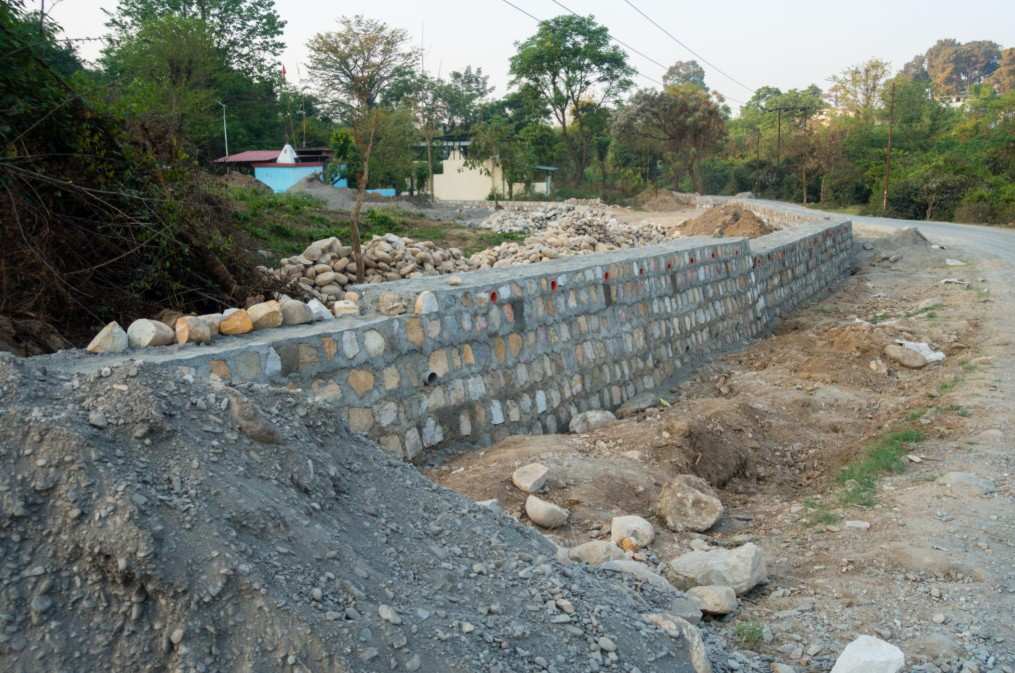
A Practical Example of a Toe Wall
On mountain roads, you may observes stone masonry or RCC walls constructed along the edge of the road embankment, which serve to support the slope. This structure is typically a Toe Wall. Similarly, in river embankments, the wall provided beneath the pitching is also a Toe Wall.
What Is a Breast Wall?
A Breast Wall is a retaining structure that engineers construct on the exposed front face of a hill slope to provide support to loose soil, weathered rocks, and materials resulting from hill cutting. This wall is primarily placed on the uphill side.
The primary purpose of a Breast Wall is to stabilize the exposed slope following hill cutting and to prevent falling materials from tumbling onto the road or any adjacent structures. Lateral earth pressure acts directly upon this wall.
In hill road projects, when workers construct a road by cutting into the hillside, the soil on the uphill side becomes unstable. Engineers specifically provide a Breast Wall to support this unstable slope.
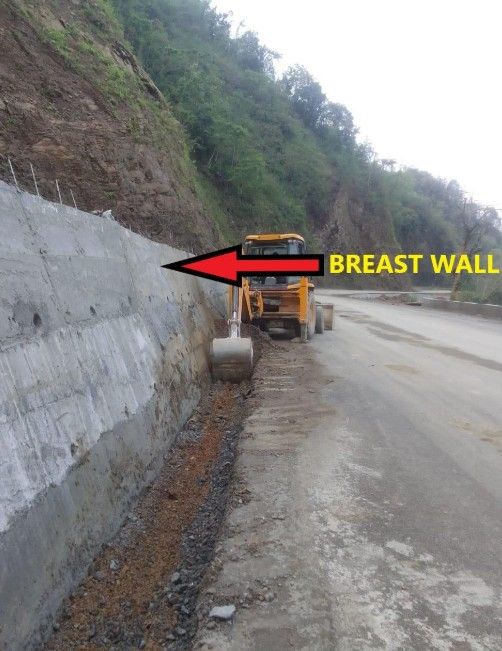
Practical Example of a Breast Wall
In hill stations, you may have seen tall masonry or RCC walls situated along the uphill side of roads, which serve to support the cut slope. These walls are known as Breast Walls. They prevent loose rocks and soil from falling onto the road.
Diagram: Toe Wall vs Breast Wall Position
Simple Representation
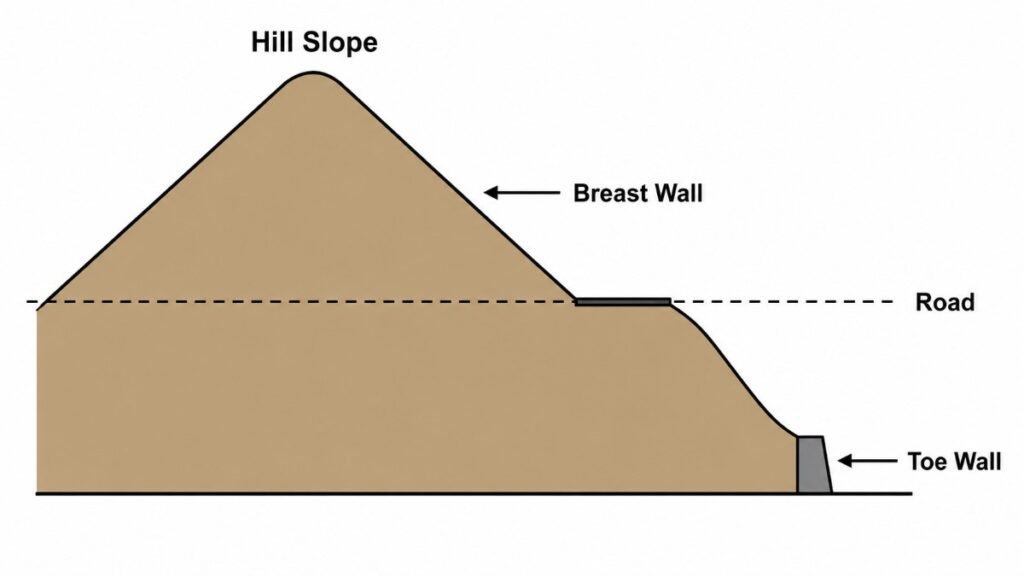
This diagram clearly illustrates that the breast wall is situated on the uphill side, whereas the toe wall is provided at the bottom of the slope.
1. Difference in Location (Toe Wall and Breast Wall)
The most fundamental difference between a Toe Wall and a Breast Wall lies in their location. Engineers construct a Toe Wall at the bottom of a slope specifically in the “toe” area whereas they construct a Breast Wall along the face of the slope or on the uphill side.
A Toe Wall typically sits at the base of an embankment, marking the point where the slope terminates. Its primary function relates to controlling downward soil movement and preventing erosion. This wall reinforces the base of the slope, thereby ensuring the stability of the overlying soil.
The location of a Breast Wall is entirely opposite. Engineers construct it in front of an uphill cut slope. They install a Breast Wall when the natural slope has been disturbed typically as a result of hill cutting operations.
In practical field scenarios, if you observe a wall on the downhill side of a road, it is most likely a Toe Wall; conversely, a wall situated on the uphill side is a Breast Wall.
2. Difference in Main Purpose (Toe Wall and Breast Wall)
The primary objective of a Toe Wall is to provide support to the toe of a slope and to control erosion. Its focus lies mainly on slope stabilization and the prevention of soil slippage.
The primary objective of a Breast Wall is to retain a cut slope and to support loose hillside materials. The main role of this wall is to provide protection against rockfalls and landslides.
A Toe Wall controls water flow and soil movement induced by gravity. A Breast Wall resists direct earth pressure.
For this reason, a Toe Wall is generally regarded as a protective structure, whereas a Breast Wall falls into the category of a retaining structure.
3. Difference in Earth Pressure (Toe Wall and Breast Wall)
Generally, low earth pressure acts on a Toe Wall, as its primary function is to protect the toe of the slope. Consequently, its cross-section is comparatively smaller.
Significant lateral earth pressure acts on a Breast Wall because it directly retains the uphill soil mass. For this very reason, the design of a Breast Wall is considered more critical.
When designing a Breast Wall, factors such as active earth pressure, surcharge loads, seismic forces, and drainage pressure must be taken into consideration. In the case of a Toe Wall, however, primarily erosion forces and slope pressures are considered.
This is the reason why the thickness and reinforcement of a Breast Wall are typically greater.
4. Difference in Height (Toe Wall and Breast Wall)
The height of a Toe Wall is generally limited, typically ranging from 1 to 3 meters, depending on the slope conditions.
The height of a Breast Wall can be quite substantial, as the depth of the hill cutting involved may be significant. In many highway projects, Breast Walls are constructed to heights ranging from 6 to 10 meters.
If the slope height is excessive and the cut section is unstable, stepped Breast Walls are also provided.
Excessive height is normally avoided in a Toe Wall, as its primary purpose is not retaining the slope, but rather providing toe protection.
To explore more about Toe wall and structures, Click on given link.
Toe Wall in Civil engineering : A complete guide
what is Retaining Wall and Its Type: Complete Guide
One Way Slab vs Two Way Slab: complete guide
5. Difference in Construction Material (Toe Wall and Breast Wall)
A Toe Wall is commonly constructed using dry rubble masonry, random rubble masonry, gabion boxes, or RCC.
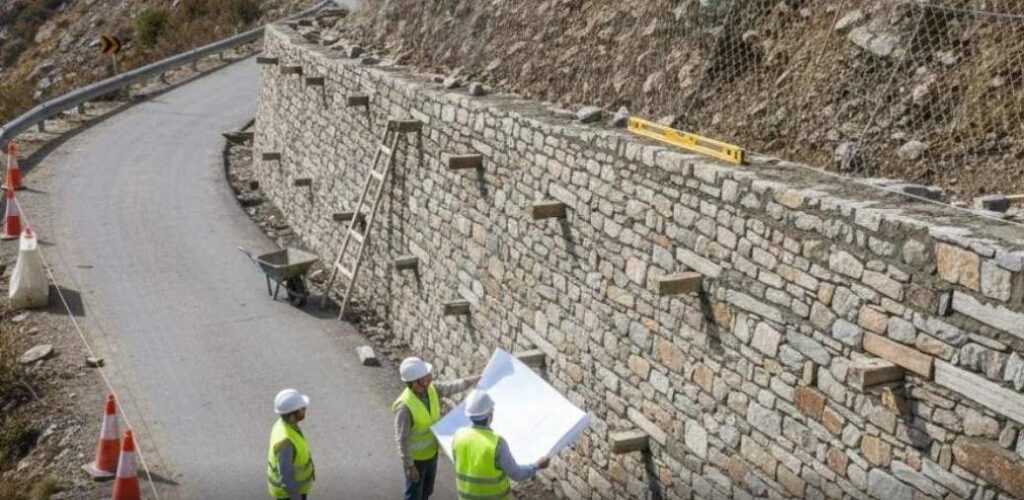
A Breast Wall is generally constructed using stronger materials such as RCC, reinforced masonry, or cement masonry because it is subjected to heavy earth pressure.
In mountainous regions, stone masonry Breast Walls are quite common, as stones are readily available locally.
In modern highway projects, RCC Breast Walls are increasingly being preferred due to their superior structural performance.
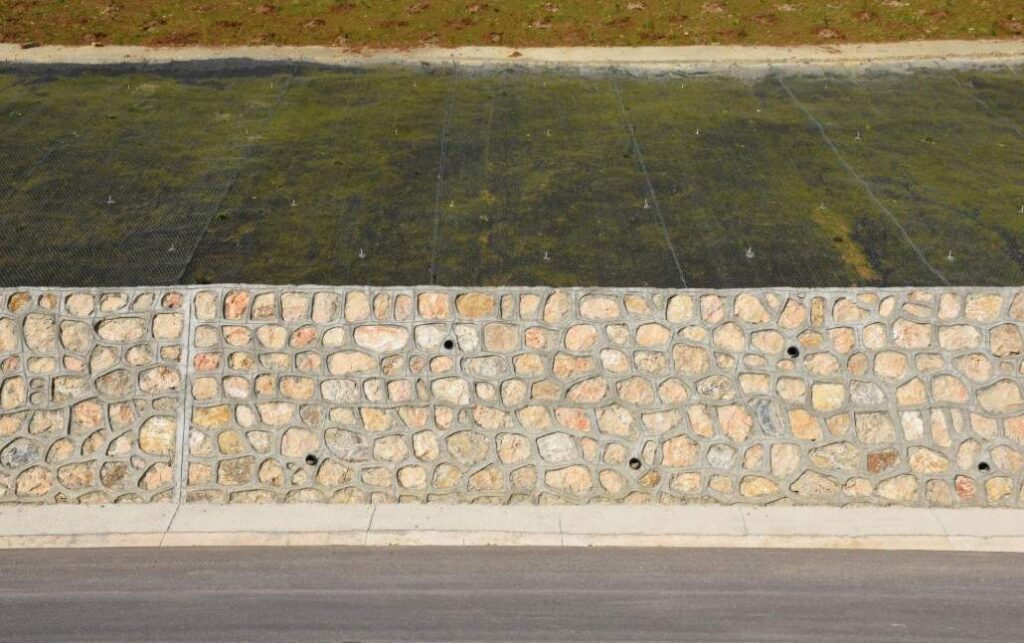
6. Difference in Drainage Requirement (Toe Wall and Breast Wall)
The drainage requirement for a Toe Wall is moderate, as water primarily manifests in the form of surface runoff.
For a Breast Wall, drainage is of paramount importance because water pressure can build up behind the retained soil, potentially becoming a major cause of wall failure.
Consequently, weep holes, filter media, and drainage layers are incorporated into the design of a Breast Wall.
If adequate drainage is not provided, the resulting increase in hydrostatic pressure could cause the Breast Wall to overturn or crack.
7. Difference in Structural Design (Toe Wall and Breast Wall)
The structural analysis of a Toe Wall is comparatively simple. It involves checking for sliding resistance, toe pressure, and erosion resistance.
The structural design of a Breast Wall is more complex. It entails calculations for overturning stability, sliding stability, bearing pressure, and bending moments.
Rankine or Coulomb earth pressure theories are utilized in the design of a Breast Wall.
The design of a Toe Wall is primarily based on practical site conditions and empirical guidelines.
8. Difference in Failure Pattern (Toe Wall and Breast Wall)
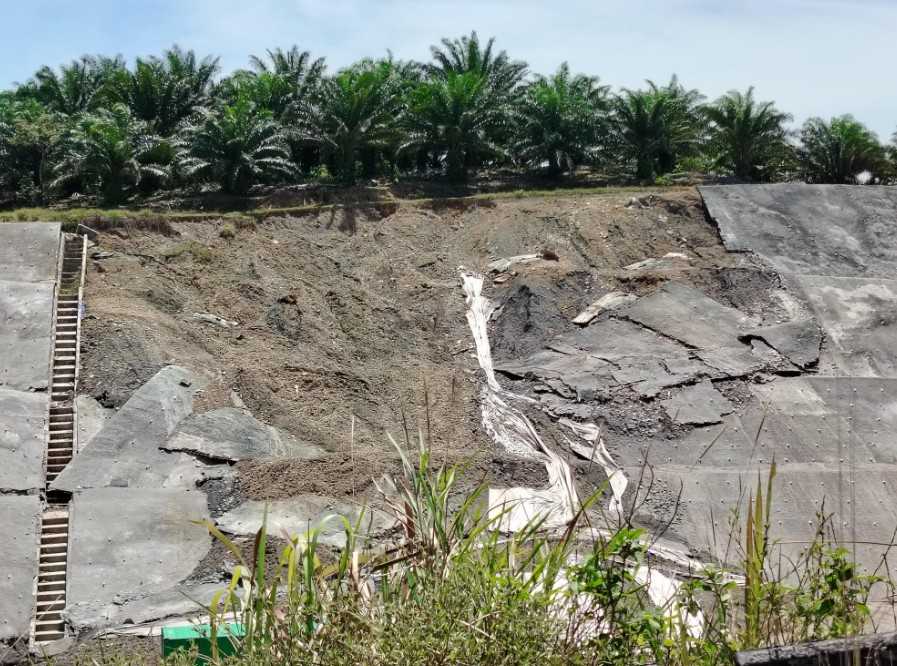
Toe wall failure is primarily caused by erosion, scouring, undermining, or settlement.
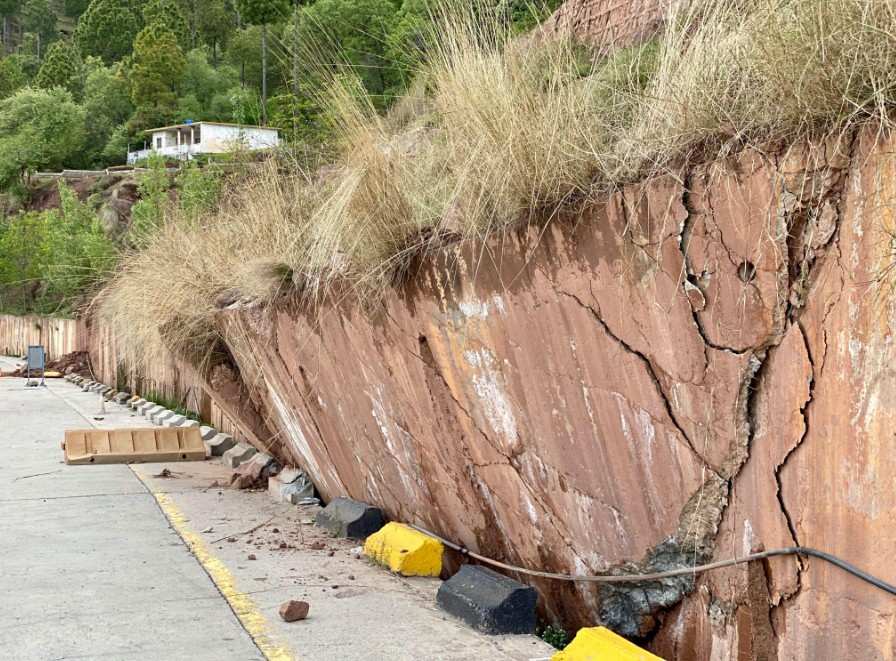
Breast wall failure generally occurs due to overturning, sliding, bulging, or cracking.
In hilly regions, instances of breast wall collapse caused by drainage blockage following intense rainfall are quite common.
Failure of the toe wall weakens the toe of the slope, leading to the gradual development of slope instability.
9. Difference in Construction Cost (Toe Wall and Breast Wall)
A Toe Wall is a comparatively economical structure because it features a smaller cross-section and is subject to lower loading.
A Breast Wall is expensive because it necessitates excavation, reinforcement, drainage arrangements, and heavy structural sections.
The construction cost of RCC Breast Walls can be quite high, particularly in difficult hilly terrain.
In the case of a Toe Wall, economical construction is feasible through the use of locally available stones.
10. Difference in Maintenance (Toe Wall and Breast Wall)
Toe Wall maintenance is primarily limited to erosion repair and the replacement of damaged pitching.
Breast Wall maintenance is more critical, as drainage blockages, wall cracks, and slope movement require continuous monitoring.
If continuous water seepage is observed in the Breast Wall, an immediate inspection is required.
Periodic inspections of the Toe Wall are primarily conducted following the monsoon season.
11. Difference in Application Area (Toe Wall and Breast Wall)
Toe Wall is widely used in river protection works, canal lining, road embankment and slope pitching.
Breast Wall is mainly used in hill roads, mountain highways and cut slope stabilization works.
Toe Wall is also common in hydraulic structures while Breast Wall is mostly used in geotechnical slope stabilization.
12. Difference in Foundation Requirement (Toe Wall and Breast Wall)
Toe Wall’s foundation can be comparatively shallow provided soil is stable.
Stronger and deeper foundation of the breast wall is required because high lateral pressure affects the wall stability.
Breast wall foundation design appears to be extremely important in weak hill soil conditions.
Foundation failure is the major cause of breast wall collapse.
Comparison Table: Toe Wall And Breast Wall
| Parameter | Toe Wall | Breast Wall |
|---|---|---|
| Location | At the bottom of the slope | On the uphill slope face |
| Main Purpose | Controls erosion | Retains earth pressure |
| Earth Pressure | Low | High |
| Height | Generally small | Generally large |
| Cost | Economical | Expensive |
| Drainage Requirement | Moderate | Very important |
| Common Material | Rubble masonry | RCC or masonry |
| Failure Type | Erosion failure | Overturning failure |
| Application | Embankment protection | Support for hill cutting |
| Design Complexity | Simple | Complex |
Relevant IRC and IS Codes
A few Code Links are given only for references and study purpose.
| Code | Description |
|---|---|
| IRC SP 48 | Hill Road Manual |
| IRC 75 | Guidelines for Hill Roads |
| IS 1905 | Masonry Design Code |
| IS 456 | RCC Design Code |
| IS 14458 | Retaining Wall Guidelines |
Conclusion
Both Toe Wall and Breast Wall are important slope protection structures in civil engineering; however, their functions, designs, and applications differ completely. A Toe Wall is primarily utilized for protecting the toe of a slope and controlling erosion, whereas a Breast Wall is constructed for the purpose of retaining earth and supporting hill cuttings.
It is crucial for site engineers and students to understand the distinction between these two structures, as an incorrect selection can lead to slope failure and structural damage. Proper drainage, sound foundation design, and quality construction are essential for ensuring the long-term stability of both types of walls.
In modern highway and hill infrastructure projects, the combined use of Toe Walls and Breast Walls plays a pivotal role in enhancing both slope stabilization and road safety.
FAQs on Toe Wall And Breast Wall
1. What is the main difference between a Toe Wall and Breast Wall?
A Toe Wall is constructed at the bottom portion of a slope or embankment, with its primary purpose being erosion control and providing support to the toe of the slope. A Breast Wall is provided on the front face of an uphill cut slope, and its main function is to retain loose soil and rocks. Simply put, a Toe Wall is located on the downhill side, whereas a Breast Wall is situated on the uphill side.
2. Where is a Toe Wall commonly used in civil engineering?
Toe Walls are commonly used in highway embankments, river protection works, canal lining, hill roads, and slope pitching projects. This structure is particularly useful in areas where there is a high risk of soil erosion caused by rainwater or flowing water.
3. Why is drainage important in Breast Wall construction?
Water pressure can develop within the soil retained behind a Breast Wall. If a proper drainage system such as weep holes and filter media is not provided, the resulting increase in hydrostatic pressure can lead to cracking, bulging, or even the collapse of the wall. For this reason, drainage is extremely important in Breast Wall construction.
4. Which material is best for Toe Wall construction?
Dry rubble masonry, random rubble masonry, gabion boxes, and Reinforced Cement Concrete (RCC) are commonly used materials for Toe Walls. The selection of material depends on site conditions, the intensity of water flow, and the project budget. In the context of hill roads, stone masonry Toe Walls are often a highly economical and popular choice.
5. Can a Toe Wall and Breast Wall be used together in a single project?
Yes, both structures can be utilized simultaneously in hill road and slope stabilization projects. A Breast Wall is provided on the uphill side to ensure the stability of the cut slope, while a Toe Wall is constructed on the downhill side to control embankment erosion and prevent soil slippage.
6. What are the common causes of Toe Wall and Breast Wall failure?
Toe Wall failure is primarily caused by erosion, scouring, foundation settlement, and poor construction quality. Breast Wall failure generally results from excessive earth pressure, inadequate drainage, overturning, sliding, and weak foundation conditions. Proper design and regular maintenance are essential for ensuring the stability of these walls.