
- What is Road Safety Engineering? How to Cut Highway Accidents by 50%
- What is Road Safety Engineering? How to Cut Highway Accidents by 50%
- What is Road Safety Engineering? (Basic Concepts & Importance)
- Hidden Engineering Flaws Behind Highway Accidents
- Proven Methods of Road Safety Engineering: How to Reduce Accidents by 50%?
- Black Spot Identification and Rectification (MoRTH Protocols)
- Forgiving Roadsides and Crash Barrier Systems (IRC:119)
- Geometric Design Optimization (IRC:73 and IRC:SP:84)
- Traffic Calming Measures (Speed Management)
- Retro-Reflective Signage and Thermoplastic Road Markings (IRC:67 & IRC:35)
- Dedicated infrastructure for vulnerable road users (VRUs)
- Skid Resistance and Advanced Drainage Engineering
- Road Safety Audit (RSA): A tool to prevent accidents before they occur (Ref: SP:88)
- Modern Technology in Road Safety Engineering (Future of Highways)
- Case Study: How did engineering interventions change the picture?
- Practical Checklist for Highway Engineers and Contractors
- About the Author
- Frequently Asked Questions (FAQs)
- What is the difference between Road Safety Engineering and Traffic Engineering?
- Which IRC codes are the most important for Road Safety Engineering in India?
- How long does it take to address a 'black spot'?
- Can highway accidents be reduced simply by installing speed breakers?
- How can a civil engineer become a Road Safety Auditor?
What is Road Safety Engineering? How to Cut Highway Accidents by 50%
Every year, hundreds of thousands of people in India fall victim to road accidents, a significant proportion of which occur on National and State Highways. Often, when a major accident takes place, the blame is placed entirely on driver error or over-speeding. However, from the perspective of a highway engineer, the reality is quite different. Did you know that a minor technical flaw in road design—such as incorrect super-elevation, a blind curve, or poor drainage—can lead even a skilled driver into a fatal situation?
This is where the true essence of Road Safety Engineering comes into play. It goes far beyond simply painting white lines on the road or installing signboards; it is a precise science that integrates human psychology, vehicle dynamics, and civil engineering to design roads where, even if a mistake occurs, it does not result in a loss of life. In today’s detailed guide, we will take a deep dive into what Road Safety Engineering entails and explore how the application of proven engineering methods—as established by the Indian Roads Congress (IRC) and the Ministry of Road Transport and Highways (MoRTH)—can help reduce highway accidents by up to 50%.
What is Road Safety Engineering? (Basic Concepts & Importance)
In simple terms, Road Safety Engineering is a specialized branch of traffic engineering that optimizes road geometric design, traffic control devices, and the roadside environment to minimize both the frequency and severity of road crashes.
In the past, the primary focus of engineers was on ensuring that vehicles could travel from one place to another in the shortest possible time (mobility). Today, however, the emphasis is on the “Safe System Approach.” This approach is guided by one golden rule: “Humans will inevitably make mistakes; therefore, road infrastructure should be ‘forgiving’ enough to ensure that such a mistake does not result in death.”
The 3 Es of Road Safety and the Role of Engineering
To address road safety, the ‘3 E’s’ concept is followed globally:
- Engineering: Designing roads, signage, lighting, and barriers in a scientific manner.
- Enforcement: Strictly implementing traffic rules through traffic police and surveillance cameras.
- Education: Raising awareness among drivers and pedestrians regarding traffic rules.
Hidden Engineering Flaws Behind Highway Accidents
When we visit a site to inspect an accident-prone area, we often uncover technical flaws that remain invisible to the average person. To achieve a 50% reduction in accidents, it is essential to understand these root causes:
- Deficient Geometric Design: Sudden sharp horizontal curves, inadequate Stopping Sight Distance (SSD), and improper super-elevation (banking) can cause high-speed vehicles to lose their balance.
- Unforgiving Roadside Environment: Hazards such as trees, electric poles, deep open drains, or unshielded bridge piers located right along the roadside. In the event of a ‘run-off-road’ crash, colliding with these rigid objects often leads to fatal injuries.
- Poor Pavement Surface & Drainage: Issues like rutting, potholes, or ‘bleeding’ on bituminous (asphalt) roads reduce skid resistance. Furthermore, if the road camber is inadequate, water accumulates during rain, leading to ‘hydroplaning’—where a layer of water forms between the tires and the road surface—effectively causing brakes to fail.
- Inconsistent Traffic Control Devices: Faded road markings, non-retroreflective signboards (which do not remain visible at night), and speed breakers installed in inappropriate locations.
- Uncontrolled Access & Median Openings: Unauthorized breaches in highway medians—often created to provide access to villages or roadside eateries (dhabas)—as well as local roads that merge with the highway without dedicated acceleration or deceleration lanes.
Proven Methods of Road Safety Engineering: How to Reduce Accidents by 50%?
Global research (such as that from the World Bank and iRAP—International Road Assessment Programme) and data from MoRTH have established that if the 7 core engineering interventions listed below are properly implemented on existing and upcoming highways, fatalities and serious injuries can be reduced by more than 50%.
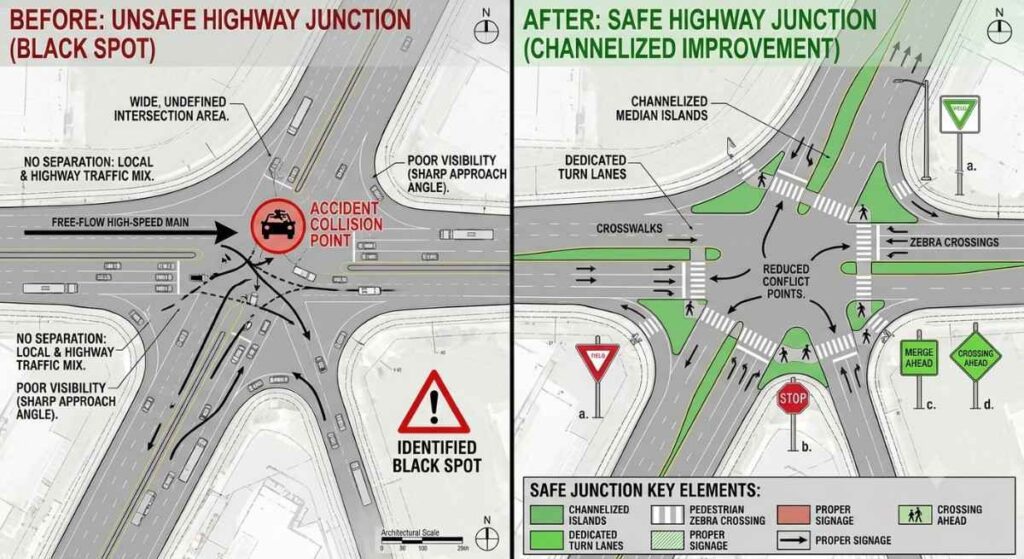
Black Spot Identification and Rectification (MoRTH Protocols)
Any 500-meter stretch on a highway where 5 or more road accidents (resulting in fatalities or grievous injuries) or 10 fatalities have occurred over the last 3 years is designated as a ‘Black Spot’ in accordance with MoRTH guidelines.
Engineering Treatment:
- Initially, a micro-analysis of crash data is conducted for the specific location—often by creating a ‘collision diagram’—to determine the angle and timing of the collisions.
- Short-term measures: Immediate interventions include the installation of solar blinkers, chevron signs, thermoplastic rumble strips, and hazard markers.
- Long-term measures: If a geometric flaw is identified, corrective actions may include realigning a curve, channelizing a junction, or constructing a pedestrian underpass (VUP/PUP).
Forgiving Roadsides and Crash Barrier Systems (IRC:119)
In engineering, there is a concept known as the “Clear Zone”—an open space beyond the edge of the carriageway where, should a vehicle go out of control, the driver can safely regain control and steer it back onto the road. However, in areas with high embankments (exceeding 3 meters) or where hazards—such as a ditch, a body of water, or a concrete pillar—exist along the roadside, the installation of crash barriers is mandatory.
- W-Beam and Thrie-Beam Metal Crash Barriers: These steel barriers absorb the kinetic energy of an impact and redirect the vehicle back toward the roadway, preventing it from overturning or plunging into a ditch or ravine.
- Wire Rope Safety Barriers: These consist of high-tension steel cables installed in the median to prevent vehicles from crossing over into the opposing lane and causing a head-on collision.
- End Terminals (Crash Cushions): The terminal end of a W-beam barrier should never be left exposed or simply anchored into the ground (in a “fishtail” or “turndown” configuration), as a high-speed vehicle could strike it, ramp upward, and become airborne. Instead, systems such as P-4/MELT (Modified Eccentric Loader Terminal) or energy-absorbing crash cushions must always be used.
Geometric Design Optimization (IRC:73 and IRC:SP:84)
The geometry of a road is the foundation of its safety. If the design speed is 100 km/h, every element must be designed in accordance with that speed:
- Sight Distance: A driver must be able to see the road ahead clearly enough to either apply the brakes safely if an obstacle appears (Stopping Sight Distance) or to overtake (Overtaking Sight Distance). Sight distance is often obstructed on vertical curves (crests and sags), which can be addressed by flattening the gradient.
- Super-elevation (e): On curves, the outer edge of the road is raised to counterbalance centrifugal force (up to a maximum of 7% or 0.07 in plain terrain). Incorrect super-elevation can cause vehicles to be pushed toward the outer edge of the road.
- Paved Shoulders: Highways should have paved shoulders at least 1.5m to 2.5m wide. These provide a safe space for broken-down vehicles to park and offer drivers room to take evasive action in an emergency.
Traffic Calming Measures (Speed Management)
When highways pass near a village, town, or toll plaza, reducing vehicle speed from 100 km/h to 40–50 km/h presents a major challenge. Installing conventional speed breakers (humps) in such locations can be highly dangerous. Instead, scientific “traffic calming measures” are employed:
- Transverse Bar Markings (TBM): These consist of thermoplastic paint strips applied to the road surface at specific, logarithmically decreasing intervals. As a vehicle passes over them, they create an optical illusion that makes the driver perceive their speed as being much higher, prompting them to instinctively apply the brakes.
- Rumble Strips: These are raised strips (10mm to 15mm in height) that generate mild vibrations and noise upon contact with vehicle tires. They are particularly effective when installed as “shoulder rumble strips,” serving to alert drivers who may be experiencing drowsiness—a feature especially useful at night.
- Gateway Treatments: These involve visually narrowing the road—often through the use of median islands and overhead gantries—before entering a populated area. This encourages drivers to subconsciously reduce their speed.
Retro-Reflective Signage and Thermoplastic Road Markings (IRC:67 & IRC:35)
In India, more than 50% of fatal accidents occur between 6:00 PM and 6:00 AM, primarily due to poor visibility. In road safety engineering, the concept of “Self-Explaining Roads” is employed—meaning the road itself should communicate to the driver what lies ahead.
- IRC:67 Compliant Signage: Signboards should utilize Type-XI (micro-prismatic) retro-reflective sheeting, which becomes highly visible from a distance when illuminated by vehicle headlights. Warning signs (such as those indicating a sharp curve or a school ahead) must be placed at an appropriate distance from the hazard—typically 90 to 180 meters, in accordance with IRC guidelines.
- Thermoplastic Paint with Glass Beads (IRC:35): Hot-applied thermoplastic paint, embedded with “drop-on” glass beads, is used for lane markings, edge lines, and zebra crossings. At night, these glass beads reflect light, making lane boundaries clearly visible.
- Solar Road Studs (“Cat’s Eyes”): Installing LED or retro-reflective road studs along the center and edge lines—particularly on curves, bridges, and in fog-prone areas—ensures that the road alignment remains clearly visible, even in conditions of near-zero visibility (such as dense fog).
Dedicated infrastructure for vulnerable road users (VRUs)
Indian highways are not used exclusively by cars and trucks; they also see a high volume of pedestrians, cyclists, and two-wheelers. When fast-moving traffic and slow-moving local traffic share the same lane, accidents become inevitable.
- Service Roads: In urban and semi-urban areas, it is essential to construct service roads—7.0m to 7.5m in width—on both sides of the main carriageway to prevent local traffic from entering the highway.
- VUP, LVUP, and PUP: To facilitate the crossing of roads by villagers and livestock, infrastructure such as Vehicular Underpasses (VUP), Light Vehicular Underpasses (LVUP), Pedestrian Underpasses (PUP), and Foot Over Bridges (FOB) should be provided.
- Bus Bays and Truck Lay-byes: Dedicated bus bays should be constructed to prevent buses from stopping on the main carriageway; this significantly reduces the incidence of rear-end collisions.
To read more articles, check the following guides:
How to Determine Safe Bearing Capacity of Soil (2026): Tests, Formula, and Indian Standard Codes
Major Types of Structural Cracks Explained with Practical Examples
How Does The 10-30-65 Method Work In CBR Testing? Complete Guide
Skid Resistance and Advanced Drainage Engineering
The true test of a good engineer comes during the rainy season. If the road surface has become smooth due to wear (polished aggregates), vehicles may skid even in dry weather when brakes are applied.
- Micro-Surfacing and Stone Matrix Asphalt (SMA): Using SMA or an open-graded friction course on high-speed corridors enhances the grip (skid resistance) between the tires and the road surface, while also facilitating rapid water drainage.
- Sub-surface and Surface Drainage: It is essential to strictly maintain the camber (2.5% for bituminous roads and 2.0% for concrete roads) and construct lined side drains. This prevents water from weakening the subgrade and ensures that no waterlogging occurs on the road.
Road Safety Audit (RSA): A tool to prevent accidents before they occur (Ref: SP:88)
Many people believe that a safety check is conducted only after a road has been built. However, a Road Safety Audit (RSA) is a formal, independent examination carried out by a certified Road Safety Auditor at every stage of a road project. According to IRC:SP:88, there are five main stages of an RSA:
| RSA Stage | When is it Conducted? | Main Engineering Focus |
|---|---|---|
| Stage 1: Feasibility Study | During route selection and DPR preparation | Assessment of alignment, bypasses, junction types, and connectivity. |
| Stage 2: Preliminary Design | Before land acquisition | Checking of cross-sections, sight distances, and horizontal/vertical curves. |
| Stage 3: Detailed Design | Upon finalization of construction drawings | Review of signage, road markings, crash barriers, drainage, and lighting layouts. |
| Stage 4: During Construction | While work is in progress on-site (Work Zone) | Checking of traffic diversions, barricading, and worker safety in accordance with IRC:SP:55. |
| Stage 5: Pre-Opening & O&M | Immediately before and after opening to road traffic | Night-time inspection, retro-reflectivity testing, and monitoring of operational ‘black spots’. |
A good RSA (Road Safety Audit) identifies 80% of design flaws before construction even begins, saving the costs associated with later demolition and reconstruction, while ensuring a safe highway from day one.
Modern Technology in Road Safety Engineering (Future of Highways)
As we approach 2026 and beyond, the integration of smart technologies with traditional civil engineering is elevating Road Safety Engineering to the next level, making highway corridors both safer and more responsive.
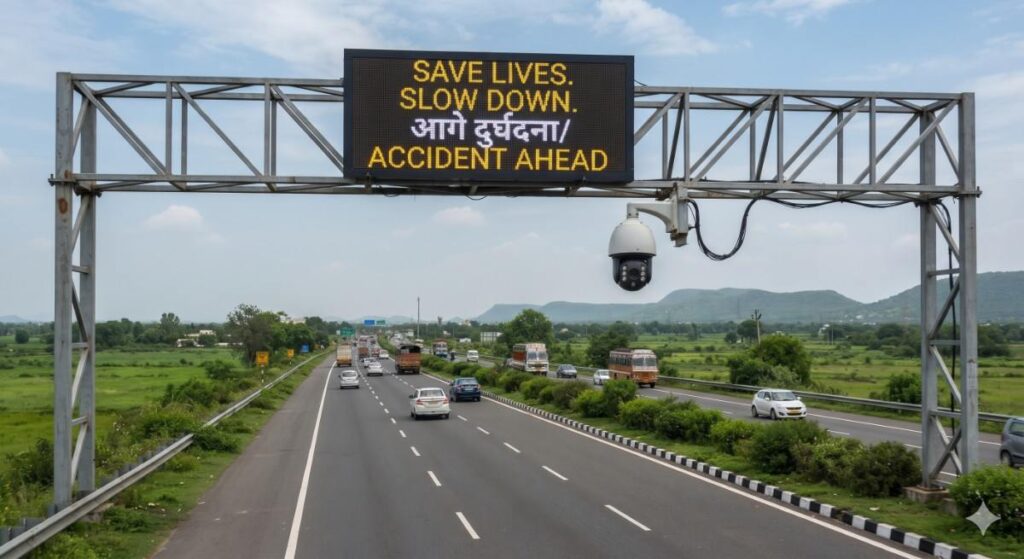
- ATMS (Advanced Traffic Management System): PTZ cameras, Automatic Traffic Counter-cum-Classifiers (ATCC), and Variable Message Signs (VMS) are being installed along highways at regular intervals. By providing real-time data, these systems enable the immediate display of alerts—such as warnings about potential accidents or foggy conditions—on VMS boards.
- iRAP Star Rating System: Highways are now assigned a safety rating ranging from 1 to 5 stars. To align with established Road Safety Engineering benchmarks, the NHAI and MoRTH have set a target for all new highways to meet at least a 4-star or 5-star safety standard.
- LIDAR and Drone Surveys: Mobile LiDAR vehicles are now being used to map geometric flaws, road surface rutting, and roadside encroachments with millimeter-level precision. This high-precision data assists Road Safety Engineering teams in promptly identifying hidden hazards.
- Intelligent Speed Assistance (ISA) & V2X: Smart road infrastructure can now communicate directly with sensors in modern vehicles, providing drivers with warnings on their dashboards—for instance, when approaching blind curves. Such connected systems render Road Safety Engineering proactive and future-ready.
Case Study: How did engineering interventions change the picture?
To understand how effective these methods are on the ground, we can look at the example of the Mumbai-Pune Expressway, where Road Safety Engineering brought about a significant transformation. As India’s first 6-lane high-speed expressway, it initially saw a high number of fatalities due to issues like over-speeding, sharp curves in the ghat (mountain pass) section, and vehicles crossing over the median.
- The SaveLIFE Foundation, the MSRDC (Maharashtra State Road Development Corporation), and traffic engineers collaborated to launch a “Zero Fatality Corridor” project. Rather than relying solely on increasing the number of police personnel, they focused on Road Safety Engineering:
- In the ghat section, old and damaged crash barriers were replaced with high-containment ‘Thrie-beam’ barriers and roller barriers, which adhere to strict Road Safety Engineering standards.
- To prevent rear-end collisions, illegal parking along the highway was eliminated, and dedicated truck lay-byes were constructed—a crucial component of Road Safety Engineering.
- At blind curves, chevron signs, solar-powered blinkers, and transverse rumble strips were installed to provide advance warnings to drivers, in line with Road Safety Engineering principles.
- Energy-absorbing crash cushions were installed in front of concrete pillars and bridge abutments, significantly reducing the severity of impacts—a key outcome of effective Road Safety Engineering.
- The result: Within just four years, fatalities from road accidents on this expressway dropped by more than 52%. This serves as clear evidence that with the right approach to Road Safety Engineering, it is entirely possible to cut the number of accidents by half.
Practical Checklist for Highway Engineers and Contractors
If you are a site engineer, highway planner, or maintenance contractor, incorporate these 5 practices into your daily routine to meet Road Safety Engineering goals for your project stretch:
- Conduct Night-Time Inspections: Inspect your site at night at least once a month. Signboards and markings that appear fine during the day may reveal their true retro-reflectivity under vehicle headlights at night—this is the real test of Road Safety Engineering.
- Prioritize Work Zone Safety (IRC:SP:55): When carrying out maintenance, ensure that plastic cones, barricades, and flagmen are positioned with the correct taper length. According to Road Safety Engineering principles, work zone accidents are highly preventable if safety protocols are strictly followed.
- Trim Vegetation: Regularly trim bushes growing along the median and road shoulders, as they can obscure signboards and block sight distance on curves. Regular trimming is essential for maintaining clear visibility—a key component of Road Safety Engineering.
- Maintain Crash Barriers: Do not leave W-beam barriers damaged after an accident for months on end. A damaged barrier will not function effectively in a subsequent impact; therefore, replace it immediately in accordance with Road Safety Engineering standards.
- Zero-Tolerance for Drainage Issues and Potholes: Ensure that all culverts, catch pits, and side drains are cleared (desilted) before the monsoon season. Proper drainage is a foundational element of Road Safety Engineering, helping to prevent pavement failure and vehicle skidding.
About the Author
My name is Susanta Kumar Mohapatra, and I am a Civil Engineering professional with over 11 years of practical experience in the construction and infrastructure sector. I hold a B.Tech degree in Civil Engineering and an M.E. degree in Construction Management. Throughout my career, I have worked in key areas such as road construction, bridge projects, highway engineering, quality control, material testing, quantity estimation, and project management.
I launched CivilGuruHub.com to share my practical field experience and technical knowledge in simple, accessible language. On this platform, I publish research-based articles covering IS/IRC codes, highway maintenance, construction technology, and engineering calculators—resources designed for students, site engineers, quality engineers, quantity surveyors, and contractors.
In addition to the website, I share videos on site execution, laboratory testing, and practical calculations via my YouTube channel, “The Civil Site.” Thank you sincerely for your trust and support!
Frequently Asked Questions (FAQs)
What is the difference between Road Safety Engineering and Traffic Engineering?
Answer: The primary objective of Traffic Engineering is to ensure smooth traffic flow, reduce congestion, and save travel time (Mobility). In contrast, the sole focus of Road Safety Engineering is to improve road design and the environment to prevent road crashes and fatalities (Safety). Digital tools, such as ATMS , are also part of this branch.
Which IRC codes are the most important for Road Safety Engineering in India?
Answer: Key IRC codes for highway safety include: IRC:SP:88 (Road Safety Audit), IRC:67 (Road Signs), IRC:35 (Road Markings), IRC:119 (Roadside Safety Barriers), IRC:SP:55 (Safety in Construction Zones), and IRC:73 / IRC:86 (Geometric Design Standards). The proper integration of these standards makes Road Safety Engineering effective.
How long does it take to address a ‘black spot’?
Answer: Addressing a black spot occurs in two phases. Short-term measures—such as installing signage, road markings, rumble strips, and blinkers—can be completed within 15 to 30 days; these serve as ‘quick-win’ steps in Road Safety Engineering. Long-term measures—such as constructing flyovers, realigning curves, or land acquisition—can take anywhere from 6 months to 2 years.
Can highway accidents be reduced simply by installing speed breakers?
Answer: Certainly not! Installing unscientific speed breakers (humps) on National and State Highways is illegal (violating IRC:99) and often becomes a cause for major accidents itself. To control speeds on highways, Transverse Bar Markings (TBM) and rumble strips are used as part of road safety engineering; these are designed based on digital surveys.
How can a civil engineer become a Road Safety Auditor?
Answer: After obtaining a degree or diploma in civil engineering and gaining a minimum amount of experience (typically 5 years) in highway design or construction, you can become a certified Road Safety Auditor by completing a 15-day certification course offered by institutions such as the CRRI (Central Road Research Institute), IAHE (Indian Academy of Highway Engineers), or various IITs. This qualification allows you to pursue a specialized career in road safety engineering, which may also encompass areas like ATMS (Advanced Traffic Management System) data analysis.
Ultimately, it can be said that roads are not merely constructed from soil, aggregate, and bitumen; they are built upon the trust of the people who travel on them. When an engineer, fully grasping their responsibility, designs every curve, signboard, and crash barrier in accordance with IRC standards, they—perhaps unknowingly—prevent the devastation of thousands of families. Road Safety Engineering is not an expense, but an investment that yields returns in the form of human lives saved. Technologies—such as the ATMS shown in ‘image_8.png’—are making this process even more effective.
If you found this guide informative, please share it with your civil engineering colleagues. Also, let us know in the comments below: what do you consider to be the most significant shortcoming in Road Safety Engineering on the highways in your area?