
Table of Contents
Introduction
In highway engineering, experts consider Road Curve Calculation one of the most important concepts for designing safe and efficient roads. During the planning of highways, expressways, city roads, hill roads, bypasses, and village roads, engineers often find it impossible to maintain a completely straight alignment due to terrain conditions, buildings, rivers, forests, railway crossings, and safety requirements. Therefore, engineers use curves to provide smooth directional changes, making Road Curve Calculation essential in road design.
Proper Road Curve Calculation ensures vehicle safety, riding comfort, and smooth traffic movement. If engineers do not design curves accurately, problems such as vehicle skidding, overturning, drainage issues, and accident risks can increase significantly. This is why engineers follow standard guidelines and perform precise Road Curve Calculation before construction.
The process of Road Curve Calculation involves determining horizontal curves, vertical curves, transition curves, super elevation, chainage calculations, and stopping sight distance. These calculations help engineers create safer roads with better driving comfort and improved operational efficiency.
This guide explains 7 easy methods of Road Curve Calculation using practical examples and field engineering concepts. Understanding Road Curve Calculation is highly beneficial for highway engineers, site supervisors, civil engineering students, quantity surveyors, contractors, and competitive exam aspirants.
Basic Components of Road Curve Design
| Calculation Method | Main Purpose | Common Use |
|---|---|---|
| Horizontal Curve Calculation | Determines curve radius and geometry | Highway alignment |
| Vertical Curve Calculation | Provides smooth gradient transition | Roads and bridges |
| Super Elevation Calculation | Prevents skidding on curves | High-speed roads |
| Transition Curve Calculation | Creates gradual curve entry | Expressways |
| Stopping Sight Distance | Ensures driver visibility | Safety design |
| Chainage Calculation | Curve positioning and setting out | Site execution |
| Curve Setting Out Methods | Field implementation of curves | Construction work |
What is a Road Curve?
In road alignment design, whenever the direction or slope of a road changes, introducing an abrupt, sharp turn is not safe. To resolve this issue, engineers provide a smooth transition section—known as a road curve. The primary purpose of curves is to ensure comfortable, safe, and smooth movement for vehicles.
Simply put, engineers introduce a curve when a straight road needs to transition gradually into a turn, or when different slopes need to be connected smoothly. Without a properly designed curve, vehicles face an increased risk of sudden turns, skidding, and accidents. For this reason, engineers consider precise road curve calculation a critical aspect of modern highway engineering.
During the road design phase, engineers take into account factors such as traffic speed, terrain conditions, vehicle dynamics, and safety standards. Accurate road curve calculations facilitate the maintenance of an appropriate turning radius, adequate visibility, and vehicle stability. Consequently, engineers consider road curve calculation an essential component of the design process in highway projects.
In highway engineering, engineers primarily categorize curves into two types:
| Curve Type | Purpose |
|---|---|
| Horizontal Curve | Used for changing road direction |
| Vertical Curve | Used for changing gradient or slope |
Engineers utilize horizontal curves to alter the road’s directional alignment, whereas they use vertical curves to smoothly connect ascending and descending slopes.
Proper road curve calculation enhances road safety, reduces vehicle operating costs, and improves driving comfort. For these reasons, engineers evaluate multiple parameters during the design stage to ensure the accuracy of their road curve calculations.
In contemporary transportation projects, efficient road curve calculation directly influences both the operational performance and the long-term durability of the road infrastructure. Therefore, engineers consider a thorough understanding of curves and their underlying design principles a fundamental requirement in the field of highway engineering.
IRC Codes Used in Road Curve Calculation
The following IRC standards are very important in highway projects:
| IRC Code | Purpose |
|---|---|
| IRC 38 | Horizontal Curves Design |
| IRC 73 | Rural Highway Standards |
| IRC 86 | Geometric Design Standards |
| IRC SP 23 | Road Safety Guidelines |
| IRC 99 | Hill Road Design |
| IRC 52 | Drainage and Camber |
Important Terms in Road Curve Calculation
| Term | Meaning |
|---|---|
| Radius (R) | Radius of Curve |
| Deflection Angle | Turning angle |
| Tangent Length | Tangent distance |
| Super Elevation | Outer edge raising |
| Transition Curve | Gradual Transition Curve |
| Chainage | Distance measurement |
| K Value | Vertical curve comfort factor |
| SSD | Stopping Sight Distance |
Method 1 – Horizontal Curve Calculation
The horizontal curve is the most commonly used type of curve in highway alignment. A horizontal curve is provided whenever the direction of the road changes to the left or the right.
Without proper road curve calculations, a vehicle may skid when traveling at high speeds.
Formula for Horizontal Curves
Radius Formula
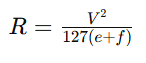
Where:
R = Radius in meters
V = Speed in km/hr
e = Superelevation
f = Side friction factor
Practical Example
Given:
Design Speed = 80 km/hr
Superelevation = 0.07
Friction factor = 0.15
Calculation:
R = 80² / [127 × (0.07 + 0.15)]
= 6400 / 27.94
= 229 meters (approx.)
This means that a minimum radius of 229 meters must be provided on the highway.
Tangent Length Formula
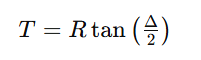
T = Tangent length
Δ = Deflection angle
Site Engineering Tips
- Curve marking is most accurate when performed using a Total Station.
- The peg interval is typically set at 10m or 20m.
- Providing a transition curve is crucial for safety.
- Installing reflectors and chevron signs is mandatory on sharp curves.


Method 2 – Super Elevation Calculation in Road Design
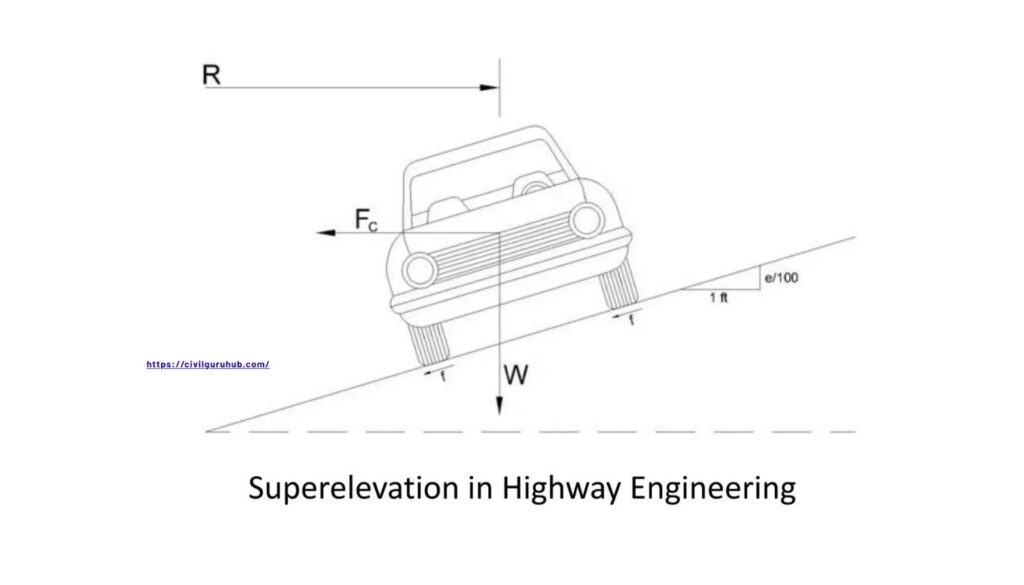
When a vehicle travels along a curve, it is subjected to a centrifugal force that pushes it outward. To counteract this force, the outer edge of the road curve is raised slightly higher than the inner edge; this elevation is known as super elevation. Providing appropriate super elevation is a crucial part of road curve design calculations, as it enhances vehicle stability and mitigates the risk of accidents.
In road design, performing accurate road curve calculations is essential, as erroneous calculations can lead to vehicle skidding, overturning, and the creation of unsafe driving conditions. When performing road curve calculations, highway engineers take into account factors such as design speed, curve radius, and terrain conditions.
Super Elevation Formula
e = V² / 225R
Where:
- e = Super elevation
- V = Design Speed (km/hr)
- R = Radius of Curve (m)
Example Calculation
Given:
Speed = 60 km/hr
Radius = 150 m
Using the formula:
e = 3600 / 33750
e = 0.106
This indicates that the calculated super elevation requirement is approximately 10.6%; however, practical road design adheres to the limits prescribed by the IRC (Indian Roads Congress). Therefore, during road curve calculations, the permissible value—as stipulated by the relevant standards—must be adopted.
IRC Recommended Limits
| Terrain Type | Maximum Super Elevation |
|---|---|
| Plain Area | 7% |
| Snow Area | 10% |
| Urban Roads | 4% |
Site Procedure for Super Elevation Construction
| Step | Process |
|---|---|
| 1 | Establish center line accurately |
| 2 | Measure pavement width |
| 3 | Calculate required outer edge lifting |
| 4 | Maintain designed gradient continuously |
| 5 | Perform proper roller compaction |
Accurate road curve calculation ensures smoother driving, improved drainage, enhanced vehicle control, and safer movement along curved road sections. During the construction phase, engineers repeatedly verify the road curve calculation values, as even minor discrepancies can adversely affect the long-term performance and safety of the pavement. Ultimately, precise road curve calculation results in the creation of safer and more efficient roadways.
To Get more knowledge abot Highway click on links, given below
what is Superelevation in road: complete guide
How to Calculate Camber Tolerance in Road Construction Step by Step
How Do GSB and WMM Differ? 10 important Facts for Highway Construction
Method 3 – Transition Curve Calculation
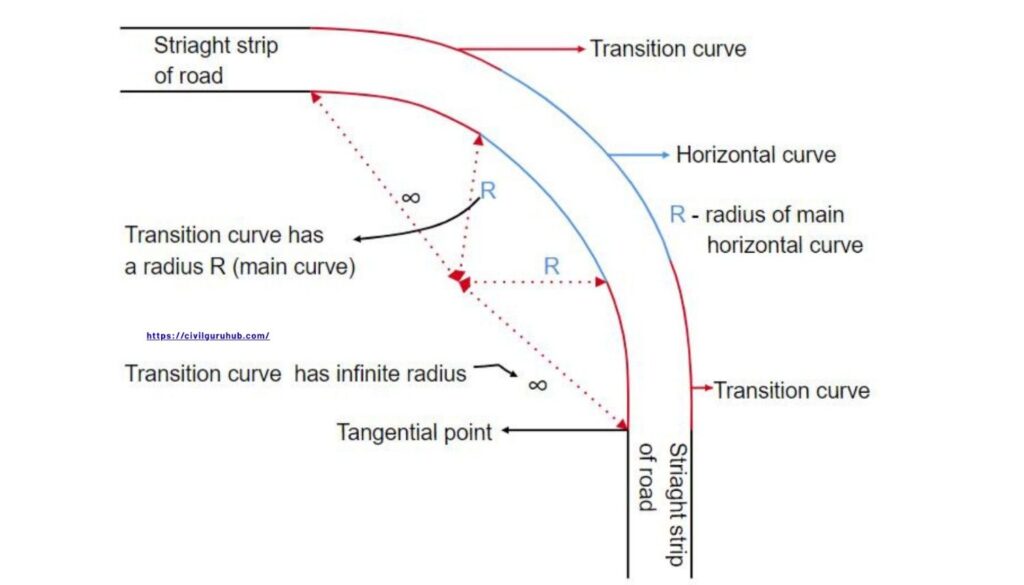
Transition curve is an important part of highway geometry because it creates a smooth connection between a straight section of road and a circular curve. Without a proper transition, vehicles experience sudden changes in direction, which can create discomfort and increase accident risks. This is why transition curve design plays a major role in accurate Road curve calculation and safe road construction practices.
In simple words, a transition curve gradually introduces curvature so that vehicles can move from straight alignment to curved alignment smoothly. Engineers use this concept extensively during Road curve calculation because it improves vehicle stability and reduces lateral shock experienced by drivers and passengers.
The transition length is generally calculated using the following relationship:
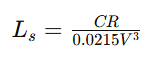
Where:
Ls = Transition Length
V = Design Speed
C = Rate of Change of Centrifugal Acceleration
R = Radius of Curve
During Road curve calculation, selecting an appropriate transition length ensures that superelevation can be developed gradually rather than suddenly. This improves riding quality and enhances overall traffic safety.
Recommended Transition Length
| Design Speed (km/hr) | Recommended Transition Length (m) |
|---|---|
| 40 | 30 |
| 60 | 45 |
| 80 | 60 |
The importance of transition curves becomes more significant at higher speeds because vehicles require additional distance to adjust safely. Proper Road curve calculation therefore always considers transition length together with radius, speed, widening, and superelevation requirements.
Major Benefits of Transition Curves
- Smooth vehicle movement during entry and exit of curves
- Improved passenger comfort and reduced side jerk
- Better distribution of centrifugal forces
- Reduced accident probability on curved sections
- Gradual development of superelevation
Practical Field Tips
- Provide extra widening on transition sections
- Use clear pavement markings for driver guidance
- Apply reflective paint for better night visibility
- Verify dimensions carefully during Road curve calculation and site execution
- Ensure smooth alignment continuity throughout construction
Accurate Road curve calculation combined with properly designed transition curves results in safer, more comfortable, and longer-lasting road infrastructure.
Method 4 – Vertical Curve Calculation
In road construction, when transitioning from one gradient to another, it is unsafe to introduce an abrupt change in slope. To address this issue, vertical curves are incorporated. Vertical curves smooth out the road alignment and ensure that vehicle movement remains both comfortable and safe. For this reason, road curve calculation is considered a vital component of highway engineering and pavement design.
Vertical curves are primarily of two types: Summit Curves and Valley Curves. While each serves a distinct purpose, the common objective of both is to facilitate a smooth transition between gradients. Without proper road curve calculation, sudden changes in slope can negatively impact vehicle control, riding comfort, and visibility.
Types of Vertical Curves
| Type | Purpose |
|---|---|
| Summit Curve | Used when two ascending or descending gradients meet at a higher point |
| Valley Curve | Used when gradients meet at a lower point or depression |
Summit Curve Calculation
Summit curves are generally employed in crest conditions, where visibility is the most critical factor. The formula used to calculate the length of a summit curve is:
L = N S²/4.4
Here, ‘L’ represents the curve length, while ‘N’ and ‘S’ represent the design parameters. Accurate road curve calculation ensures that drivers are provided with sufficient stopping sight distance.
Valley Curve Calculation
Valley curves are utilized at lower intersection points and are crucial for ensuring driving comfort during nighttime.
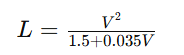
Here, ‘V’ represents the design speed. Correct road curve calculation in valley sections enhances headlight visibility and vehicle stability.
Importance of Vertical Curves
- Enhanced driving comfort during gradient transitions
- Improved sight distance and visibility
- Safer overtaking opportunities
- Better driving conditions at night
- Reduced sudden vehicle jerks
IRC Recommended Minimum Curve Length
| Design Speed (km/hr) | Minimum Curve Length (m) |
|---|---|
| 40 | 60 |
| 60 | 90 |
| 80 | 120 |
Proper road curve calculation is essential for both highway safety and user comfort. Therefore, performing accurate road curve calculations during the design stage is considered extremely important for ensuring long-term pavement performance and traffic safety.
Method 5 – K Value Calculation in Road Curve Calculation
In highway engineering, K Value is considered one of the most important parameters for designing vertical curves because it directly represents how smooth a curve will perform for vehicles. During Road curve calculation, engineers use K Value to determine whether a vertical curve provides enough comfort, visibility, and safety for road users.
Simply put, a higher K Value means a smoother transition between different road grades. This smoothness becomes extremely important on highways and high-speed roads where sudden changes in slope can create discomfort and unsafe driving conditions. That is why understanding K Value is essential during Road curve calculation for modern roadway projects.
The basic formula used in Road curve calculation for determining K Value is:
K=L/A
Where:
K = Curve smoothness factor
L = Length of vertical curve
A = Algebraic difference in grades
Example of K Value Calculation
Suppose:
Curve Length = 120 m
Grade Difference = 4%
Using the formula:
K = 120 ÷ 4
Therefore:
K = 30
This means the curve provides a moderate level of smoothness suitable for many highway applications. During Road curve calculation, such values help engineers decide whether curve length should be increased or reduced.
Why K Value is Important in Road Curve Calculation
K Value plays a major role in determining driving quality and roadway performance. During Road curve calculation, engineers consider K Value because it offers several advantages:
- Improves riding comfort for passengers
- Reduces sudden vehicle movement and bouncing
- Enhances highway safety and visibility
- Supports smoother vehicle operation at higher speeds
- Improves drainage performance on vertical curves
Recommended K Values
| Road Type | Recommended K Value |
|---|---|
| National Highway | 30–50 |
| Expressway | 50–80 |
| Village Road | 10–20 |
Proper selection of K Value during Road curve calculation ensures that roads remain safer, smoother, and more comfortable for long-term transportation performance.
Method 6 – Extra Widening Calculation in Road Curves
When a curve is introduced in a road alignment, vehicles require more space during the turning maneuver compared to traveling on a straight road. To accommodate this additional space requirement, extra widening is provided. It is crucial to account for this extra widening during proper road curve calculations, as it ensures smoother and safer vehicle movement.
As a vehicle navigates a curve, its rear wheels do not precisely follow the path traced by the front wheels. This phenomenon is known as off-tracking. Consequently, the width of the carriageway must be increased. Furthermore, drivers require both lateral clearance and psychological comfort while traversing a curved section. Therefore, road curve calculations incorporate the effects of both mechanical and psychological factors.
Generally, the following formula is used to calculate the required extra widening:
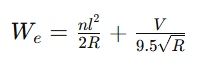
Where:
We = Required extra widening
n = Number of traffic lanes
l = Wheelbase of the vehicle
R = Radius of the curve
V = Design speed
This formula combines two components:
Mechanical Widening
Mechanical widening is provided to compensate for the wheel tracking effect. When a vehicle moves along a curve, the rear wheels shift inward, thereby necessitating additional width.
Psychological Widening
Drivers prefer to maintain a certain side clearance within the curved section. Psychological comfort also becomes a significant factor when vehicles are traveling at high speeds. Therefore, this widening component is included in accurate road curve calculations.
Recommendations for extra widening are generally derived from IRC:73-1980 (and subsequent updates / related IRC geometric design references). In the IRC, recommended values are provided in the form of ranges, such as:
| Radius of Curve (m) | Extra Width (m) |
|---|---|
| Up to 20 | 1.5 |
| 21–40 | 1.5 |
| 41–60 | 1.2 |
| 61–100 | 0.9 |
| 101–300 | 0.6 |
| Above 300 | Nil |
Method 7 – Stopping Sight Distance Calculation
What is SSD?
The minimum distance required for a driver to bring a vehicle to a halt after spotting an obstacle is known as SSD.
Formula
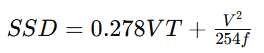
Example
Given:
Speed = 80 km/hr
Reaction Time = 2.5 sec
Friction = 0.35
SSD = 55.6 + 72
SSD = 127 meters (approx.)
Road Curve Setting Out Methods
| Method | Use |
|---|---|
| Offset Method | Small projects |
| Rankine Method | Highway curves |
| Deflection Angle Method | Accurate setting |
| Total Station Method | Modern projects |
Recommended Survey Tools for Road Curve Calculation
To perform accurate road curve calculations, highway engineers require proper surveying instruments and safety equipment. If you work on highway projects, road alignment surveys, or curve setting-out tasks, the tools listed below can be highly useful for you.
| Product | Use |
|---|---|
| Total Station Tripod | Curve survey |
| Auto Level Machine | RL checking |
| Measuring Wheel | Chainage measurement |
| Prism Pole | Alignment survey |
| Safety Jacket | Site safety |
Professional Tip for Highway Engineers
If you regularly work on highway projects, using high-quality survey equipment improves both accuracy and productivity. With the aid of proper instruments, errors in road curve calculations and field layouts are significantly reduced.
Affiliate Disclosure
“As an Amazon Associate, we earn from qualifying purchases.”
Common Mistakes in Road Curve Calculation
- Wrong radius selection
- Improper super elevation
- Insufficient widening
- Poor drainage
- Transition curve omission
- Wrong chainage marking
- Incorrect K value calculation
Conclusion
Road curve calculation is considered a crucial topic in highway engineering, as it has a direct impact on road safety, driving comfort, vehicle stability, and pavement performance. To design any highway efficiently, merely establishing the road alignment is insufficient; scientifically designing the curves is equally important. Without accurate road curve calculations, vehicles may encounter difficulties while turning, the risk of accidents may increase, and long-term maintenance costs could rise. Consequently, curve geometry is meticulously analyzed during the highway design process.
In this detailed guide, we have explained key concepts—such as horizontal curves, vertical curves, superelevation, transition curves, extra widening, stopping sight distance (SSD), and K-values—using a practical approach and in accordance with IRC standards. It is the proper combination of all these parameters that ensures a safe and economical road design. Whether you are involved in the execution of highway projects, engaged in field supervision, or preparing for a career in civil engineering, a strong grasp of road curve calculations will provide you with a significant advantage in both design comprehension and real-world site applications. In modern highway projects, an understanding of road curve calculations is considered essential for efficient planning and the development of safer transportation systems.
FAQs – Road Curve Calculation
1. What is Road Curve Calculation?
Road Curve Calculation is a process within highway engineering involving the calculation of the radius, super-elevation, transition curves, and safety parameters for the turning sections of a road.
2. What is the significance of the ‘K Value’ in highway engineering?
The K Value represents the smoothness of a vertical curve. A higher K Value leads to improved driving comfort and enhanced road safety.
3. Why is Super-elevation provided?
Super-elevation is provided to counteract the centrifugal force acting on a vehicle while traversing a curve, thereby preventing the vehicle from skidding or overturning.
4. Which IRC codes are important for Road Curve Design?
IRC 38, IRC 73, IRC 86, and IRC SP 23 are commonly used codes for road curve design and highway geometric standards.
5. What is the main purpose of a Transition Curve?
A transition curve facilitates a smooth transition between a straight road section and a circular curve, thereby minimizing sudden jerks and reducing the risk of accidents.
6. Which instruments are used in Road Curve Calculation?
Surveying instruments such as Total Stations, Auto Levels, GPS devices, Prism Poles, and Measuring Tapes are used for setting out road curves and verifying alignment.

Yo, just checked out bet29. Pretty slick site, easy to navigate. Odds seem decent. Gonna throw a few bucks down and see what happens. Fingers crossed! Good luck to all out there!