
Table of Contents
Introduction
Asphalt pavement plays a pivotal role in the fields of road construction and highway engineering. Today, asphalt technology is utilized worldwide to construct highways, urban roads, airport runways, and village roads. However, when it comes to asphalt pavement, the most significant question facing engineers and contractors is: Is Cold Mix Asphalt superior to Hot Mix Asphalt?
Both of these technologies are widely employed within the road construction industry; however, they differ in their operational processes, costs, durability, maintenance requirements, and environmental impact. Frequently, engineers must determine which mix is most suitable based on factors such as the project’s location, climatic conditions, traffic volume, and available budget. For this very reason, understanding the comparative differences between Cold Mix and Hot Mix is essential.
Cold Mix typically requires preparation at lower temperatures and primarily serves maintenance tasks, pothole repairs, and roads with low traffic volumes. Conversely, Hot Mix Asphalt requires preparation at high temperatures and serves highways, expressways, and roads subject to heavy traffic. Both methods possess their own distinct advantages and limitations.
In a developing nation like India, the demand for sustainable construction practices and cost-effective road technologies continues to rise. Government agencies such as the National Highways Authority of India (NHAI) and various state Public Works Departments (PWDs) focus increasingly on adopting environmentally friendly technologies. Consequently, Cold Mix Asphalt gradually gains traction and promotion, particularly in rural and remote regions.
In this detailed blog post, we will conduct an in-depth comparison of Cold Mix and Hot Mix Asphalt. We will examine their manufacturing processes, material compositions, advantages, disadvantages, practical applications, environmental impacts, maintenance requirements, and cost analyses. Additionally, we will present practical examples and illustrative tables designed to serve as valuable resources for both blog readers and civil engineering students.
What is Cold Mix ?
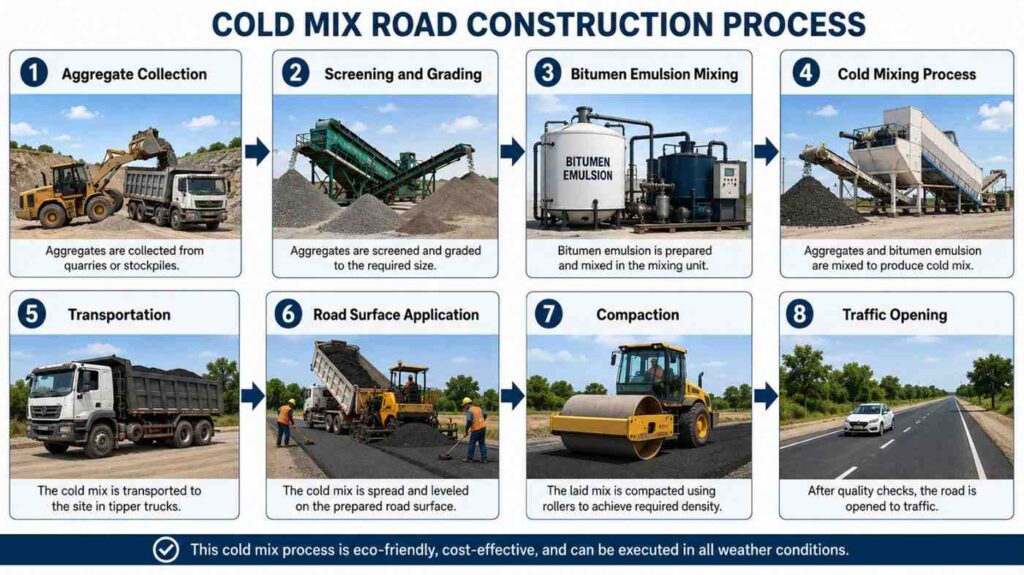
Cold Mix Asphalt is a type of asphalt mixture that is prepared and applied without the use of high temperatures. It utilizes bitumen emulsion or cutback bitumen, which is mixed with aggregates at normal atmospheric temperatures. The primary advantage of this technology is that it does not require a heating plant or entail high fuel consumption.
Cold Mix is primarily used for maintenance and repair works. When potholes develop on a road or surface distress occurs, Cold Mix provides a quick repair solution. Its application process is relatively simple and is considered quite effective, even during the rainy season.
Cold Mix technology is gradually gaining popularity in India’s rural road projects, as establishing a Hot Mix Plant in remote areas is often not practical. Contractors frequently store this material in bags for use in emergency repair works.
The production process of Cold Mix is comparatively eco-friendly, as it results in lower greenhouse gas emissions and reduced fuel consumption. Unlike Hot Mix , there is no requirement to heat the aggregates to temperatures exceeding 150°C. Consequently, this also leads to energy savings.
However, the durability of Cold Mix is lower compared to that of Hot Mix Asphalt. It is not considered suitable for heavy traffic loads or high-speed corridors. Its bonding strength and compaction quality are also comparatively inferior.
Cold Mix Asphalt Process Flow
What is Hot Mix ?
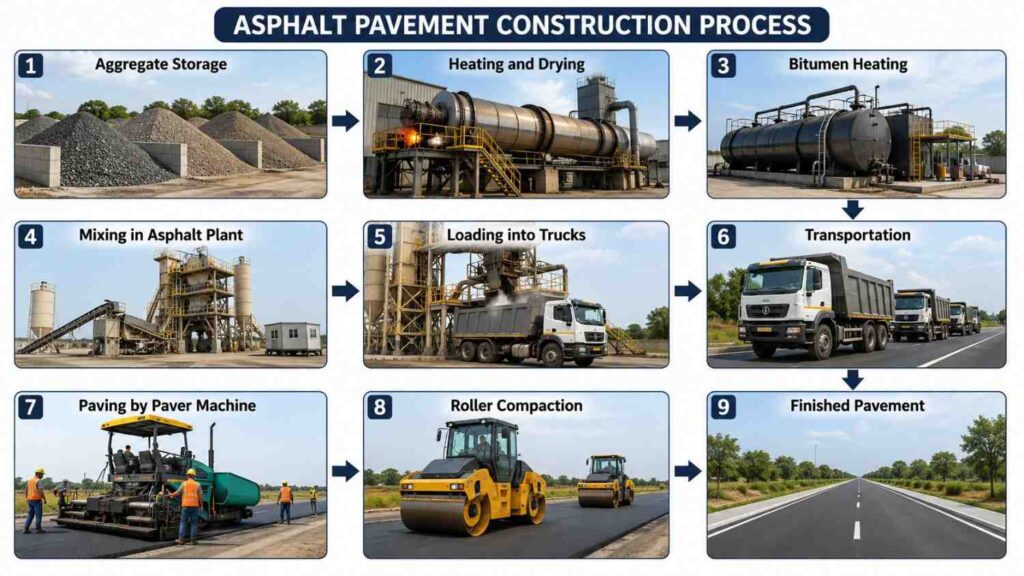
Hot Mix Asphalt, also known as HMA, is the most commonly used paving material in the road construction industry. This process involves heating aggregates and bitumen to high temperatures and mixing them uniformly. Typically, aggregates are heated to a range of 150°C to 170°C and are then mixed with hot bitumen.
The primary objective of Hot Mix is to provide a strong, durable, and long-lasting pavement surface capable of withstanding heavy traffic loads and harsh environmental conditions. For this reason, Hot Mix is extensively used on national highways, expressways, airport runways, and urban arterial roads.
A specialized asphalt plant produces Hot Mix . This plant dries and heats the aggregates, and subsequently mixes them with bitumen in precise proportions. Proper mixing and temperature control are crucial, as any deviation—whether too low or too high—can compromise the quality of the pavement.
The greatest advantage of Hot Mix lies in its superior strength and durability. Once properly compacted, it provides a smooth riding surface and offers enhanced water resistance. Furthermore, its resistance to rutting and its fatigue life are significantly superior to those of Cold Mix Asphalt.
However, the production of Hot Mix is costly due to its high fuel consumption. The operation of the asphalt plant, the heating process, and transportation logistics are also expensive. Environmental concerns also constitute a significant issue, as emissions are generated during the heating process.
Hot Mix Asphalt Production Cycle
Major Difference Between Cold Mix and Hot Mix
The objective of both Cold Mix and Hot Mix is to provide a road surface; however, their manufacturing processes, application methods, and performance characteristics are completely different. From an engineering perspective, understanding these differences is crucial.
| Parameter | Cold Mix Asphalt | Hot Mix Asphalt |
|---|---|---|
| Production Temperature | Ambient Temperature | 150°C – 170°C |
| Binder Type | Emulsion or Cutback | Hot Bitumen |
| Fuel Requirement | Very Low | High |
| Durability | Moderate | High |
| Initial Cost | Lower | Higher |
| Traffic Capacity | Low to Medium Traffic | Suitable for Heavy Traffic |
| Environmental Impact | Lower Emissions | Higher Emissions |
| Storage Capability | Can Be Stored | Requires Immediate Use |
| Main Application | Maintenance and Repairs | Maintenance and Repairs |
| Weather Dependency | Less Weather Sensitive | Temperature Sensitive |
This comparison clearly demonstrates that Cold Mix Asphalt offers an economical and eco-friendly solution, whereas Hot Mix Asphalt provides superior structural performance and long-term durability.
Performance Comparison of Cold Mix vs Hot Mix
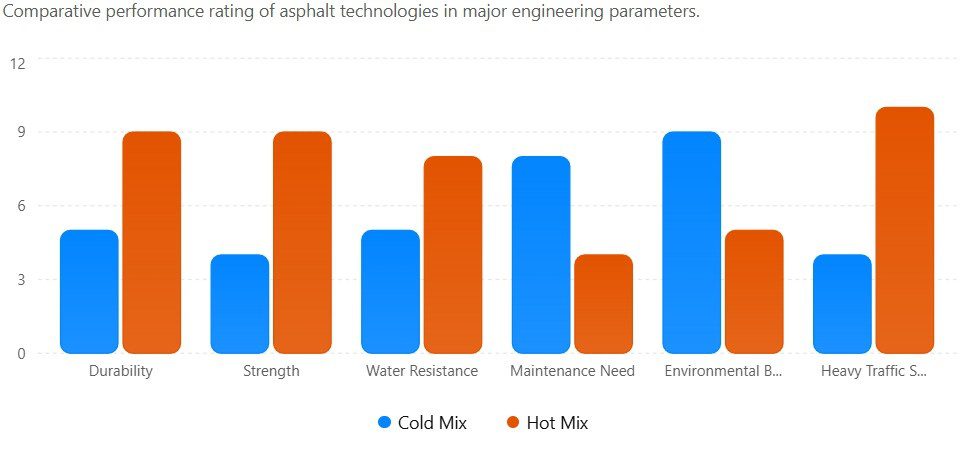
The actual quality of road pavement cannot be judged solely by its initial appearance. Real performance factors such as strength, durability, rutting resistance, fatigue life, and weather resistance are of paramount importance. A practical comparison between Cold Mix Asphalt and Hot Mix Asphalt is based on these performance factors.
Hot Mix generally delivers superior performance because the bonding between the aggregates and the bitumen is stronger. Due to high-temperature mixing, the bitumen effectively coats the aggregate surfaces, resulting in better compaction. This has a direct impact on both the strength and the service life of the pavement.
On highways subjected to heavy traffic, Hot Mix performs significantly superior. It effectively distributes wheel loads and provides excellent resistance to rutting. For this very reason, Hot Mix Asphalt remains the preferred choice for airport runways and expressways.
Cold Mix is comparatively weaker and many consider it more suitable for maintenance operations. Under conditions involving long-term heavy loading, its surface can deteriorate relatively quickly. Cold Mix pavements may also experience water infiltration and stripping problems.
However, for low-traffic rural roads and temporary repair works, many consider the performance of Cold Mix Asphalt acceptable. It offers a particularly useful solution for repairing potholes, especially during the rainy season.
Cold Mix vs Hot Mix Performance Comparison
Cost Analysis of Cold Mix and Hot Mix
Cost analysis is a crucial factor in road construction projects. Both contractors and government agencies prefer economical solutions, yet they must also take into account long-term maintenance requirements and durability.
The initial production cost of Cold Mix As remains comparatively lower because it does not require a heating process. Fuel consumption remains significantly lower, and the setup for an asphalt plant remains simpler. In remote areas, transportation and operational costs also decrease.
Cold Mix offers an economical solution for short-term repair projects and village roads. It also serves as a practical option for emergency pothole repairs, as quick application is possible.
However, when it comes to lifecycle cost analysis, Hot Mix often proves to be a superior investment. Despite its higher initial cost, it features longer maintenance intervals and a longer pavement lifespan. Consequently, long-term maintenance expenditures decrease.
On highways and urban roads, frequent maintenance leads to traffic disruptions and economic losses. For this reason, the advantage of Hot Mix Asphalt’s superior durability becomes particularly significant.
Approximate Cost Comparison Table
| Item | Cold Mix Asphalt | Hot Mix Asphalt |
|---|---|---|
| Initial Construction Cost | Low | High |
| Fuel Cost | Very Low | High |
| Plant Requirement | Simple | Advanced |
| Maintenance Frequency | High | Low |
| Pavement Life | 3-5 Years | 10-15 Years |
| Repair Cost | Moderate | Lower Long-Term |
| Transportation Cost | Lower | Higher |
This table indicates that cost-effectiveness may vary depending on the project type and expected traffic volume.

To Know More about highway, click on given link
What Are PQC Surface Cracks? 9 Types, Causes and Repair Methods: a Complete guide
What Are Rigid Pavement Failures? 10 Major Causes and Practical Solutions
What Are Flexible Pavement Failures? 10 Major Causes and Practical Solutions
Environmental Impact and Sustainability
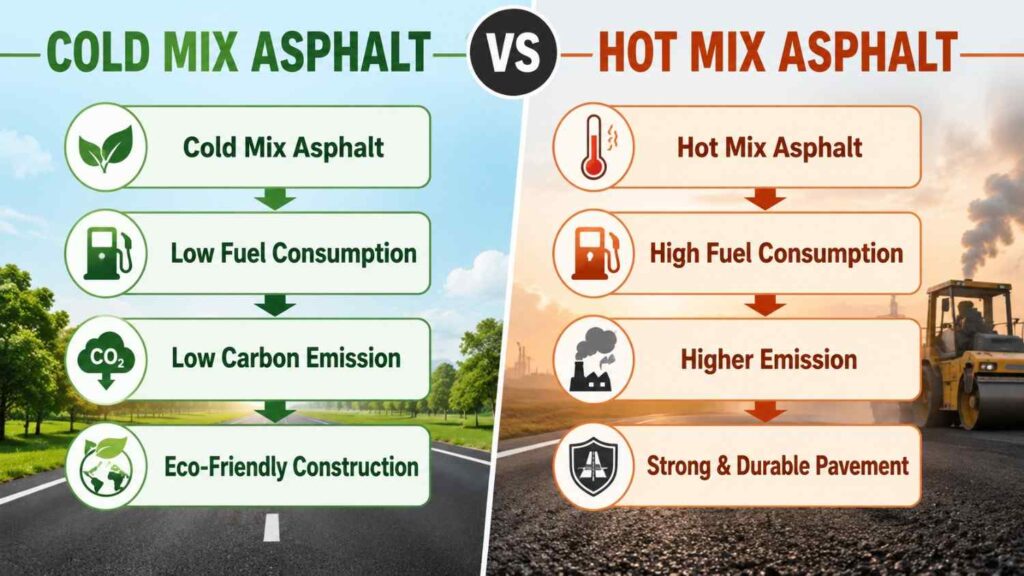
In today’s era, sustainable construction and green technology continuously gain importance. The road construction industry, too, focuses on reducing carbon emissions and energy consumption. In this context, the significance of Cold Mix Asphalt has increased considerably.
The most significant environmental advantage of Cold Mix is its low-temperature production process. It does not require the heating of aggregates, which significantly reduces fuel consumption. Consequently, companies generate comparatively lower carbon dioxide emissions and greenhouse gases.
Cold Mix also provides a safer working environment for laborers, as it minimizes their exposure to high-temperature fumes and smoke. In remote areas, the reduction in diesel consumption enhances operational sustainability.
From an environmental perspective, people generally consider Hot Mix less sustainable, as asphalt plants burn large quantities of fuel during its production. The high-temperature manufacturing process also generates emissions and dust pollution.
However, modern asphalt plants now incorporate pollution control systems and energy-efficient technologies to mitigate their environmental impact. Developers have also created intermediate solutions, such as Warm Mix Asphalt, to strike a balance between Cold Mix and Hot Mix technologies.
Applications of Cold Mix
Cold Mix primarily serves maintenance and repair projects. Its most common application includes pothole repair. During the rainy season, when potholes develop on roads and immediate repairs are required, Cold Mix Asphalt provides a highly effective solution.
Cold Mix also benefits rural roads and roads with low traffic volume. In remote locations, establishing a Hot Mix Plant is not economically feasible; therefore, Cold Mix emerges as a practical option.
Engineers also utilize Cold Mix for temporary roads and utility trench repairs. Many municipalities keep pre-packaged Cold Mix material in stock for emergency maintenance operations.
Experts consider the application of Cold Mix advantageous for hill roads and in inaccessible terrain, as its transportation and handling are significantly easier. They frequently use it for border roads and forest roads.
In India, certain projects under the Pradhan Mantri Gram Sadak Yojana (PMGSY) have adopted Cold Mix technology, which has helped improve rural connectivity.
Applications of Hot Mix
Hot Mix is utilized in major infrastructure projects where high durability and a long service life are required. National highways, expressways, and urban roads constitute its primary areas of application.
Roads subjected to heavy traffic experience continuous wheel loads and dynamic stresses. Hot Mix Asphalt provides superior strength and stability, thereby enhancing pavement performance.
Hot Mix is also extensively used for airport runways, as the loads imposed by aircraft are extremely high. Its use is also common in industrial zones and container terminals.
In urban environments, Hot Mix is considered the preferred material for ensuring a smooth riding experience and reducing noise levels. Furthermore, it serves as the standard paving material for multi-lane highways and toll roads.
Advanced Hot Mix technologies have been deployed in major highway projects across India, such as the Delhi-Mumbai Expressway, as well as in various Smart City road networks.

Challenges Faced in Cold Mix
Despite the advantages of Cold Mix, it also presents certain practical limitations. The most significant challenge lies in its lower durability and reduced structural strength. Its performance may prove inadequate under conditions involving heavy traffic loads.
Cold Mix pavements frequently experience issues such as water damage and stripping. In the absence of a proper drainage system, moisture can lead to the rapid deterioration of the pavement.
Compaction quality also poses a challenge, as achieving the requisite density at ambient temperatures can be difficult. This factor has a direct impact on the service life of the pavement.
Temperature sensitivity and curing time constitute other critical issues. Certain Cold Mix materials require a sufficient curing period to ensure proper setting.
Challenges Faced in Hot Mix
The biggest challenge associated with Hot Mix Asphalt is its high production cost. Due to continuously rising fuel prices, asphalt producers are finding production increasingly expensive.
Environmental pollution and carbon emissions are also major concerns. Dust and smoke pollution in the vicinity of asphalt plants can create significant issues.
Temperature control is also critical. If the temperature of the mix drops during paving operations, paving crews can compromise the quality of compaction and bonding.
Traffic congestion and construction delays also pose challenges in urban areas, as workers must place and compact Hot Mix Asphalt rapidly.
Required IS Codes and Tests for Cold Mix & Hot Mix
To ensure the quality of road construction and asphalt pavements, various Indian Standards (IS Codes), IRC guidelines, and laboratory tests are followed. These tests are crucial for evaluating the strength, durability, stability, and field performance of the asphalt mix.
A few reference links are given below for Study Purpose only
Important IS Codes and IRC Standards
| Material / Activity | Relevant IS / IRC Code | Purpose |
|---|---|---|
| Bitumen Testing | IS 1201 to IS 1220 | Testing of bitumen properties |
| Aggregate Testing | IS 2386 (Part 1 to 8) | Evaluation of aggregate quality |
| Sieve Analysis | IS 2386 Part 1 | Checking aggregate grading |
| Aggregate Impact Value Test | IS 2386 Part 4 | Determination of aggregate toughness |
| Los Angeles Abrasion Test | IS 2386 Part 4 | Measurement of abrasion resistance |
| Specific Gravity Test | IS 2386 Part 3 | Determination of density |
| Water Absorption Test | IS 2386 Part 3 | Measurement of aggregate absorption capacity |
| Penetration Test of Bitumen | IS 1203 | Determination of bitumen hardness |
| Ductility Test | IS 1208 | Evaluation of bitumen stretching property |
| Softening Point Test | IS 1205 | Determination of temperature susceptibility |
| Flash and Fire Point Test | IS 1209 | Safety assessment during heating |
| Viscosity Test | IS 1206 | Measurement of bitumen flow property |
| Marshall Stability Test | ASTM D6927 / IRC SP 53 | Evaluation of asphalt mix strength |
| Dense Bituminous Macadam (DBM) | MoRTH Section 507 | Specification for hot mix pavement layer |
| Bituminous Concrete (BC) | MoRTH Section 509 | Wearing course specification |
| Cold Mix Technology | IRC SP 100 | Guidelines for cold mix design and construction |
| Bituminous Mix Design | Asphalt Institute Method / IRC | Pavement mix design procedure |
| Quality Control for Roads | IRC SP 11 | Road quality control procedures |
| Flexible Pavement Design | IRC 37 | Pavement thickness design |
Field Tests for Asphalt Roads
| Field Test | Purpose |
|---|---|
| Core Cutting Test | Pavement thickness verification |
| Density Test | Compaction quality check |
| Surface Evenness Test | Riding quality evaluation |
| Temperature Monitoring | Proper paving temperature control |
| Binder Content Test | Bitumen percentage verification |
| Skid Resistance Test | Road safety evaluation |
Quality Control Checklist for Asphalt Construction
| Inspection Item | What to Check |
|---|---|
| Aggregate Gradation | Proper sieve analysis |
| Bitumen Temperature | Correct heating temperature |
| Mixing Quality | Uniform coating |
| Surface Preparation | Clean and dry surface |
| Compaction | Required density achievement |
| Joint Construction | Proper alignment and bonding |
| Weather Condition | Suitable paving environment |
Which is Better: Cold Mix or Hot Mix Asphalt?
There is no single, direct answer to this question, as the suitability of both technologies depends on the specific project requirements. If the project involves low-cost maintenance work, rural roads, or emergency repairs, Cold Mix Asphalt may be the better option.
However, if the project involves high-traffic highways, expressways, or airport runways, Hot Mix Asphalt is clearly the superior choice. It offers greater durability, strength, and long-term performance.
From the perspective of environmental sustainability, Cold Mix Asphalt offers distinct advantages. Its usage is likely to increase further in the future as the demand for green construction technologies grows.
Engineering decisions should always be made after carefully considering factors such as traffic volume, climatic conditions, budget, pavement lifespan, and environmental impact.
Conclusion
Both Cold Mix and Hot Mix Asphalt are essential components of the modern road construction industry. Cold Mix Asphalt offers an economical, eco-friendly, and maintenance-oriented solution, whereas Hot Mix Asphalt delivers high durability and superior structural performance.
Cold Mix serves as a practical option for rural roads, temporary repairs, and projects involving low traffic volumes. Conversely, Hot Mix Asphalt is considered the optimal choice for highways, urban corridors, and infrastructure subjected to heavy traffic.
In the future of the road construction industry, the significance of sustainable technologies and energy-efficient methods is expected to increase continuously. Consequently, the adoption of Cold Mix and Warm Mix Asphalt technologies is also likely to rise gradually.
Ultimately, the best choice will be the one that effectively satisfies project requirements, environmental conditions, and long-term performance expectations. It is crucial for civil engineers and contractors to possess a thorough understanding of both technologies to ensure they can select the most appropriate pavement solution.
About The Author
My name is Susanta Kumar Mohapatra. I am a civil engineering professional with over 11 years of practical experience in the construction and infrastructure sectors. I hold a B.Tech degree in Civil Engineering and an M.E. degree in Construction Management.
Throughout my career, I have worked in various areas such as road construction, bridge projects, quality control, material testing, quantity surveying, project planning, and site management. I am passionate about sharing practical knowledge related to highway engineering, laboratory testing, and construction management with engineers, students, and construction professionals.
I am the founder of CivilGuruHub.com, where I share technical articles, field experiences, laboratory test procedures, guidelines based on IRC and IS codes, and practical construction knowledge related to civil engineering. My aim is to explain civil engineering concepts in simple language and provide useful, reliable information to industry professionals.
You can connect with me through CivilGuruHub.com and my YouTube channel, “The Civil Site,” where I regularly share civil engineering tutorials and practical site knowledge.
Frequently Asked Questions (FAQ)
1. What is Cold Mix Asphalt?
Cold Mix Asphalt is an mixture prepared at ambient (normal) temperatures. It utilizes bitumen emulsion or cutback bitumen, and the aggregates are mixed without being heated. It is primarily used for pothole repair, rural roads, and general maintenance works.
2. What is Hot Mix Asphalt?
Hot Mix Asphalt is a high-temperature asphalt mixture in which aggregates and bitumen are heated and mixed at temperatures ranging from approximately 150°C to 170°C. It is considered the preferred material for highways, expressways, and roads subject to heavy traffic.
3. What is the main difference between Cold Mix and Hot Mix Asphalt?
The most significant difference between the two lies in their production temperature and performance characteristics. Cold Mix is produced at ambient temperatures and is suitable for maintenance tasks, whereas Hot Mix is prepared at high temperatures and provides long-lasting, heavy-duty pavements.
4. Which type of asphalt is more durable?
Hot Mix Asphalt is more durable because it possesses superior bonding strength and compaction quality. It can easily withstand heavy traffic loads and harsh weather conditions.
5. Which type of asphalt is eco-friendly?
Cold Mix Asphalt is comparatively more eco-friendly because it involves lower fuel consumption and carbon emissions.
6. Which asphalt is better for maintenance?
Cold mix asphalt is considered better for maintenance and quick repair works as it can be easily applied and stored.