
Table of Contents
Introduction
Now a days modern construction and infrastructure projects, merely performing the work is not sufficient; rather, completing the project within the stipulated time and budget poses the greatest challenge. Whether it involves highway construction, building projects, irrigation works, or the setup of industrial plants, proper planning and scheduling are indispensable in every scenario. To enhance the effectiveness of this planning, a highly powerful technique known as CPM (Critical Path Method) experts employ within the field of Project Management.
CPM is a scientific scheduling method that identifies the sequence, duration, and interdependencies of every activity within a project. With the aid of this method, a project manager can determine which activities are most critical and identify those tasks where a delay could potentially jeopardize the entire project timeline. For this very reason, various sectors, including the construction industry, manufacturing, software development, and infrastructure projects extensively utilize CPM.
If a project lacks proper scheduling, it can lead to idle manpower, underutilization of machinery, increased material wastage, and project costs that far exceed the projected budget. CPM serves to mitigate all these issues. Through this method, a project manager can effectively handle monitoring, control, and decision-making processes with ease.
In this article, we will discuss the detailed concept of CPM and explore how this method offers practical assistance in controlling both project time and costs. Furthermore, we will explain this concept in simple language, utilizing examples, diagrams, and tables to facilitate understanding.
What is CPM in Project Management?
The full form of CPM is the Critical Path Method. It is a project scheduling and planning technique used to systematically organize project activities. This method was developed in the 1950s and is still considered the backbone of the construction and project management industries today.
The main objectives of CPM are:
- Identifying the project duration
- Identifying critical activities
- Minimizing the risks of delay
- Improving resource utilization
- And controlling time and costs
In CPM, the duration of each activity is estimated, and logical relationships between these activities are then established. When all the activities are interconnected, a network diagram is formed. The longest path within this diagram is referred to as the “Critical Path.”
A delay in any of the activities lying on the critical path results in a delay of the entire project. Therefore, project managers must pay special attention to these specific activities.
Basic CPM Network Diagram Example
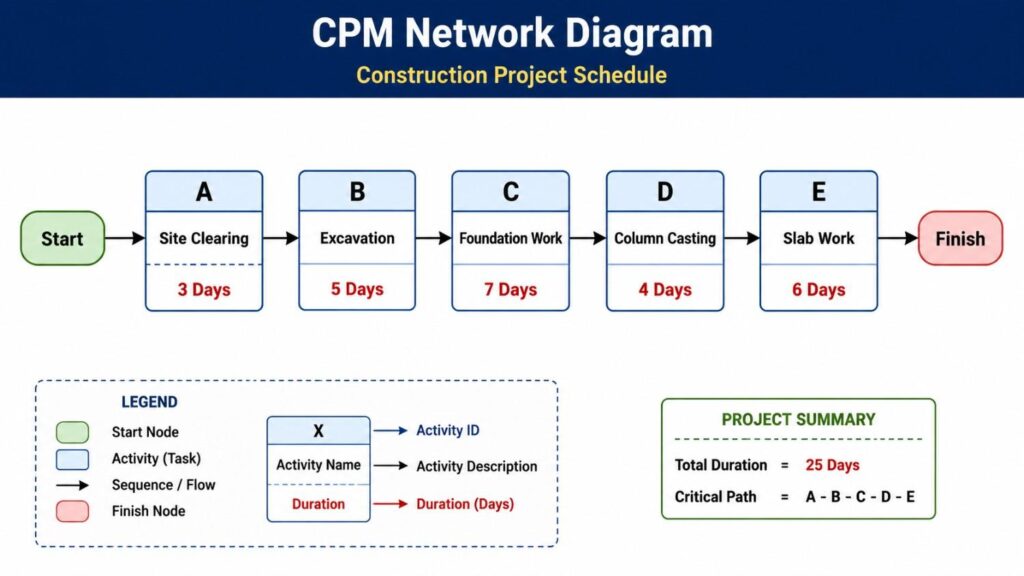
In this example, if there is a delay in any activity, the entire project completion date will be impacted.
Important Terms
| Term | Meaning |
|---|---|
| Activity | A specific task of the project |
| Duration | Time required to complete an activity |
| Critical Path | The longest sequence of activities in a project |
| Float | Available delay allowance without affecting the project |
| Network Diagram | Chart showing the sequence of activities |
| Early Start | Earliest possible time an activity can start |
| Late Finish | Latest allowable time to complete an activity |
1. Controlling time through proper project planning
The greatest advantage of CPM is that it renders project planning highly organized and structured. Typically, in construction projects, numerous tasks proceed simultaneously as well as sequentially. If planning is inadequate, activities may overlap, confusion can arise, and unnecessary delays begin to occur.
CPM divides a project into smaller, manageable activities. The duration and dependencies of each activity are clearly defined. This provides the project manager with clear visibility regarding when each task will commence and when it will conclude.
For instance, in a road construction project, if Granular Sub-Base (GSB) workers initiate their work before the subgrade preparation is complete, quality issues may arise. CPM helps avoid such logical errors.
Utilizing CPM during the planning phase also simplifies manpower scheduling. Engineers know in advance exactly how much labor and machinery will be required at each specific stage. This minimizes idle resources and enhances productivity.
Construction companies typically manage multiple projects simultaneously. If planning is weak, conflicts regarding equipment usage and labor shortages may emerge. CPM mitigates these issues and maintains a systematic workflow.
Proper planning also leads to a reduction in rework. Rework is a primary cause of project delays and cost overruns. When activities are planned logically, execution proceeds smoothly, and unnecessary interruptions are minimized.
For these reasons, CPM is considered the foundation of modern project management.
2. Controlling Delays by Identifying Critical Activities
In every project, some activities are routine, while others are highly critical. The most important feature of CPM is that it identifies these critical activities.
Critical activities are those tasks where any delay directly impacts the project completion date. These activities possess no available float or extra time.
Example:
| Activity | Duration |
|---|---|
| Excavation | 5 Days |
| PCC Work | 2 Days |
| Footing Reinforcement | 3 Days |
| Footing Casting | 2 Days |
If the casting of the footings is delayed by just two days, the entire structural work will be delayed.
CPM alerts the project manager in advance regarding which tasks require maximum focus. This makes monitoring more efficient.
Once critical activities have been identified:
- Project manager allocates skilled manpower.
- Team provides extra supervision.
- Project manager ensures material availability.
- Team keeps machinery on standby.
This proactive approach significantly reduces project delays.
Often, a slight delay in non-critical activities is acceptable because they possess available ‘float’ (slack). CPM clearly highlights this flexibility as well. This allows the project manager to avoid unnecessary pressure and manage resources efficiently.
In today’s competitive construction environment, timely completion is paramount, as delay penalties and client dissatisfaction directly impact a company’s reputation. CPM serves as a powerful tool for managing the risk of delays.
3. Reducing Costs Through Resource Optimization
A major reason for project cost overruns is poor resource management. When labor remains idle or machinery is not utilized properly, unnecessary expenses begin to escalate.
CPM effectively optimizes resources.
For instance, if a batching plant, excavator, or paver machine remains idle, the contractor may incur heavy financial losses. CPM scheduling ensures that machinery utilization is continuous and efficient.
CPM also improves labor planning. If the duration and sequence of a specific activity are clearly defined, labor deployment becomes accurate. This helps reduce overtime costs and minimize manpower wastage.
CPM also makes material management more efficient. Workers can arrange materials such as cement, steel, aggregates, and bitumen at the site at precisely the right time. Consequently, CPM successfully avoids both excessive storage and material shortages.
By utilizing it, a project manager can also perform resource leveling. This entails distributing available resources in a balanced manner.
Benefits of Resource Optimization:
| Benefit | Impact |
|---|---|
| Reduced Idle Time | Lower Operational Costs |
| Better Labor Management | Higher Productivity |
| Controlled Material Usage | Reduced Material Wastage |
| Efficient Equipment Utilization | Improved Profitability |
For this reason, the CPM indirectly improves project profitability.
To get better idea about Project Management, click on given link.
What is Time Management? 10 Proven Project Management Tips
What is risk Management: 10 Steps for Successful Projects
How to Create WBS: 8 Practical Steps Explained
4. Estimate Accurate Project Duration
In construction projects, estimating a realistic completion time is crucial. If the project duration is estimated incorrectly, it can lead to client disputes and financial losses.
CPM provides an accurate project completion timeline by analyzing activity durations.
Example:
| Activity | Duration |
|---|---|
| Earthwork | 10 Days |
| GSB Work | 5 Days |
| WMM Work | 6 Days |
| DBM Work | 4 Days |
| BC Work | 3 Days |
Total duration can be calculated logically.
Benefits of accurate scheduling:
- Better client commitment
- Effective monitoring
- Improved billing planning
- Reduce contractual disputes
Milestone-based payments are common in government projects. It helps in accurate milestone planning.
If the project duration is realistic the contractor can also do financial planning properly. Cash flow management is improving and project execution remains smooth.
5. Improving Project Monitoring and Tracking
It is not merely a planning tool, but also a monitoring tool.
During the execution phase, the project manager compares actual progress against the planned schedule. If a delay is observed in any activity, corrective actions can be taken immediately.
Example:
| Activity | Planned Progress (%) | Actual Progress (%) |
|---|---|---|
| Excavation Work | 100% | 90% |
| Foundation Work | 60% | 40% |
This comparison clearly illustrates the health of the project.
Improved monitoring ensures that:
- Delays are detected early
- Corrective actions are taken promptly
- Productivity is maintained
- Client reporting becomes easier
In construction projects, tracking daily progress is extremely important. CPM makes monitoring systematic and data-driven.
6. Making Better Decisions
During project execution, various unexpected situations arise—such as rain delays, labor shortages, machinery breakdowns, or material shortages.
CPM assists the project manager in making informed decisions.
If a delay occurs in any critical activity, the manager can immediately arrange for extra manpower or additional equipment.
CPM also aids in evaluating alternatives. For example:
- Running extra shifts
- Hiring additional labor
- Increasing parallel activities
The impact of these decisions on the project schedule can be easily analyzed.
For this reason, CPM is considered a practical decision-making tool.
7. Improving Coordination
In large-scale construction projects, multiple teams work simultaneously.
For example:
- Survey Team
- Earthwork Team
- Concrete Team
- Quality Team
- Machinery Team
If coordination is weak, the workflow gets disrupted.
CPM provides a clear work sequence for all teams. Every department knows exactly when their specific tasks are scheduled to start and finish.
This reduces communication gaps and improves teamwork.
8. Improving Risk Management
Uncertainty is very high in the construction industry.
Risks:
- Weather issues
- Material shortages
- Financial delays
- Equipment breakdowns
- Labor disputes
CPM helps in identifying critical risks.
A project manager can undertake contingency planning in advance. This proactive planning minimizes project disruption.
You can read Research papers by Ilo Hammed Owolabi and Shoyanbo Moshood Olarewanju click on below link.
Analysis of Critical Path Method (CPM) To Optimized Project Scheduling
9. Improving client satisfaction
A client always expects timely and high-quality project delivery.
CPM provides schedule transparency. The client can be provided with regular progress reports and milestone updates.
If the project is completed on time:
- Client trust is enhanced.
- The chances of securing future projects increase.
- The company’s reputation is strengthened.
In the construction business, reputation is a highly valuable asset.
10. Increasing Overall Project Profitability
When project delays are minimized, resource utilization improves, and rework is reduced, profitability automatically increases.
Indirectly, CPM:
- Improves cost control
- Increases productivity
- Reduces waste
- Enhances financial planning
For this very reason, successful contractors make CPM an integral part of their daily project management practice.
Real-Life Construction Example
Suppose a highway project involves the following activities:
| Activity | Duration |
|---|---|
| Clearing & Grubbing | 4 Days |
| Earthwork | 10 Days |
| Subgrade | 6 Days |
| GSB | 5 Days |
| WMM | 6 Days |
| DBM | 4 Days |
| BC | 3 Days |
If the earthwork is delayed, the entire pavement work will be delayed. CPM clearly identifies this dependency and assists the contractor in taking timely action.
CPM Calculation Step by Step with Example
The primary objective of CPM (Critical Path Method) calculation is to determine the total duration of a project and identify its critical path. This involves utilizing the sequence, duration, and dependencies of the project activities.
CPM calculation typically consists of four main steps:
- Identifying activities and their durations
- Constructing a network diagram
- Performing the Forward Pass calculation
- Performing the Backward Pass calculation
- Identifying Float and the Critical Path
Let’s understand this in detail using a simple construction example.
Step 1: Identifying Activities and Duration
Suppose a small building foundation project.
| Activity | Description | Duration (Days) | Predecessor |
|---|---|---|---|
| A | Site Clearing | 2 | – |
| B | Excavation | 4 | A |
| C | PCC Work | 2 | B |
| D | Reinforcement Work | 3 | C |
| E | Footing Casting | 2 | D |
| F | Backfilling | 3 | E |
Here:
Duration = The time required to complete an activity
Predecessor = Which activity must be completed first
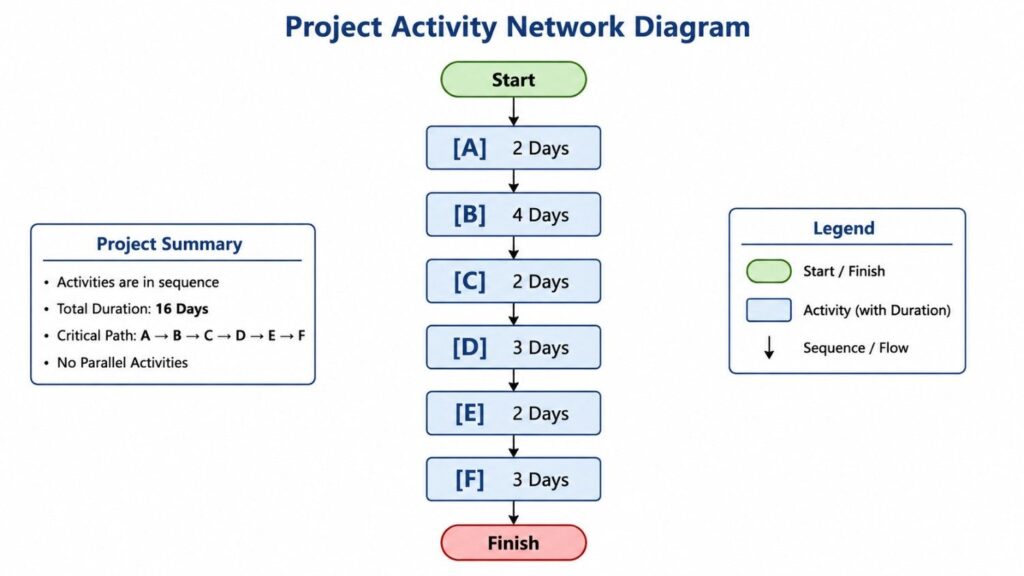
Step 2: Preparing Network Diagram
Now, let’s arrange the activities in sequence.
Step 3: Forward Pass Calculation
The Forward Pass is used to calculate the Early Start (ES) and Early Finish (EF).
Formula:
Early Finish = Early Start + Duration
The first activity of a project always starts at 0.
Forward Pass Table
| Activity | Duration | ES | EF |
|---|---|---|---|
| A | 2 | 0 | 2 |
| B | 4 | 2 | 6 |
| C | 2 | 6 | 8 |
| D | 3 | 8 | 11 |
| E | 2 | 11 | 13 |
| F | 3 | 13 | 16 |
Here:
ES for Activity A = 0
EF = 0 + 2 = 2
The ES for the next activity, Activity B, will be equal to the previous EF.
The calculation continues in this manner.
The EF of the final activity constitutes the total project duration.
Total Project Duration = 16 Days
Step 4: Backward Pass Calculation
The Backward Pass is used to calculate the Late Start (LS) and Late Finish (LF).
Formula:
Late Start = Late Finish − Duration
The backward calculation begins with the last activity.
Backward Pass Table
| Activity | Duration | LF | LS |
|---|---|---|---|
| F | 3 | 16 | 13 |
| E | 2 | 13 | 11 |
| D | 3 | 11 | 8 |
| C | 2 | 8 | 6 |
| B | 4 | 6 | 2 |
| A | 2 | 2 | 0 |
Here:
LF of the last activity F = Total Project Duration = 16
LS = 16 − 3 = 13
Then LF of previous activity is equal to LS of next activity.
Step 5: Float Calculation
Float refers to the amount of delay allowed without delaying the project.
Formula:
Float = LS − ES
or
Float = LF − EF
Float Table
| Activity | ES | EF | LS | LF | Float |
|---|---|---|---|---|---|
| A | 0 | 2 | 0 | 2 | 0 |
| B | 2 | 6 | 2 | 6 | 0 |
| C | 6 | 8 | 6 | 8 | 0 |
| D | 8 | 11 | 8 | 11 | 0 |
| E | 11 | 13 | 11 | 13 | 0 |
| F | 13 | 16 | 13 | 16 | 0 |
The float for all activities is 0.
This means:
All these activities are critical activities.
Identifying the Critical Path
The critical path is the path where the float is zero.
In this example:
A → B → C → D → E → F
Critical Path Duration = 16 Days
If any of these activities is delayed, the entire project will be delayed.
CPM Formula Visualization
Forward Pass:
EF=ES+Duration
Backward Pass:
LS=LF−Duration
Float Formula:
Float=LS−ES
Common Mistakes in CPM Calculation
| Mistake | Effect |
|---|---|
| Wrong activity duration | Incorrect schedule |
| Dependency error | Wrong critical path |
| Float calculation mistake | Delay analysis wrong |
| Network logic issue | Project monitoring failure |
Practical Benefits of CPM Calculation
Through CPM calculation:
- The project duration is determined accurately.
- Critical activities are identified.
- Delay control becomes easier.
- Resource planning is improved.
- Project monitoring becomes systematic.
For this reason, CPM is considered a highly important planning tool in construction projects.
Conclusion
CPM, or the Critical Path Method, is a highly effective and practical tool in modern project management. It systematizes project planning, scheduling, monitoring, and controlling. In the construction industry, both time and cost are extremely critical factors, and CPM assists in efficiently managing both of these aspects.
With the aid of this method, a project manager can identify critical activities, minimize delays, optimize resources, and enhance project profitability. Whether it is a small building project or a large scale highway construction endeavor, CPM proves useful in every type of project.
In today’s competitive construction landscape, successful contractors are those who adopt scientific planning methodologies. CPM is one such powerful technique that significantly boosts the project success rate.
If you are a civil engineer, site engineer, planning engineer, or project manager, practical knowledge of CPM can prove immensely beneficial for both your career growth and project performance.
About The Author
My name is Susanta Kumar Mohapatra. I am a civil engineering professional with over 11 years of practical experience in the construction and infrastructure sectors. I hold a B.Tech degree in Civil Engineering and an M.E. degree in Construction Management.
Throughout my career, I have worked in various areas such as road construction, bridge projects, quality control, material testing, quantity surveying, project planning, and site management. I am passionate about sharing practical knowledge related to highway engineering, laboratory testing, and construction management with engineers, students, and construction professionals.
I am the founder of CivilGuruHub.com, where I share technical articles, field experiences, laboratory test procedures, guidelines based on IRC and IS codes, and practical construction knowledge related to civil engineering. My aim is to explain civil engineering concepts in simple language and provide useful, reliable information to industry professionals.
You can connect with me through CivilGuruHub.com and my YouTube channel, “The Civil Site,” where I regularly share civil engineering tutorials and practical site knowledge.
FAQ – CPM (Critical Path Method) in Project Management
1. What is the full form of CPM?
The full form of CPM is the Critical Path Method. It is a project scheduling and planning technique used to identify the project completion time and critical activitie
2. What is the main purpose of CPM?
The main purpose of CPM is to complete a project in the minimum amount of time and within a controlled budget. Through this method, a project manager can identify critical activities and potential risks of delay.
3. What is the Critical Path?
The Critical Path is the longest sequence of activities within a project; a delay in any activity along this path results in a delay of the entire project. There is no ‘float’ (or extra time) available on this path.
4. In which industry is CPM most widely used?
CPM is primarily used in construction, highway projects, bridge construction, manufacturing, software development, and infrastructure projects.
5. What is a CPM network diagram?
A CPM network diagram is a graphical representation that illustrates all the activities involved in a project, along with their interdependencies.
6. What is Float or Slack?
Float (or Slack) refers to the amount of extra time by which an activity can be delayed without affecting the project’s overall completion date.
7. How does CPM help control project delays?
CPM identifies critical activities and alerts the project manager in advance regarding which specific tasks require maximum monitoring and resource allocation.
8. Which CPM software tools are commonly used?
Commonly used CPM software tools include:
Microsoft Project
Primavera P6
OpenProject
Asta Powerproject
These tools are utilized for scheduling and tracking project progress.