
Table of Contents
Introduction
Whenever we travel on modern roads, we often come across terms like Expressways, Highways, and Freeways. Many people consider them to be the same, but in reality, there are significant differences in their design, traffic control, speed limits, access management, and construction standards.
Infrastructure development in India has accelerated rapidly over the past few years. Major projects such as the Delhi-Mumbai Expressway, Purvanchal Expressway, and Mumbai-Nagpur Samruddhi Mahamarg have made Expressways a common topic of discussion among the general public. Despite this, approximately 90 percent of people remain unaware of the differences between Expressways and National Highways.
This topic is also crucial for civil engineering students, site engineers, highway engineers, and candidates preparing for competitive exams. Understanding the correct terminology in road engineering is essential for design, planning, and project execution.
In this article, we will explore in detail what Expressways, Highways, and Freeways are, and examine the actual differences between them. We will also look at key technical aspects in accordance with IRC and MoRTH standards.
| Feature | Expressway | Highway | Freeway |
|---|---|---|---|
| Access Control | Full | Partial | Full |
| Speed | 100-120 kmph | 60-100 kmph | 100-130 kmph |
| Signals | No | May Exist | No |
What are Expressways?
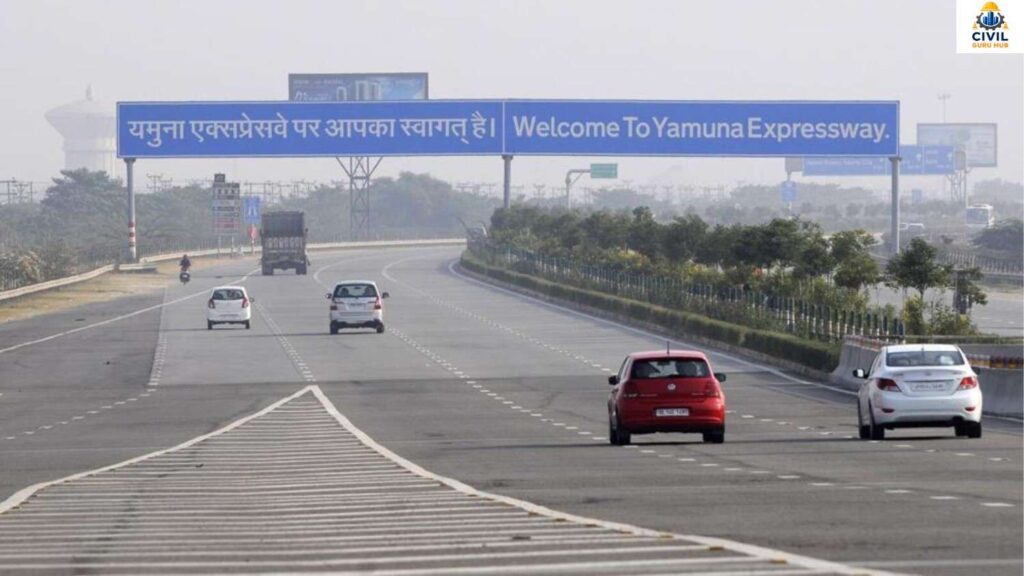
An expressway is a high-speed road network designed to make long-distance travel fast, safe, and efficient. The primary objective of these roads is to connect major cities, industrial hubs, and economic corridors.
Compared to regular roads and highways, access control on expressways is very strict. This means that vehicles cannot directly enter or exit the road from just any point; specially designed interchanges are provided for entry and exit.
The most significant feature of expressways is uninterrupted traffic movement. There are virtually no traffic signals, speed breakers, local crossings, or roadside disturbances. Consequently, vehicles can maintain a constant high speed.
In India, most expressways are being constructed with a 6-lane or 8-lane configuration. Provisions for future lane expansion are also included in many projects to cater to anticipated traffic demand.
Key Features of Expressways
| Parameter | Typical Value |
|---|---|
| Design Speed | 100–120 km/h |
| Access Control | Fully Controlled |
| Lane Width | 3.75 m |
| Median Width | 5 m or More |
| Entry/Exit | Interchange-Based |
| Traffic Signals | Not Provided |
Expressways are designed with safety as a priority. Features such as median barriers, crash barriers, intelligent traffic systems, and emergency response systems are utilized.
In today’s world, expressways have become the backbone of economic development, as they lower logistics costs and significantly reduce travel time.
What is a Highway?
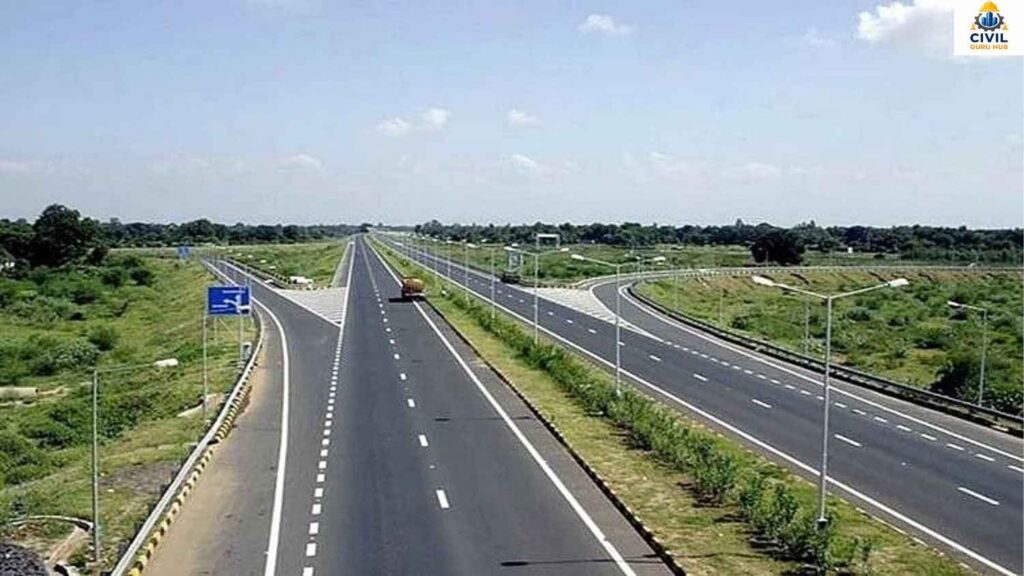
“Highway” is a broad term representing any major road that connects cities, towns, or regions. While every expressway is a highway, not every highway is an expressway.
In India, National Highways (NH), State Highways (SH), and Major District Roads fall under the highway category.
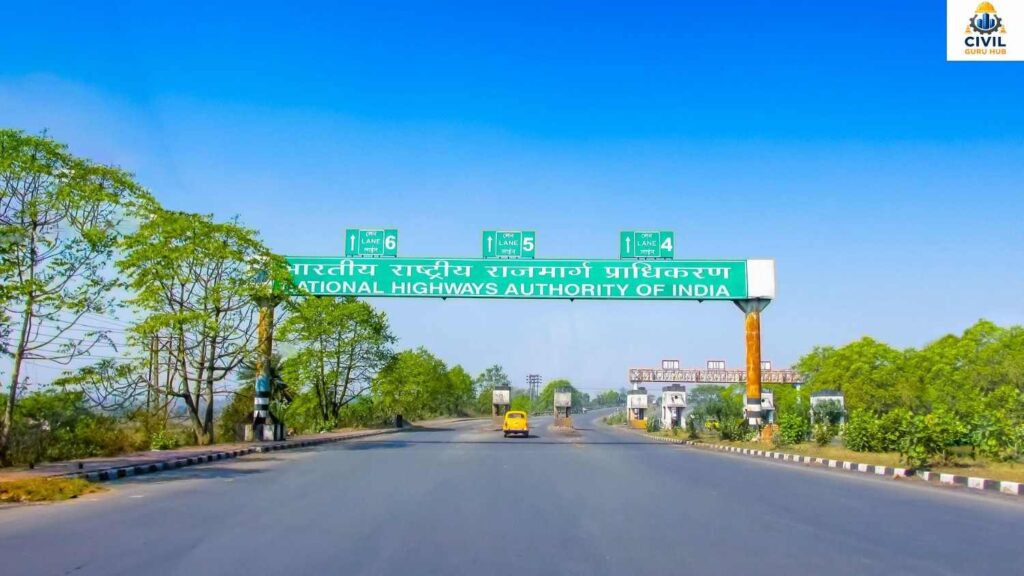
National Highways connect various states and major cities across the country. Their maintenance and development are primarily handled by the NHAI or MoRTH.
Traffic movement on highways is relatively fast, but access control may be limited or even non-existent. Local roads, villages, and commercial establishments can be directly connected to the highway.
Consequently, frequent traffic interruptions are observed on highways; vehicles may encounter traffic signals, intersections, and pedestrian crossings.
Highway Characteristics
| Parameter | Highway |
|---|---|
| Speed | Moderate to High |
| Access Control | Partial |
| Signals | May Be Present |
| At Grade Junctions | Available |
| Local Traffic | Allowed |
The greatest advantage of highways is their connectivity; they link almost every region of the country.
Highways play a crucial role in the road transport network by supporting the agriculture, industry, and tourism sectors.
The construction cost of highways is lower compared to expressways because they do not require extensive grade separators and interchanges.
For civil engineers, striking the right balance between geometric design, pavement design, drainage, and traffic engineering is essential in highway design.
What is a Freeway?
The term “Freeway” is primarily used in America and some Western countries. Technically, the concepts of freeways and expressways are quite similar.
A freeway is a fully controlled-access road where traffic movement is completely uninterrupted. There is no direct access provided to local roads or adjacent properties.
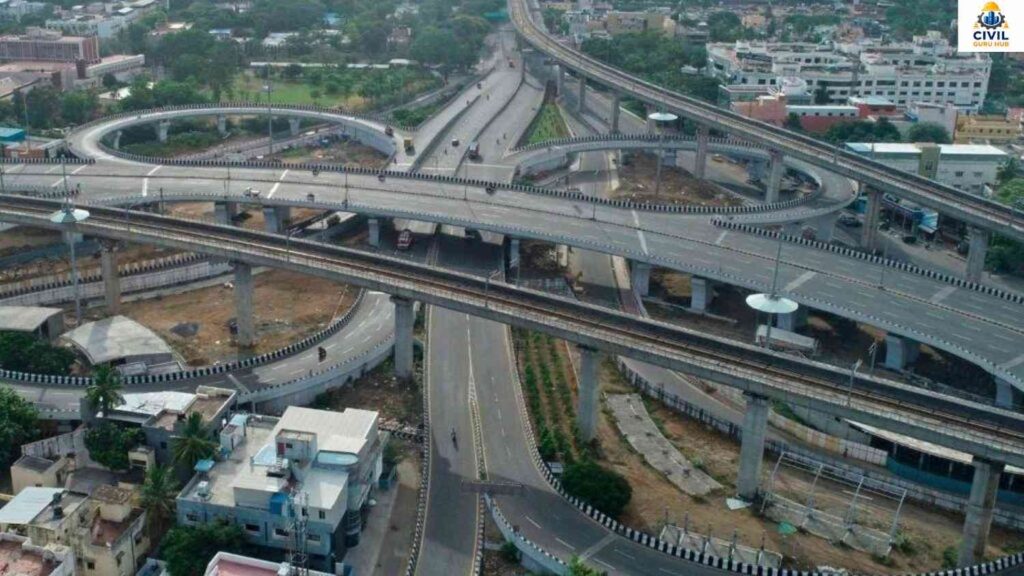
These roads feature grade-separated intersections. This means that the intersecting roads cross at different levels, eliminating the need for traffic signals.
The primary objective of a freeway is to facilitate high-speed mobility.
Freeway Features
| Parameter | Freeway |
|---|---|
| Access Control | Fully Controlled |
| Traffic Signal | No |
| Pedestrian Crossing | No |
| Railway Crossing | No |
| Intersections | Grade Separated |
Many people mistakenly believe that a “Freeway” means a toll-free road. In reality, this is a misconception.
The term “Freeway” refers to the “free flow of traffic,” not to the absence of toll collection.
In many countries, tolls may be charged on freeways, while some freeways may be toll-free.
From an engineering perspective, the design philosophy for modern expressways and freeways is largely the same.
To read more articles on Highway, check the following guides:
What are Top 15 Highway Construction Challenges in 2026: A Complete Civil Engineering Guide
How to Calculate Camber Tolerance in Road Construction Step by Step
Cold Mix vs Hot Mix Asphalt: Which is Better?
Important IRC and MoRTH Standards
Some important standards are followed in Road and Expressways design:
Code Description
| Code | Description |
|---|---|
| IRC 73 | Geometric Design Standards |
| IRC SP 99 | Access Controlled Highways Guidelines |
| IRC 37 | Flexible Pavement Design |
| IRC 112 | Concrete Structures Design |
| IRC 6 | Road Bridges Loading Standards |
| IRC 67 | Road Sign Standards |
| MoRTH Specifications | Highway Construction Guidelines |
What is the Real Difference Between Expressways, Highways, and Freeways?
Many people consider expressways, highways, and freeways to be the same. In reality, these three road categories differ in terms of purpose, design standards, traffic management, and access control. That is why they are treated as distinct categories in civil engineering and transportation planning.
Expressways are designed for high-speed, long-distance travel. Vehicle movement here remains uninterrupted; there is no direct access from villages, markets, or local roads. Entry and exit are permitted only via interchanges.
On the other hand, highways connect various cities and towns across the country. Local traffic can also ply on them. They often feature intersections, traffic signals, and U-turn facilities. Consequently, the average travel speed on highways is lower compared to expressways.
The concept of freeways is primarily used in America and Europe. From an engineering perspective, freeways and expressways are nearly identical; both feature fully controlled access and grade-separated junctions.
The table below helps illustrate the differences between them:
| Parameter | Expressway | Highway | Freeway |
|---|---|---|---|
| Access Control | Fully Controlled | Partial | Fully Controlled |
| Traffic Signal | No | May exist | No |
| Speed | 100-120 kmph | 60-100 kmph | 100-130 kmph |
| Pedestrian Access | No | May exist | No |
| Direct Property Access | No | May exist | No |
| Intersections | Grade Separated | Can be at-grade | Grade Separated |
This comparison clarifies that while every expressway is a highway, not every highway is an expressway. Understanding this distinction is crucial in highway engineering.
Why is the Design of Expressways So Special?
When engineers design an expressway, their primary objective is to balance safety and speed. Consequently, the design standards for expressways are significantly more stringent than those for standard highways.
To begin with, horizontal and vertical alignments are planned with great care. Sharp curves are avoided to ensure that vehicles can travel safely even at high speeds.
The lane width is typically set at 3.75 meters. Adequate shoulder width is also provided to allow vehicles to stop safely during emergencies.
The design of the median is also crucial for expressways. A wide median or crash barrier separates traffic moving in opposite directions, thereby reducing the risk of head-on collisions.
Expressways feature advanced drainage systems. If rainwater accumulates on the road surface, the risk of hydroplaning increases; therefore, proper cross-slopes and side drainage systems are incorporated into the design.
Modern expressways also utilize Intelligent Transportation Systems (ITS), which include CCTV monitoring, variable message signs, traffic sensors, and emergency communication systems.
In recent times, sustainability has also become a key focus in expressway design. Features such as solar lighting, rainwater harvesting, and the development of green corridors are being integrated into many projects.
It is this advanced engineering that makes the travel experience on expressways smoother, safer, and more comfortable.
What Does “Access-Controlled Road” Mean?
“Access-controlled road” is a term frequently heard in the context of expressways, yet most people do not know its true meaning.
Access control means that the entry and exit of vehicles onto the road are strictly regulated. No individual or vehicle is permitted to enter the road directly from just any point along its route.
For instance, suppose an expressway passes near a village. Local residents cannot simply drive onto the expressway directly from in front of their homes; instead, they must use designated interchanges or service roads.
This system offers several significant benefits.
The primary benefit is safety. Eliminating random entry and exit points drastically reduces the risk of accidents.
The second benefit is improved traffic flow. Vehicles can maintain a constant speed without interruptions.
The third benefit is reduced travel time. With fewer interruptions, long-distance journeys can be completed much faster.
This is why most modern expressways around the world are fully access-controlled.
In India, too, new expressways are being developed based on this concept to make the transportation network more efficient.
Why Do Expressways Have Higher Speed Limits?
People often ask why speed limits on expressways are higher compared to highways.
The straightforward answer lies in design standards.
When a road is planned for a design speed of 120 kmph, its curves, gradients, sight distance, and pavement quality are all engineered accordingly.
Expressways have very few sharp bends. The road surface is of high quality. There is no pedestrian movement, and animal crossings are controlled.
Due to these factors, vehicles remain relatively safe even at high speeds.
However, this does not mean that unlimited speed is permitted on expressways.
Every expressway has a statutory speed limit that must be adhered to. Excessive speed can still be a primary cause of accidents.
According to road safety experts, driver discipline is just as important as road quality for safe driving.
That is why speed cameras and automatic enforcement systems are being installed on modern expressways.
Major Expressways of India
The network of expressways in India has expanded rapidly over the past few years.
Some of the important expressways are listed below:
| Expressway | Approx Length |
|---|---|
| Delhi-Mumbai Expressway | 1386 km |
| Yamuna Expressway | 165 km |
| Purvanchal Expressway | 341 km |
| Agra-Lucknow Expressway | 302 km |
| Mumbai-Nagpur Expressway | 701 km |
| Delhi-Meerut Expressway | 96 km |
All these expressways are making significant contributions to India’s economic growth.
These projects have played a crucial role in reducing logistics costs and travel time, as well as in fostering regional development.
What Are the Major Benefits of Expressways?
In today’s times, expressways are not merely roads; they have become a vital component of the country’s economic growth. When new expressways are constructed in a region, their impact extends beyond transportation to influence industry, tourism, logistics, and employment.
The most significant benefit is the reduction in travel time. Journeys that previously took 10 to 12 hours can now be completed in 6 to 7 hours via expressways. This leads to fuel savings and reduces vehicle operating costs.
The logistics sector also benefits greatly from expressways. Trucks and commercial vehicles can reach their destinations without significant interruptions. This accelerates goods delivery and enhances supply chain efficiency.
Another crucial benefit of expressways is road safety. Due to controlled access and the absence of traffic signals or local crossings, the likelihood of accidents is lower compared to standard highways.
Numerous studies indicate that industrial development accelerates rapidly in the vicinity of expressways. New warehouses, logistics parks, manufacturing units, and commercial hubs begin to emerge, thereby strengthening the local economy.
The tourism sector also derives direct benefits from expressways. Easier access to tourist destinations leads to an increase in visitor numbers, which in turn benefits hotels, restaurants, and other local businesses.
For these reasons, both the central and state governments in India are consistently focusing on new expressway projects. In the coming years, expressways could become the strongest pillar of India’s transportation infrastructure.
To read more articles on Highway, check the following guides:
What Are PQC Surface Cracks? 9 Types, Causes and Repair Methods: a Complete guide
What Are Rigid Pavement Failures? 10 Major Causes and Practical Solutions
What Are 10 Highway Construction Equipment? Complete Guide
Common Misconceptions People Have About Expressways
Many people harbor various misconceptions regarding expressways. This is why a topic like “The Truth About Expressways, Highways, and Freeways” still surprises people today.
The first misconception is that expressways and highways are the same thing. In reality, they differ in terms of design standards and access control systems.
A second misconception is that there are no speed restrictions on expressways. Speed limits do exist, and violating them can result in penalties.
Many people believe that the term “freeway” implies a toll-free road. In fact, the term refers to the free flow of traffic, not the absence of toll collection.
Another common myth is that expressways are merely luxury projects. In reality, expressways reduce logistics costs and support the national economy.
Some people believe that accidents do not occur on expressways. Although safety standards are superior, accidents can still happen due to factors like speeding, driver fatigue, and careless driving.
To truly understand expressways, it is essential to grasp the engineering facts and practical realities rather than relying on common misconceptions.
How Do Safety Features Work on Expressways?
Safety is given the utmost importance when designing modern expressways. Highway engineers plan everything—from road geometry to traffic management—with safety in mind.
First, median barriers are installed. These separate vehicles traveling in opposite directions and help prevent head-on collisions.
Crash barriers are also crucial; if a vehicle loses control, a crash barrier can prevent it from veering off the road.
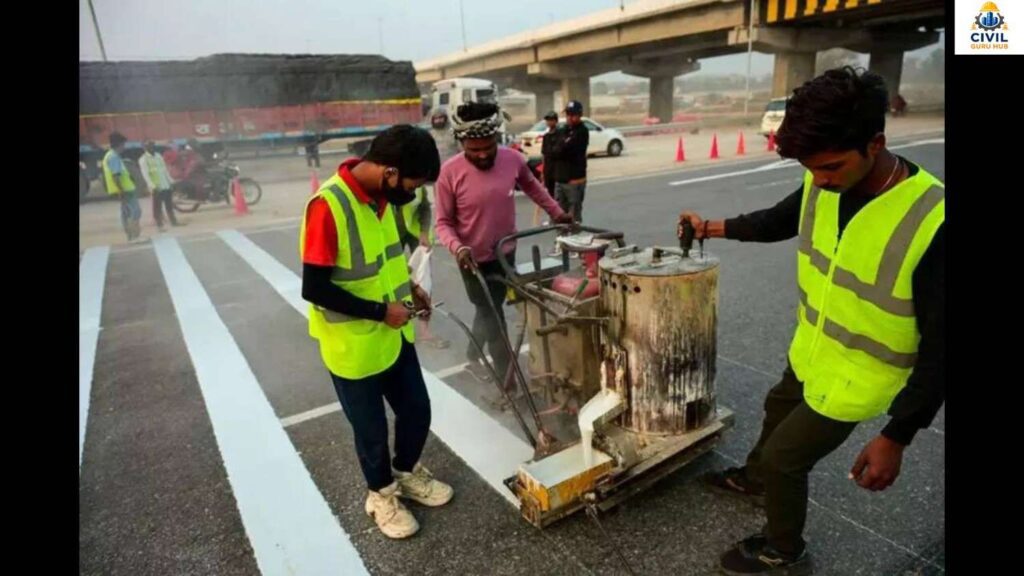
Reflective road markings and road studs enhance visibility at night, helping drivers maintain lane discipline.
Emergency call boxes and CCTV cameras are also installed on expressways, enabling an immediate response in the event of an accident or emergency.
Intelligent Transportation Systems (ITS) are being installed on many new expressways. These systems provide real-time traffic monitoring, weather alerts, and emergency information.
Safety audits are another vital aspect of expressways. Before the road is opened, engineers inspect the entire corridor to identify potential hazards.
It is due to this comprehensive approach that expressways are considered among the safest road systems in the world.
The Relationship Between Toll Systems and Expressways
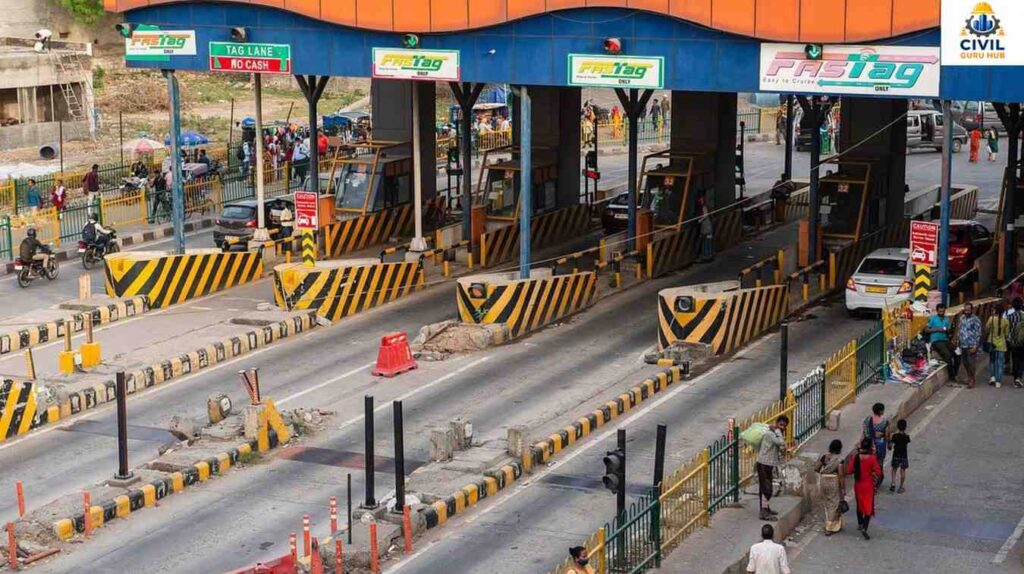
Whenever a new high-speed road corridor is discussed, the issue of toll collection inevitably becomes a topic of conversation. Developing such infrastructure projects requires investment on a massive scale. Significant costs are incurred across every component—from determining the road alignment and acquiring land to constructing major bridges, flyovers, underpasses, interchanges, drainage systems, and safety infrastructure. Consequently, project agencies and concessionaires must implement toll collection systems to recover their costs.
Modern corridors, such as expressways, utilize advanced electronic systems for toll collection. In India, FASTag has made the toll payment process significantly simpler and faster. While long queues used to form at toll plazas in the past, vehicles can now pass through toll gates without significant interruption. This reduces fuel consumption and enhances the overall travel experience.
Revenue generated from tolls is used not only to recover project costs but also for road maintenance and upgrades. These funds support periodic activities such as pavement repairs, lane marking renewal, maintenance of crash barriers and lighting systems, and emergency response services. Failure to carry out regular maintenance can compromise both the quality and safety of the road.
Many people view tolls as an additional expense; however, when one considers the savings in travel time, improved fuel efficiency, and reduced vehicle wear and tear, the economic benefits become evident. For this reason, the toll-based infrastructure model is considered successful and sustainable in many countries around the world.
What Will India’s Expressways Look Like in the Future?
Driven by rapid infrastructure development, the landscape of road connectivity in India is set to become increasingly modern in the coming years. Several major corridor projects currently under construction will provide faster and safer connectivity across the country’s states. Experts believe that within the next decade, India’s high-speed road network could rank among the largest and most modern in the world.
Future expressways will extensively utilize smart technology. AI-based traffic monitoring systems will analyze real-time traffic conditions and instantly relay information regarding accidents or disruptions to control centers. Intelligent Transport Systems (ITS) will enhance the effectiveness of traffic management and emergency response.
Charging infrastructure will also be expanded to promote the adoption of electric vehicles. Plans are underway to incorporate fast-charging stations, battery-swapping facilities, and renewable energy-based utilities into many new projects. This will encourage green mobility and help reduce carbon emissions.
Sustainable construction practices will also play a crucial role in the future. There will be increased use of recycled construction materials, rainwater harvesting systems, solar-powered lighting, and eco-friendly drainage arrangements. This will make it possible to strike a balance between infrastructure development and environmental protection.
Additionally, logistics parks, warehousing hubs, and industrial corridors will rapidly develop alongside these high-speed road networks. This will strengthen the manufacturing and supply chain sectors. Infrastructure planners believe that such projects will play a pivotal role in elevating India’s economy to new heights.
Recommended Tools for Highway Engineers
If you work in highway engineering, expressway design, or road construction projects, these practical tools can significantly improve your productivity and accuracy.
| Product | Purpose | Best For |
|---|---|---|
| Measuring Wheel | Measures distances and assists in road alignment surveys | Site Engineers |
| Auto Level Machine | Used for level checking and road gradient surveys | Highway Engineers |
| Scientific Calculator | Performs highway design and engineering calculations | Students and Engineers |
| Reflective Safety Jacket | Enhances personal safety during site inspections and fieldwork | Field Enginee |
Note: Regular use of these tools helps ensure accurate measurements and maintain a safe working environment in highway surveys, road construction quality control, and expressway projects.
Conclusion
In the realm of road transportation, several terms are used that may appear similar at first glance but differ significantly in meaning and application from an engineering and planning perspective. Therefore, it is crucial to understand these concepts correctly, especially for civil engineering students, highway professionals, and individuals associated with the infrastructure sector.
Expressways are high-speed, fully access-controlled corridors designed primarily to make long-distance travel safer, faster, and uninterrupted. Highways, on the other hand, represent a broader category that may include local access points, intersections, and mixed traffic conditions. The concept of “freeways” is predominantly observed in Western countries; they, too, are a form of controlled-access road system.
India has witnessed remarkable progress in road infrastructure over the past few years. New corridors have strengthened connectivity between cities and states, not only reducing travel time but also boosting logistics efficiency and industrial growth. Improved connectivity has also led to positive changes in trade, tourism, and regional development.
Modern road infrastructure is the result of advanced engineering design, geotechnical studies, traffic forecasting, safety planning, and environmental considerations. When traveling along such a corridor, one is essentially experiencing a vast engineering ecosystem. Thus, understanding these road systems is vital, not only from an academic standpoint but also from practical and economic perspectives.
About the Author
My name is Susanta Kumar Mohapatra, and I am a Civil Engineering professional with over 11 years of practical experience in the construction and infrastructure sectors. I hold a B.Tech degree in Civil Engineering and an M.E. degree in Construction Management. Throughout my career, I have worked in key areas such as road construction, bridge projects, quality control, material testing, estimation, project planning, and site management.
For me, Civil Engineering is not just a profession but a passion. To share this passion with a wider audience, I launched CivilGuruHub.com, where I share information regarding practical site knowledge, highway engineering, building construction, laboratory tests, quantity surveying, project management, and the latest construction technologies. My goal is to provide quality content to students, site engineers, and professionals in simple, practical language.
If you wish to enhance your knowledge in the fields of Civil Engineering and construction, please visit my YouTube channel, “The Civil Site.” On this channel, I regularly share practical Civil Engineering concepts, site execution methods, construction techniques, highway engineering topics, and career-related guidance.
Additionally, I run another YouTube channel called “Daily IQ Hub.” Here, I upload engaging quiz videos, general knowledge questions, current affairs updates, and IQ-based content on a daily basis. If you enjoy testing your knowledge and learning new facts, “Daily IQ Hub” is an excellent platform for you.
Thank you to everyone supporting CivilGuruHub.com. I remain committed to providing you with practical, useful, and industry-relevant information that aids in your career advancement and professional growth.
Affiliate Disclaimer
Some articles, reviews, and recommendation sections published on CivilGuruHub.com may contain affiliate links. This means that if you purchase a product or service through an affiliate link, we may receive a small commission at no extra cost to you.
We strive to recommend only those products, tools, and resources that are useful and relevant to Civil Engineering, Construction, Highway Engineering, Surveying, Material Testing, and Professional Development. Recommendations are based on our research, practical experience, and the product’s utility within the industry.
Affiliate commissions do not influence the quality of our content, reviews, or recommendations. Our primary objective is to provide our readers with accurate, practical, and valuable information so they can make informed decisions.
All information provided on CivilGuruHub.com is for educational and informational purposes. Before purchasing any product or service, you should verify its specifications, features, warranty, and official details.
Your support helps us maintain the website, publish new content, and create more useful resources for the Civil Engineering community.
Thank you,
Susanta Kumar Mohapatra
Founder – Civilguruhub.com
FAQ
Q1. What is the biggest difference between expressways and highways?
Expressways are fully access-controlled, whereas highways may have local access points and intersections.
Q2. Is every expressway a highway?
Yes, but not every highway is an expressway.
Q3. What is the difference between a freeway and an expressway?
In engineering terms, they represent essentially the same concept; the difference is primarily a matter of regional terminology.
Q4. Why are speed limits higher on expressways?
Because their geometric design is intended to accommodate high-speed traffic.
Q5. Which is India’s longest expressway?
The Delhi-Mumbai Expressway is one of India’s largest expressway projects.
Q6. Are pedestrians allowed on expressways?
No; for safety reasons, pedestrians and slow-moving traffic are not permitted.
Q7. Why are tolls collected on expressways?
To recover construction and maintenance costs.
Q8. What is an access-controlled road?
A road where entry and exit are restricted to designated interchanges.
Q9. Do accidents not occur on expressways?
Accidents can occur, but the risk is comparatively lower due to safety standards.
Q10. Why are expressways important for highway engineers?
Because they represent the most advanced and rapidly growing sector of modern transportation engineering.