
Table of Contents
Introduction
Drainage structures play a very big role in the world of civil engineering and infrastructure development. Whenever any road, highway, railway track, irrigation canal, or urban drainage system is constructed, engineers use culverts to pass the water flow safely.
One of the most important and widely used structures among these culverts is Box Culvert. The use of box culvert has become very common in today’s modern highway projects, smart city developments, and irrigation works because it is known for its strong, durable, and hydraulic efficiency.
In simple language, box culvert is an RCC or reinforced concrete structure whose shape is like a rectangular or square box. Its main purpose is to safely pass water beneath the road or embankment. This structure is especially used in places where water discharge is high and maintaining soil stability is important.
It has a huge contribution to NHAI projects, PMGSY roads, irrigation schemes, and urban storm water systems in India. Designers create this structure while keeping in mind hydraulic calculations, traffic load, soil pressure, and durability factors. If proper design and construction standards are followed, then it can serve efficiently for 50 to 100 years.
In this article, we will go into detail about box culvert and understand 15 important facts which every civil engineer, site engineer, diploma student, and construction professional should know.
1. What Is a Box Culvert?
A box culvert is a closed RCC drainage structure typically designed in a rectangular or square shape. Its primary purpose is to safely convey water beneath roads, railway embankments, or earth fills. This structure is called a “box” because its cross-section resembles an enclosed box.
Compared to traditional pipe culverts, box culverts offer a greater water-carrying capacity. Engineers prefer box culverts in situations where the discharge volume is high or when limited vertical clearance is available. In this structure, the top slab supports the traffic load, the side walls resist lateral earth pressure, and the bottom slab distributes the foundation load.
Basic Diagram
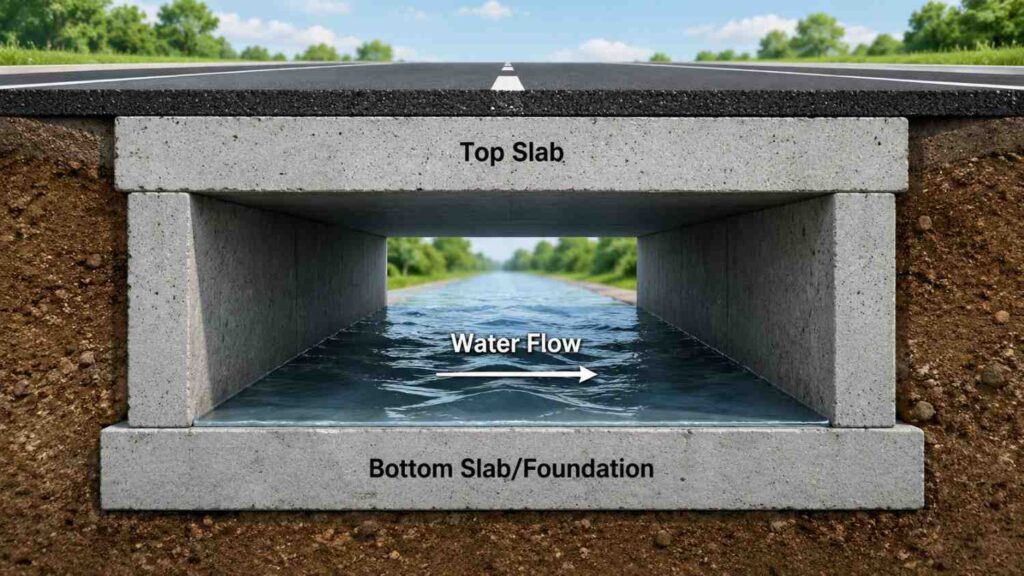
Box culverts can be single cell, double cell, triple cell, or multi-cell type. If the discharge is high then engineers can provide multiple openings so that the hydraulic flow passes smoothly.
Box Culvert vs Pipe Culvert Table
| Parameter | Box Culvert | Pipe Culvert |
|---|---|---|
| Shape | Rectangular | Circular |
| Water Capacity | High | Moderate |
| Load Distribution | Better | Average |
| Maintenance | Easy | Difficult |
| Construction Cost | Higher | Lower |
| Suitable For | High discharge | Small drainage |
In modern highway projects, the RCC box culvert is the most common choice, as it offers high levels of both strength and durability.
2. Why Are Box Culverts Widely Used in Modern Construction?
The use of box culverts in modern infrastructure projects is increasing rapidly. The primary reasons for this are their structural efficiency and hydraulic performance. Engineers prefer structures that offer a long service life and require minimal maintenance; they effectively satisfy both of these requirements.
Their greatest advantage is their high load-carrying capacity. Heavy trucks and overloaded vehicles travel continuously on highways and expressways. While pipe culverts can sometimes fail under excessive loads, a properly designed RCC box culvert efficiently withstands heavy traffic loads.
Drainage congestion is a major problem in urban areas. Inadequate rainwater drainage leads to waterlogging, which subsequently causes damage to roads. It provide a wide waterway, allowing floodwater to be discharged rapidly.
Common Applications
| Project Type | Use |
|---|---|
| Highways | Cross drainage |
| Railways | Water passage |
| Irrigation | Canal crossing |
| Smart Cities | Storm drainage |
| Village Roads | Seasonal nala crossing |
Another significant reason is the low maintenance requirement. Being an RCC structure, it experiences comparatively less corrosion and deformation. Provided that high-quality concrete and reinforcement are utilized, the structure remains stable for decades.
Hydraulic efficiency is also a major benefit. Due to its rectangular cross-section, the flow area is maximized. Consequently, engineers predominantly utilize box culverts in flood-prone regions.
3. How Does a Box Culvert Work?
The working principle of a box culvert is based on hydraulic flow and structural load distribution. When rainwater, canal water, or stream flow needs to pass to the opposite side of a road embankment, it provides a controlled pathway for the water.
Water enters through the culvert inlet and flows through the enclosed RCC chamber to the outlet side. During this process, the top slab of the structure bears the traffic load, while the side walls resist the pressure exerted by the surrounding soil.
Water Inlet —> RCC Box Chamber —> Water Outlet
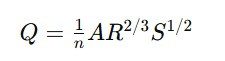
If the culvert is properly designed then water flows smoothly without excessive turbulence. Hydraulic engineers determine culvert size using Manning’s Equation and discharge calculations.
Important Forces Acting
| Force Type | Effect |
|---|---|
| Earth Pressure | Side wall loading |
| Traffic Load | Top slab loading |
| Water Pressure | Internal hydraulic force |
| Foundation Reaction | Bottom slab support |
If the drainage slope is insufficient or if silting occurs, the culvert may become blocked. Therefore, periodic maintenance and desilting are required.
Proper compaction is also extremely important during the construction phase. Poor backfilling can lead to uneven settlement, which generates cracks.
4. What Materials Are Used ?
The most common material used in box culvert construction is RCC, or Reinforced Cement Concrete. RCC provides high compressive strength and tensile resistance.
| Material | Purpose |
|---|---|
| Cement | Binding |
| Sand | Fine aggregate |
| Aggregate | Strength |
| Steel Reinforcement | Tensile resistance |
| Water | Hydration |
| Admixtures | Workability |
Generally, M25 or M30 grade concrete is used, depending on the project specifications. For reinforcement, Fe500 or Fe550 grade steel is utilized.
Admixtures are added to enhance waterproofing and durability. In flood-prone areas, sulphate-resistant cement is also employed.
Construction quality directly impacts the lifespan of the culvert. Poor material quality can lead to honeycombing, cracks, seepage, and reinforcement corrosion.
5. What Are the Main Components?
A box culvert consists of several structural components. Each component plays a specific role.
| Component | Function |
|---|---|
| Top Slab | Carries the traffic load |
| Side Walls | Resist earth pressure |
| Bottom Slab | Provides foundation support |
| Wing Walls | Retain the surrounding soil |
| Apron | Protects against scouring and erosion |
The top slab is the most critical structural member because it is subjected to direct vehicular loads. The bottom slab controls settlement.
Wing walls guide the water flow and prevent embankment erosion.
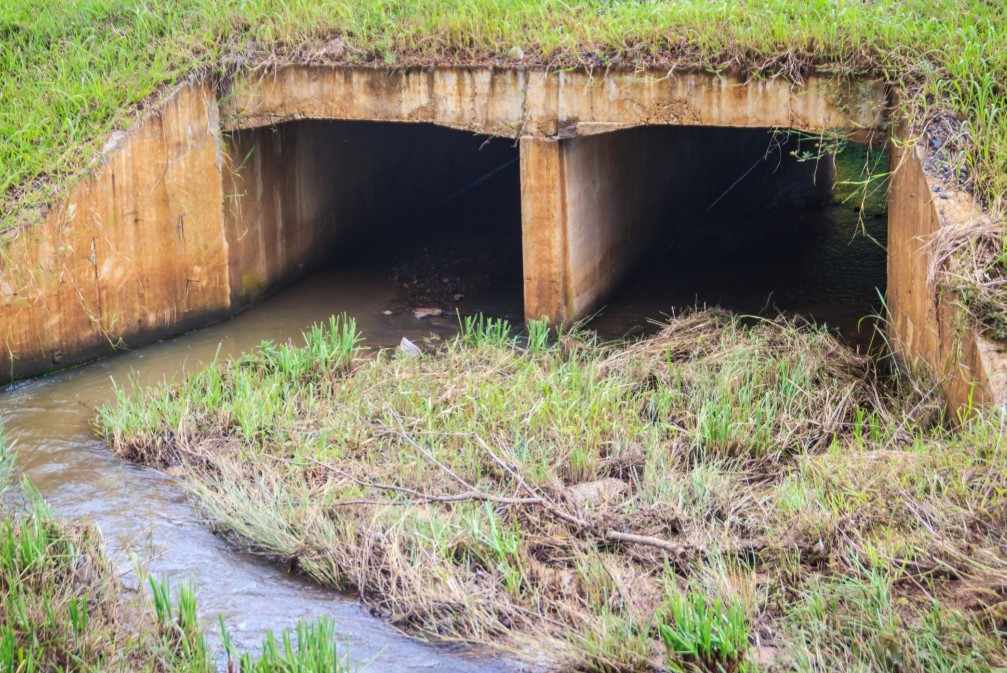
6. Which Types of Box Culverts Are Commonly Used?
| Type | Description |
|---|---|
| Single Cell | One opening |
| Double Cell | Two openings |
| Triple Cell | Three openings |
| Multi-Cell | Multiple openings |
A single-cell culvert is suitable for minor drainage. Multi-cell culverts are used in flood discharge areas.
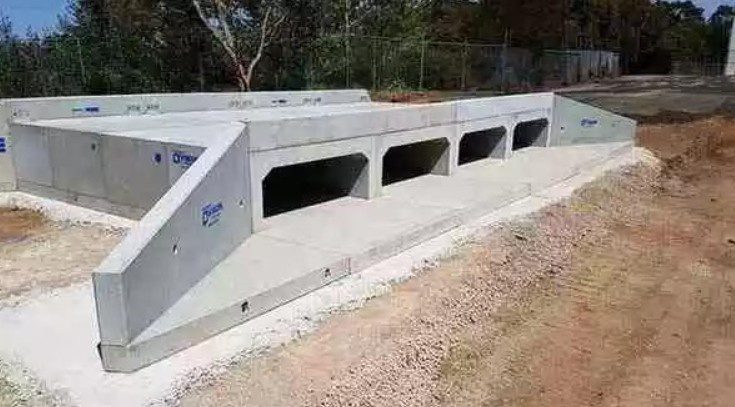
Both precast and cast-in-situ methods are available. Precast culverts offer rapid installation.
To get More idea about structures, Click on given link.
What Are Toe Wall and Breast Wall? Complete Comparison in 12 Points
One Way Slab vs Two Way Slab: complete guide
Toe Wall in Civil engineering : A complete guide
7. How Is a Box Culvert Designed?
The design process is based on both hydraulic and structural analysis.
- Design Steps
- Catchment area calculation
- Discharge estimate
- hydraulic sizing
- load calculation
- reinforcement design
Structural design is according to IRC and IS codes.
8. Why Is Soil Investigation Important?
Foundation safety depends directly on the soil-bearing capacity. Weak soil can cause settlement and cracks.
Soil Investigation Parameters
| Parameter | Importance |
|---|---|
| SBC | Foundation design |
| Water Table | Stability |
| Soil Type | Settlement behavior |
SPT tests and bore log analyses are commonly used.
9. What Are the Advantages?
| Benefit | Explanation |
|---|---|
| High Strength | Heavy load resistance |
| Long Life | Durable structure |
| Hydraulic Efficiency | Better water flow |
| Low Maintenance | Reduced repair cost |
10. What Are the DisAdvantages?
| Issue | Effect |
|---|---|
| High Initial Cost | Expensive construction |
| Skilled Labour Needed | Complex work |
| Heavy Weight | Transportation issue |
11. Where Are Box Culverts Commonly Used?
| Area | Application |
|---|---|
| Highways | Drainage crossing |
| Railways | Water passage |
| Cities | Storm drainage |
| Irrigation | Canal crossing |
12. How Is a Box Culvert Constructed?
The construction process has been systematic.
Construction Steps
- site clearing
- Excavation
- PCC laying
- reinforcement fixing
- Shuttering
- pouring concrete
- Curing
- Backfilling
Proper curing should be done for minimum 14 days.
13. Why Does It Fail?
Failure is mostly caused by poor design or construction errors.
| Reason | Result |
|---|---|
| Poor Compaction | Settlement |
| Low Quality Concrete | Cracks |
| Inadequate Drainage | Water pressure |
14. What Maintenance Does a Box Culvert Need?
Maintenance increases the lifespan of a structure.
| Activity | Purpose |
|---|---|
| Desilting | Water flow improve |
| Crack Repair | Leakage control |
| Inspection | Structural safety |
A pre-monsoon inspection should be mandatory.
15. Why Should Every Civil Engineer Understand?
Drainage structures are of paramount importance in civil engineering projects. If drainage systems fail, the entire road infrastructure can suffer severe damage. Consequently, every civil engineer must possess a comprehensive understanding of the design, construction, and maintenance of box culverts.
A site engineer requires expertise in reinforcement detailing, hydraulic slopes, shuttering alignment, and concrete quality control. A design engineer, on the other hand, must have a thorough grasp of loading calculations and IRC standards.
The demand for box culvert is projected to rise even further in future smart infrastructure projects. These structures will play a pivotal role in the development of sustainable drainage systems and flood-resistant infrastructure.
Important IS Codes
A few References are given here with links, Only for Study purpose
| IS Code | Title / Purpose |
|---|---|
| IS 456:2000 | Plain and Reinforced Concrete – Code of Practice |
| IS 800:2007 | General Construction in Steel – Code of Practice |
| IS 875 (Part 1 to 5) | Design Loads for Buildings and Structures |
| IS 1893 (Part 1):2016 | Criteria for Earthquake Resistant Design of Structures |
| IS 3370 | Concrete Structures for Storage of Liquids |
| IS 1786 | High Strength Deformed Steel Bars and Wires for Concrete Reinforcement |
| IS 383 | Specification for Coarse and Fine Aggregates from Natural Sources |
| IS 10262 | Concrete Mix Proportioning Guidelines |
| IS 516 | Methods of Tests for Strength of Concrete |
| IS 5816 | Splitting Tensile Strength Test of Concrete |
| IS 6403 | Determination of Bearing Capacity of Shallow Foundations |
| IS 1498 | Classification and Identification of Soils |
| IS 2720 Series | Methods of Test for Soils |
| IS 2212 | Brick Masonry Construction Code |
| IS 1200 | Method of Measurement of Building and Civil Engineering Works |
| IS 2502 | Code of Practice for Bending and Fixing of Reinforcement |
| IS 1343 | Prestressed Concrete – Code of Practice |
| IS 1904 | Design and Construction of Foundations in Soils |
Conclusion
The box culvert serves as an essential drainage structure in modern civil engineering, extensively utilized in highways, railways, irrigation systems, and urban infrastructure projects. Its high load-carrying capacity, excellent hydraulic efficiency, and long service life make it the preferred choice for engineers.
With proper design, quality construction, and regular maintenance, it can perform efficiently for decades. Every civil engineer should possess detailed knowledge regarding the components, design principles, construction sequence, and maintenance requirements of this structure, as it constitutes a vital part of practical field engineering.
FAQs
1. What is the main purpose of a box culvert?
The main purpose of a box culvert is to safely pass water through a road, railway, or embankment. This drainage structure efficiently discharges flood water, rainwater, and canal flow and prevents road damage.
2. Why is RCC used in box culvert construction?
RCC i.e. Reinforced Cement Concrete provides high strength, durability, and load carrying capacity. It is considered the most suitable material to safely resist heavy traffic load and earth pressure.
3. What is the difference between a pipe culvert and a box culvert?
Pipe culverts are circular in shape and used for small drainage systems, while box culverts are rectangular in shape and used in high-water discharge areas. Box culverts generally have greater hydraulic capacity and load resistance.
4. Where are box culverts commonly used?
Box culverts are extensively used in highways, railways, irrigation canals, village roads, urban drainage systems, and smart city projects. They are especially useful in flood-prone and heavy drainage areas.
5. How long does a box culvert last?
With proper design, quality construction, and regular maintenance, It can perform efficiently for approximately 50 to 100 years.
6. What are the common causes of box culvert failure?
Poor compaction, low-quality concrete, inadequate reinforcement, drainage blockage, excessive settlement, and improper design are the major reasons for failure. These problems can be reduced by regular inspection and maintenance.